What Is 6063 Aluminum
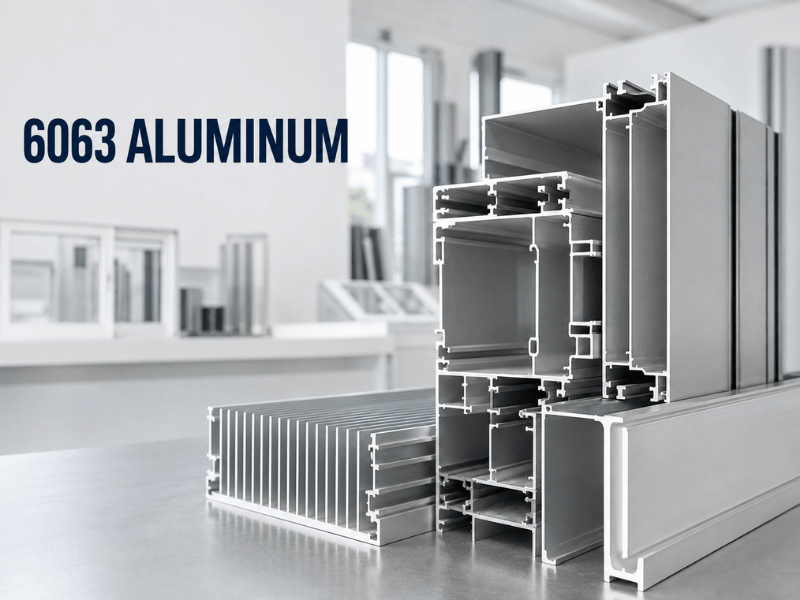
6063 is a heat-treatable aluminum-magnesium-silicon (Al-Mg-Si) alloy with low total alloying content, which gives it moderate strength but outstanding formability and surface quality. Its silicon and magnesium form a small amount of Mg₂Si that precipitates during aging, so strength comes from heat treatment rather than heavy alloying.
That combination makes 6063 the most widely used architectural aluminum alloy: it extrudes into complex shapes, anodizes to a bright uniform finish, and costs less per meter than stronger 6000-series grades. The rest of this guide covers the composition, tempers, and selection logic you need before specifying it.
Chemical Composition
6063 composition sits in a tight band that protects both extrudability and finish. Values follow EN AW-6063 (AlMg0.7Si) and ASTM B221.
| Element | Composition (wt%) |
|---|---|
| Silicon (Si) | 0.20–0.60 |
| Iron (Fe) | 0.35 max |
| Copper (Cu) | 0.10 max |
| Manganese (Mn) | 0.10 max |
| Magnesium (Mg) | 0.45–0.90 |
| Chromium (Cr) | 0.10 max |
| Zinc (Zn) | 0.10 max |
| Titanium (Ti) | 0.10 max |
| Others (each / total) | 0.05 / 0.15 max |
| Aluminum (Al) | Remainder |
Keeping copper and excess magnesium low is what lets 6063 extrude cleanly and anodize without streaking — push those up and you move toward 6061’s strength but lose the surface quality.
Mechanical Properties by Temper
Strength in 6063 is set almost entirely by temper. Typical room-temperature values for extrusions and wire (EN 755 / ASTM B221):
| Temper | Tensile (MPa) | Yield (MPa) | Elongation (%) |
|---|---|---|---|
| O | 90 | 55 | 25 |
| T4 | 150 | 90 | 20 |
| T5 | 185 | 145 | 12 |
| T52 | 185 | 130 | 12 |
| T6 | 240 | 215 | 12 |
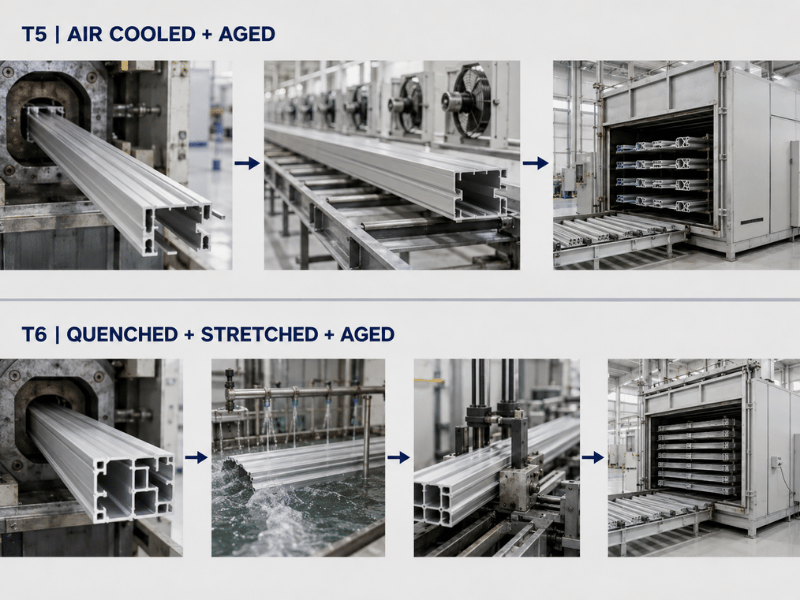
T5 is the architectural default; T6 is the load-bearing option. The jump from T5 to T6 is about 30% in yield, at the cost of a water quench and stretch correction.
Tempers Explained
- O — Annealed and soft, used only where heavy forming is required before heat treatment.
- T4 — Solution treated and naturally aged; moderate strength, good formability.
- T5 — Extruded, air-cooled, and artificially aged. The standard for windows, doors, and trim.
- T52 — T5 with a light stretch to relieve residual stress, so long lengths stay flatter after machining.
- T6 — Solution treated, water quenched, and aged. Highest strength of the common 6063 tempers, for structural use.
Physical Properties
These values affect thermal and electrical design more than structural choice:
- Density: 2.70 g/cm³
- Modulus of elasticity: ~69 GPa
- Thermal conductivity: ~200 W/m·K
- Electrical conductivity: ~53% IACS
6063’s thermal conductivity makes it a common choice for heat sinks and enclosures, where forming a thin, finned profile is as important as heat flow.
Key Characteristics
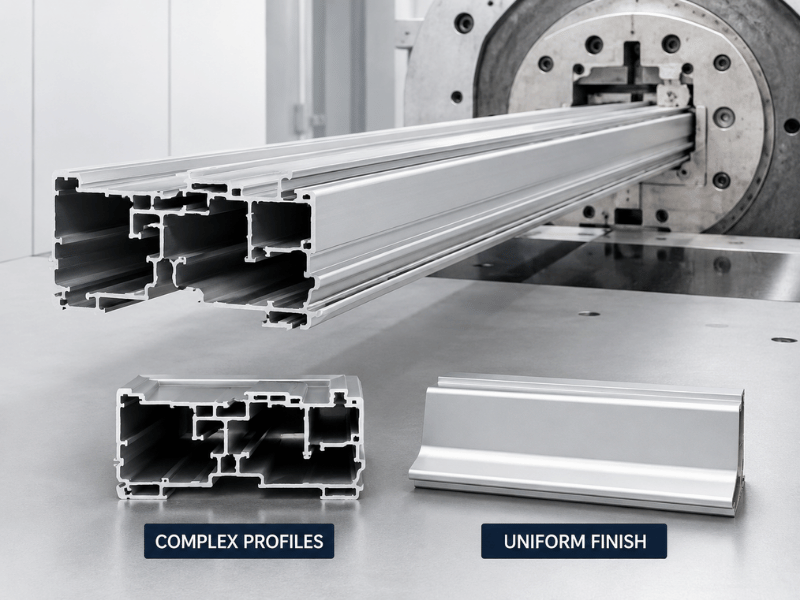
- Extrudability: Excellent — the best in the 6000 series, allowing thin walls and hollow sections at high ram speed.
- Surface finish: Excellent — anodizes to a clear, even layer and accepts color anodizing, polishing, and powder coating.
- Corrosion resistance: Good in atmospheric and indoor service; limited in marine or constant-moisture environments.
- Weldability: Good with TIG/MIG, though the weld heat-affected zone loses strength.
- Strength: Moderate — lower than 6061 and 6005, which is the trade-off for its finish and formability.
Where 6063 Aluminum Is Used
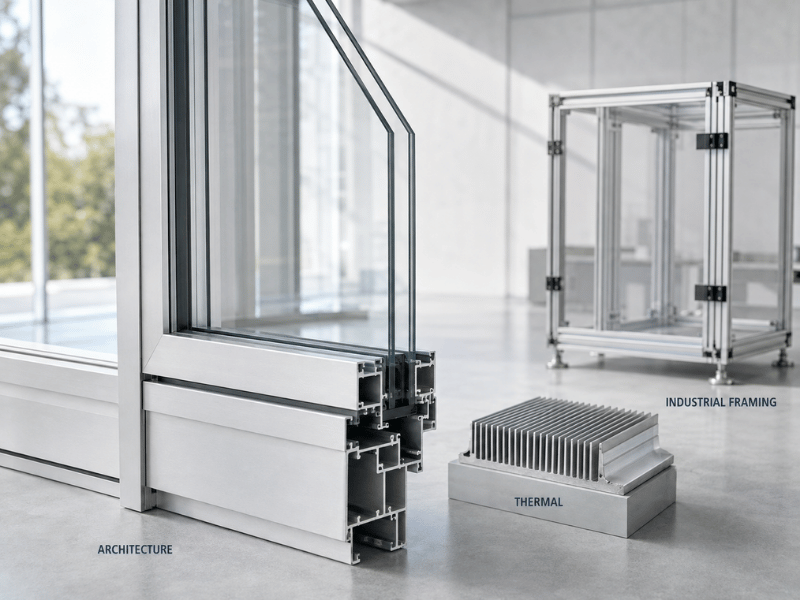
6063’s application list is driven by appearance and form rather than load:
- Building and architecture — window and door frames, curtain walls, railings, facades, decorative trim.
- Interior and furniture — display systems, lighting channels, partitions, handles.
- Industrial framing — machine guards, conveyor and equipment frames, enclosures.
- Electronics and thermal — heat sinks, LED housings, enclosures where fins are extruded.
- Transport — non-structural vehicle trim and interior sections.
For any part exposed to seawater or sustained humidity, specify anodizing or powder coating, and keep expectations realistic — 6063 is not a marine-grade alloy.
6063 vs 6061
This is the comparison most specifiers actually face.
| Factor | 6063 | 6061 |
|---|---|---|
| Typical T6 strength | 240 / 215 MPa | 310 / 276 MPa |
| Extrudability | Excellent | Good (slower, streak-prone) |
| Anodized finish | Bright, uniform | Streak-prone |
| Weldability | Good | Very good |
| Best fit | Architectural, decorative | Structural, welded, load-bearing |
| Relative cost (same shape) | Lower | Higher |
Choose 6063 when the part is seen and lightly loaded; choose 6061 when it must carry load or be welded into a structure.
6063 vs 6060 vs 6005
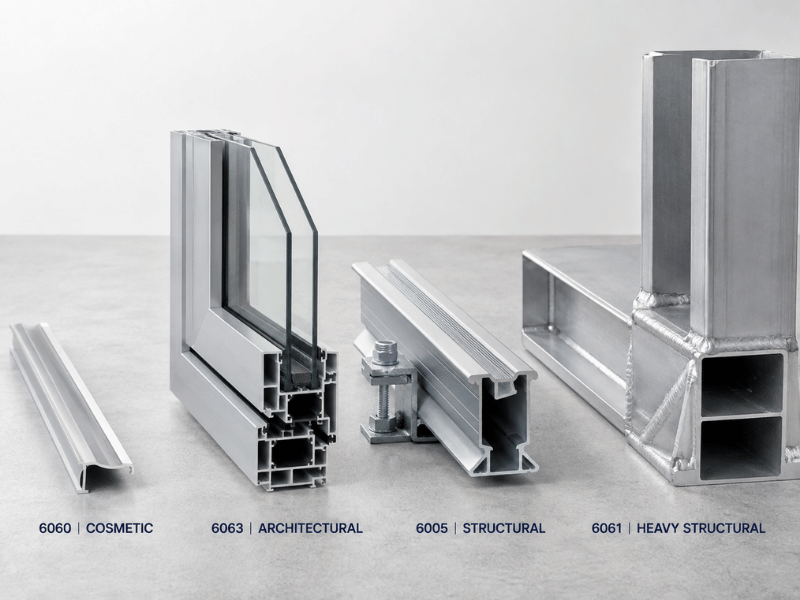
Two nearby grades often enter the shortlist:
- 6060 — Even lower strength than 6063 (T5 ~150/110 MPa) with a slightly finer finish; common in European decorative profiles. Choose it for purely cosmetic, non-structural trim.
- 6005 — Stronger than 6063 (T5 ~260/240 MPa) with good but less refined finish; used for solar rails, ladders, and structural framing. Choose it when you need more load capacity than 6063 but not the full strength of 6061.
The three form a ladder: 6060 (cosmetic) → 6063 (architectural) → 6005 (structural) → 6061 (heavy structural).
Machining, Welding, and Finishing
- Machining: Fair, comparable to other aluminum alloys. T6 machines slightly harder than T5; use standard carbide tooling with proper coolant.
- Welding: TIG or MIG with 4043 filler for crack resistance or 5356 for higher joint strength. Expect the heat-affected zone to have a lower strength than the parent temper, so design welds outside the load path where possible.
- Finishing: Sulfuric-acid (Type II) anodizing gives the signature clear or colored coat; Type III (hard anodize) is possible but less common; powder coating (including RAL 9016) and polishing are standard.
Pros and Limitations
| Strength | Limit |
|---|---|
| Best surface finish in the 6000 series | Lower strength than 6061 or 6005 |
| Excellent extrudability for thin/hollow shapes | Not for high-load structural members |
| Strong anodizing and powder-coat response | Limited corrosion resistance in marine use |
| Good, low-cost fit for visible parts | Weld zone softens (HAZ) |
| Easy to cut, drill, and form | T6 needs stretch correction after quench |
How to Specify 6063 for Your Project
Send a complete spec to avoid reworks:
- Alloy and temper — “6063-T5”, not just “6063”.
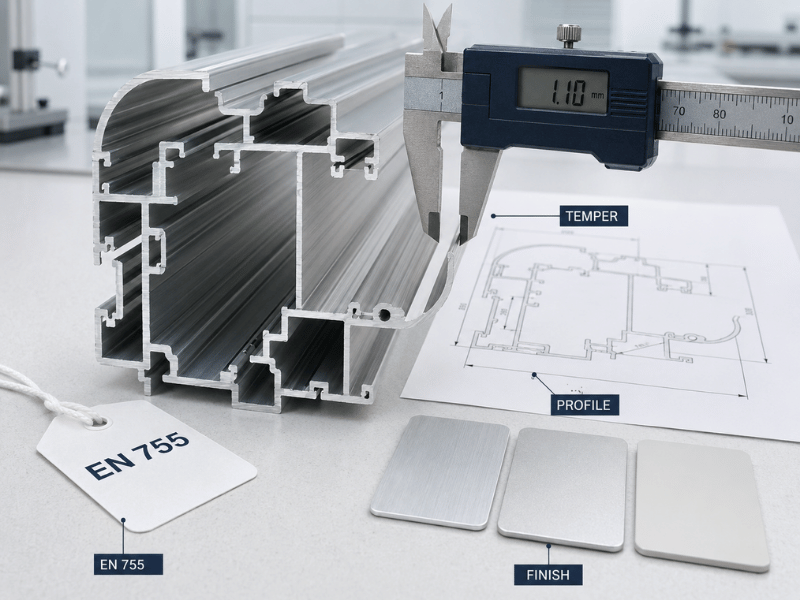
- Profile drawing — with wall thickness (standard tooling handles ~1.0–1.2 mm minimum), radii, and tolerances.
- Finish — mill, anodized (with color), or powder coat.
- Standard — EN 755 for European work; local equivalent otherwise.
- Quantity and lead-time window — prototype vs. production changes, die, and scheduling options.
Conclusion
6063 aluminum trades peak strength for the best finish, formability, and cost among 6000-series alloys, which is why it dominates architectural and decorative profiles — the real decision is picking the right temper and confirming the part isn’t secretly structural.
Linsy Aluminum, a Shenzhen-based factory with more than 20 years of experience, supplies 6063 in sheet, coil, tube, bar, profile, and custom extrusions with full MTC documentation per order and SGS test reports available on request; typical custom lead time runs 10–60 days depending on size and processing, with low-MOQ production and in-house CNC machining, welding, anodizing, and powder coating.
Send your specification or drawing to Linsy Aluminum for a grade-and-temper review and quote on 6063 aluminum.
Frequently Asked Questions
Is 6063 aluminum strong?
Moderately. In the common T5 temper, it reaches about 185 MPa tensile and 145 MPa yield; T6 reaches 240 / 215 MPa. That is lower than 6061 but sufficient for most architectural and decorative parts that are not heavily loaded.
6063 vs 6061 — which should I choose?
Choose 6063 for visible, lightly loaded parts where finish and form matter (window frames, trim, heat sinks). Choose 6061 when the part carries structural load or must be welded, since 6061 is stronger and welds more predictably.
Can 6063 aluminum be anodized?
Yes, and it is one of the best anodizing alloys. It produces a uniform, bright layer under Type II sulfuric acid anodizing and also accepts color anodizing, polishing, and powder coating.
Is 6063 suitable for marine environments?
Only with protection. Its corrosion resistance is good in atmospheric and indoor use but limited in seawater or constant moisture. For coastal service, specify anodizing or powder coating and avoid relying on the bare mill finish.
What does the T5 temper mean for 6063?
T5 means the extruded profile was air-cooled and artificially aged, with no separate solution heat treatment. It is the standard architectural temper: enough strength for frames and trim, low residual stress, and the lowest cost per meter.