Was ist 6005-Aluminium?
6005 Aluminiumlegierung ist eine wärmebehandelbare Legierung der 6xxx-Serie auf Basis des Aluminium-Magnesium-Silizium-Systems (Al-Mg-Si). Ihre Festigkeit resultiert aus der Ausscheidung von Magnesiumsilizid (Mg₂Si) während der Auslagerung, wodurch die Legierung zunächst stranggepresst und anschließend ausgehärtet werden kann – dieselbe Familienlogik wie bei 6063 und 6061, jedoch auf eine andere Balance abgestimmt.
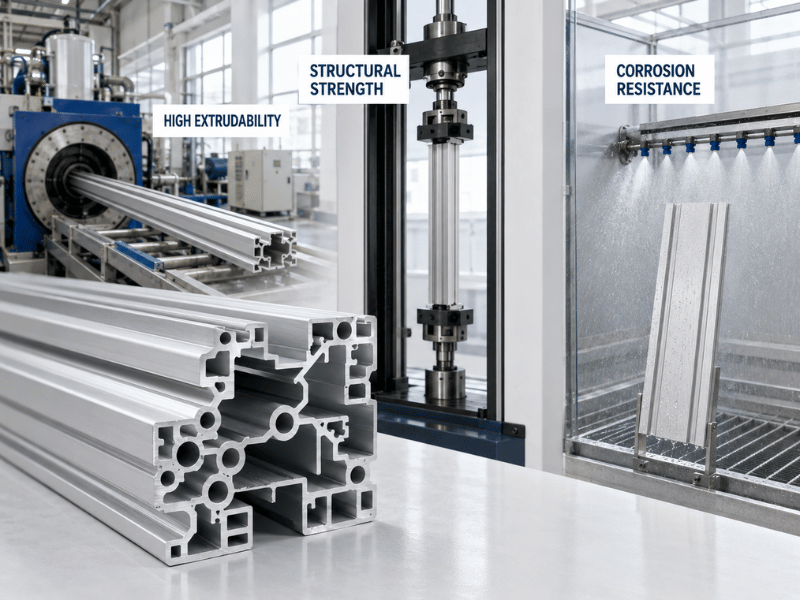
Diese Balance ist der entscheidende Vorteil: 6005 liefert eine deutlich höhere Festigkeit als 6063 oder 6060, lässt sich dabei aber leichter strangpressen und erzielt eine bessere Oberfläche als 6061. Der Kompromiss besteht darin, dass die Spitzenzugfestigkeitswerte von 6061 nicht erreicht werden. Die praktische Frage ist, ob das Verhältnis von Festigkeit zu Extrudierbarkeit zum Profil, zu den Lasten und zur Oberflächengüte passt, die das Projekt erfordert.
Chemische Zusammensetzung
Die Zusammensetzung von 6005 (AA 6005, gemäß ASTM B221 und EN 573-3) ist innerhalb enger Grenzen kontrolliert:
| Element | Inhalt (%) | Rolle |
|---|---|---|
| Aluminium | Bilanz | Unedles Metall |
| Silizium (Si) | 0.6 – 0.9 | Bildet die Mg₂Si-Härtungsphase |
| Magnesium (Mg) | 0.4 – 0.6 | Bildet die Mg₂Si-Härtungsphase |
| Mangan (Mn) | 0,10 max | Kornfeinung |
| Eisen (Fe) | 0,35 max | Verunreinigungskontrolle |
| Kupfer (Cu) | 0,10 max | Verunreinigungskontrolle |
| Chrom (Cr) | 0,10 max | Gefügestrukturkontrolle |
| Zink (Zn) | 0,10 max | Verunreinigungskontrolle |
| Titan (Ti) | 0,10 max | Kornfeinung |
Die Silizium- und Magnesiumgehalte sind das, was 6005 von seinen Nachbarn unterscheidet: Sie halten Extrudierbarkeit und Oberflächengüte näher an 6063, während die ausgehärtete Festigkeit in Richtung 6061 angehoben wird.
Mechanische und physikalische Eigenschaften von 6005
| Eigentum | Wert | Hinweis |
|---|---|---|
| Dichte | 2,70 g/cm³ | Standard für 6xxx-Legierungen |
| Zugfestigkeit (T5) | ~260 MPa (min. 190) | Abgekühlt nach dem Strangpressen + künstlich ausgelagert |
| Streckgrenze (T5) | ~215 MPa (min. 145) | |
| Zugfestigkeit (T6) | ~310 MPa (min. 260) | Lösungsgeglüht + künstlich ausgelagert |
| Streckgrenze (T6) | ~275 MPa (min. 240) | |
| Dehnung beim Bruch | ~8–10 % | T6 geringfügig niedriger als T5 |
| Brinell-Härte | ~80 HB (T5) / ~90 HB (T6) | |
| Ermüdungsfestigkeit | ~115 MPa (T5) / ~130 MPa (T6) | 5×10⁸ Zyklen |
| Elastischer Modul | ~70 GPa | Gleich über alle Auslagerungszustände |
| Wärmeleitfähigkeit | ~170–180 W/m·K | |
| Elektrische Leitfähigkeit | ~45-50% IACS | |
| Schmelzbereich | ~580–650 °C |
Die Streckgrenze von mindestens ~240 MPa im Zustand T6 ist der Wert, der die meisten statischen Berechnungen bestimmt – sie ist der Grund, warum 6005 viele schwerere Stahlprofile im Transport- und Brückenbau ersetzt hat. Der T5-Zustand tauscht einen Teil dieser Festigkeit gegen einen kostengünstigeren Weg: Er wird direkt aus der Strangpresswärme ausgelagert und überspringt einen separaten Lösungsglühofen – was bei langen Profilen und knappem Budget eine Rolle spielt. Eine begleitende Übersicht der wichtigsten Eigenschaften von 6005 fasst die Legierung in zusammengefasster Form zusammen.
Die Auslagerungszustände T5 und T6
6005 wird am häufigsten in zwei Auslagerungszuständen geliefert, und der Unterschied liegt in der Wärmebehandlungsroute, nicht in der Legierung:
T5 — nach dem Strangpressen abgekühlt und künstlich gealtert. Das Profil verlässt die Presse, wird abgeschreckt und bei erhöhter Temperatur ohne separaten Lösungsglühschritt gealtert. Es ist die wirtschaftliche Wahl für lange architektonische und strukturelle Profile, bei denen ~260 MPa Zugfestigkeit ausreichen.
T6 — lösungsgeglüht und künstlich gealtert. Das Profil wird erneut lösungsgeglüht, abgeschreckt und gealtert, wodurch die härtende Phase vollständiger gelöst und wieder ausgeschieden wird. Dies bringt etwa 50 MPa mehr Zugfestigkeit und 30–60 MPa mehr Streckgrenze gegenüber T5, auf Kosten eines zusätzlichen Ofendurchlaufs und einer etwas geringeren Duktilität.
Die Auswahl wird in der Regel durch die Last bestimmt: T5 deckt Geländer, Rahmen und architektonische Profile ab; T6 deckt Brückenelemente, Lkw- und Anhängerstrukturen sowie lasttragende Komponenten ab, bei denen die zusätzliche Festigkeit den zusätzlichen Prozessschritt rechtfertigt.
Wo 6005 eingesetzt wird

Bau- und Architekturkonstruktionen
6005-Profile tragen strukturelle Lasten und behalten gleichzeitig die saubere Oberfläche, die architektonische Anwendungen erfordern. Handläufe, Treppenwangen, Vorhangfassadenrahmen, Fenster- und Türrahmen sowie Brückengeländer sind Standardanwendungen – die Legierung lässt sich in die komplexen Hohlprofile extrudieren, die diese Konstruktionen benötigen, und die Wahl zwischen T5/T6 stimmt die Festigkeit auf die Spannweite ab.
Transport, Industrie und Elektrotechnik
Lkw- und Anhängerrahmen, Dachschienen, Schienenfahrzeugkomponenten und Hebegeräte verwenden 6005, wo Gewicht eine Rolle spielt und Schweißverbindungen Teil der Konstruktion sind – die Legierung lässt sich zuverlässig mit MIG oder WIG schweißen, und der Festigkeitsverlust in der Wärmeeinflusszone ist bei korrekter Verfahrensweise beherrschbar. Im industriellen Bereich nutzen Leitern, Gerüste und Solarpanelrahmen dieselbe Balance aus Festigkeit und Gewicht, während elektrische Gehäuse, Kühlkörper und Stromschienen die gute Leitfähigkeit ausnutzen.
6005 vs. 6061 vs. 6063 vs. 6060
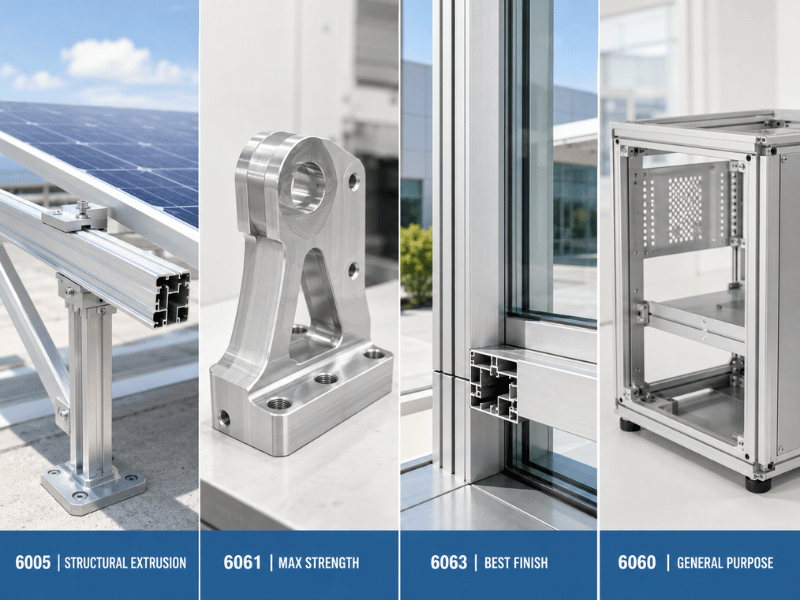
| Legierung | Zugfestigkeit (MPa, min.) | Streckgrenze (MPa, min.) | Extrudierbarkeit | Oberfläche / Eloxierung | Am besten für |
|---|---|---|---|---|---|
| 6060 | 190 (T6) | 150 (T6) | Ausgezeichnet | Very good | Zierleisten, Rohre, dekorative Strangpressprofile |
| 6063 | 205 (T6) | 170 (T6) | Hervorragend (Referenz) | Very good | Architekturrahmen, Fenster-/Türsysteme |
| 6005 | 260 (T6) | 240 (T6) | Gut | Gut | Strukturprofile, Transport, Geländer |
| 6061 | 290 (T6) | 240 (T6) | Mäßig | Mäßig (Cu beeinflusst Oberfläche) | Hochfeste bearbeitete Teile, geschweißte Konstruktionen |
Die Werte sind Mindestgarantien gemäß ASTM B221 / EN 755. Die Mindestwerte für 6005-T5 liegen bei 190 MPa Zugfestigkeit und 145 MPa Streckgrenze – der T5-Weg liegt unter T6, ist aber kostengünstiger in der Herstellung.
Wann 6005 die richtige Wahl ist
Zwei Bedingungen sprechen für 6005. Das Bauteil ist ein stranggepresstes Profil, das strukturelle Lasten tragen muss – Geländer, Rahmen, Brückenelement oder Fahrzeugkomponente – und die Oberfläche muss sauber ausgeführt werden können. Wenn das Profil lang ist, der Querschnitt komplex und die Konstruktion zwischen der Festigkeit von 6063 und den Kosten von 6061 liegt, ist 6005 der Mittelweg, der in der Regel gewinnt.
Wann eine andere Legierung besser passt
Wenn maximale Festigkeit aus einem bearbeiteten oder dickwandigen Bauteil gefordert ist, liefert 6061-T6 eine höhere Mindestzugfestigkeit, und sein Kupfergehalt ist in dieser Rolle akzeptabel. Wenn Extrudierbarkeit, Oberflächengüte und Eloxierverhalten wichtiger sind als Festigkeit – Fenstersysteme, Zierleisten, dekorative Profile – sind 6063 oder 6060 der bessere Ausgangspunkt. Wenn der Querschnitt dünn und rein dekorativ ist, ist 6060 günstiger und leichter zu extrudieren.
Arbeiten mit 6005 – Was Sie wissen müssen
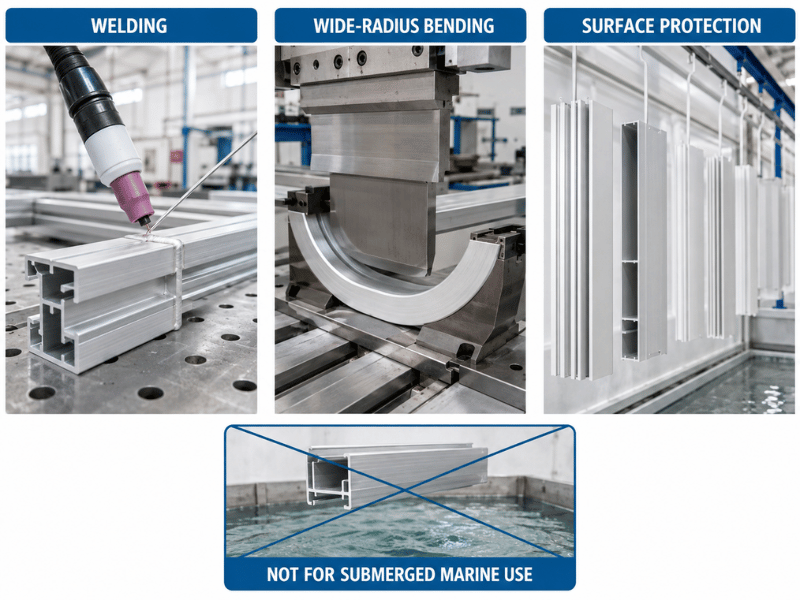
Strangpressen. 6005 ist für die Presse konzipiert: Es lässt sich mit guten Geschwindigkeiten zu komplexen Hohl- und Dünnwandprofilen strangpressen, und die gealterte Oberfläche nimmt ein helles, klares eloxiertes Finish an — einer der praktischen Vorteile dieser Legierung gegenüber 6061, dessen Kupfergehalt das Eloxieren trübt.
Schweißen. MIG-, TIG- und Widerstandsschweißen funktionieren alle bei 6005. Die Schweißzone und der wärmebeeinflusste Bereich verlieren nach dem Schweißen etwas Festigkeit, daher ist die T6-Grundfestigkeit die Auslegungsreserve — für Schweißverbindungen, die die volle Nennlast tragen müssen, sollten Zusatzwerkstoff und Verfahren anwendungsbezogen qualifiziert werden.
Eloxieren und Oberflächenbehandlung. 6005 lässt sich zu einem hellen, klaren Finish eloxieren und nimmt Pulverbeschichtung gut an. Für den Außen- oder meernahen Einsatz ist Eloxieren oder Beschichten der Standardschutz, da blankes 6005, wie 6061, korrosionsbeständig, aber nicht seewasserimmun ist.
Zerspanung. 6005 lässt sich mit Standardwerkzeugen bearbeiten und hält Toleranzen gut; die Spanlenkung ist einfacher als bei weicherem 6063, und die Legierung ist eine gängige Wahl für stranggepresste Profile, die anschließend gebohrt, mit Gewinde versehen oder auf Länge geschnitten werden.
Vor- und Nachteile im Überblick
| Faktor | Vorteil | Begrenzung |
|---|---|---|
| Stärke | Deutlich über 6063/6060, nahe 6061 im T6-Zustand | Unter der Spitzenzugfestigkeit von 6061 |
| Extrudierbarkeit | Komplexe Hohlprofile bei guter Geschwindigkeit | Nicht so schnell wie 6063 |
| Oberfläche / Eloxieren | Helle, klar eloxierte Oberfläche | Kupferfreiheit verbessert die Oberfläche, jedoch nicht die hellste der Familie |
| Schweißeignung | Ausgezeichnet mit MIG/WIG/Widerstandsschweißen | Festigkeitsverlust in der Wärmeeinflusszone erfordert Auslegungsreserve |
| Korrosionsbeständigkeit | Gut für Außen- und Industrieanwendungen | Meereseinsatz erfordert Eloxieren oder Beschichten |
| Kosten | Geringere Prozesskosten als 6061 für Profile | T6 erfordert einen Lösungsglühschritt |
Schlussfolgerung
6005 ist die praktische Mitte der 6xxx-Strangpressfamilie: fester als 6063 und 6060, leichter strangpressbar und oberflächenbehandelbar als 6061 und in T5 sowie T6 schweißbar. Der Kompromiss besteht darin, dass die Spitzenfestigkeit weiterhin 6061 gehört — daher findet 6005 seinen Platz bei stranggepressten Strukturprofilen, bei denen Oberflächenqualität und Profilkomplexität ebenso wichtig sind wie die Last.
Linsy Aluminum liefert 6005 Aluminiumlegierung über Standardproduktformen mit MTC-Dokumentation zu jeder Bestellung und SGS-Prüfberichten auf Anfrage. Das Werk in Shenzhen unterstützt kundenspezifische Abmessungen mit geringen Mindestmengen bei einer typischen Lieferzeit von 10–60 Tagen, und hausinterne Verarbeitung wie CNC-Bearbeitung, Laserschneiden und Oberflächenveredelung deckt die meisten Schritte ab, die 6005-Projekte benötigen.
Wenn das Bauteil ein stranggepresstes 6005-Profil zwischen verschiedenen Härtezuständen oder Legierungen ist, senden Sie die Zeichnung oder Spezifikation an Linsy Aluminum für eine Lagerprüfung und ein Angebot.
Häufig gestellte Fragen
Wie vergleicht sich 6005 mit 6061 in Bezug auf die Festigkeit?
6005-T6 garantiert mindestens 260 MPa Zugfestigkeit und 240 MPa Streckgrenze, während 6061-T6 mindestens 290 MPa Zugfestigkeit und 240 MPa Streckgrenze garantiert. 6061 hat am oberen Ende die Nase vorn; 6005 gibt etwas Festigkeit zugunsten besserer Strangpressbarkeit und einer saubereren eloxierten Oberfläche ab.
Was ist der Unterschied zwischen 6005 und 6063?
6063 ist für Strangpressbarkeit und Oberflächengüte optimiert — es ist die Referenzlegierung für architektonische Rahmen und Fenstersysteme, mit etwa 205 MPa Zugfestigkeit im T6-Zustand. 6005 tauscht einen Teil dieser Leichtigkeit gegen etwa 50–100 MPa mehr Festigkeit ein, weshalb es für Strukturprofile, Geländer und Transportkomponenten gewählt wird, bei denen das Profil sowohl Last tragen als auch gut aussehen muss.
Reduziert Schweißen die Festigkeit von 6005?
Ja. Die wärmebeeinflusste Zone neben der Schweißnaht verliert einen Teil der aushärtungsbedingten Festigkeit, was für alle 6xxx-Härtezustände normal ist. Für Schweißverbindungen, die die volle Nennlast tragen, bietet die T6-Grundfestigkeit die Reserve, und Zusatzwerkstoff sowie Verfahren sind anwendungsspezifisch zu qualifizieren.
Lässt sich 6005 gut eloxieren?
Ja — dies ist einer seiner Vorteile gegenüber 6061. Da 6005 kein Kupfer über Spurenmengen hinaus enthält, nimmt es eine helle, klare eloxierte Oberfläche an, ohne die Trübung, die Kupfer verursacht. Klares oder farbiges Eloxieren sowie Pulverbeschichtung sind beide Standard.
Ist 6005 für marine Umgebungen geeignet?
6005 hat eine gute allgemeine und atmosphärische Korrosionsbeständigkeit, ist aber wie 6061 nicht meerwasserimmun. Für Küsten- oder Meeresanwendungen sind Eloxieren oder Pulverbeschichtung der Standardkorrosionsschutz; für ständige Meerwassertauchung ist eine Legierung der 5xxx-Serie wie 5083 die sicherere Wahl.