4032 Aluminium: Zusammensetzung, Eigenschaften und Anwendungen
SEO-Titel: 4032 Aluminiumlegierung: Zusammensetzung, Eigenschaften und Verwendungen
Meta-Beschreibung: 4032 Aluminium ist eine hochsiliziumhaltige Schmiedelegierung, die für Verschleißfestigkeit und thermische Stabilität bis etwa 250°C ausgelegt ist. Entdecken Sie ihre Zusammensetzung, mechanischen Eigenschaften und wie sie im Vergleich zu 2618, 6061 und 5086 für Kolben und hochreibungsbelastete Teile abschneidet.
Was ist 4032 Aluminium?
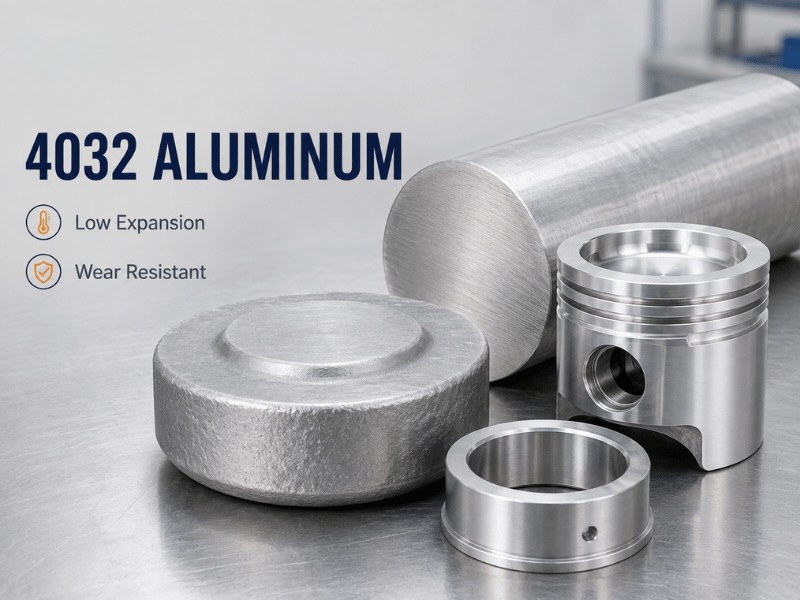
4032 ist eine Aluminium-Silizium-Legierung der 4xxx-Serie, die für geschmiedete, hochreibungsbelastete, temperaturwechselbeanspruchte Teile entwickelt wurde – am häufigsten Kolben, Buchsen und Ventilkomponenten. Ihre beiden bestimmenden Merkmale sind ein hoher Siliziumgehalt (11,0–13,5%), der die Matrix härtet, sowie ein niedriger Wärmeausdehnungskoeffizient, der die Teile beim Erwärmen und Abkühlen maßhaltig hält.
Aus dieser chemischen Zusammensetzung ergeben sich zwei Einschränkungen. Erstens ist 4032 keine schweißbare Legierung: Der hohe Siliziumgehalt macht Schmelzschweißnähte anfällig für Heißrisse, und die Legierung wird fast ausschließlich als Schmiedeteil oder bearbeitete Stange verwendet, nicht als geschweißte Konstruktion. Zweitens ist ihre Korrosionsbeständigkeit moderat – ausreichend für ölbenetzte oder beschichtete Motorinnenteile, jedoch nicht vergleichbar mit Legierungen der 5xxx- oder 6xxx-Serie im freien oder maritimen Einsatz.
Chemische Zusammensetzung von 4032-Aluminium
Silizium, Nickel, Kupfer und Magnesium spielen jeweils eine eigene Rolle. Die groben Siliziumpartikel in der Matrix verleihen 4032 ihre Abriebfestigkeit und ihren ungewöhnlich niedrigen Ausdehnungskoeffizienten; Nickel verstärkt die Hochtemperaturfestigkeit; und Kupfer plus Magnesium bilden Al₂Cu- und Mg₂Si-Ausscheidungen, die die Festigkeit bei künstlicher Alterung erhöhen. Zusammen bewirken diese Elemente, dass sich 4032 völlig anders verhält als eine Allzwecklegierung der 6xxx-Serie.
| Element | Gewicht % | Rolle in der Legierung |
| Aluminium (Al) | Bilanz | Matrixmetall |
| Silizium (Si) | 11.0–13.5% | Primärer Härter; erhöht die Verschleißfestigkeit und senkt die Wärmeausdehnung |
| Magnesium (Mg) | 0.8–1.3% | Bildet Mg₂Si-Ausscheidungen während der Alterung; trägt zur Festigkeit bei |
| Kupfer (Cu) | 0.50–1.3% | Bildet Al₂Cu-Ausscheidungen; primärer Festigkeitsbeitrag durch Ausscheidungshärtung |
| Nickel (Ni) | 0.50–1.3% | Senkt die Wärmeausdehnung und verbessert die Hochtemperaturfestigkeit und Kriechbeständigkeit |
| Eisen (Fe) | ≤1,0% | Verunreinigungskontrolle; niedrig gehalten zum Schutz der Duktilität |
Mechanische und physikalische Eigenschaften
Die folgenden Werte sind typisch für 4032 im T6-Zustand (lösungsgeglüht und künstlich gealtert), dem Zustand, der für die meisten geschmiedeten und bearbeiteten Teile verwendet wird.
| Eigentum | Wert | Hinweis |
| Dichte | 2,69 g/cm³ | Geringfügig unter der Basislinie von reinem Aluminium |
| Zugfestigkeit (Ultimate Tensile Strength) | ~380 MPa (55 ksi) | T6-Zustand, Raumtemperatur |
| Zugstreckgrenze (0,2%-Offset) | ~315 MPa (46 ksi) | Entscheidend für die Auslegungsspannung |
| Dehnung beim Bruch | ~9% | Niedriger als bei duktilen Legierungen wie 2618 |
| Wärmeleitfähigkeit | ~150 W/m-K | Durch hohen Siliziumgehalt reduziert |
| Wärmeausdehnungskoeffizient | 19,4 µm/m·K | Niedrig – nahe an Gusseisen, ein wesentlicher Vorteil |
| Schmelzbereich | 530–570°C | Solidus bis Liquidus |
Der niedrige Ausdehnungskoeffizient ist die wichtigste Kennzahl. Mit 19,4 µm/m·K dehnt sich 4032 etwa 15% weniger aus als 6061 und bleibt dem Gusseisen-Zylinder, gegen den es arbeitet, viel näher – weshalb es ein Standardmaterial für Kolben ist.
4032 Aluminium-Zustände: T6, T651, O und F
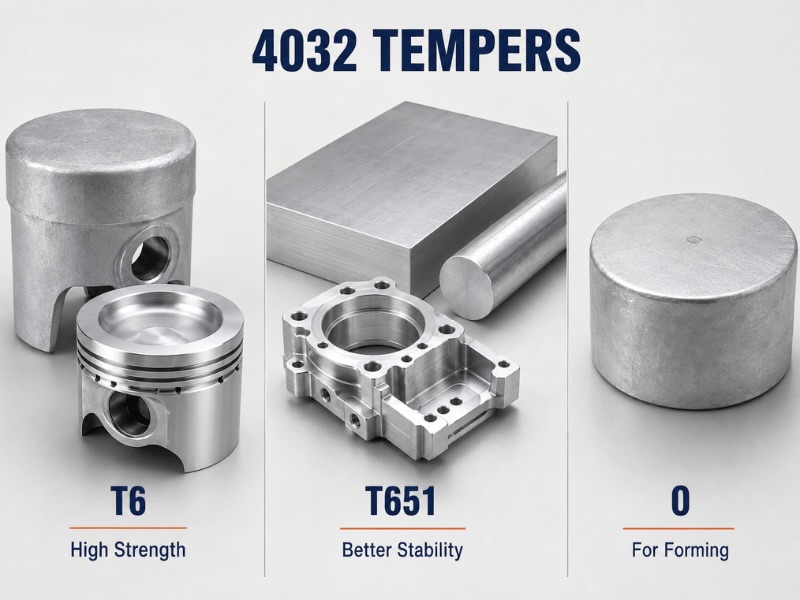
T6 ist der wichtigste Festigkeitszustand von 4032, erzeugt durch Lösungsglühen mit anschließender künstlicher Alterung. T651 fügt zwischen Lösungsglühen und künstlicher Alterung einen kontrollierten Reckvorgang ein, um Eigenspannungen abzubauen. O ist der weichgeglühte Zustand, der verwendet wird, wenn eine höhere Umformbarkeit erforderlich ist, und F ist der herstellungsbedingte Zustand ohne speziell kontrollierte mechanische Eigenschaften. Der gelieferte Zustand hängt auch von der Produktform, der Liefernorm und dem verfügbaren Lagerbestand ab.
| Temperament | Verarbeitungszustand | Hauptmerkmal | Typisches Produkt / Anwendung |
| T6 | Lösungsgeglüht und künstlich gealtert | Hohe Festigkeit, Verschleißfestigkeit, niedrige Wärmeausdehnung | Kolben, Ventilkörper, mechanische Teile |
| T651 | Lösungsgeglüht, durch Recken spannungsarm geglüht, dann künstlich gealtert | Bessere Maßhaltigkeit, reduzierte Bearbeitungsverformung | Stange, Platte, präzisionsbearbeitete Teile |
| O | Geglüht | Geringere Festigkeit, verbesserte Umformbarkeit | Teile, die umgeformt und anschließend auf T6/T651 wärmebehandelt werden |
| F | Herstellungsbedingt | Eigenschaften hängen vom Herstellungsprozess ab | Sonderanfertigungen oder herstellungsbedingte Artikel |
| H112 | Geringe Kaltverfestigung durch Umformung | Gebunden an spezifische Produktform und Herstellungsprozess | Einige Stangen, Rohre oder Sonderbestellungen |
4032-T6 Aluminium
4032-T6 ist der Standardzustand für diese Legierung. Nach Lösungsglühen und künstlicher Alterung erreicht sie etwa 380 MPa Zugfestigkeit und 315 MPa Streckgrenze, mit der niedrigen Ausdehnung von 19,4 µm/m·K, die sie über Wärmezyklen stabil hält. Fast jeder geschmiedete Kolben, jede Buchse und jeder Ventilkörper aus 4032 wird im T6-Zustand geliefert, sofern nicht eine nachgelagerte Bearbeitung eine strengere Eigenspannungskontrolle erfordert.
4032-T651 Aluminium
T651 vs. T6
T651 fügt zwischen Lösungsglühen und künstlicher Alterung einen kontrollierten Reckvorgang (typischerweise 1–3%) ein. Das Recken baut die beim Abschrecken eingeschlossenen inneren Spannungen ab – es verändert nicht die Zug- oder Streckgrenze, die nahe den T6-Werten bleiben (etwa 380 MPa Zugfestigkeit, 315 MPa Streckgrenze). Der eigentliche Gewinn ist die Eigenspannungskontrolle: Ein T6-Teil kann sich beim Materialabtrag in der Bearbeitung verziehen, während ein T651-Teil seine Form hält, weil diese Spannungen bereits abgebaut sind.
Stabilität bei Präzisionsbearbeitung
Beim Bearbeiten eines T6-Schmiedeteils oder einer T6-Stange kann der ungleichmäßige Abtrag von verspanntem Material dazu führen, dass sich das Teil federt oder verzieht und enge Toleranzen zerstört. Die vorentspannte Struktur von T651 hält das Teil während des Zerspanens stabil, daher ist es die sicherere Wahl für dünne Wände, asymmetrische Querschnitte und Merkmale mit engen Toleranzen.
Gängige Formen und Auswahl
T651 in 4032 wird am häufigsten als Stange und Platte oder als daraus geschnittene präzisionsbearbeitete Rohlinge geliefert; geschmiedete Kolben werden in der Regel im T6-Zustand gefertigt, da Schmieden und Endbearbeitung die Verformung bereits kontrollieren. T651 wird spezifiziert, wenn die weiterverarbeitende Werkstatt umfangreiche Sekundärbearbeitungen durchführt und keine Verformung nach der Bearbeitung tolerieren kann – der geringe Aufpreis ist gerechtfertigt, um Ausschuss zu vermeiden. Die vollständige T6-gegenüber-T651-Entscheidung ist im Auswahlleitfaden am Ende dieses Abschnitts zusammengefasst.
Produktnorm und Dickenabhängigkeit
Mindestwerte für 4032-T6/T651 folgen der jeweiligen Formnorm – ASTM B247 für Schmiedeteile, B211 für Stangen und Rundstäbe, B221 für Strangpressprofile, B209 für Platten und Bleche – und die veröffentlichten Mindestwerte sinken mit zunehmender Querschnittsdicke. Die Werte sollten für die exakte Produktform und Dicke abgelesen werden, nicht als einzelne “typische” Zahl.
Einkaufs-Checkliste
| Zu spezifizierendes Merkmal | Einzelheiten |
| Temperament | T6 oder T651 |
| Produktform und Abmessungen | Durchmesser oder Dicke, Länge, Menge |
| Maßgebende Norm | ASTM B247 / B211 / B221 / B209 oder Zeichnung |
| Zertifikatspaket | MTC (Standard); SGS- oder Drittprüfberichte zu Mechanik und Zusammensetzung (auf Anfrage) |
4032-O Aluminium
4032-O ist der vollständig weichgeglühte Zustand. Die Festigkeit liegt deutlich unter T6, während die Umformbarkeit steigt. O wird daher für Material verwendet, das gebogen, gezogen oder anderweitig umgeformt werden muss, bevor es in einem späteren Verfahrensschritt auf T6 oder T651 wärmebehandelt wird. Es handelt sich um einen Übergangszustand und nicht um einen fertigungsendgültigen Zustand für die meisten 4032-Bauteile.
4032-F und H112 Aluminium
4032-F ist der herstellungsbedingte Zustand: Es wird keine spezielle thermische oder mechanische Behandlung zur Steuerung der Eigenschaften angewendet, sodass das Ergebnis vollständig von der Herstellungsweise des Bauteils abhängt. F ist für 4032 selten ein Lieferzustand, da das Material normalerweise als geschmiedete oder zerspante Stange statt als Blech oder Band geliefert wird; F kann jedoch bei Sonderbestellungen oder im herstellungsbedingten Zustand auftreten.
H112 wird auf bestimmte gewalzte oder stranggepresste Formen angewendet, bei denen eine leichte Kaltverfestigung durch den Umformprozess ohne separate Wärmebehandlung akzeptiert wird. Für 4032 ist dies auf Sonderbestellungen von Stangen oder Rohren beschränkt und kein Standardzustand für Kolben. H112 ist als formabhängige, nicht standardmäßige Option zu behandeln; die Eigenschaften sind vor der Spezifikation anhand des tatsächlichen Lieferstandards zu verifizieren.
Auswahl zwischen 4032-T6 und T651
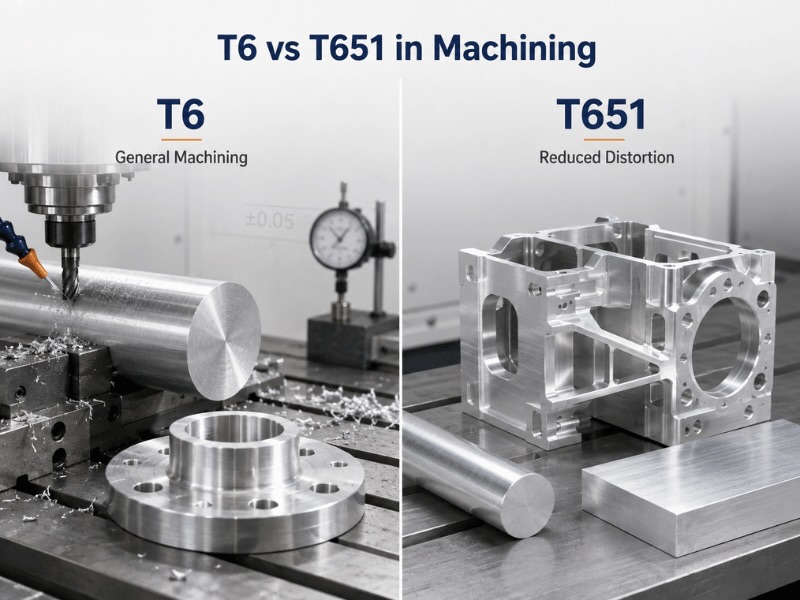
Die Auswahl beginnt mit der Bearbeitung nach Materialeingang. Wenn das Bauteil fertig bearbeitet ankommt oder nur eine leichte Zerspanung benötigt, ist T6 die wirtschaftliche Standardwahl und deckt die überwiegende Mehrheit geschmiedeter Kolben und Buchsen ab. Wenn der Prozess erhebliche Materialmengen entfernt oder enge Toleranzen an dünnen oder asymmetrischen Querschnitten hält, ist der geringe Aufpreis für T651 gerechtfertigt, um Verzugsausschuss zu vermeiden. O ist für Vorformstufen reserviert, und F/H112 gilt nur für die engen Fälle, in denen der herstellungsbedingte Zustand akzeptabel ist.
Warum 4032 sich so verhält, wie es sich verhält
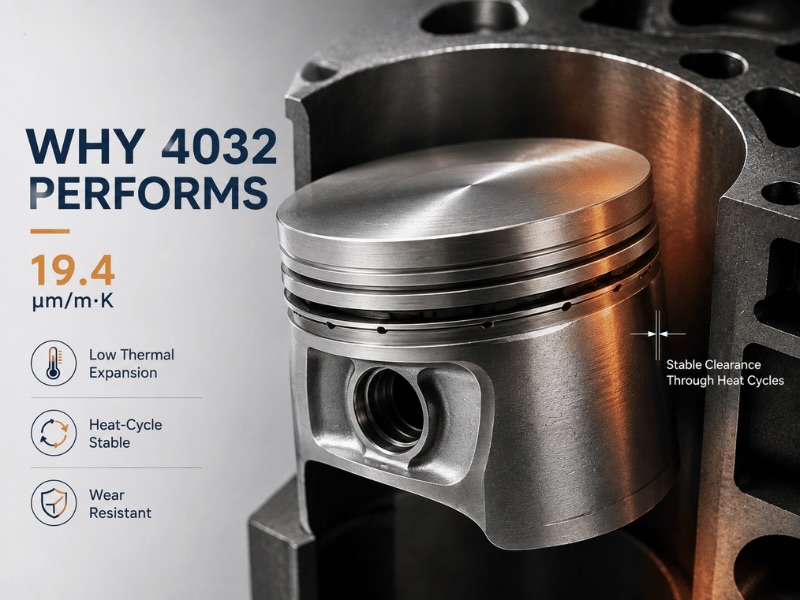
Verschleißfestigkeit. Die in der Matrix verteilten Siliziumpartikel wirken als eingebaute verschleißfeste Phase. In Kombination mit der Fähigkeit, eine harte anodisierte oder phosphatierte Beschichtung aufzunehmen, übersteht 4032 die Gleit- und Fressbelastungen von Kolbenhemden und Buchsen.
Dimensionsstabilität unter Wärme. Geringe Wärmeausdehnung plus nickelstabilisierte Hochtemperaturfestigkeit bedeutet, dass ein 4032-Bauteil seine Passung über wiederholte Wärmezyklen hält. Es behält eine nutzbare Festigkeit bis etwa 250°C; kurze Ausreißer können höher liegen, aber es ist keine Extremtemperaturlegierung wie 2618.
Bearbeitbarkeit. Das Silizium verbessert Spanbruch und Oberflächengüte, sodass sich 4032 gut auf CNC- und Drehautomaten bearbeiten lässt. Der Kompromiss ist Werkzeugverschleiß — dieselben harten Partikel, die die Verschleißfestigkeit unterstützen, schleifen die Schneidkanten ab, weshalb Hartmetallwerkzeuge und ein konstanter Kühlmittelstrom empfohlen werden.
Schweißbarkeit und Korrosion — die zwei Grenzen. Schmelzschweißen wird nicht empfohlen: Der hohe Siliziumgehalt führt zu Heißrissen in der Schweißnaht und der Wärmeeinflusszone, und die Eigenschaften nach dem Schweißen liegen deutlich unter denen des Grundmaterials. Baugruppen werden durch Verbindungselemente, Presssitze oder Kleben gefügt. Die Korrosionsbeständigkeit ist mäßig; in exponierten, feuchten oder chloridhaltigen Umgebungen benötigt 4032 eine Anodisierung, Phosphatierung oder Lackierung und ist nicht die richtige Wahl für dauerhafte Meerwasserexposition.
Gemeinsame Anwendungen
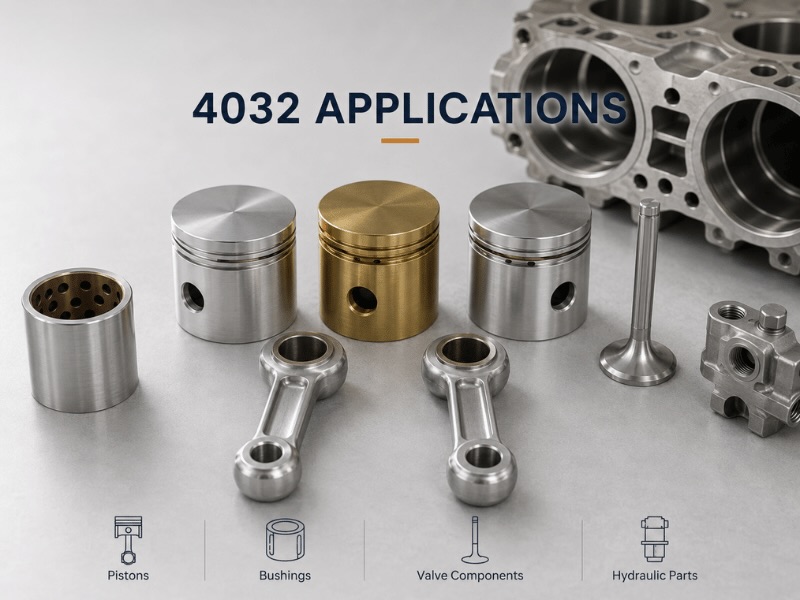
Die Kombination aus geringer Ausdehnung, Verschleißfestigkeit und thermischer Stabilität weist 4032 für innen geschmierte, wärmezyklisch belastete, reibungsbeanspruchte Bauteile aus:
- Kolben für Verbrennungsmotor- und Verdichteranwendungen
- Buchsen und Lager für Zahnstangenlenkungen und ähnliche Mechanismen
- Getriebeventile und Hydraulikkomponenten
- Geschmiedete Verbindungselemente und Hochtemperaturbefestigungen, bei denen Fressbeständigkeit von Bedeutung ist
- Teile für Kopierer und Bürogeräte, die über lange Lebensdauer eine stabile Passung benötigen
In jedem Fall wird das Bauteil typischerweise geschmiedet oder aus Stange zerspant — nicht geschweißt — und läuft in einer ölbenetzten oder beschichteten Umgebung, die den Korrosionsschutz bietet, den die Legierung selbst nicht aufweist.
4032 vs. 2618 vs. 6061 vs. 5086
Gegenüber 2618 tauscht 4032 Spitzenhochtemperaturfestigkeit und Duktilität gegen einfachere Schmiedbarkeit und geringere Kosten bei Großserien-Automobilkolben. Gegenüber 6061 und 5086 ist 4032 in Verschleiß und thermischer Stabilität überlegen, aber in Schweißbarkeit und Korrosionsbeständigkeit unterlegen — die drei sind selten direkte Substitute.
| Charakteristisch | 4032 | 2618 | 6061 | 5086 |
| Primärlegierung | Si (11–13,5%) | Cu (1,8–2,7%) | Mg, Si | Mg (3,5–4,5%) |
| Zugfestigkeit (MPa) | ~380 (T6) | ~440 (T6) | ~310 (T6) | ~300–350 (H32) |
| Korrosionsbeständigkeit | Mäßig | Mäßig | Sehr gut | Ausgezeichnet |
| Thermische Stabilität | Gut (bis ~250°C) | Hervorragend (bis ~300°C) | Mäßig (~150°C) | Mäßig (~150°C) |
| Schweißeignung | Schlecht | Schlecht | Ausgezeichnet | Ausgezeichnet |
| Duktilität | Niedrig | Hoch | Mäßig | Gut |
| Anwendungen | Kolben, Lager | Kolben für die Luft- und Raumfahrt | Strukturelle Teile | Schiffsrümpfe |
Vor- und Nachteile im Überblick
4032 wird gewählt, wenn…
- Das Bauteil ein Kolben, eine Buchse, ein Ventil oder eine andere reibungsbeanspruchte Komponente ist, die ölbenetzt oder beschichtet läuft
- Geringe Wärmeausdehnung und erhaltene Passung über Wärmezyklen erforderlich sind
- Die Geometrie geschmiedet oder zerspant ist, nicht geschweißt
4032 wird nicht empfohlen, wenn…
- Schmelzschweißen erforderlich ist (6061 oder eine 5xxx-Legierung ist die geeignete Alternative)
- Das Bauteil ohne Schutz Meerwasser- oder Chloridexposition ausgesetzt ist (5086 oder 6061 ist die geeignete Alternative)
- Das Budget dominiert und Verschleiß-/Wärmebeständigkeit nicht kritisch sind (6061 ist günstiger und besser verfügbar)
| Eigentum | Vorteil | Begrenzung |
| Verschleißfestigkeit | Hervorragend durch Siliziumpartikel | — |
| Wärmeausdehnung | Gering, nahe Gusseisen | — |
| Hochtemperaturfestigkeit | Gut bis ~250°C | Unter 2618 bei extremen Temperaturen |
| Bearbeitbarkeit | Gute Spanbildung | Werkzeugverschleiß durch Silizium |
| Schweißeignung | — | Schlecht; Schmelzschweißen nicht empfohlen |
| Korrosionsbeständigkeit | — | Mäßig; benötigt Beschichtung bei exponierter Verwendung |
| Kosten | — | Höher als 6061 |
Schlussfolgerung
4032-Aluminium wird ausgewählt für geringe Wärmeausdehnung, eingebaute Verschleißfestigkeit und stabile Hochtemperaturfestigkeit — aber es tauscht Schweißbarkeit und Korrosionsbeständigkeit gegen diese Eigenschaften ein, ein Kompromiss, der für ölbenetzte, geschmiedete, reibungsbeanspruchte Bauteile akzeptabel ist, bei denen die Schwächen der Legierung konstruktiv berücksichtigt werden, und eine schlechte Wahl für geschweißte oder exponierte Strukturen darstellt.
Linsy Aluminium liefert 4032 in Stangen-, Rohr- und Profilformen mit anwendungsgerechten Zuständen; Standardabmessungen ab Lager und kundenspezifische Produktion mit geringer Mindestbestellmenge werden typischerweise in 10–60 Tagen geliefert, jede Bestellung wird mit MTC versandt, SGS-Prüfberichte sind auf Anfrage erhältlich, und das Werk verfügt über ISO-9001-, 14001- und 45001-Zertifizierungen. Für die geringe Ausdehnung und Verschleißfestigkeit von 4032 in einer spezifischen Anwendung senden Sie bitte Güte, Zustand, Produktform und Abmessungen für eine Spezifikationsprüfung und Lagerbestandsbestätigung.
Häufig gestellte Fragen
Was sind die Hauptvorteile von 4032-Aluminium?
Sein geringer Wärmeausdehnungskoeffizient, die hohe siliziumbedingte Verschleißfestigkeit und die stabile Festigkeit bei erhöhter Temperatur. Es lässt sich sauber zerspanen und hält die Passung über Wärmezyklen, weshalb es bei geschmiedeten Kolben- und Buchsenanwendungen dominiert. Es wird nicht wegen Schweißbarkeit oder Korrosionsbeständigkeit gewählt.
Wie verhält sich 4032-Aluminium bei hohen Temperaturen?
Die Silizium-Nickel-Chemie hält es dimensionsstabil und nutzbar bis etwa 250°C, mit kurzen Spitzen darüber. Es übertrifft 6061 und 5086 in thermischer Stabilität, aber für extreme Luft- und Raumfahrttemperaturen um 300°C ist 2618 die stärkere Wahl.
Kann Aluminium 4032 geschweißt werden?
Nein. 4032 hat eine schlechte Schmelzschweißbarkeit, da der hohe Siliziumgehalt Heißrisse in der Schweißnaht und der Wärmeeinflusszone verursacht und die Festigkeit nach dem Schweißen unter das Grundmaterial fällt. Kolben und Buchsen aus 4032 werden geschmiedet oder zerspant und dann durch Verbindungselemente, Presssitze oder Kleben gefügt.
Welche Branchen verwenden 4032-Aluminium am häufigsten?
Die Automobil- und allgemeine Motorenfertigung führt, für Kolben, Verbindungselemente und Buchsen. Es kommt auch in Hydraulikventilen, Getriebekomponenten und Bürogeräteteilen wie Kopierermechanismen vor, wo eine stabile Passung über lange Lebensdauer wichtiger ist als Korrosionsbeständigkeit.
Wie verhält sich Aluminium 4032 im Vergleich zu Aluminium 6061?
4032 ist überlegen in Verschleißfestigkeit, geringer Wärmeausdehnung und Hochtemperaturstabilität, kann aber nicht geschweißt werden und hat nur eine mäßige Korrosionsbeständigkeit. 6061 ist die vielseitigere, schweißbare, korrosionsbeständigere und kostengünstigere Option, abgewogen gegen deutlich geringere Verschleiß- und Wärmeleistung — die beiden dienen unterschiedlichen Problemstellungen, statt direkt zu konkurrieren.