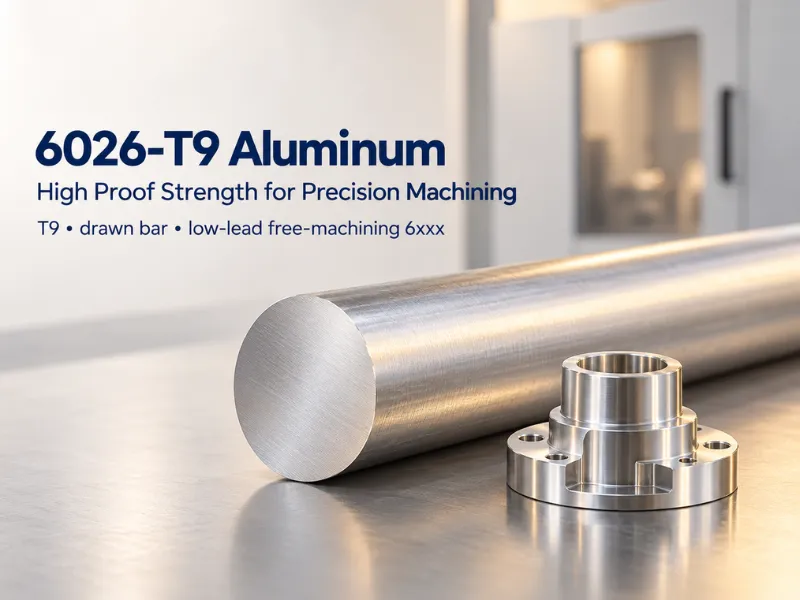
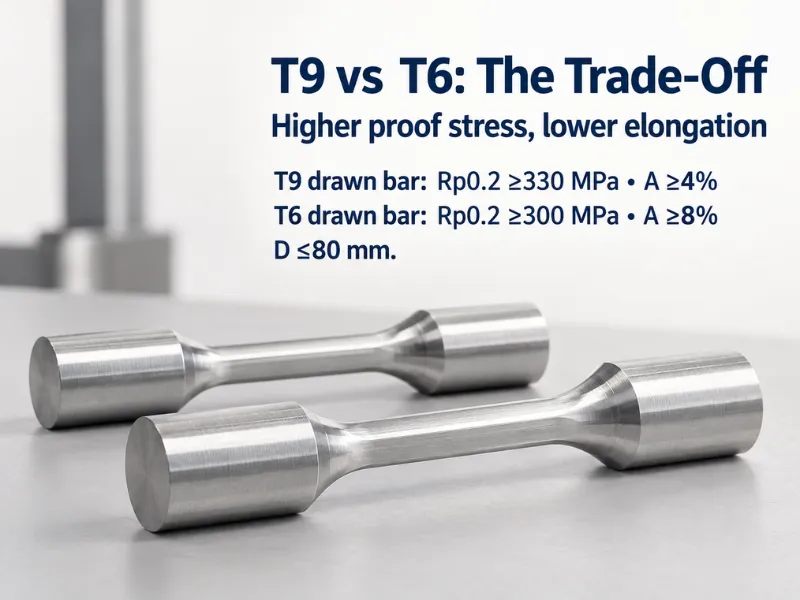
6026-T9 ist die Temperatur, die anzugeben ist, wenn ein bearbeitetes Teil dem bleibenden Verformen so weit widerstehen muss, wie es diese Legierung zulässt, und danach nie mehr gebogen wird. Kaltverfestigung des Stabes nach dem Auslagern bringt die 0,2%-Dehngrenze auf 330 MPa, 30 MPa über T6, und lässt 4% Bruchdehnung zum Arbeiten übrig statt 8%.
Festigkeit ist nur die Hälfte der Entscheidung. Die Fertigungsfolge legt auch fest, in welcher Form jede Temperatur verfügbar ist, und eine Temperatur in einer Form, die wir nicht fertigen können, ist keine Spezifikation, die Sie vergeben können.
Was 6026 ist
6026 ist eine 6xxx-Al–Mg–Si-Legierung, die ihre Festigkeit aus der Ausscheidung von Mg₂Si während der künstlichen Auslagerung gewinnt. Ihr bestimmendes Merkmal ist der Zusatz für freies Zerspanen: Wismut mit 0,50–1,50% bricht den Span, während Blei auf 0,40% begrenzt ist, statt der Mechanismus zu sein. Das bewahrt die Korrosionsbeständigkeit und das Anodisierverhalten eines gewöhnlichen 6xxx und fügt die Spanbeherrschung einer Automatenlegierung hinzu — die Rolle, die 6262 und 6012 erfüllten, wobei Wismut den Span bricht.
Der Kompromiss liegt darin, wo die Legierung angesiedelt ist, nicht darin, was sie leisten kann. Wismut erhöht die Festigkeit nicht, daher ist 6026 in erster Linie eine Zerspanungslegierung und erst in zweiter Linie eine Strukturlegierung; wo maximale Festigkeit der Treiber ist, erfüllen 6082 oder 7075 diese Aufgabe besser. Was ein 6026-Teil in der Praxis entscheidet, ist die Temperatur, denn die Spanne über T6, T8, T9 und T6510/T6511 reicht von 300 bis 330 MPa in der Dehngrenze und von 8% bis 4% in der Bruchdehnung — weit genug, um zu entscheiden, ob das Teil überhaupt umgeformt werden kann.
Chemische Zusammensetzung (EN 573-3)
Wismut ist der gezielte Zusatz; Zinn und Blei liegen an den Verunreinigungsobergrenzen. Diese Unterscheidung ist wichtig, wenn Sie ein Walzwerkszeugnis lesen, denn ein hoher Zinnwert ist ein Kontaminationssignal, kein Vorteil für freies Zerspanen.
| Element | 6026 (EN 573-3, Gew%) | Was es bewirkt |
|---|---|---|
| Si | 0.60–1.40 | Bildet Mg₂Si mit Mg — die Festigkeitsquelle |
| Fe | 0,70 max. | Verunreinigung; beeinflusst Oberflächenbeschaffenheit und Zähigkeit |
| Cu | 0.20-0.50 | Erhöht die Festigkeit und härtet die Ausscheidung |
| Mn | 0.20–1.00 | Steuert Gefüge und Rekristallisation |
| Mg | 0.60–1.20 | Gleicht sich mit Si zu Mg₂Si aus |
| Cr | 0,30 max. | Verunreinigung in dieser Güte |
| Zn | 0,30 max. | Verunreinigung |
| Ti | 0,20 max. | Kornfeinungsmittel |
| Bi | 0.50–1.50 | Zusatz für freies Zerspanen — bricht den Span |
| Pb | 0,40 max. | Restgehalt; die Obergrenze, die die ELV- und RoHS-Ausnahmen zulassen |
| Sn | 0,05 max | Verunreinigungsobergrenze, kein Zusatz |
| Andere | 0,05 max jeweils, 0,15 max gesamt | — |
| Al | Bilanz | — |
Prüfen Sie drei Zeilen auf dem Zeugnis, bevor Sie eine Schmelze annehmen: Bi innerhalb 0,50–1,50%, Sn bei oder unter 0,05% und Pb bei oder unter 0,40%. Eine Schmelze mit Bi unter 0,50% zerspannt lang und spanig; eine mit Sn über 0,05% signalisiert Schrottkontamination statt einer Designänderung.
Wie die T-Temperaturen hergestellt werden
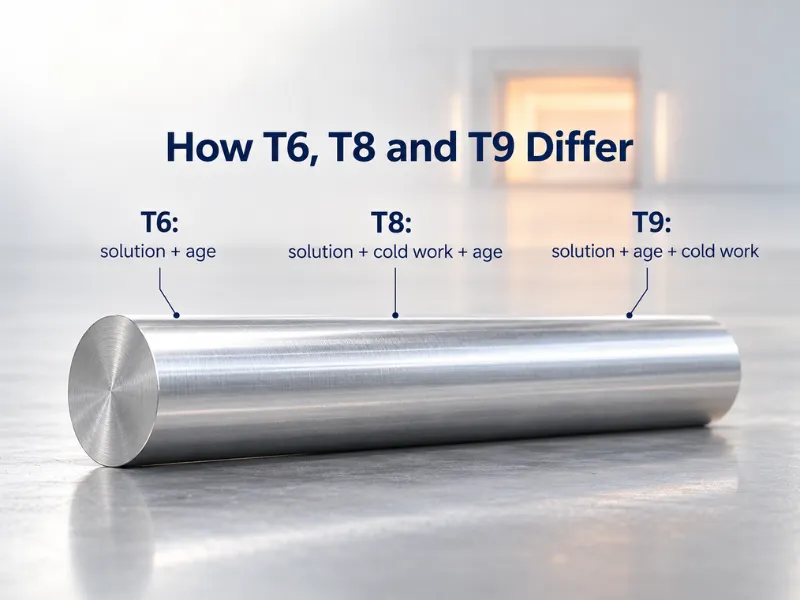
Jede ausscheidungshärtbare 6xxx-Temperatur beginnt gleich: Der Block wird lösungsgeglüht, um die Legierungselemente zu lösen, abgeschreckt, um sie in übersättigter Lösung einzufangen, und dann ausgelagert, sodass sie als feine Partikel auscheiden. Das Suffix nach T dokumentiert, was um diese Kernsequenz herum geschieht — und die Reihenfolge von Kaltverformung gegenüber Auslagerung ist es, was T8 von T9 trennt.
- T6 — lösungsgeglüht, dann künstlich ausgelagert. Keine Kaltverformung.
- T8 — lösungsgeglüht, kaltverformt, dann künstlich ausgelagert. Kaltverformung kommt vor der Auslagerung.
- T9 — lösungsgeglüht, künstlich ausgelagert, dann kaltverformt. Kaltverformung ist der letzte Arbeitsgang.
- T6510 — T6 gefolgt von Spannungsabbau durch Recken, bleibende Verformung 1–3% bei Rundstäben, Stäben, Profilen und Rohren (0,5–3% bei gezogenem Rohr), ohne weiteres Richten nach dem Recken.
- T6511 — wie T6510, außer dass leichtes Richten nach dem Recken zulässig ist, um Maßtoleranzen einzuhalten.
T9 ist die einzige der fünf, die den Stab nach dem Auslagern kaltverformt. Die Auslagerung hat die Ausscheidung bereits eingestellt; das Kaltziehen fügt dann Versetzungsverfestigung obendrauf hinzu und legt den Durchmesser im selben Durchgang fest. Ein T9-Stab kommt mit bereits festgelegten Abmessungen und bereits abgebauter Eigenspannung an, weshalb präzisionsgedrehte Teile üblicherweise in T9 spezifiziert werden — der Durchmesser, auf den Sie bearbeiten, ist der Durchmesser, den der Stab hält.
T8 kehrt diese Reihenfolge um. Die Kaltverformung erfolgt vor der Auslagerung, sodass der Stab in seinem gezogenen Maß ausgelagert wird, statt nach der Auslagerung gezogen zu werden. Ein T8-Stab erreicht 315 MPa Dehngrenze und 345 MPa Zugfestigkeit bei 4% Bruchdehnung — mehr Dehngrenze als T6, 15 MPa weniger als T9.
6026-T9 in Zahlen
Die folgenden Mindestwerte stammen aus EN 754-2 für kaltgezogenen Stab und EN 755-2 für Strangpressprodukte. T9 existiert nur als gezogenes Produkt; T6510 und T6511 existieren nur als Strangpressprodukt, und sie tragen dieselbe Festigkeitslinie wie T6 in jedem Größenband.
| Temperament | Form und Norm | Größenbereich | Rm min (MPa) | Rp0,2 min (MPa) | A min (%) | HB (typ.) |
|---|---|---|---|---|---|---|
| T6 | Gezogener Stab, EN 754-2 | D ≤ 80 mm | 370 | 300 | 8 | 95 |
| T8 | Gezogener Stab, EN 754-2 | D ≤ 80 mm | 345 | 315 | 4 | 95 |
| T9 | Gezogener Stab, EN 754-2 | D ≤ 80 mm | 360 | 330 | 4 | 95 |
| T6 / T6510 / T6511 | Stranggepresst, EN 755-2 | D ≤ 140 mm | 370 | 300 | 8 | 95 |
| T6 / T6510 / T6511 | Stranggepresst, EN 755-2 | 140 < D ≤ 200 mm | 340 | 250 | 8 | 90 |
| T6 / T6510 / T6511 | Stranggepresst, EN 755-2 | 200 < D ≤ 250 mm | 300 | 200 | 8 | 90 |
Wählen Sie nach der Dehngrenzen-Spalte, nicht nach der Zugfestigkeits-Spalte. T9 hält die höchste Streckgrenze bei 330 MPa, 30 MPa über T6, während sein Zugfestigkeits-Mindestwert von 360 MPa tatsächlich 10 MPa unter dem von T6 mit 370 liegt — Kaltverformung an einem ausgelagerten Gefüge erkauft Widerstand gegen bleibende Verformung und gibt dafür Zugfestigkeit und Bruchdehnung auf.
Die physikalischen Eigenschaften liegen dort, wo ein 6xxx normalerweise liegt; dies sind typische Werte, keine Mindestwerte: Dichte 2,72 g/cm³, Elastizitätsmodul etwa 69–70 GPa, Wärmeleitfähigkeit 172 W/(m·K), elektrische Leitfähigkeit rund 26 MS/m (etwa 44% IACS) und ein Wärmeausdehnungskoeffizient von 23,4 × 10⁻⁶/K zwischen 20 und 100 °C. Die Erstarrung verläuft etwa bei 575–650 °C.
T9 vs. T6 vs. T8 vs. T6510/T6511
| Temperament | Sequenz | Rm min | Rp0,2 min | A min | Spezifizieren, wenn |
|---|---|---|---|---|---|
| T6 | Lösung + Auslagerung | 370 | 300 | 8% | You need the best tensile-elongation balance, or the part is extruded rather than drawn |
| T8 | Solution + cold work + age | 345 | 315 | 4% | The bar is already cold drawn and the part needs more proof stress than T6 at the same 4% elongation |
| T9 | Solution + age + cold work | 360 | 330 | 4% | The finished part is cut, not formed, and must hold its set under the highest load the grade allows |
| T6510 | T6 + stretch, no re-straightening | 370 | 300 | 8% | A large extruded section is machined flat or square and residual stress would move it |
| T6511 | T6510 + light straightening | 370 | 300 | 8% | Same as T6510, but the section needs straightening inside standard tolerance after the stretch |
T9 is the right call when the part is produced entirely by machining and the design load is carried below the yield point. The 330 MPa proof stress is the highest the alloy offers, and the cold-finished diameter means the bar is already where the tolerance wants it. The cost is 4% elongation: T9 leaves almost no room for a bend, a swage, or a crimp after delivery.
T6 covers the widest range of work. Its 370 MPa tensile and 8% elongation give room to form or straighten after heat treatment, and it is the temper extruded tube and profile come in. If the part needs any deformation after aging, T6 or one of its stress-relieved versions is the one that can still take it.
T8 sits between them and is easy to overlook. It is a drawn-bar temper like T9, but with cold work ahead of aging: 315 MPa proof stress and 345 MPa tensile, still at 4% elongation. Specify T8 when the drawing calls for more proof stress than T6 and the part will not be formed — but T9 is available, it gives 15 MPa more proof stress at the same elongation, so T8 usually loses that comparison on a like-for-like drawing.
T6510 and T6511 are the stress-relieved versions of T6 and exist only for extruded product. They change residual stress, not the strength line, so the choice between them and T6 is about distortion after machining rather than load capacity. T6510 forbids straightening after the stretch; T6511 allows light straightening to hold tolerance, which is why it appears more often on standard extruded sections.
Shapes and Sizes
The temper usually decides the form. T9 and T8 are drawn-bar tempers; T6510 and T6511 are extruded; T6 exists in both. Where a drawing needs a temper the standard form does not carry, the route changes — the order does not get refused.
- Bar and rod — round 6–400 mm, hex and square 6–200 mm, length 1000–6000 mm. T9 is normally a cold-drawn round bar.
- Sheet and plate — 0.5–120 mm thick, 1000–2600 mm wide, length 1000–6000 mm.
- Rohr — outer diameter 10–300 mm, wall 0.5–30 mm.
- Spule — supplied on enquiry. Tell us the required temper, width and coil weight and we confirm what the mill can run; coil is not a standing stock form for this grade.
- Custom profiles — extruded to your section drawing (how custom extrusion profiles are produced covers the route from drawing to die).
Non-standard sections and sizes are produced to order. Low-MOQ custom runs typically take 10–60 days depending on size and processing; what a size outside the standard range changes is the production route and the lead time, not whether we will quote it.
Go / No-Go
- Go when the part is turned or milled in volume, the enquiry has to clear RoHS or ELV, and 6061-T6 is short on strength while a 2xxx or 7xxx grade would be more than the design needs. The bismuth chip control is what pays for the alloy, and it pays most on automatic lathes running long batches.
- Go when the part needs an anodized finish and free-machining behavior at the same time; a leaded free-machining grade dulls that finish and carries its own compliance burden. Note the qualification: 6026 meets ELV and RoHS under the lead exemption for aluminum alloys, which permits up to 0.40% Pb. It is a low-lead grade, not a zero-lead grade, and the distinction matters if your compliance file treats exemptions differently from substance bans.
- No-go when the drawing fixes T9 or T8 on a part that still has to be formed. That is a temper mismatch rather than an alloy limitation — 6026 forms in O and T4, and the drawing changes temper, not grade.
- No-go when the service environment needs the seawater performance of a 5xxx alloy, or when 6061 or 6063 already meets the drawing. 6026 costs more than either, and the premium only returns where the free-machining behavior and the compliance position are both being used.
Specifying and Sourcing 6026
Four lines on the enquiry prevent most wrong deliveries:
- Name the standard, not only the alloy.
6026-T9 to EN 754-2fixes the product form, the size band and the property table;6026-T9on its own leaves all three open. - Pair the temper with a form the standard carries. T9 and T8 belong to drawn bar under EN 754-2; T6, T6510 and T6511 belong to extruded product under EN 755-2. Asking for
T9 extruded profilesends the enquiry back for clarification. - Give the size band, not just the nominal. The EN 755-2 minimums step down at 140 mm and again at 200 mm, so a 210 mm bar is specified against 300 MPa tensile, not 370.
- Fordern Sie EN 10204 3.1. That certificate carries the heat’s actual chemistry and mechanical results, signed at the producing mill, and it is the only document that lets you check Bi, Sn and Pb against the limits above.
Unser 6026 Aluminiumlegierung page lists the forms and tempers we run, so the size and temper can be checked before you write the enquiry.
Schlussfolgerung
T9 gives 6026 its highest proof stress at 330 MPa and its lowest elongation at 4%, so it suits a part that is machined to final form and loaded below yield, and rules out anything that still has to bend. T6, T8 and T6510/T6511 trade that yield back for formability or for lower residual stress in large sections.
We draw and supply 6026 in T6, T8, T9, T6510 and T6511 across bar, sheet, tube and custom profiles, with MTC on every order and coil quoted on enquiry.
Send your drawing with the standard, temper and size band, and we will confirm the production route and lead time before you commit.
Häufig gestellte Fragen
What is 6026 T9 aluminum?
6026 is a low-lead free-machining 6xxx alloy, and T9 is the temper produced by aging the bar and then cold working it. Because the cold draw is the last step, the bar arrives strengthened and dimensionally finished — which is why T9 suits precision turned parts.
Is 6026 T9 stronger than T6?
It depends which strength you mean. T9 reaches a higher 0.2% proof stress, 330 MPa against T6’s 300, so it resists permanent set better. Its tensile minimum is 360 MPa against T6’s 370 — 10 MPa lower — and its elongation drops from 8% to 4%.
Can 6026 T9 be welded?
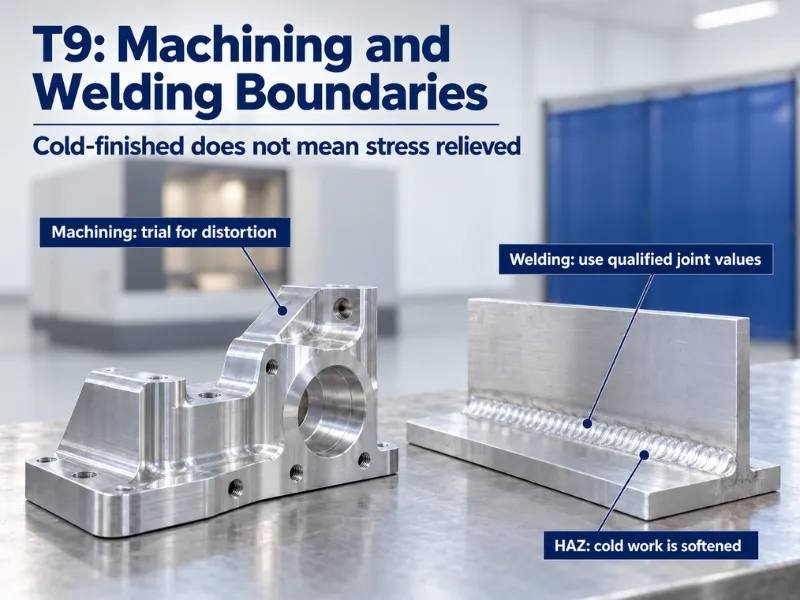
Yes, by TIG or MIG, but the joint will not hold T9 properties. The heat-affected zone reverts toward the annealed condition, and no post-weld aging treatment restores the T9 structure in this grade. If the finished assembly must carry T9 strength across a weld, change the design to a mechanical joint or pick a temper you can accept losing.
Which tempers do you supply, and what is the minimum order?
We supply bar, sheet, tube and custom profiles in T6, T8, T9, T6510 and T6511. Coil is quoted on enquiry. Round bar runs 6–400 mm and sheet 0.5–120 mm thick.
Non-standard sizes go to low-MOQ custom production, typically 10–60 days. Send the drawing, temper and size band for a route and a price.