¿Qué es el aluminio 6005?
Aleación de aluminio 6005 Es una aleación tratable térmicamente de la serie 6xxx basada en el sistema aluminio-magnesio-silicio (Al-Mg-Si). Su resistencia proviene de la precipitación de siliciuro de magnesio (Mg₂Si) durante el envejecimiento, lo que permite que la aleación se extruya primero y se endurezca después — la misma lógica de familia que 6063 y 6061, pero ajustada para un equilibrio diferente.
Ese equilibrio es la parte útil: el 6005 ofrece una resistencia notablemente mayor que el 6063 o el 6060, mientras se extruye más fácilmente y se obtiene una mejor superficie que con el 6061. La contrapartida es que no alcanza los valores máximos de tracción del 6061. La cuestión práctica es si la posición entre resistencia y extruibilidad se ajusta al perfil, las cargas y el acabado que el proyecto necesita.
Composición química
La composición del 6005 (AA 6005, según ASTM B221 y EN 573-3) se controla dentro de límites estrictos:
| Elemento | Contenido (%) | Papel |
|---|---|---|
| Aluminio | Saldo | Metal común |
| Silicio (Si) | 0.6 – 0.9 | Forma la fase de endurecimiento Mg₂Si |
| Magnesio (Mg) | 0.4 – 0.6 | Forma la fase de endurecimiento Mg₂Si |
| Manganeso (Mn) | 0,10 máx. | Refinamiento de grano |
| Hierro (Fe) | 0,35 máx. | Control de impurezas |
| Cobre (Cu) | 0,10 máx. | Control de impurezas |
| Cromo (Cr) | 0,10 máx. | Control de la estructura de grano |
| Zinc (Zn) | 0,10 máx. | Control de impurezas |
| Titanio (Ti) | 0,10 máx. | Refinamiento de grano |
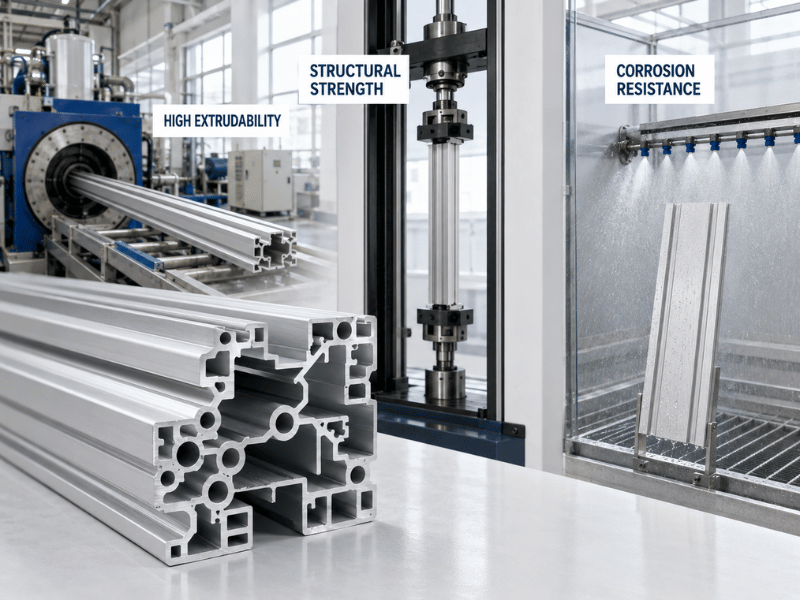
Los niveles de silicio y magnesio son lo que separa al 6005 de sus vecinos: mantienen la extruibilidad y el acabado superficial más cercanos al 6063, mientras elevan la resistencia envejecida hacia el 6061.
Propiedades mecánicas y físicas del 6005
| Propiedad | Valor | Nota |
|---|---|---|
| Densidad | 2,70 g/cm³ | Estándar para aleaciones de la serie 6xxx |
| Resistencia máxima a la tracción (T5) | ~260 MPa (mín. 190) | Enfriado desde extrusión + envejecido artificialmente |
| Límite elástico (T5) | ~215 MPa (mín. 145) | |
| Resistencia máxima a la tracción (T6) | ~310 MPa (mín. 260) | Tratado en solución + envejecido artificialmente |
| Límite elástico (T6) | ~275 MPa (mín. 240) | |
| Alargamiento a la rotura | ~8–10% | T6 ligeramente inferior al T5 |
| Dureza Brinell | ~80 HB (T5) / ~90 HB (T6) | |
| Resistencia a la fatiga | ~115 MPa (T5) / ~130 MPa (T6) | 5×10⁸ ciclos |
| Módulo elástico | ~70 GPa | Igual en todos los temple |
| Conductividad térmica | ~170–180 W/m·K | |
| Conductividad eléctrica | ~45-50% IACS | |
| Intervalo de fusión | ~580–650 °C |
El límite elástico de ~240 MPa mínimo en T6 es el valor que impulsa la mayoría de los cálculos estructurales — es la razón por la que el 6005 reemplazó muchas secciones de acero más pesadas en aplicaciones de transporte y puentes. El temple T5 sacrifica parte de esa resistencia por una ruta de menor costo: se envejece directamente desde el calor de extrusión, omitiendo un horno de solución separado, lo que importa cuando el perfil es largo y el presupuesto es ajustado. Una descripción general de las propiedades clave del 6005 cubre la aleación en forma resumida.
Los temples T5 y T6
El 6005 se suministra más frecuentemente en dos temples, y la diferencia está en la ruta de tratamiento térmico, no en la aleación:
T5 — enfriado desde la extrusión y envejecido artificialmente. El perfil sale de la prensa, se templa y se envejece a temperatura elevada sin un paso de solución separado. Es la opción económica para largas series arquitectónicas y estructurales donde ~260 MPa de resistencia a la tracción es suficiente.
T6 — tratado térmicamente por solución y envejecido artificialmente. El perfil se resolubiliza, se templa y se envejece, lo que disuelve y reprecipita la fase endurecedora de forma más completa. Esto añade aproximadamente 50 MPa de resistencia a la tracción y 30–60 MPa de límite elástico sobre el T5, a costa de un paso adicional por horno y una ductilidad ligeramente menor.
La selección generalmente está impulsada por la carga: el T5 cubre barandillas, marcos y secciones arquitectónicas; el T6 cubre miembros de puentes, estructuras de camiones y remolques, y componentes portantes donde la resistencia adicional compensa el paso de proceso extra.
Dónde se utiliza el 6005

Construcción y estructuras arquitectónicas
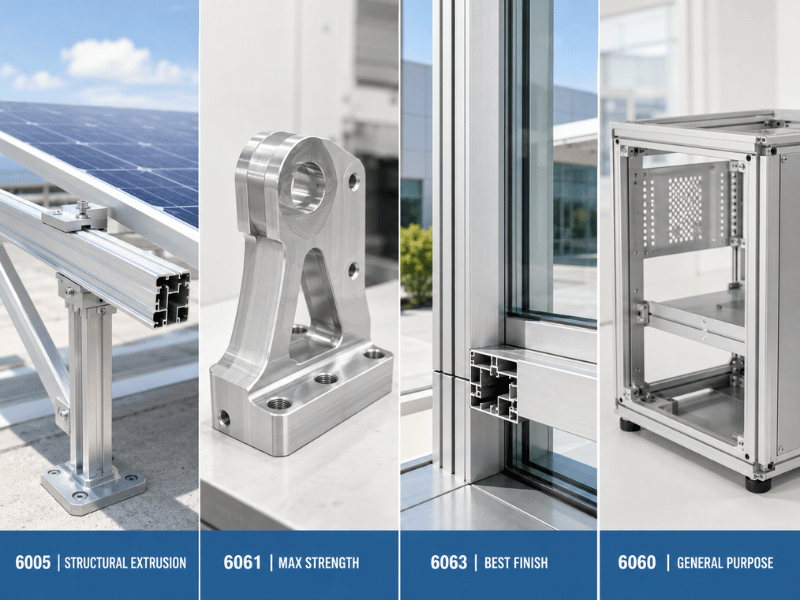
Los perfiles de 6005 soportan cargas estructurales mientras mantienen la superficie limpia que exige el trabajo arquitectónico. Pasamanos, largueros de escaleras, marcos de muros cortina, marcos de ventanas y puertas, y barandillas de puentes son usos estándar — la aleación se extruye en las secciones huecas complejas que estos diseños requieren, y la elección T5/T6 ajusta la resistencia a la luz.
Transporte, industrial y eléctrico
Los marcos de camiones y remolques, rieles de techo, componentes de vagones de ferrocarril y equipos de elevación utilizan 6005 donde el peso importa y las soldaduras forman parte de la fabricación — la aleación se suelda de manera confiable con MIG o TIG, y la pérdida en la zona afectada por el calor es manejable con el procedimiento adecuado. En el lado industrial, escaleras, andamios y marcos de paneles solares aprovechan el mismo equilibrio entre resistencia y peso, mientras que los gabinetes eléctricos, disipadores de calor y barras colectoras utilizan su buena conductividad.
6005 vs 6061 vs 6063 vs 6060
| Aleación | UTS (MPa, mín.) | Límite elástico (MPa, mín.) | Extrudabilidad | Superficie / Anodizado | Lo mejor para |
|---|---|---|---|---|---|
| 6060 | 190 (T6) | 150 (T6) | Excelente | Muy buena | Molduras, tubería, extrusiones decorativas |
| 6063 | 205 (T6) | 170 (T6) | Excelente (referencia) | Muy buena | Marcos arquitectónicos, sistemas de ventanas/puertas |
| 6005 | 260 (T6) | 240 (T6) | Bien | Bien | Perfiles estructurales, transporte, barandillas |
| 6061 | 290 (T6) | 240 (T6) | Moderado | Moderado (el Cu afecta el acabado) | Piezas mecanizadas de alta resistencia, estructuras soldadas |
Los valores son mínimos garantizados según ASTM B221 / EN 755. Los mínimos del 6005-T5 son 190 MPa de tracción y 145 MPa de límite elástico — la ruta T5 se sitúa por debajo del T6 pero cuesta menos producirla.
Cuándo el 6005 es la elección correcta
Dos condiciones apuntan al 6005. La pieza es un perfil extruido que debe soportar carga estructural — barandilla, marco, miembro de puente o componente de vehículo — y la superficie necesita un acabado limpio. Si el perfil es largo, la sección es compleja y el diseño se sitúa entre la resistencia del 6063 y el costo del 6061, el 6005 es el punto medio que generalmente gana.
Cuándo otra aleación se ajusta mejor
Cuando el requisito es la máxima resistencia de una pieza mecanizada o de sección gruesa, el 6061-T6 ofrece una mayor resistencia mínima a la tracción, y su contenido de cobre es aceptable en ese rol. Cuando la extruibilidad, el acabado superficial y la respuesta al anodizado importan más que la resistencia — sistemas de ventanas, molduras, perfiles decorativos — el 6063 o el 6060 son el mejor punto de partida. Cuando la sección es delgada y puramente decorativa, el 6060 es más económico y más fácil de extruir.
Trabajar con 6005 — lo que necesita saber
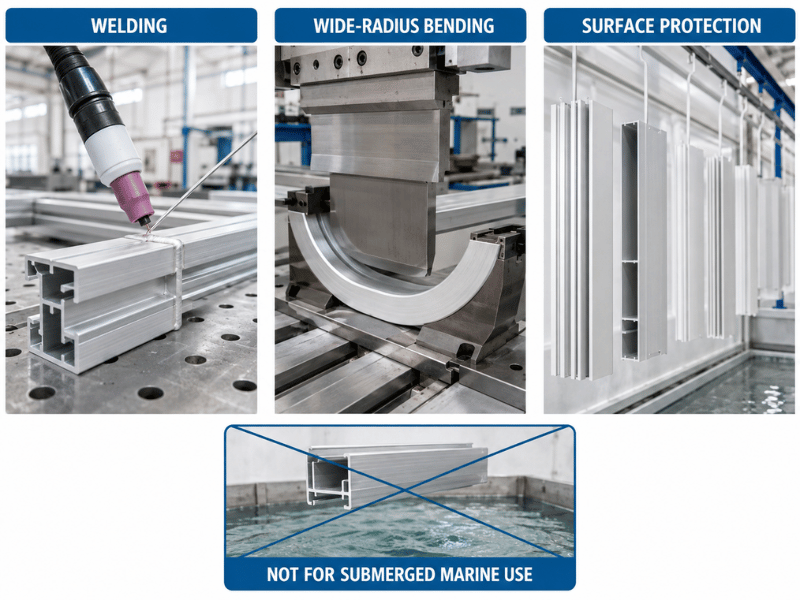
Extrusión. El 6005 está diseñado para la prensa: se extruye en secciones huecas complejas y de pared delgada a buenas velocidades, y la superficie envejecida admite un acabado anodizado brillante y transparente — una de las ventajas prácticas de esta aleación sobre el 6061, cuyo contenido de cobre opaca el anodizado.
Soldadura. La soldadura MIG, TIG y por resistencia funcionan todas en el 6005. La zona de soldadura y el área afectada por el calor pierden algo de resistencia después de soldar, por lo que la resistencia base del T6 es el margen de diseño — para uniones soldadas que deban soportar la carga nominal completa, el material de aporte y el procedimiento deben cualificarse según la aplicación.
Anodizado y acabado. El 6005 se anodiza con un acabado brillante y transparente y acepta bien el recubrimiento en polvo. Para servicio exterior o en proximidad marina, el anodizado o el recubrimiento son la protección estándar, ya que el 6005 desnudo, al igual que el 6061, es resistente a la corrosión pero no inmune al agua de mar.
Mecanizado. El 6005 se mecaniza con herramientas estándar y mantiene bien las tolerancias; el control de viruta es más fácil que en el 6063 más blando, y la aleación es una elección común para perfiles extruidos que luego se taladran, roscan o cortan a medida.
Ventajas y limitaciones de un vistazo
| Factor | Ventaja | Limitación |
|---|---|---|
| Fuerza | Muy por encima del 6063/6060, cercano al 6061 en T6 | Por debajo de la tracción máxima del 6061 |
| Extrudabilidad | Secciones huecas complejas a buena velocidad | No tan rápido como el 6063 |
| Superficie / anodizado | Acabado anodizado brillante y claro | Libre de cobre ayuda al acabado, pero no es el más brillante de la familia |
| Soldabilidad | Excelente con MIG/TIG/resistencia | La pérdida de resistencia en la ZAC requiere margen de diseño |
| Resistencia a la corrosión | Adecuado para exteriores/uso industrial | Servicio marino requiere anodizado o recubrimiento |
| Coste | Menor costo de proceso que el 6061 para perfiles | El T6 añade un paso de tratamiento en solución |
Conclusión
El 6005 es el punto medio práctico de la familia de extrusión 6xxx: más resistente que el 6063 y el 6060, más fácil de extruir y acabar que el 6061, y soldable tanto en T5 como en T6. La contrapartida es que la resistencia máxima sigue perteneciendo al 6061 — por lo que el 6005 se gana su lugar en perfiles estructurales extruidos donde la calidad superficial y la complejidad de la sección importan tanto como la carga.
Linsy Aluminum suministra Aleación de aluminio 6005 En todos los formatos de producto estándar con documentación MTC en cada pedido e informes de ensayo SGS disponibles bajo solicitud. La fábrica de Shenzhen admite dimensiones personalizadas con MOQ bajo y un plazo de entrega típico de 10 a 60 días, y el procesamiento interno, como mecanizado CNC, corte por láser y acabado superficial, cubre los pasos que la mayoría de los proyectos con 6005 requieren.
Si la pieza es un perfil extruido de 6005 entre templetes o entre aleaciones, envíe el dibujo o la especificación a Linsy Aluminum para una verificación de stock y cotización.
Preguntas frecuentes
¿Cómo se compara el 6005 con el 6061 en resistencia?
El 6005-T6 garantiza un mínimo de 260 MPa de resistencia a la tracción y 240 MPa de límite elástico, mientras que el 6061-T6 garantiza un mínimo de 290 MPa de tracción y 240 MPa de límite elástico. El 6061 mantiene la ventaja en el extremo superior del rango; el 6005 cede un poco de resistencia a cambio de una mejor extruibilidad y una superficie anodizada más limpia.
¿Cuál es la diferencia entre 6005 y 6063?
El 6063 está optimizado para extruibilidad y acabado superficial — es la aleación de referencia para marcos arquitectónicos y sistemas de ventanas, con aproximadamente 205 MPa de tracción en T6. El 6005 sacrifica parte de esa facilidad por unos 50–100 MPa más de resistencia, por lo que se elige para perfiles estructurales, barandillas y componentes de transporte donde la sección debe soportar carga y además tener buen aspecto.
¿La soldadura reduce la resistencia del 6005?
Sí. La zona afectada por el calor junto a la soldadura pierde parte de la resistencia endurecida por envejecimiento, lo cual es normal en todos los templetes 6xxx. Para uniones soldadas que soportan carga nominal completa, la resistencia base del T6 proporciona el margen, y el material de aporte y el procedimiento deben calificarse según la aplicación.
¿El 6005 se anodiza bien?
Sí — esta es una de sus ventajas sobre el 6061. Debido a que el 6005 no contiene cobre más allá de niveles traza, admite un acabado anodizado brillante y claro sin el apagado que provoca el cobre. El anodizado claro o de color y el recubrimiento en polvo son ambos estándar.
¿Es el 6005 adecuado para entornos marinos?
El 6005 tiene buena resistencia general y atmosférica a la corrosión, pero al igual que el 6061 no es inmune al agua de mar. Para servicio costero o marino, el anodizado o el recubrimiento en polvo son la protección estándar; para inmersión constante en agua de mar, una aleación de la serie 5xxx como el 5083 es la opción más segura.