O que é o Alumínio 2024?
2024 é uma liga de alumínio da série 2000, com cobre como principal elemento de liga (3,8–4,9% Cu, além de 1,2–1,8% Mg e 0,3–0,9% Mn). Sua resistência é obtida por endurecimento por precipitação — um ciclo controlado de tratamento térmico que forma aglomerados sub-microscópicos de cobre na rede de alumínio — e não por trabalho a frio. O resultado é uma das ligas de alumínio mais resistentes disponíveis na forma forjada, com resistência à tração comparável à do aço de baixo carbono, a aproximadamente um terço da densidade.
Esse teor de cobre também é o motivo pelo qual a liga 2024 corrói mais facilmente que as ligas 5xxx ou 6xxx. Na prática, o material é quase sempre fornecido como chapa alclad (alumínio puro metalurgicamente ligado à superfície) ou protegido por anodização ou pintura. É esse perfil de resistência-peso que torna a 2024 a escolha padrão para fuselagens e maquinário de alto desempenho — e exatamente por isso o têmper que você escolhe, especialmente para peças conformadas, importa mais do que a própria liga.
Compreendendo o Têmper T4
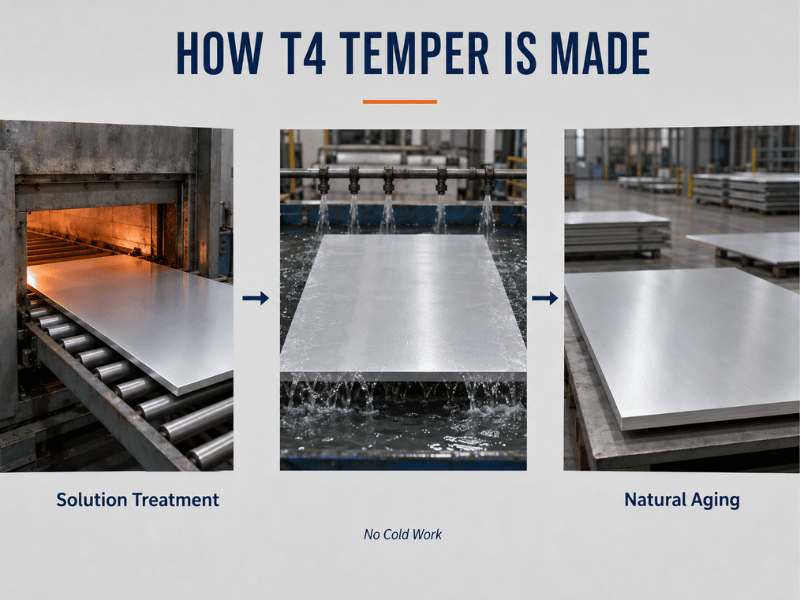
A designação completa “T4” descreve um tratamento térmico em duas etapas aplicado após a liga ser fundida, trabalhada até sua forma final (chapa, placa, barra ou tubo) e submetida a tratamento térmico de solução.
- Tratamento térmico de solubilização. A liga é aquecida a aproximadamente 493°C (920°F) para dissolver precipitados ricos em cobre em uma solução sólida uniforme. Nessa temperatura, os átomos de cobre ficam totalmente dispersos na matriz de alumínio. O material é então rapidamente temperado — geralmente em água fria — para reter o cobre em uma solução sólida supersaturada. Se a liga resfriasse lentamente, o cobre precipitaria como partículas grosseiras e fracamente ligadas; a têmpera rápida evita isso.
- Envelhecimento natural. O material temperado é mantido à temperatura ambiente por vários dias. Durante esse período, os átomos de cobre difundem-se por curtas distâncias através da rede de alumínio e aglomeram-se nos planos {100}, formando zonas coerentes conhecidas como zonas de Guinier-Preston (GP). Essas zonas tensionam a rede circundante e impedem o movimento de discordâncias, que é o mecanismo que aumenta a resistência. O processo de envelhecimento atinge resistência próxima ao pico após cerca de 4–5 dias e continua lentamente por meses, embora as propriedades práticas de projeto estabilizem na primeira semana.
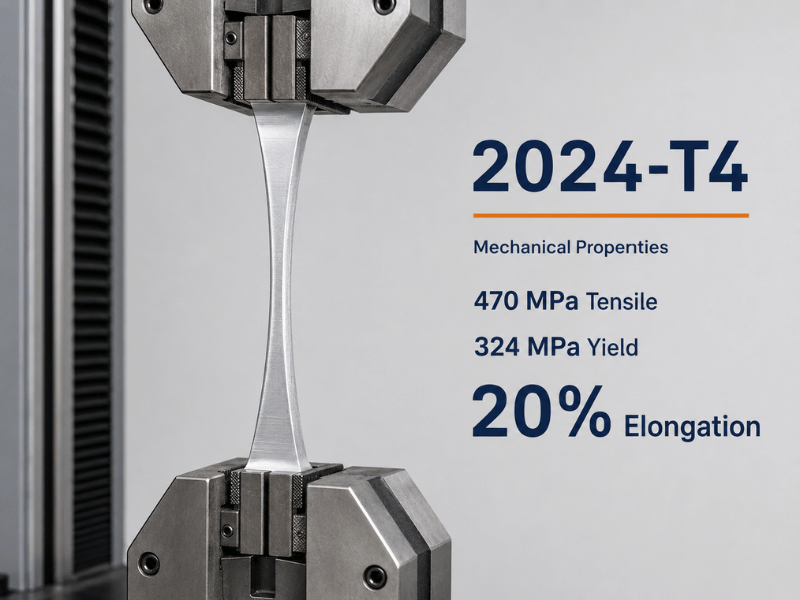
O resultado é um têmper que combina alta resistência à tração (~470 MPa de resistência máxima) com a maior ductilidade entre os têmperes comumente especificados da liga 2024 — tipicamente 19–20% de alongamento em 50 mm. Essa ductilidade é consequência direta do que o T4 não inclui: não há etapa de trabalho a frio e nenhum estiramento de alívio de tensões. O material mantém a total conformabilidade da condição recém-temperada, enquanto ainda atinge a resistência total envelhecida.
Como o T4 Difere do T3
O T3 é o têmper mais próximo do T4. Ambos são tratados termicamente em solução e envelhecidos naturalmente. A diferença é uma única etapa de processamento: o T3 recebe uma redução controlada por trabalho a frio (tipicamente 1–3%) após a têmpera e antes do envelhecimento natural. Esse trabalho a frio adiciona encruamento — mais discordâncias na rede — o que aumenta ligeiramente a resistência à tração e ao escoamento, mas reduz a ductilidade e a conformabilidade.
Para uma peça que será conformada, dobrada ou estirada após o tratamento térmico, o T4 é a escolha mais prática. A ausência de trabalho a frio significa que o material deforma-se mais uniformemente e tolera raios de dobra mais apertados antes de trincar. Para uma peça que será usada como laminada ou trefilada sem conformação adicional, a vantagem marginal de resistência do T3 pode ser preferível. O guia 2024-T3 aborda a rota de trabalho a frio em mais detalhes.
Propriedades Mecânicas do 2024-T4
| Propriedade | Valor | Notas |
|---|---|---|
| Densidade | 2,78 g/cm³ | Típico para a série 2xxx |
| Resistência à tração final | 470 MPa (68 ksi) | Longitudinal, temperatura ambiente |
| Limite de Escoamento à Tração (deslocamento de 0,2%) | 324 MPa (47 ksi) | Rege a maioria dos cálculos estruturais de projeto |
| Alongamento na ruptura | ~19–20% | Em medidor de 50 mm; o mais alto entre os têmperes da liga 2024 |
| Módulo de elasticidade | 73,1 GPa (10.600 ksi) | Aproximadamente um terço do aço |
| Resistência à Fadiga (5×10⁸ ciclos) | ~140 MPa (20 ksi) | Corpo de prova liso, R = −1 |
| Resistência ao cisalhamento | 285 MPa (41 ksi) | Relevante para projeto de fixadores e juntas rebitadas |
| Dureza Brinell | 120 HB | Carga de 500 kg, esfera de 10 mm |
| Condutividade elétrica | 30% IACS | Baixo para alumínio — especifique para resistência, não para condução de corrente |
O limite de escoamento de 324 MPa é o número que rege a maioria dos projetos estruturais. O que distingue o T4 dos outros têmperes da liga 2024 não é o valor de escoamento — o T351 atinge os mesmos 325 MPa — mas o alongamento. Com ~20%, o T4 retém aproximadamente 30–40% mais ductilidade que o T351 (~12–15%) e quase o dobro da ductilidade do T6 (~8–10%). Essa diferença reflete-se diretamente na conformabilidade: uma chapa T4 pode ser dobrada com raio mais apertado ou estirada mais antes de trincar do que a mesma liga em T3, T351 ou T6.
Onde o 2024-T4 É Utilizado
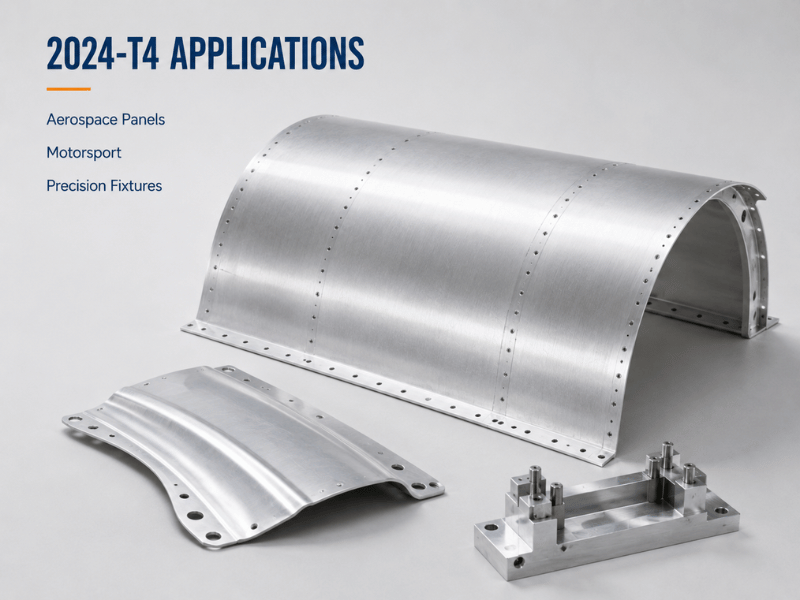
A combinação de alta resistência, resistência à fadiga e ductilidade superior torna o T4 o têmper padrão para chapas aeroespaciais conformadas e para aplicações onde o material deve ser moldado após o tratamento térmico.
Estruturas aeroespaciais
O principal domínio de aplicação. Revestimentos de asas, painéis de fuselagem e coberturas estruturais são frequentemente conformados a partir de chapa 2024-T4 na condição alclad. As operações de conformação — dobra em prensa, estiramento ou conformação por rolos — aproveitam o alto alongamento do T4 para alcançar contornos complexos sem trincas. Uma vez conformada, a peça retém a resistência total envelhecida do têmper.
Revestimentos inferiores de asas e revestimentos de fuselagem sofrem ciclos de fadiga dominados por tração durante cada voo. O 2024-T4 fornece a resistência à fadiga necessária para longas vidas úteis, mantendo o peso em aproximadamente um terço de um projeto equivalente em aço. A camada alclad protege contra a corrosão que, de outra forma, limitaria a vida útil da liga nua em ambientes úmidos ou com alta concentração de sal.
Para componentes estruturais usinados — anteparas, conexões, suportes — o T351 é tipicamente preferido ao T4 porque o estiramento de alívio de tensões previne distorção de usinagem. O papel do T4 é especificamente em chapa conformada e placa leve, onde a capacidade de conformação importa mais que a estabilidade de usinagem. Para uma comparação mais ampla entre ligas, a análise 2024 vs 7075 aborda quando cada família de liga é adequada.
Outras Aplicações de Alta Tensão
- Automobilismo e veículos de alto desempenho. Painéis de carroceria, componentes de suspensão e suportes estruturais conformados a partir de chapa 2024-T4 aparecem em aplicações de corrida e alto desempenho onde a economia de peso importa e o material deve ser moldado em geometrias complexas.
- Ferramentas de precisão e dispositivos. Gabaritos de montagem e dispositivos de inspeção que exigem uma combinação de conformabilidade (para corresponder a peças contornadas) e rigidez beneficiam-se da chapa T4 em espessuras moderadas.
- Militar e defesa. Invólucros estruturais, painéis de acesso e coberturas conformadas onde a relação resistência-peso e a capacidade de conformação são ambas necessárias.
T4 vs Outros Têmperes da Liga 2024 — Como Escolher
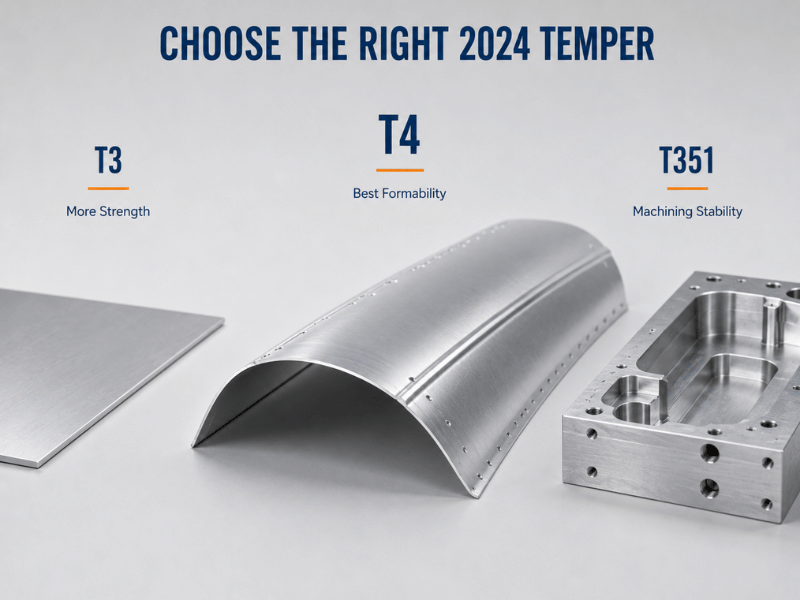
A liga 2024 está disponível em vários têmperes, cada um otimizado para uma rota de fabricação diferente. A tabela abaixo mapeia as principais opções em relação aos critérios típicos de seleção.
| Temperamento | Tratamento | Resistência à tração (MPa) | Limite de Escoamento (MPa) | Alongamento | Melhor para | Evitar quando |
|---|---|---|---|---|---|---|
| T4 | Solução + envelhecimento natural | 470 | 324 | ~20% | Chapa conformada e placa leve necessitando máxima ductilidade | Usinagem de seções espessas (sem alívio de tensões) |
| T3 | Solubilização + trabalho a frio + envelhecimento natural | 483 | 345 | ~18% | Chapa fina exigindo resistência máxima com conformação moderada | Conformação profunda ou raios de dobra apertados |
| T351 | Solução + estiramento + envelhecimento natural | 470 | 325 | ~12–15% | Peças usinadas de seção espessa, estruturas críticas à fadiga | Operações de conformação (ductilidade inferior) |
| T6 | Solução + envelhecimento artificial | 483 | 393 | ~8–10% | Aplicações de resistência estática máxima | Estruturas críticas à fadiga (menor tenacidade à fratura) |
| T3511 | Igual ao T351, para extrusões | 425 | 310 | ~10% | Barras, perfis e tubos extrudados | Chapa ou placa plana (T4 ou T351 é o equivalente em forma de produto) |
Quando o T4 É a Escolha Certa
- A peça será conformada, dobrada ou estirada após o tratamento térmico. O alongamento de ~20% do T4 e a ausência de tensões residuais de trabalho a frio conferem a maior janela de conformação de qualquer têmper da liga 2024. Raios de dobra de 1,5t a 3t são práticos para dobras de 90° em espessuras moderadas.
- A aplicação prioriza ductilidade e resistência à trinca em detrimento da resistência ao escoamento absoluta. O T4 atinge o mesmo limite de escoamento que o T351 (324–325 MPa), mantendo ao mesmo tempo significativamente mais alongamento, o que é importante para peças sujeitas a impacto ou que devem tolerar pequenas deformações sem fraturar.
Quando Outro Tempero se Ajusta Melhor
- A peça será extensivamente usinada a partir de chapa espessa. O T4 não possui etapa de alívio de tensões, portanto tensões residuais de têmpera permanecem no material. A remoção assimétrica de material — cavidades profundas, fresamento unilateral — liberará essas tensões e causará empenamento da peça. 2024-T351 é a escolha padrão para componentes estruturais usinados.
- A resistência estática máxima é a prioridade. O ciclo de envelhecimento artificial do T6 eleva o limite de escoamento para 393 MPa — aproximadamente 20% acima do T4 — mas à custa da ductilidade e tenacidade à fratura. Para aplicações puramente de carga estática sem preocupações com fadiga, o guia 2024-T6 aborda essa compensação.
- Chapa fina que exige resistência máxima. A etapa de trabalho a frio do T3 adiciona um incremento moderado de resistência que pode ser útil em chapas de pequena espessura, onde cada quilonewton importa. A contrapartida é a redução da conformabilidade.
Trabalhando com 2024-T4 — O Que Você Precisa Saber
Usinagem. 2024-T4 usina bem com ferramentas de metal duro afiadas em altas rotações do fuso e avanços moderados. O material produz cavacos curtos e limpos e mantém um bom acabamento superficial. No entanto, como o T4 retém tensões residuais de têmpera, a remoção pesada de material de um lado de uma chapa ou placa pode causar movimento dimensional. Para peças de precisão usinadas a partir de estoque espesso, mude para T351. Para operações em nível de chapa — recorte, furação, fresamento leve — o T4 é suficientemente estável.
Soldagem. A soldagem por fusão do 2024-T4 não é recomendada. A liga é suscetível à trinca a quente na zona de solda, e a zona afetada pelo calor (ZAC) perde o efeito de endurecimento do tratamento de precipitação, retornando a propriedades próximas ao estado recozido adjacente à solda. Métodos práticos de união são rebitagem, aparafusamento, colagem adesiva ou soldagem por fricção e mistura mecânica (friction stir welding). A soldagem por fricção e mistura mecânica preserva mais a resistência do metal de base porque a temperatura de pico permanece abaixo do limite do tratamento de solução, mas requer equipamentos especializados e qualificação de processo.
Proteção contra corrosão. O 2024-T4 sem revestimento sofrerá corrosão em serviço — mais rapidamente que as ligas 5xxx ou 6xxx e significativamente mais rápido em ambientes de água salgada ou úmidos. Três estratégias de proteção cobrem a maioria das aplicações:
- Alclad. Uma camada fina de alumínio comercialmente puro (tipicamente liga 1230 ou 1100) é laminada por ligação a ambas as superfícies. O revestimento atua como ânodo de sacrifício, protegendo o núcleo. O Alclad 2024-T4 é padrão para chapas aeroespaciais.
- Anodização. A anodização com ácido sulfúrico (MIL-A-8625 Tipo II) forma uma camada de óxido controlada que melhora a resistência à corrosão e a adesão de tinta. A anodização dura (Tipo III) é possível, mas pode reduzir a vida em fadiga se não for devidamente selada.
- Revestimento por conversão química e pintura. O revestimento por conversão de cromato (Alodine) seguido de primer epóxi e acabamento em poliuretano é o sistema de proteção padrão para peças usinadas de 2024.
Conformabilidade. O T4 oferece a melhor conformabilidade entre os têmperas padrão do 2024. Na condição recém-temperada (antes da conclusão do envelhecimento natural), pode ser conformado com ainda maior liberdade. Uma vez totalmente envelhecido, raios de dobramento de 1,5t a 3t para dobras de 90° em espessuras moderadas são práticos. Para formas complexas que exigem deformação severa, a conformação deve ser concluída antes que o material atinja a resistência total de envelhecimento — tipicamente dentro de algumas horas após a têmpera.
Vantagens e Limitações em Resumo
| Fator | Vantagem | Limitação |
|---|---|---|
| Relação resistência-peso | Competitivo com aço de baixo carbono a um terço da densidade | Limite de escoamento inferior ao 7075-T6 ou 2024-T6 |
| Fadiga | Excelente vida em fadiga em ciclos dominados por tração | Sensibilidade à fadiga com entalhe exige projeto detalhado cuidadoso |
| Formabilidade | Maior ductilidade entre os têmperas do 2024 (~20% de alongamento) | A janela de conformação se estreita uma vez concluído o envelhecimento natural |
| Estabilidade de usinagem | Bom controle de cavacos e acabamento superficial em operações de nível de chapa | Sem alívio de tensões — usinagem pesada de estoque espesso causa empenamento |
| Resistência à corrosão | Aceitável com alclad ou revestimento protetor | Liga sem revestimento não adequada para serviço desprotegido |
| Soldabilidade | Soldável por fricção e mistura mecânica | Não soldável por fusão — trinca a quente e perda de resistência na ZAC |
| Disponibilidade | Produto padrão aeroespacial em chapa fina e chapa de média espessura | Chapa espessa tipicamente especificada como T351, não T4 |
Conclusão
O 2024-T4 ocupa uma posição específica no espectro de têmperas do alumínio: ele entrega a resistência total e a resistência à fadiga da família de ligas 2024, mantendo ao mesmo tempo a maior ductilidade de qualquer têmpera padrão do 2024. Essa combinação o torna a escolha padrão para chapas aeroespaciais conformadas e para qualquer aplicação em que o material deva ser moldado após o tratamento térmico. A contrapartida é igualmente clara — o T4 não possui etapa de alívio de tensões, portanto não é o têmpera adequado para componentes de seção espessa fortemente usinados e, como todas as variantes do 2024, exige proteção contra corrosão em serviço.
A Linsy Aluminum fornece Liga de alumínio 2024 em chapa fina, chapa, barra, tubo e fio, nos têmperas T3, T4, T351 e T851. Fornecimento direto de fábrica com documentação MTC em cada pedido e relatórios de teste SGS disponíveis mediante solicitação significa que o material chega com rastreabilidade completa — sem lacunas de intermediários, sem fontes de usina desconhecidas. Produção personalizada com MOQ baixo suporta dimensões não padronizadas com prazo de entrega típico de 10 a 60 dias.
Entre em contato com a Linsy Aluminum hoje para discutir seus requisitos de 2024-T4 e solicitar um orçamento.
PERGUNTAS FREQUENTES
Qual é a diferença entre 2024-T4 e 2024-T3?
Ambos os têmperas são tratados termicamente por solução e envelhecidos naturalmente. O T3 adiciona uma redução controlada por trabalho a frio (1–3%) após a têmpera, o que aumenta ligeiramente a resistência, mas reduz a ductilidade. O T4 omite o trabalho a frio, conferindo aproximadamente 20% de alongamento em comparação com cerca de 18% do T3. Escolha o T4 para peças conformadas que exigem máxima conformabilidade; escolha o T3 para chapa fina onde o ganho marginal de resistência importa mais que a capacidade de conformação.
O 2024-T351 pode ser anodizado?
Sim. A anodização com ácido sulfúrico (Tipo II conforme MIL-A-8625) é a especificação mais comum. A camada de óxido resultante melhora a resistência à corrosão e fornece uma base para adesão de tinta. A anodização dura (Tipo III) também é possível, mas pode reduzir a vida em fadiga se não for devidamente controlada — a camada de óxido frágil pode atuar como ponto de iniciação de trincas sob carregamento cíclico. Especifique anodização selada para peças críticas em fadiga.
O 2024-T4 pode ser soldado?
Não — não por soldagem por fusão. O 2024 é suscetível à trinca a quente na zona de solda, e a zona afetada pelo calor reverte a propriedades próximas ao estado recozido, perdendo a resistência do endurecimento por precipitação. Rebitagem, aparafusamento e colagem adesiva são os métodos de união padrão. A soldagem por fricção e mistura mecânica é uma alternativa viável para juntas de topo de seção espessa, pois permanece abaixo da temperatura de tratamento de solução, mas requer equipamentos especializados e qualificação de processo.
Qual é o prazo de entrega típico para chapa 2024-T351?
Os prazos padrão de usina para chapa 2024-T351 variam de 4 a 12 semanas, dependendo da espessura e quantidade. Material de grau aeroespacial com certificações completas de usina geralmente se situa no extremo mais longo. Trabalhar com um fornecedor que mantém estoque de espessuras comuns pode reduzir significativamente o prazo efetivo de entrega. Sempre confirme se o prazo cotado inclui o ciclo de estiramento e envelhecimento natural — algumas cotações mais curtas excluem o período completo de envelhecimento e entregam material que continuará a ganhar resistência após o recebimento.
Como o 2024-T4 se compara ao 2024-T351 para usinagem?
O T351 é a melhor escolha para componentes usinados. O T351 inclui um estiramento de alívio de tensões (1–3% de alongamento após a têmpera) que redistribui as tensões residuais de têmpera ao longo da seção transversal. O T4 não possui alívio de tensões, portanto as tensões residuais permanecem. Quando você usina material de um lado de uma chapa T4, essas tensões são liberadas de forma desigual e a peça empena. Para operações em nível de chapa — recorte, furação, fresamento leve — o T4 é estável. Para fresamento de cavidades profundas ou remoção assimétrica de material de estoque espesso, mude para T351.
O 2024-T4 pode ser usado em ambientes marinhos?
Não sem tratamento protetor contínuo. O 2024 sem revestimento corrói rapidamente em exposição à água salgada — mais rápido que as ligas marinhas da série 5xxx, como 5083 ou 5052. O Alclad 2024-T4 com sistema completo de pintura pode sobreviver em ambientes marinhos acima do convés ou abrigados, mas requer manutenção regular. Para aplicações marítimas imersas ou na zona de respingos, escolha uma liga 5xxx ou 6xxx. O 2024-T4 não tem lugar em estruturas de casco ou convés.
Qual é o prazo de entrega típico para chapa fina 2024-T4?
Os prazos padrão de usina para chapa fina 2024-T4 variam de 4 a 12 semanas, dependendo da espessura, largura e quantidade. Material alclad de grau aeroespacial com certificações completas de usina geralmente se situa no extremo mais longo. Trabalhar com um fornecedor que mantém estoque de espessuras comuns pode reduzir significativamente o prazo efetivo de entrega. Sempre confirme se o prazo cotado inclui o período de envelhecimento natural — algumas cotações mais curtas entregam material que ainda não atingiu a resistência total de envelhecimento.