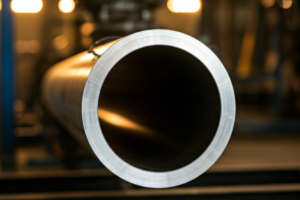
¿Qué es el aluminio 5083-H321?
H321 es el temple de chapa estructural marina del 5083, una aleación Al-Mg no tratable térmicamente formulada con 4,0–4,9% de magnesio, manganeso y cromo. El endurecimiento por deformación, no el tratamiento de precipitación, proporciona la resistencia, y la aleación se encuentra entre las más resistentes y más resistentes al agua de mar de los grados comunes no tratables térmicamente.
Ese nivel de magnesio también hace que el 5083 sea susceptible a la sensibilización — precipitación de fase β en los límites de grano — cuando se mantiene por encima de aproximadamente 65°C, por lo que la resistencia y el comportamiento frente a la corrosión dependen del temple especificado. Para trabajos de casco y estructuras offshore, el temple H321 con calificación marina, en lugar de un temple genérico endurecido por deformación, es la versión que respalda dicha calificación.
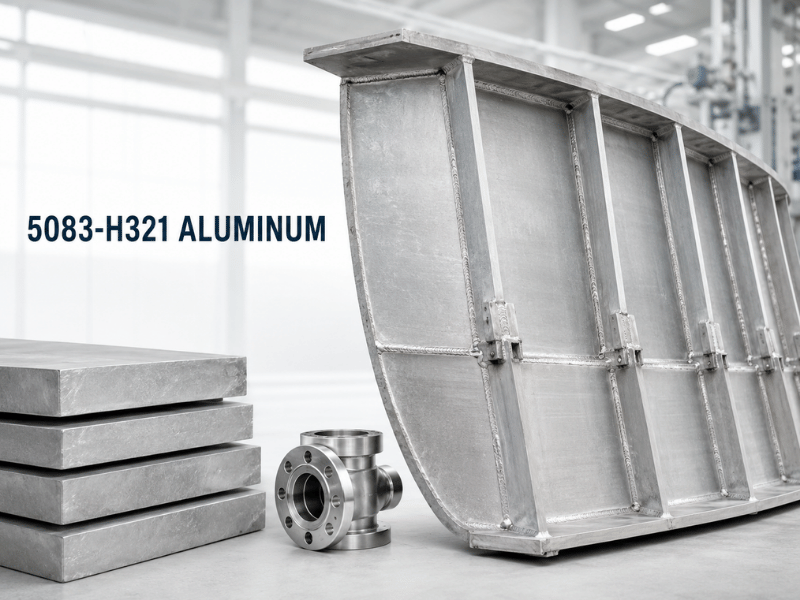
Comprensión del temple H321
H321 significa que la chapa es endurecida por deformación y luego estabilizada mediante un tratamiento a baja temperatura. Para el 5083, H321 es el temple estándar de chapa estructural marina: alcanza aproximadamente la resistencia del nivel H32, pero se produce y ensaya para servicio en agua de mar, con resistencia mejorada a la exfoliación y a la corrosión bajo tensión (SCC) y buena estabilidad dimensional durante la soldadura.
La etapa de estabilización distingue al H321 de un H32 convencional. Mantiene estables las propiedades de endurecimiento por deformación para que la chapa no se ablande a temperatura ambiente durante su vida útil, y sustenta la resistencia del material a la SCC en servicio marino, así como su planitud durante el soldeo y montaje.
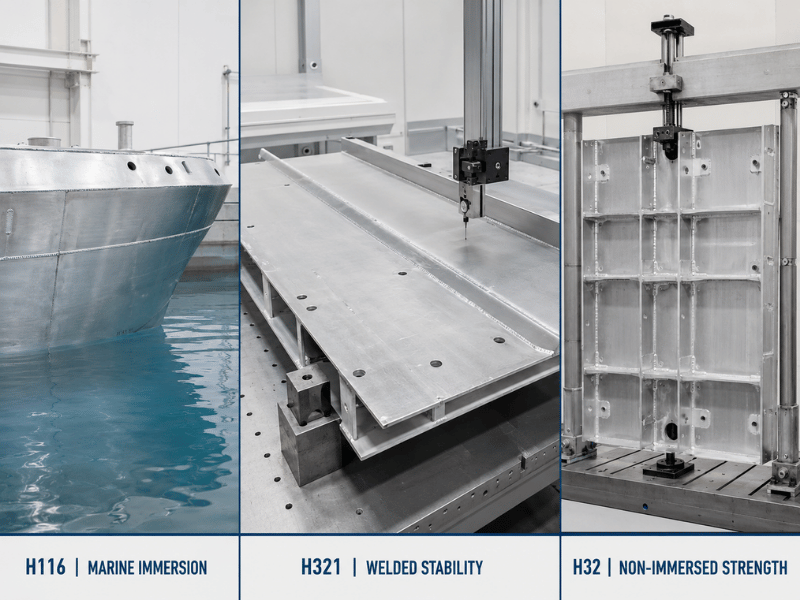
H321 y H116 son los dos temples del 5083 con calificación marina — ambos superan el ensayo de corrosión intergranular ASTM G67 — mientras que H32 y H34 son temples genéricos endurecidos por deformación sin dicha calificación marina de corrosión. Esa calificación, no una diferencia de resistencia, es la razón por la que los astilleros especifican H321 o H116 para el forro de casco sumergido.
Cómo se diferencia el H321 del H32
El H32 se endurece por deformación hasta aproximadamente 1/4 duro y se estabiliza, ofreciendo un límite elástico típico ligeramente superior (aproximadamente 235 MPa) que el H321 (aproximadamente 215–228 MPa), pero el H32 es un temple de chapa de uso general, sin calificación marina. El H321 sacrifica una pequeña cantidad de resistencia a cambio de los ensayos de corrosión marina y la planitud de chapa que requieren las estructuras de casco sumergido. Se selecciona H321 o H116 cuando la pieza se encuentra en contacto continuo con agua de mar; se utiliza H32 o H34 para estructuras no sumergidas donde la mayor resistencia lidera la especificación. Consulte la guía de selección de chapa 5083 para detalles de espesores y temples.
Propiedades mecánicas del 5083-H321
| Propiedad | 5083-H321 (típico) |
|---|---|
| Densidad | 2,66 g/cm³ |
| Resistencia última a la tracción | 317 MPa (46 ksi) |
| Resistencia a la fluencia (0.2% de compensación) | 228 MPa (33 ksi) |
| Elongación a la rotura | 12-16% |
| Módulo de elasticidad | 70 GPa (10,2×10⁶ ksi) |
| Resistencia a la fatiga (5×10⁸ ciclos) | 160 MPa (23 ksi) |
| Resistencia al corte | 190 MPa (28 ksi) |
| Dureza Brinell | 85–89 HB |
| Conductividad térmica | 117 W/m·K |
| Rango de fusión | 570–640°C |
El límite elástico impulsa la mayoría de las selecciones de 5083-H321. Con aproximadamente 215–228 MPa, es el temple 5xxx con calificación marina de mayor límite elástico, por lo que soporta cargas de casco y recipientes a presión con peso moderado — y el mínimo ASTM B209 (215 MPa) sirve como base de diseño, confirmándose el lote real contra su MTC.
Dónde se utiliza el 5083-H321
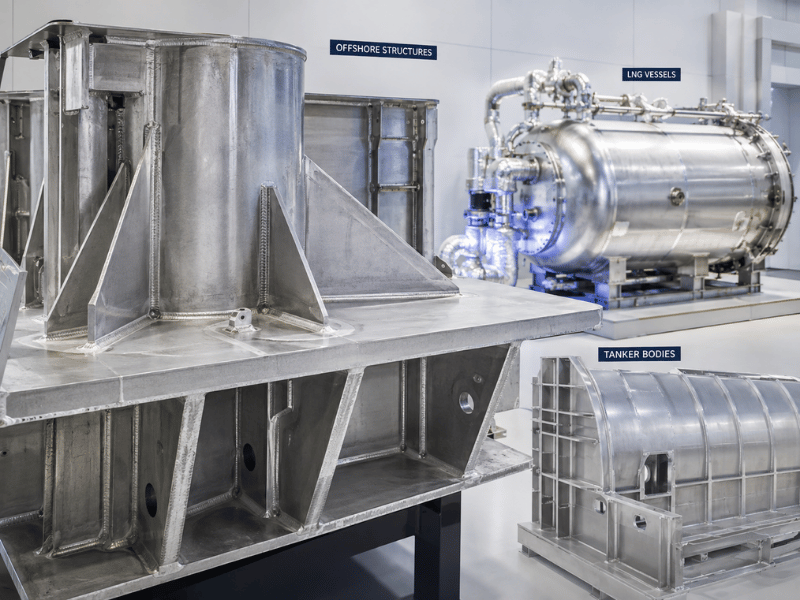
Construcción naval y estructuras offshore
El 5083-H321 es la chapa predeterminada para cascos y superestructuras de buques y plataformas offshore. Su combinación de resistencia, resistencia a la corrosión por agua de mar y resistencia a la SCC lo convierte en el estándar para forros de casco, cubiertas, mamparos y refuerzos en contacto continuo con agua de mar, donde un temple no marino podría implicar riesgo de ataque intergranular. Para una selección más amplia de aleaciones, consulte la guía de selección de aleaciones de grado marino.
Recipientes a presión y servicio criogénico
La aleación mantiene su tenacidad hasta temperaturas criogénicas, por lo que el H321 se utiliza en tanques de GNL, recipientes a presión criogénicos y cuerpos de vagones o camiones cisterna donde la ductilidad a baja temperatura es crítica. Su soldabilidad permite que grandes fabricaciones soldadas mantengan la resistencia a través de la unión, razón por la cual también aparece en equipos químicos y de transporte.
Selección de temple del 5083
| Temple | Tratamiento | Resistencia máxima a la tracción (típica) | Límite elástico (típico) | Calificación marina | Lo mejor para |
|---|---|---|---|---|---|
| O | Recocido, completamente blando | 275 MPa | 125 MPa | No | Conformado profundo, curvados complejos |
| H116 | Endurecido por deformación, ensayado para uso marino | 305 MPa | 215 MPa | Sí (ASTM G67) | Forro de casco sumergido |
| H321 | Endurecido por deformación + estabilizado | 305–317 MPa | 215–228 MPa | Sí (ASTM G67) | Chapa estructural marina, estabilidad dimensional |
| H32 | 1/4 duro + estabilizado | 315 MPa | 235 MPa | No | Estructuras no sumergidas, mayor resistencia |
| H34 | 1/2 duro + estabilizado | 340 MPa | 270 MPa | No | Piezas rígidas planas, máxima resistencia |
Valores típicos según catálogo Linsy / AA; confirmar contra el MTC del lote específico.
Aplicaciones donde encaja el H321
- La pieza está en contacto continuo o casi continuo con agua de mar (forro de casco, cubiertas, offshore) y requiere calificación marina de corrosión además de planitud de chapa.
- La estructura es soldada y debe mantener resistencia y estabilidad dimensional a través de la unión.
Cuándo otro temple se adapta mejor
- H116 — la misma calificación marina con normas ligeramente diferentes de planitud de chapa y suministro; la alternativa habitual para cascos sumergidos.
- H32 / H34 — piezas no sumergidas donde se requiere mayor límite elástico; H34 ofrece la máxima resistencia de la familia para componentes rígidos planos.
- O — la geometría requiere embutición profunda o curvados cerrados que los temple deformados en frío agrietarían.
Procesamiento y fabricación de 5083-H321
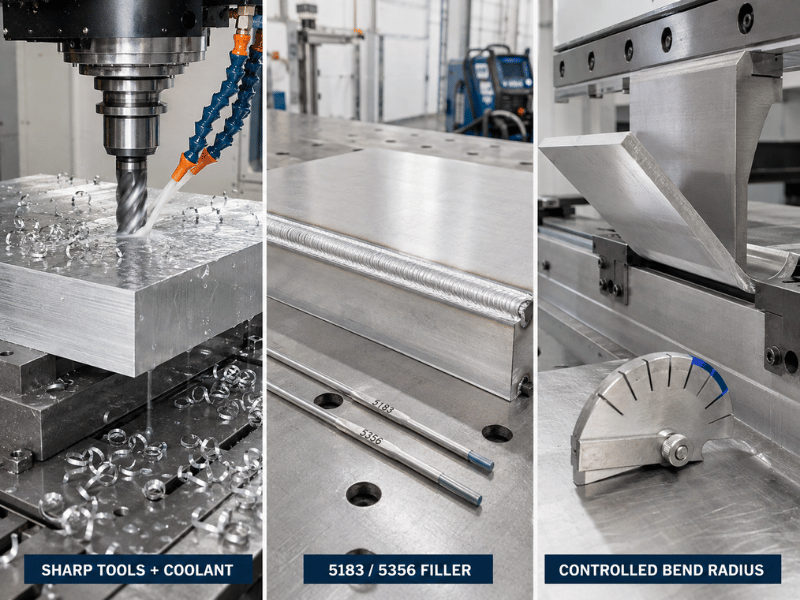
El mecanizado de 5083-H321 es solo regular. La estructura gomosa y endurecida por deformación tiende a acumularse en el filo de corte (filo recrecido — material de la pieza que se adhiere a la herramienta y arruina el acabado), por lo que se requieren insertos afilados, ángulo de ataque positivo y refrigerante, con velocidades moderadas y sin pausas que permitan que la viruta se suelde a la canal.
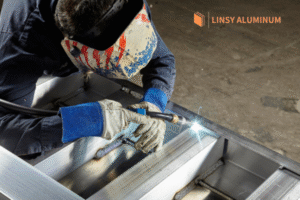
La soldadura es uno de los puntos fuertes de la aleación. Tanto TIG como MIG producen uniones sólidas, con un aporte de la serie 5xxx acorde al nivel de magnesio (5183 o 5356) para evitar la sensibilización. La zona afectada térmicamente (ZAT — la banda junto a la soldadura) pierde parte del endurecimiento por deformación y revierte hacia la condición recocida cerca de la línea de fusión, pero la caída es mucho más leve que en una unión de 6xxx-T6 tratable térmicamente: la soldadura conserva aproximadamente el 80–90 % de la resistencia del metal base.
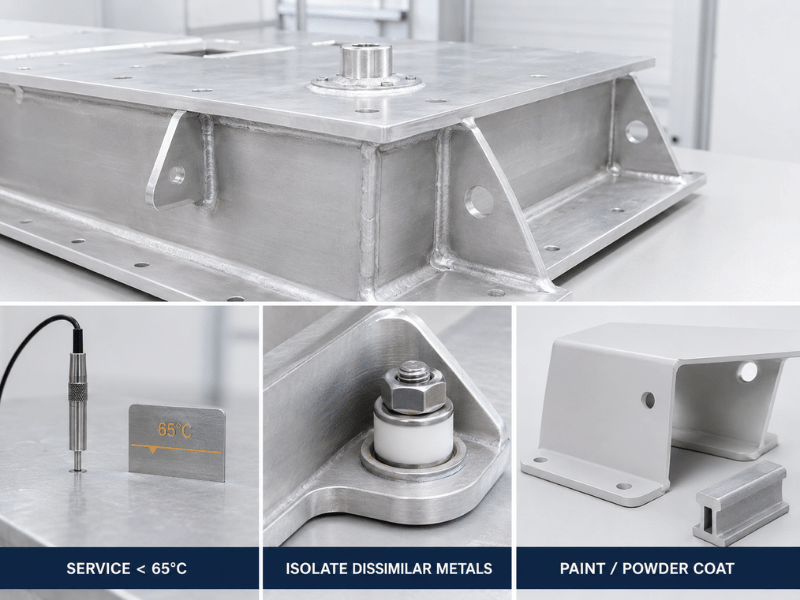
La protección contra la corrosión está en gran medida incorporada, pero se aplican dos limitaciones. El servicio continuo se mantiene por debajo de aproximadamente 65 °C (150 °F) para evitar la sensibilización de la fase β que provoca corrosión intergranular, y cuando el H321 se encuentra en inmersión continua en agua de mar, la calificación marina — no un temple H común — es en lo que se basa la especificación. El contacto con metales más nobles, como el acero inoxidable, se aísla con sellos o recubrimientos para prevenir el ataque galvánico.
La conformabilidad es buena para una placa endurecida por deformación, pero no a nivel de temple O. Los radios mínimos de curvado son mayores que los del material recocido — aproximadamente la misma amplitud de curvado que el H32, mayor que el O — y el mayor límite elástico implica más retorno elástico en las características conformadas. Cuando la pieza se lamina o se curva, la resistencia de la placa estabilizada se tiene en cuenta en la configuración de la prensa.
Ventajas y limitaciones del 5083-H321
| Propiedad | Ventaja | Limitación |
|---|---|---|
| Resistencia (no tratable térmicamente) | Mayor límite elástico de la serie 5xxx con calificación marina (215–228 MPa) | Límite elástico inferior a los grados 6xxx-T6 |
| Corrosión (agua de mar) | Excelente; calificación marina frente a SCC y exfoliación | Se sensibiliza por encima de ~65 °C en servicio continuo |
| Soldabilidad | Excelente; el ablandamiento de la ZAT es mucho más leve que en 6xxx-T6 | La ZAT pierde endurecimiento por deformación cerca de la línea de fusión; unión a ~80–90 % de la resistencia del metal base |
| Formabilidad | Buena para una placa endurecida por deformación | Radios mayores que el O; más retorno elástico |
| Tenacidad criogénica | Conserva la tenacidad hasta temperaturas de GNL | — |
| Mecanizado | — | Solo regular; viruta gomosa, se requieren herramientas afiladas |
| Disponibilidad | Disponible como placa marina, chapa y barra | No es una aleación para anodizado decorativo |
| Coste | Grado marino competitivo | No es un sustituto de bajo costo para el 5052 |
Conclusión
El 5083-H321 combina la mayor resistencia de las aleaciones comunes no tratables térmicamente con resistencia a la corrosión de grado marino y buena soldabilidad — la opción estándar para cascos, estructuras offshore y recipientes a presión criogénicos. Sus limitaciones son claras: el servicio continuo se mantiene por debajo de aproximadamente 65 °C para evitar la sensibilización, y su mecanizado es solo regular, por lo que el soporte downstream adecuado importa tanto como la propia aleación.
Ese equilibrio es fácil de gestionar cuando el proveedor cubre la gama de 5083 marino y el procesamiento asociado: Linsy Aluminum suministra 5083-H321 en placa, chapa y barra, con dimensiones estándar y personalizadas en cantidades mínimas de pedido reducidas, y ofrece mecanizado CNC interno, soldadura TIG y MIG, corte por láser y tratamientos superficiales como anodizado y recubrimiento en polvo; cada pedido se envía con un MTC, los informes de ensayo SGS están disponibles bajo solicitud con costo adicional, y los pedidos personalizados de 5083 suelen tener un plazo de entrega de 10 a 60 días. Para 5083-H321 en una forma, temple o condición mecanizada específica, consulte los productos de aluminio 5083 de Linsy; los planos y especificaciones pueden enviarse a Linsy para una verificación de idoneidad de grado y plazo de entrega.
Preguntas frecuentes
¿Qué hace que el 5083-H321 sea adecuado para uso marino?
Resiste la corrosión del agua de mar y mantiene la tenacidad a bajas temperaturas sin volverse frágil. Como temple con calificación marina (ensayado según ASTM G67 para corrosión intergranular), el H321 resiste la corrosión bajo tensión en inmersión continua en agua de mar — la razón por la que es la opción predeterminada para el chapado de cascos y estructuras offshore.
¿Cómo se compara el 5083-H321 con el H116 y el H32?
El H321 y el H116 son ambos temples de placa 5083 con calificación marina; el H32 es un temple endurecido por deformación de uso general sin el ensayo de corrosión marina, con un límite elástico típico ligeramente superior (aproximadamente 235 MPa frente a 215–228 MPa). El H116 o el H321 se seleccionan para servicio en inmersión en agua de mar; el H32 o el H34 se utilizan para estructuras no sumergidas donde la resistencia es prioritaria.
¿Se puede soldar el 5083-H321, y cómo?
Sí. El H321 se suelda con TIG o MIG utilizando un aporte de la serie 5xxx acorde al nivel de magnesio del metal base — típicamente 5183 o 5356. Dado que el 5083 no es tratable térmicamente, la zona afectada térmicamente no se ablanda como lo haría una unión de 6061-T6, por lo que la resistencia soldada se mantiene cercana a la de la placa madre.
¿Se anodiza bien el 5083-H321?
El 5083-H321 no se utiliza para anodizado decorativo de apariencia. Su alto contenido de magnesio se anodiza con un acabado gris e irregular, en lugar del aspecto decorativo brillante del 6061, por lo que la mayoría de los compradores pintan o aplican recubrimiento en polvo al H321 para obtener color y resistencia a la abrasión, y dependen del óxido nativo para la protección contra la corrosión.
¿Qué límite de temperatura se aplica al servicio del 5083-H321?
El servicio continuo se mantiene por debajo de aproximadamente 65 °C (150 °F). Por encima de ese valor, el alto contenido de magnesio puede precipitar la fase β en los límites de grano y provocar sensibilización — corrosión intergranular y corrosión bajo tensión — por lo que la temperatura de servicio se indica en el diseño.
¿Qué plazo de entrega se aplica a los pedidos personalizados de 5083-H321?
Para tamaños y temples no estándar, la producción personalizada de 5083 suele tardar de 10 a 60 días según la aleación, las dimensiones y el procesamiento. Linsy envía un MTC con cada pedido y puede gestionar informes SGS bajo solicitud.