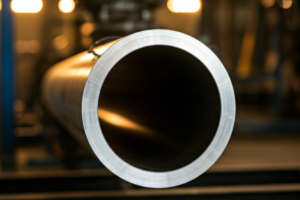
What Is 5083-H321 Aluminum?
H321 is the marine structural plate temper of 5083, a non-heat-treatable Al-Mg alloy built around 4.0–4.9% magnesium with manganese and chromium. Strain hardening, not precipitation treatment, supplies the strength, and the alloy ranks among the strongest and most seawater-resistant of the common non-heat-treatable grades.
That magnesium level also makes 5083 susceptible to sensitization — β-phase precipitation at grain boundaries — when held above about 65°C, so strength and corrosion behavior follow the temper specified. For hull and offshore work, the marine-qualified H321 temper, rather than a general-purpose strain-hardened temper, is the version that carries the qualification behind it.
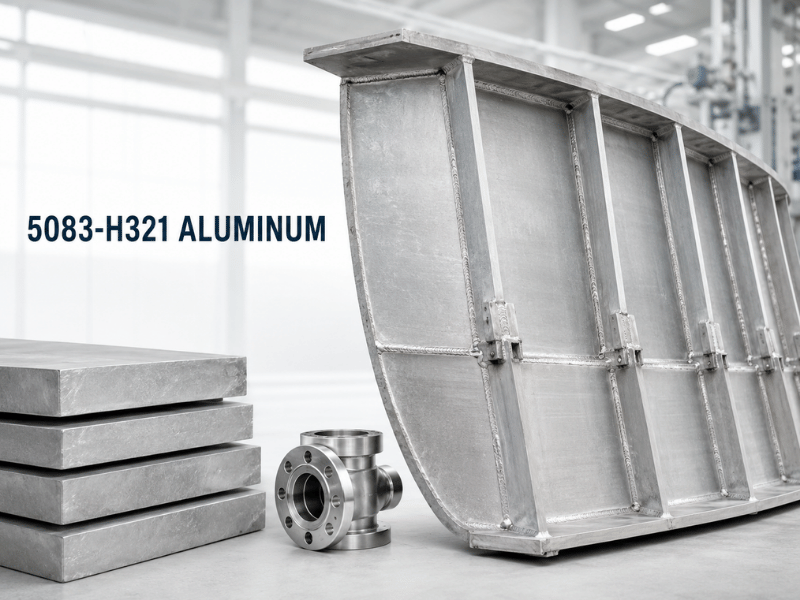
Understanding the H321 Temper
H321 means the plate is strain hardened and then stabilized with a low-temperature treatment. For 5083, H321 is the standard marine structural plate temper: it reaches roughly H32-level strength but is produced and tested for seawater service, with improved resistance to exfoliation and stress-corrosion cracking (SCC) and good dimensional stability through welding.
The stabilization step separates H321 from a plain H32. It holds the strain-hardened properties stable so the plate does not soften at room temperature over service life, and it underpins the plate’s resistance to SCC in marine service and its flatness as it is welded and fitted.
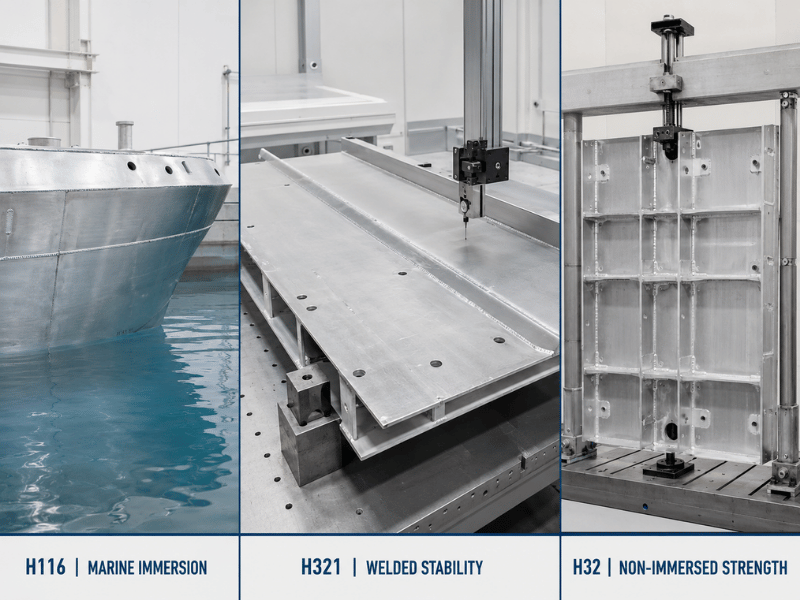
H321 and H116 are the two marine-qualified 5083 tempers — both pass ASTM G67 intergranular-corrosion testing — while H32 and H34 are general-purpose strain-hardened tempers without that marine corrosion qualification. That qualification, not a strength gap, is the reason yards specify H321 or H116 for immersed hull plating.
How H321 Differs from H32
H32 is strain-hardened to about 1/4 hard and stabilized, giving slightly higher typical yield (about 235 MPa) than H321 (about 215–228 MPa), but H32 is a general sheet temper, not marine-qualified. H321 trades a small amount of strength for the marine corrosion testing and plate flatness that immersed hull structures need. H321 or H116 is selected when the part sits in continuous seawater; H32 or H34 is used for non-immersed structures where higher strength leads the spec. See the 5083 plate selection guide for thickness and temper details.
5083-H321 Mechanical Properties
| Property | 5083-H321 (typical) |
|---|---|
| Density | 2.66 g/cm³ |
| Ultimate tensile strength | 317 MPa (46 ksi) |
| Yield strength (0.2% offset) | 228 MPa (33 ksi) |
| Elongation at break | 12–16% |
| Modulus of elasticity | 70 GPa (10.2×10⁶ ksi) |
| Fatigue strength (5×10⁸ cycles) | 160 MPa (23 ksi) |
| Shear strength | 190 MPa (28 ksi) |
| Brinell hardness | 85–89 HB |
| Thermal conductivity | 117 W/m·K |
| Melting range | 570–640°C |
Yield strength drives most 5083-H321 selections. At about 215–228 MPa it is the highest-yield marine-qualified 5xxx temper, so it carries hull and pressure-vessel load at modest weight — and the ASTM B209 minimum (215 MPa) serves as the design floor, with the actual lot confirmed against its MTC.
Where 5083-H321 Is Used
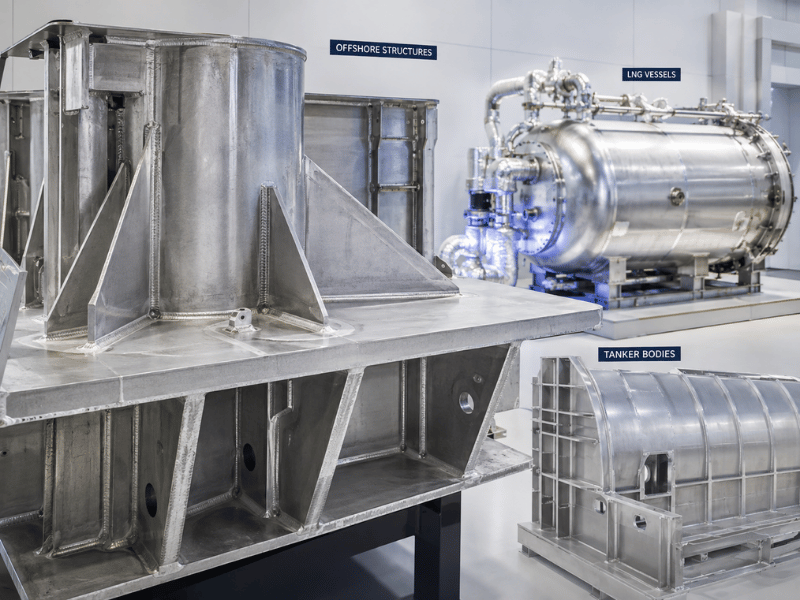
Shipbuilding and Offshore Structures
5083-H321 is the default hull and superstructure plate for vessels and offshore platforms. Its combination of strength, seawater corrosion resistance, and SCC resistance makes it the standard for hull plating, decks, bulkheads, and brackets in continuous seawater contact, where a non-marine temper would risk intergranular attack. For the broader alloy choice, view the marine grade alloy selection guide.
Pressure Vessels and Cryogenic Service
The alloy keeps toughness down to cryogenic temperatures, so H321 is used for LNG tanks, cryogenic pressure vessels, and rail or tanker bodies where low-temperature ductility matters. Its weldability lets large welded fabrications hold strength through the joint, which is why it also appears in chemical and transport equipment.
5083 Temper Selection
| Temper | Treatment | UTS (typical) | Yield (typical) | Marine-qualified | Best for |
|---|---|---|---|---|---|
| O | Annealed, fully soft | 275 MPa | 125 MPa | No | Deep forming, complex bends |
| H116 | Strain-hardened, marine-tested | 305 MPa | 215 MPa | Yes (ASTM G67) | Immersed hull plating |
| H321 | Strain-hardened + stabilized | 305–317 MPa | 215–228 MPa | Yes (ASTM G67) | Marine structural plate, dimensional stability |
| H32 | 1/4 hard + stabilized | 315 MPa | 235 MPa | No | Non-immersed structures, higher strength |
| H34 | 1/2 hard + stabilized | 340 MPa | 270 MPa | No | Flat rigid parts, max strength |
Typical values per Linsy catalog / AA; confirm against the MTC for the specific lot.
Applications Where H321 Fits
- The part is in or near continuous seawater (hull plating, decks, offshore) and needs marine corrosion qualification plus plate flatness.
- The structure is welded and must hold strength and dimensional stability through the joint.
When Another Temper Fits Better
- H116 — the same marine qualification with slightly different plate flatness and supply norms; the usual alternative for immersed hulls.
- H32 / H34 — non-immersed parts where higher yield is required; H34 gives the top strength of the family for flat, rigid components.
- O — the geometry needs deep drawing or tight bends that strain-hardened tempers would crack.
Processing and Fabrication of 5083-H321
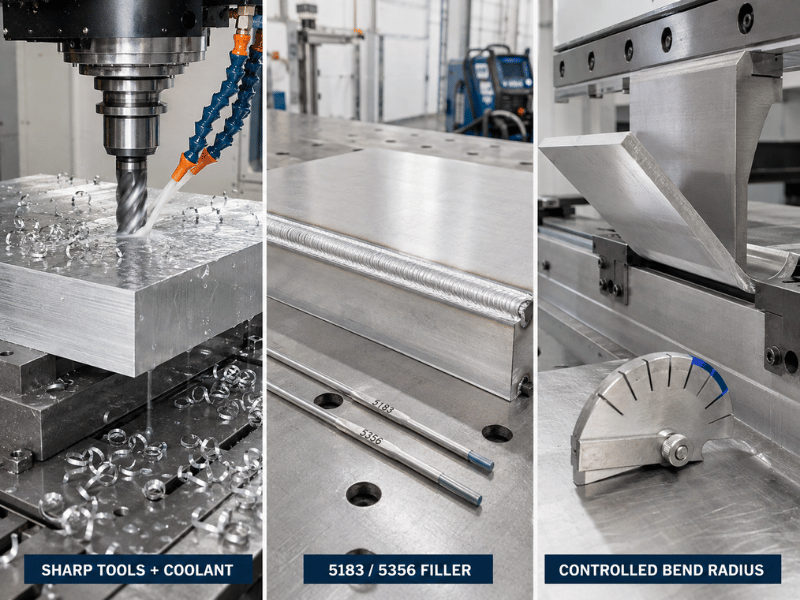
Machining 5083-H321 is only fair. The gummy, work-hardening structure tends to build up on the cutting edge (built-up edge — workpiece material that smears onto the tool and ruins finish), so sharp inserts, positive rake, and coolant are required, with moderate speeds and no dwell that lets the chip weld to the flute.
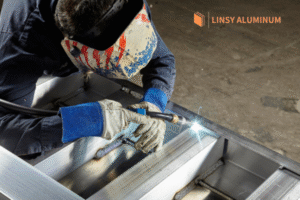
Welding is one of the alloy’s strengths. TIG and MIG both produce sound joints, with a 5xxx filler matched to the magnesium level (5183 or 5356) to avoid sensitization. The heat-affected zone (HAZ — the band beside the weld) does lose some strain hardening and reverts toward the annealed condition near the fusion line, but the drop is far milder than in a heat-treatable 6xxx-T6 joint: the weldment retains roughly 80–90% of base-plate strength.
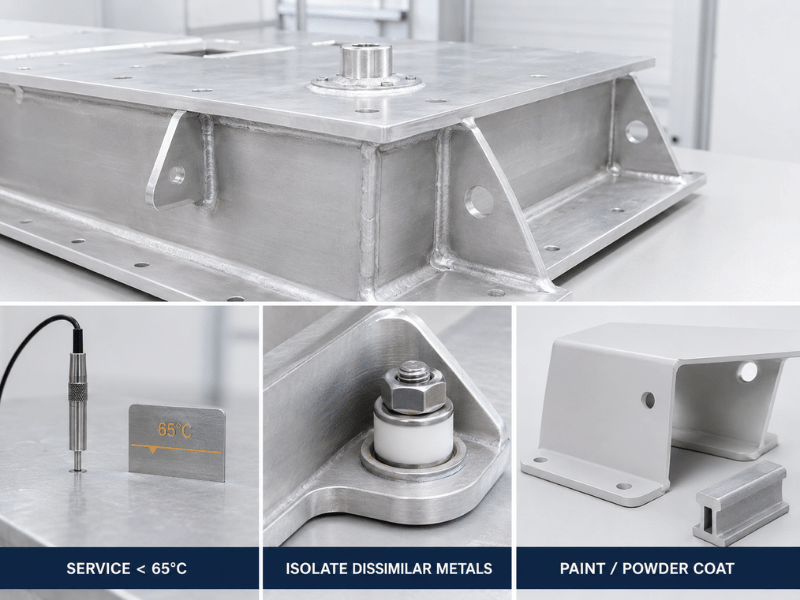
Corrosion protection is largely built in, but two limits apply. Sustained service stays below about 65°C (150°F) to avoid β-phase sensitization that drives intergranular corrosion, and where H321 sits in continuous seawater, the marine qualification — not a plain H temper — is what the specification relies on. Contact with nobler metals such as stainless steel is isolated with seals or coatings to prevent galvanic attack.
Formability is good for a strain-hardened plate but not at the O level. Minimum bend radii are wider than annealed stock — roughly the same bend latitude as H32, larger than O — and the higher yield means more springback on formed features. Where the part is rolled or bent, the stabilized plate’s strength is accounted for in the press setup.
Advantages and Limitations of 5083-H321
| Property | Advantage | Limitation |
|---|---|---|
| Strength (non-heat-treatable) | Highest-yield marine-qualified 5xxx (215–228 MPa) | Yield strength below 6xxx-T6 grades |
| Corrosion (seawater) | Excellent; marine-qualified vs SCC and exfoliation | Sensitizes above ~65°C sustained |
| Weldability | Excellent; HAZ softening far milder than 6xxx-T6 | HAZ loses strain hardening near the fusion line; joint at ~80–90% of base strength |
| Formability | Good for a strain-hardened plate | Wider radii than O; more springback |
| Cryogenic toughness | Retains toughness to LNG temperatures | — |
| Machining | — | Only fair; gummy chip, sharp tools required |
| Availability | Stocked as marine plate, sheet, bar | Not a decorative anodizing alloy |
| Cost | Competitive marine grade | Not a low-cost substitute for 5052 |
Conclusion
5083-H321 pairs the highest strength of the common non-heat-treatable alloys with seawater-grade corrosion resistance and good weldability — the standard choice for hulls, offshore structures, and cryogenic pressure vessels. Its limits are clear: sustained service stays below about 65°C to avoid sensitization, and it machines only fairly, so the right downstream support matters as much as the alloy itself.
That trade is easy to manage when the supplier covers the marine 5083 range and the processing around it: Linsy Aluminum supplies 5083-H321 in plate, sheet, and bar, with both stock and custom dimensions at low minimum order quantities, and provides in-house CNC machining, TIG and MIG welding, laser cutting, and surface treatments such as anodizing and powder coating; every order ships with an MTC, SGS test reports are available on request at extra cost, and custom 5083 orders typically run on a 10–60 day lead time. For 5083-H321 in a specific form, temper, or machined condition, see Linsy’s 5083 aluminum products; drawings and specifications can be sent to Linsy for a grade-fit and lead-time check.
Frequently Asked Questions
What makes 5083-H321 suitable for marine use?
It resists seawater corrosion and keeps toughness at low temperatures without going brittle. As a marine-qualified temper (tested to ASTM G67 for intergranular corrosion), H321 resists stress-corrosion cracking in continuous seawater — the reason it is the default for hull plating and offshore structures.
How does 5083-H321 compare with H116 and H32?
H321 and H116 are both marine-qualified 5083 plate tempers; H32 is a general-purpose strain-hardened temper without the marine corrosion test, with slightly higher typical yield (about 235 MPa vs 215–228 MPa). H116 or H321 is selected for immersed seawater service; H32 or H34 is used for non-immersed structures where strength leads.
Can 5083-H321 be welded, and how?
Yes. H321 is welded with TIG or MIG using a 5xxx filler matched to the base magnesium level — typically 5183 or 5356. Because 5083 is non-heat-treatable, the heat-affected zone does not soften the way a 6061-T6 joint would, so welded strength stays close to the parent plate.
Does 5083-H321 anodize well?
5083-H321 is not used for decorative appearance anodizing. Its high magnesium content anodizes to a gray, uneven finish rather than the bright decorative look of 6061, so most buyers paint or powder-coat H321 for color and abrasion resistance, and rely on the native oxide for corrosion protection.
What temperature limit applies to 5083-H321 service?
Sustained service stays below about 65°C (150°F). Above that, the high magnesium content can precipitate β-phase at grain boundaries and trigger sensitization — intergranular corrosion and stress-corrosion cracking — so the service temperature is stated in the design.
What lead time applies to custom 5083-H321 orders?
For non-stock sizes and tempers, custom 5083 production typically runs 10–60 days depending on alloy, dimensions, and processing. Linsy ships an MTC with every order and can arrange SGS reports on request.