Wat is 1350-aluminium?
1350 is een legering uit de 1xxx-serie met een minimaal aluminiumgehalte van 99,50%, en het is de legering die de Aluminum Association aanduidt als EC-kwaliteit (Electrical Conductor). De legering is niet warmtebehandelbaar — de beperkte sterkte die zij heeft, verkrijgt zij door koudversteviging (strain hardening), niet door oplossingsbehandeling en uitharding zoals bij 6xxx- of 2xxx-legeringen.
Die zuiverheid is het hele punt: ijzer en silicium worden bewust op lage grenzen gehouden om de elektrische geleidbaarheid te beschermen, waardoor 1350 de standaardkeuze is voor draad, busbar en transformatorwikkelingen in plaats van voor structurele onderdelen. De bepalende afweging is maximale geleidbaarheid ten koste van lage sterkte — en die afweging is precies waarom de door u gekozen temper (O voor vervorming, H19 voor sterkte) meer uitmaakt dan welke andere specificatie dan ook.
Chemische samenstelling van 1350-aluminium
1350 wordt vrijwel volledig beheerst door bovengrenzen voor onzuiverheden, omdat het basismetaal al 99,5% aluminium is. IJzer en silicium zijn de twee elementen die de geleidbaarheid het meest schaden, dus hun grenzen zijn strikt.
| Element | Gehalte (max. tenzij anders vermeld) |
|---|---|
| Aluminium (Al) | Minimaal 99,50% (balans) |
| Silicium (Si) | 0.10% |
| IJzer (Fe) | 0.40% |
| Koper (Cu) | 0.05% |
| Mangaan (Mn) | 0.01% |
| Magnesium (Mg) | 0.01% |
| Chroom (Cr) | 0.01% |
| Zink (Zn) | 0.05% |
| Titanium (Ti) | 0.02% |
| Overige (elk / totaal) | 0.03% / 0.10% |
De ijzer-siliciumverhouding is in de praktijk ook van belang: EC-geleiderdraad wordt doorgaans gespecificeerd met Fe + Si zodanig gecontroleerd dat de som laag genoeg blijft om de geleidbaarheid te beschermen. Voor elektrisch gebruik is de bovenstaande samenstellingstabel de acceptatiebasis (ASTM B230 / B233, EN AW-1350, GB 1A35).
Fysische en mechanische eigenschappen van 1350-aluminium
Het enige getal dat 1350 definieert, is de elektrische geleidbaarheid — een gegarandeerd minimum van 61,2% IACS (International Annealed Copper Standard), gewoonlijk gespecificeerd op 61,8% IACS. Dat is de hoogste geleidbaarheid van alle gangbare gewalste aluminiumlegeringen en de reden waarom koper wordt vervangen door 1350 in gewichtsgevoelige geleiders.
| Eigendom | Waarde |
|---|---|
| Dichtheid | 2,70 g/cm³ |
| Smelttraject | 646–657 °C |
| Elektrische geleidbaarheid | ≥ 61,2% IACS (gewoonlijk 61,8% IACS) |
| Thermische geleidbaarheid | ~234 W/(m·K) |
| Elasticiteitsmodulus | ~68,9 GPa |
| Treksterkte, O-temper | 60–100 MPa |
| Treksterkte, H19-temper | 150–200 MPa |
| Vloeigrens, O-temper | 20–50 MPa |
| Vloeigrens, H19-temper | 145–185 MPa |
| Rek, O / H19 | ≥ 20% / ≥ 1,5% |
De geleidbaarheid blijft in essentie constant over de tempers — ongeveer 61,8% IACS in zowel O als H19 — dus het kiezen van H19 voor sterkte kost geen stroomvoerende capaciteit. De bovenstaande mechanische waarden gelden voor draad volgens ASTM B230; plaat en andere vormen schalen volgens dezelfde koudvervormingslogica maar gebruiken vormspecifieke waarden.
Gebruikelijke temperaturen van 1350 aluminium
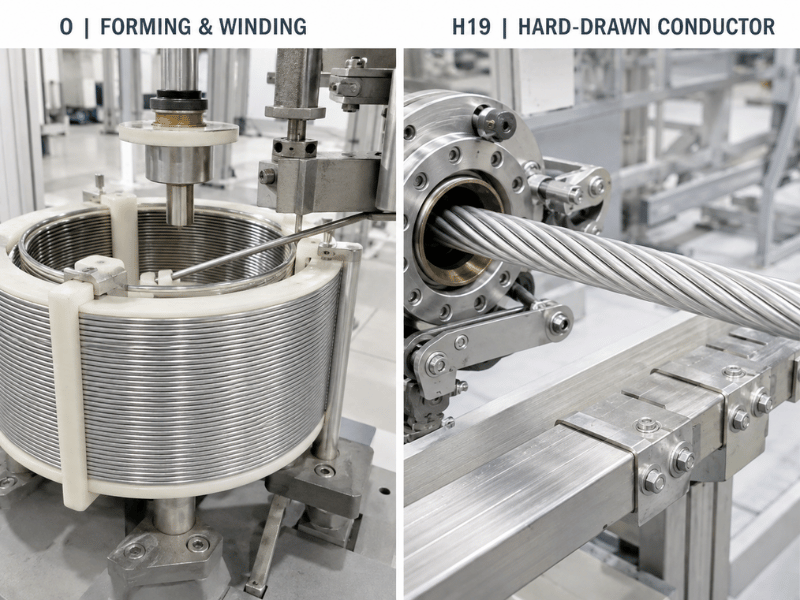
1350 wordt uitsluitend versterkt door koudvervorming (strain hardening), nooit door warmtebehandeling. Uitgaande van de volledig zachte O-toestand past elke H1x-stap meer reductie en gedeeltelijk gloeien toe om de sterkte te verhogen ten koste van de rek.
| Temper | Koudverstevigingsniveau | Typische UTS (MPa) | Geschikt voor |
|---|---|---|---|
| O | Volledig gegloeid, zacht | 60–100 | Trekken, wikkelen, strakke buigingen |
| H12–H18 | Progressieve koudvervorming tussen O en H19 | Stijgt van ~90 naar ~170 over de reeks | Gevormde geleiders die meer stijfheid nodig hebben dan O |
| H19 | Volledig hard (standaard EC-draad) | 150–200 | Bovenleidinggeleiders, busbar, kabelkernen |
H19 is het commerciële werkpaard: het is de temper die wordt gespecificeerd voor hardgetrokken EC-draad in ASTM B230 en voor concentrisch geslagen strenggeleiders (AAC/ACSR) in ASTM B231. Als de toepassing een getrokken draad, strengkabel of busbar betreft, is H19 vrijwel altijd de juiste keuze. O is gereserveerd voor magneetdraad, fijntrekken en flexibele geleiders waar vervormbaarheid overheerst.
Go/No-Go-limieten
Gebruik deze lijst om te bepalen of 1350 past voordat u het specificeert.
Go — gebruik 1350 wanneer:
- Maximale elektrische geleidbaarheid bij minimaal gewicht de prioriteit is — bovenleidingen, busbar en transformator- of motorwikkelingen waar 61,2% IACS meer uitmaakt dan sterkte.
- Het onderdeel niet-structureel is en in vorm wordt gevormd of getrokken — magneetdraad, spoelwikkeling en flexibele geleiders profiteren van de vervormbaarheid van de O-temper.
- Corrosiebestendigheid in gewone atmosferische of licht chemische omstandigheden voldoende is — de zuivere aluminiumoxidefilm beschermt blootgestelde buitengeleiders zonder coating.
- Een kopervvervanging gewenst is vanwege gewicht of kosten, en het ontwerp de lagere geleidbaarheidsverhouding van aluminium ten opzichte van koper kan accepteren (~61% vs 100% IACS).
No-Go — gebruik 1350 niet wanneer:
- Het onderdeel mechanische belasting draagt — 1350-H19 bereikt slechts ongeveer 150–200 MPa treksterkte, ver onder structurele kwaliteiten zoals 6061-T6 (310 MPa) of 6082-T6.
- Hardheid of slijtvastheid een vereiste is — de legering is zacht zelfs bij H19 en zal vreten of krassen bij glijdend contact.
- De bedrijfstemperatuur hoog is en de sterkte behouden moet blijven — zoals alle aluminium verliest 1350 aanzienlijke sterkte boven ongeveer 150 °C, dus het is geen structureel materiaal voor hoge temperaturen.
- Het onderdeel schroefdraad, herhaald buigen onder belasting of bewerkte belastingspaden nodig heeft — de lage vloeigrens en hardheid maken het een slechte structurele keuze.
Waar 1350-aluminium wordt gebruikt
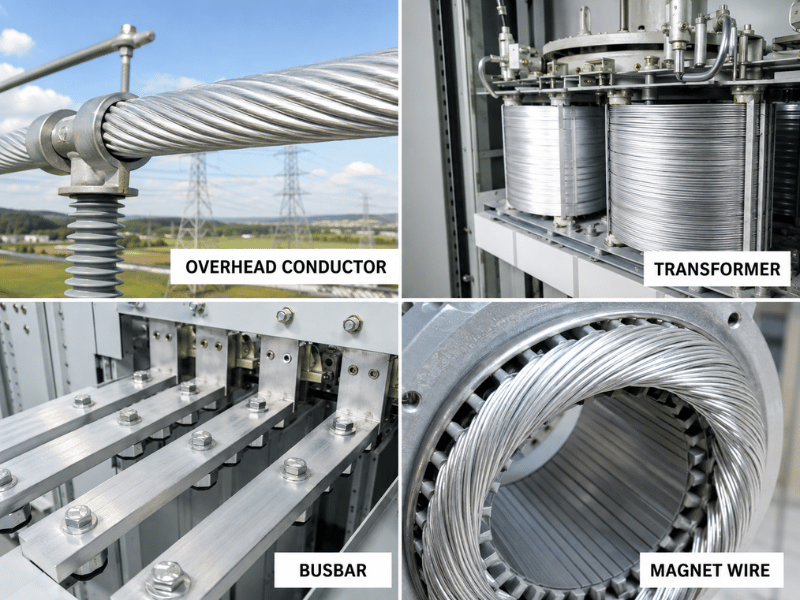
De Go/No-Go-criteria hierboven scheiden “moet ik?” van “waar?”. De onderstaande lijst brengt de systemen in kaart waar 1350 standaardpraktijk is.
Energieoverdracht en -distributie
Bovengrondse geleiders zijn het grootste gebruik: alle-aluminium (AAC) en aluminium geleider staalversterkte (ACSR) lijnen zijn gebouwd uit hard-getrokken 1350-H19 draden omdat ze de meeste stroom per kilogram dragen van alle gangbare bovengrondse geleiderfamilies. Ondergrondse kabelkernen, onderstation buswerk en transformatorwikkelingen gebruiken dezelfde EC-graad geleidbaarheid, met O-temper draad waar flexibiliteit tijdens installatie van belang is.
Magneetdraad, Spoelwikkeling en Busbar
Motoren, generatoren en transformatoren gebruiken 1350-O voor magneetdraad en fijne spoelwikkeling, waar extreme vervormbaarheid en hoogste geleidbaarheid de doorslag geven. Busbar — zowel massief als gestrand — gebruikt H19 voor starre, hoogstroom distributie in schakelapparatuur en vermogenselektronica. Voor EC-grade draadvormen, zie Linsy's 1350-O/H19 aluminium draad.
1350 vs 6061 vs 8000 — Hoe te Kiezen
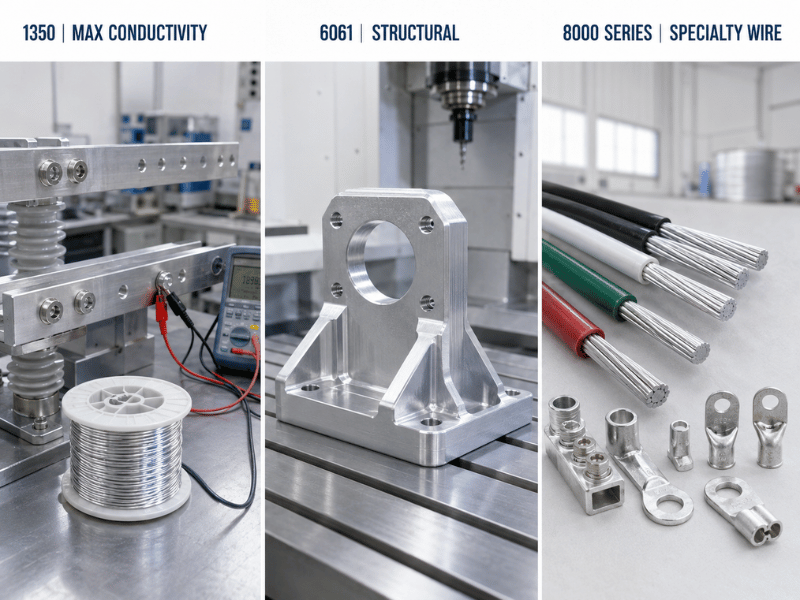
Deze drie zijn geen concurrenten; ze beantwoorden verschillende vragen. 1350 is de geleidbaarheidsgraad, 6061 is de structurele graad, en 8000-serie vervult niche geleiderrollen.
| Eigendom | 1350 (EC-graad) | 6061-T6 | 8000-serie geleidergraden |
|---|---|---|---|
| Primaire rol | Elektrische geleidbaarheid | Structurele sterkte | Speciale geleiders (sommige installatiedraad) |
| Elektrische geleidbaarheid | 61,2% IACS (min) | ~40% IACS | Meestal onder 61,2% IACS |
| Treksterkte | 60–200 MPa (per temper) | 310 MPa | ~100–200 MPa |
| Warmtebehandeling | Nee (alleen koudvervorming) | Ja (T6) | Varieert per graad |
| Corrosiebestendigheid | Hoog (zuiverheid) | Hoog (minder dan 1350) | Goed, afhankelijk van legering |
| Typisch gebruik | Draad, busbar, wikkelingen | Framen, bewerkte onderdelen | Specifieke 8000 geleiderspecificaties |
Kies 1350 wanneer geleidbaarheid per gewicht de beperking is. Kies 6061-T6 wanneer het onderdeel belasting moet dragen en lassen of bewerken betrokken is. Overweeg een 8000-serie graad (bijvoorbeeld 8176 of 8130 installatiedraad) alleen wanneer een specifieke norm of legeringsvoordeel — niet hogere geleidbaarheid — de specificatie bepaalt; 1350 blijft voorop lopen op pure IACS-prestatie. Voor het structurele alternatief, zie de 6061 aluminium legering pagina.
Werken met 1350 Aluminium
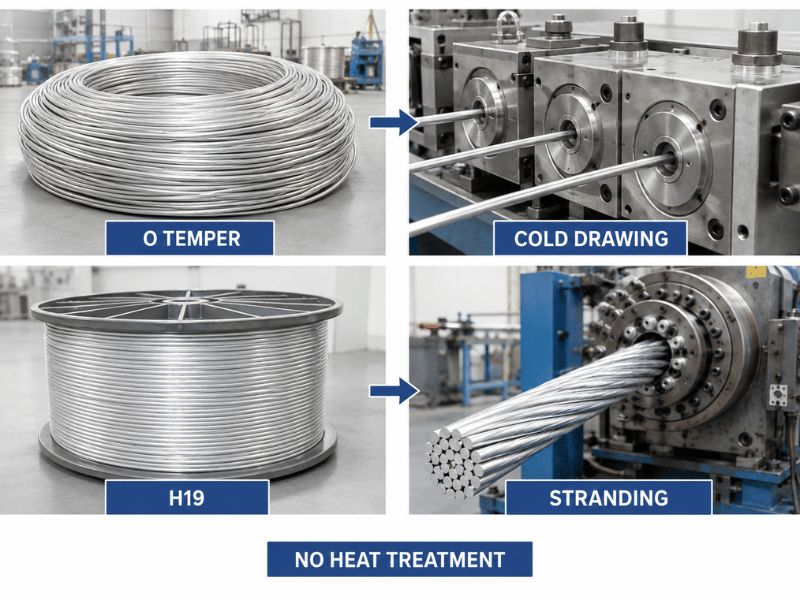
Vormen en trekken: In de O-temper is 1350 extreem vervormbaar — het trekt, buigt en wikkelt zonder problemen, wat de reden is dat het de standaard is voor magneetdraad en fijne geleiders. H19 verliest het grootste deel van die ductiliteit (rek daalt tot ongeveer 1,5%), dus vorm het vóór de uiteindelijke verharding of gebruik het as-drawn.
Lassen en verbinden: 1350 laat zich goed weerstandslassen (gebruikt voor geleiderverbindingen) en kan worden verbonden door MIG/TIG met geschikt toevoegmateriaal, hoewel lassen ongebruikelijk is in standaard geleiderproductie. Merk op dat lassen de legering niet warmtebehandelt — er is geen T-temper om te herstellen.
Corrosiebescherming: De hoge zuiverheid geeft 1350 uitstekende atmosferische corrosieweerstand door zijn natuurlijke oxidefilm, dus de meeste buitengeleider-toepassingen hebben geen coating nodig. In chloride- of industriële omgevingen geldt dezelfde anodisering, verf of omhulling als bij andere aluminiumgraden.
Geen warmtebehandeling: Omdat 1350 niet warmtebehandelbaar is, komt sterkte alleen van koudvervorming. Elke gloeistap brengt het terug naar O-temper; het herstellen van H19 vereist hertrekken, niet ovenbehandeling. Plan de fabricageroute rond de uiteindelijke temper.
Voor- en nadelen in één oogopslag
| Afmeting | Sterkte | Beperking |
|---|---|---|
| Elektrische geleidbaarheid | Hoogste van alle gangbare aluminiumlegeringen (≥61,2% IACS) | Nog steeds ~61% van koper — geen kopervervanging waar ruimte vast is |
| Gewicht | ~1/3 het gewicht van koper voor gelijke stroom | Lage sterkte beperkt structureel gebruik |
| Vervormbaarheid (O) | Uitstekend voor trekken en wikkelen | H19 is bros bij strakke bochten |
| Corrosiebestendigheid | Hoog door zuiverheid, geen coating nodig buiten | Zacht oppervlak galt onder glijdende slijtage |
| Kosten | Goedkoper en lichter dan koperen geleiders | Lage mechanische eigenschappen beperken toepassingen |
| Beschikbaarheid | Standaard EC-graad, brede molenaanvoer | Geen voorraad structureel profielgraad |
Conclusie
1350 aluminium levert de hoogste geleidbaarheid van alle gangbare gewalste aluminiumlegeringen — een gegarandeerd minimum van 61,2% IACS — maar de afweging is lage sterkte en hardheid die het uitsluit voor dragende onderdelen. Dat maakt het de juiste keuze voor geleiders, busbar en wikkelingen, en de verkeerde keuze voor alles wat structureel is.
Linsy Aluminum, een in Shenzhen gevestigde fabriek met meer dan 20 jaar ervaring, levert 1350 in draad, busbar, plaat en spoel across de 1000–8000 serie, inclusief 1350-O en 1350-H19 ec draad, met volledige MTC-documentatie per bestelling en SGS-testrapporten op aanvraag; typische aangepaste doorlooptijd bedraagt 10–60 dagen met lage-MOQ ondersteuning voor niet-voorraad maten. Wanneer de specificatie EC-grade 1350 vereist, stuur de tekening of geleiderspecificatie voor een graad-en-temper beoordeling.
Veelgestelde vragen
Wat is het verschil tussen 1350-O en 1350-H19?
1350-O is volledig gegloeid en zacht, met een rek van 20% of meer — het beste voor trekken, wikkelen en strakke buigingen. 1350-H19 is volledig hard koudverstevigd tot een treksterkte van 150–200 MPa, de standaardtemper voor overheadleidingen en busbars waar sterkte belangrijker is dan vervormbaarheid. De geleidbaarheid is in beide gevallen hetzelfde (~61,8% IACS).
Is 1350 aluminium geschikt voor constructieve toepassingen?
Nee. Zelfs bij H19 bereikt 1350 slechts ongeveer 150–200 MPa treksterkte, ver onder structurele kwaliteiten zoals 6061-T6 (310 MPa). Het is een geleiderkwaliteit, geen structurele kwaliteit, en moet beperkt blijven tot niet-dragende elektrische toepassingen.
Wat is het verschil tussen 1350 en 1370 aluminium?
Beide zijn EC-kwaliteit zuivere legeringen, maar 1370 heeft een hogere minimale zuiverheid van 99,70% aluminium tegenover 99,50% voor 1350, wat een iets betere geleidbaarheid geeft. Beide dienen als elektrische geleiders; 1370 wordt gespecificeerd wanneer de toepassing de hogere zuiverheidsgraad vereist.
Kan 1350-aluminium warmtebehandeld worden om de sterkte te verhogen?
Nee. 1350 is geen warmtebehandelbare legering — het verkrijgt sterkte alleen door koudversteviging (de H1x-tempers). Gloeien brengt het terug naar O, en het herstellen van H19 vereist opnieuw trekken, niet een ovencyclus.
Wat is het verschil tussen 1350- en 1050-aluminium?
Beide zijn zuivere legeringen met minimaal 99,5%, maar 1350 is afgestemd op elektrisch gebruik met laag gehouden ijzer- en siliciumgehalten om de geleidbaarheid te beschermen, terwijl 1050 een algemene zuivere kwaliteit is. Kies 1350 wanneer elektrische prestaties prioriteit hebben en 1050 voor algemeen vormen en fabricage.