O que é o alumínio 1350?
O 1350 é uma liga da série 1xxx com um teor mínimo de alumínio de 99,50%, e é a liga que a Aluminum Association designa como grau EC (Electrical Conductor). Não é tratável termicamente — obtém a pouca resistência que possui através do encruamento a frio, e não através de tratamento de solubilização e envelhecimento como as ligas 6xxx ou 2xxx.
Essa pureza é o ponto central: o ferro e o silício são mantidos em limites baixos especificamente para proteger a condutividade elétrica, o que faz do 1350 a escolha padrão para fios, barras coletoras e enrolamentos de transformadores, em vez de peças estruturais. O trade-off definidor é a condutividade máxima ao custo de baixa resistência — e esse trade-off é exatamente a razão pela qual o temperamento que você escolhe (O para conformação, H19 para resistência) importa mais do que qualquer outra especificação.
Composição química do alumínio 1350
O 1350 é controlado quase inteiramente por limites máximos de impurezas, porque o metal base já é 99,5% alumínio. O ferro e o silício são os dois elementos mais prejudiciais à condutividade, portanto seus limites são rigorosos.
| Elemento | Teor (máx., salvo indicação em contrário) |
|---|---|
| Alumínio (Al) | 99,50% mínimo (balanço) |
| Silício (Si) | 0.10% |
| Ferro (Fe) | 0.40% |
| Cobre (Cu) | 0.05% |
| Manganês (Mn) | 0.01% |
| Magnésio (Mg) | 0.01% |
| Cromo (Cr) | 0.01% |
| Zinco (Zn) | 0.05% |
| Titânio (Ti) | 0.02% |
| Outros (cada / total) | 0.03% / 0.10% |
A relação ferro-silício também importa na prática: o fio condutor de grau EC é tipicamente especificado com Fe + Si controlados de modo que a soma permaneça baixa o suficiente para proteger a condutividade. Para uso elétrico, a tabela de composição acima é a base de aceitação (ASTM B230 / B233, EN AW-1350, GB 1A35).
Propriedades físicas e mecânicas do alumínio 1350
O número único que define o 1350 é sua condutividade elétrica — um mínimo garantido de 61,2% IACS (International Annealed Copper Standard), comumente especificado em 61,8% IACS. Essa é a maior condutividade de qualquer liga de alumínio trabalhável convencional e a razão pela qual o cobre é substituído pelo 1350 em condutores sensíveis ao peso.
| Propriedade | Valor |
|---|---|
| Densidade | 2,70 g/cm³ |
| Faixa de fusão | 646–657 °C |
| Condutividade elétrica | ≥ 61,2% IACS (comumente 61,8% IACS) |
| Condutividade térmica | ~234 W/(m·K) |
| Módulo de elasticidade | ~68,9 GPa |
| Resistência à tração, tempera O | 60–100 MPa |
| Resistência à tração, temperamento H19 | 150–200 MPa |
| Limite de escoamento, temperamento O | 20–50 MPa |
| Limite de escoamento, temperamento H19 | 145–185 MPa |
| Alongamento, O / H19 | ≥ 20% / ≥ 1,5% |
A condutividade permanece essencialmente constante entre os temperamentos — cerca de 61,8% IACS tanto em O quanto em H19 — portanto, selecionar H19 por resistência não custa capacidade de condução de corrente. Os números mecânicos acima são para fio conforme ASTM B230; chapas e outras formas escalam com a mesma lógica de trabalho a frio, mas usam valores específicos de forma.
Temperaturas comuns do alumínio 1350
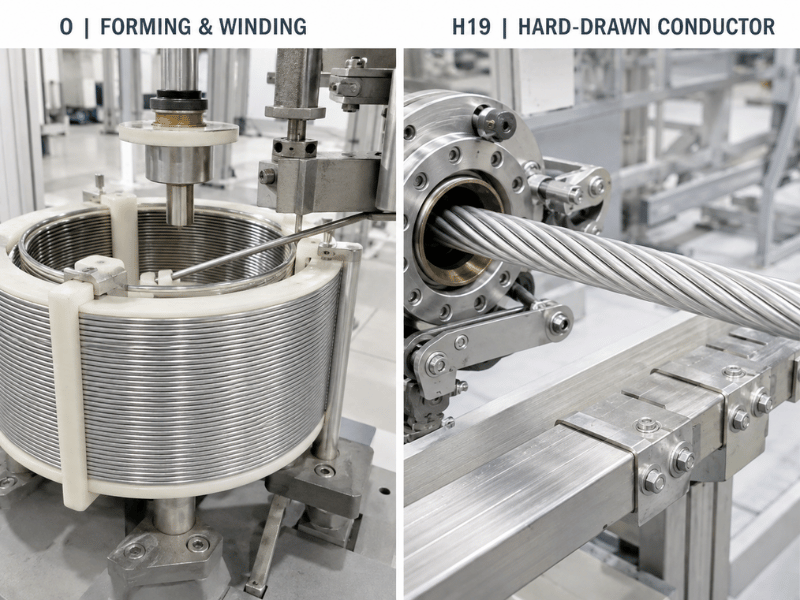
O 1350 é endurecido apenas por trabalho a frio (encruamento), nunca por tratamento térmico. Partindo da condição O totalmente mole, cada etapa H1x aplica mais redução e recozimento parcial para aumentar a resistência ao custo do alongamento.
| Temperamento | Nível de encruamento | UTS típico (MPa) | Melhor para |
|---|---|---|---|
| O | Totalmente recozido, mole | 60–100 | Trefilação, enrolamento, dobras apertadas |
| H12–H18 | Trabalho a frio progressivo entre O e H19 | Sobe de ~90 em direção a ~170 ao longo da escala | Condutores conformados que necessitam de mais rigidez que o O |
| H19 | Totalmente duro (fio EC padrão) | 150–200 | Condutores aéreos, barras coletoras, núcleos de cabos |
O H19 é o cavalo de batalha comercial: é o temperamento especificado para fio EC trefilado a duro na ASTM B230 e para condutores encordoados em camadas concêntricas (AAC/ACSR) na ASTM B231. Se a aplicação é fio trefilado, cabo encordoado ou barra coletora, o H19 é quase sempre a escolha. O O é reservado para fio de magneto, trefilação fina e condutores flexíveis onde a conformabilidade domina.
Limites de Aprovação/Reprovação
Use esta lista para decidir se o 1350 se encaixa antes de especificá-lo.
Use — utilize o 1350 quando:
- A máxima condutividade elétrica com peso mínimo é a prioridade — linhas aéreas, barras coletoras e enrolamentos de transformadores ou motores onde 61,2% IACS importa mais do que a resistência.
- A peça é não estrutural e conformada ou trefilada — fio de magneto, enrolamento de bobinas e condutores flexíveis aproveitam a conformabilidade do temperamento O.
- A resistência à corrosão em serviço atmosférico comum ou levemente químico é suficiente — o filme de óxido de alumínio puro protege condutores externos expostos sem revestimento.
- Deseja-se substituir o cobre por peso ou custo, e o projeto pode aceitar a menor relação condutividade-cobre do alumínio (~61% vs 100% IACS).
Não use — não utilize o 1350 quando:
- O componente suporta carga mecânica — o 1350-H19 atinge apenas cerca de 150–200 MPa de tração, muito abaixo de graus estruturais como 6061-T6 (310 MPa) ou 6082-T6.
- Dureza ou resistência ao desgaste é um requisito — a liga é mole mesmo em H19 e sofrerá galgamento ou riscos sob contato deslizante.
- A temperatura de serviço é elevada e a resistência deve se manter — como todo alumínio, o 1350 perde resistência notável acima de aproximadamente 150 °C, portanto não é um material estrutural para altas temperaturas.
- A peça necessita de roscamento, flexão repetida sob carga ou caminhos de carga usinados — seu baixo limite de escoamento e dureza o tornam uma escolha estrutural ruim.
Onde o alumínio 1350 é utilizado
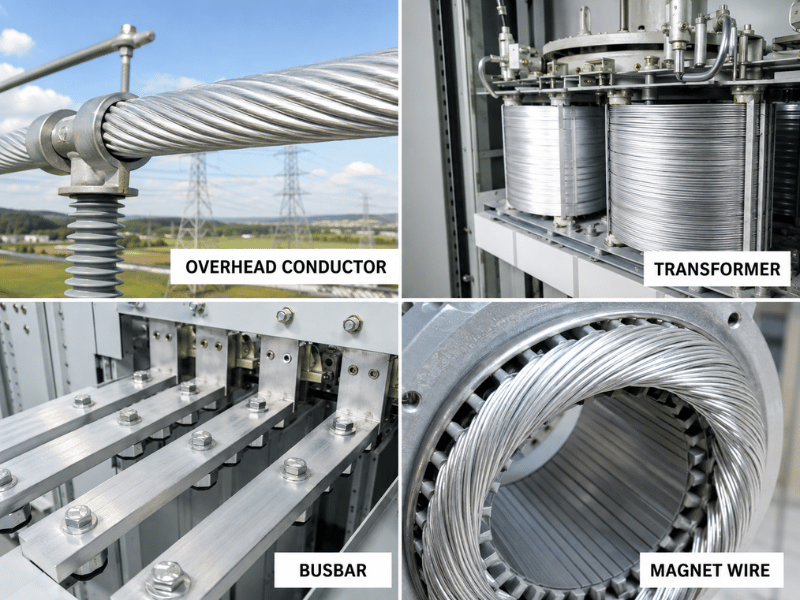
Os critérios de Use/Não use acima separam “devo?” de “onde?”. A lista abaixo mapeia os sistemas onde o 1350 é prática padrão.
Transmissão e distribuição de energia
Condutores aéreos são o maior uso: linhas totalmente de alumínio (AAC) e de alumínio com reforço de aço (ACSR) são construídas com fios 1350-H19 trefilados a duro porque transportam mais corrente por quilograma do que qualquer família comum de condutores aéreos. Núcleos de cabos subterrâneos, barramentos de subestações e enrolamentos de transformadores usam a mesma condutividade de grau EC, com fio de temperamento O onde a flexibilidade durante a instalação importa.
Fio de magneto, enrolamento de bobinas e barras coletoras
Motores, geradores e transformadores usam 1350-O para fio magnético e enrolamento fino de bobinas, onde a conformabilidade extrema e a mais alta condutividade prevalecem. Barramento — tanto maciço quanto encordoado — usa H19 para distribuição rígida de alta corrente em painéis de comutação e eletrônica de potência. Para formas de fio de grau EC, consulte o fio de alumínio 1350-O/H19 da Linsy.
1350 vs 6061 vs 8000 — Como Escolher
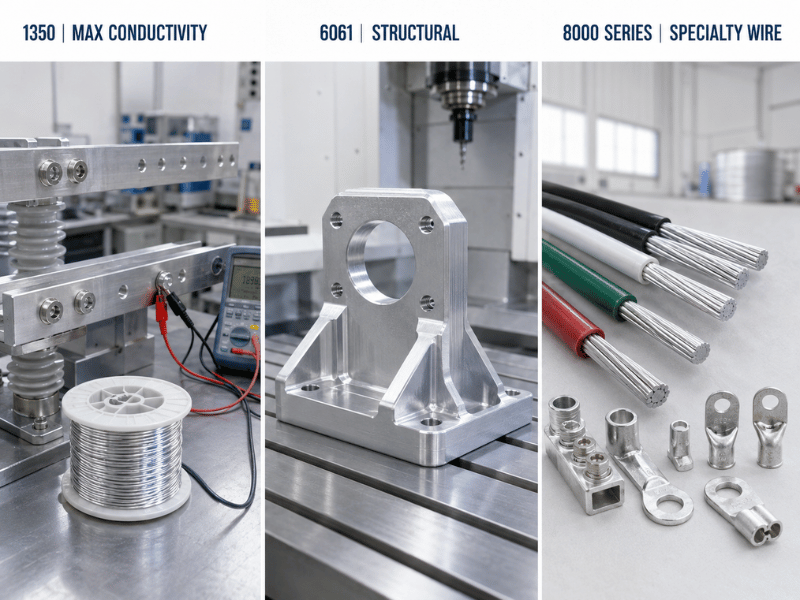
Estes três não são concorrentes; eles respondem a perguntas diferentes. 1350 é o grau de condutividade, 6061 é o grau estrutural, e a série 8000 preenche papéis de condutores de nicho.
| Propriedade | 1350 (grau EC) | 6061-T6 | Graus de condutores da série 8000 |
|---|---|---|---|
| Função principal | Condutividade elétrica | Resistência estrutural | Condutores especiais (alguns fios de construção civil) |
| Condutividade elétrica | 61,2% IACS (mín.) | ~40% IACS | Tipicamente abaixo de 61,2% IACS |
| Resistência à tração | 60–200 MPa (por têmpera) | 310 MPa | ~100–200 MPa |
| Tratamento térmico | Não (apenas encruamento a frio) | Sim (T6) | Varia por grau |
| Resistência à corrosão | Alta (pureza) | Alta (menor que 1350) | Boa, dependente da liga |
| Uso típico | Fio, barramento, enrolamentos | Estruturas, peças usinadas | Especificações específicas de condutores da série 8000 |
Escolha 1350 quando a condutividade por peso for a restrição. Escolha 6061-T6 quando a peça precisar suportar carga e envolver soldagem ou usinagem. Considere um grau da série 8000 (por exemplo, 8176 ou 8130 para fio de construção civil) apenas quando uma norma específica ou benefício de liga — não maior condutividade — orientar a especificação; 1350 ainda lidera em desempenho puro de IACS. Para a alternativa estrutural, consulte a página da liga de alumínio 6061.
Trabalhando com Alumínio 1350
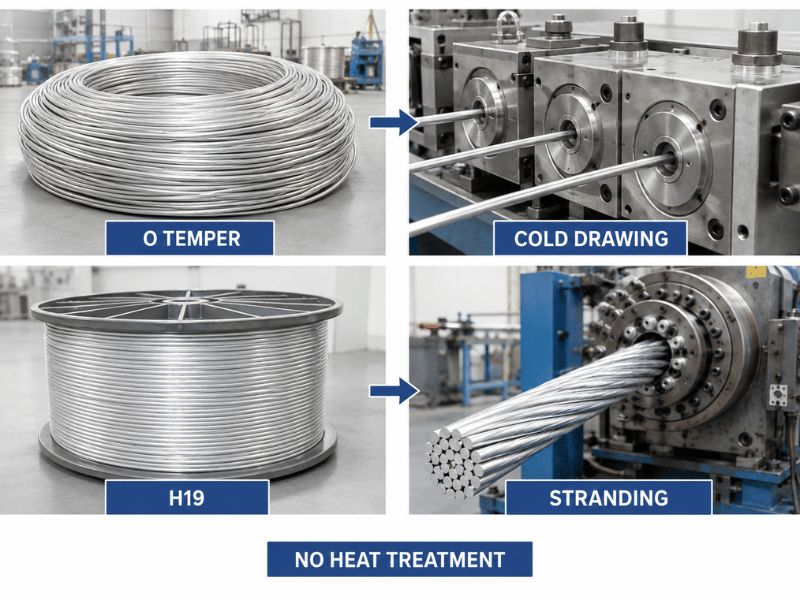
Conformação e trefilação: Na têmpera O, o 1350 é extremamente conformável — ele trefila, dobra e enrola sem dificuldade, razão pela qual é o padrão para fio magnético e condutores finos. O H19 perde a maior parte dessa ductilidade (o alongamento cai para cerca de 1,5%), portanto, conforme antes do endurecimento final ou use como trefilado.
Soldagem e junção: O 1350 solda bem por métodos de resistência (usado para emenda de condutores) e pode ser unido por MIG/TIG com material de adição apropriado, embora a soldagem seja incomum na fabricação padrão de condutores. Observe que a soldagem não trata termicamente a liga — não há têmpera T para restaurar.
Proteção contra corrosão: A alta pureza confere ao 1350 excelente resistência à corrosão atmosférica através de seu filme de óxido natural, de modo que a maioria dos usos de condutores ao ar livre não necessita de revestimento. Em ambientes com cloretos ou industriais, aplicam-se a mesma anodização, pintura ou encapamento usados em outros graus de alumínio.
Sem tratamento térmico: Como o 1350 não é tratável termicamente, a resistência vem apenas do encruamento a frio. Qualquer etapa de recozimento o retorna em direção à têmpera O; restaurar o H19 requer nova trefilação, não tratamento em forno. Planeje a rota de fabricação em torno da têmpera final.
Vantagens e Limitações em Resumo
| Dimensão | Força | Limitação |
|---|---|---|
| Condutividade elétrica | A mais alta de qualquer liga de alumínio comum (≥61,2% IACS) | Ainda ~61% do cobre — não é um substituto do cobre onde o espaço é fixo |
| Peso | ~1/3 do peso do cobre para corrente igual | Baixa resistência limita uso estrutural |
| Conformabilidade (O) | Excelente para trefilação e enrolamento | H19 é frágil em dobras apertadas |
| Resistência à corrosão | Alta devido à pureza, sem necessidade de revestimento ao ar livre | Superfície macia sofre desgaste por atrito deslizante |
| Custo | Mais barato e leve que condutores de cobre | Propriedades mecânicas baixas restringem aplicações |
| Disponibilidade | Grau EC padrão, ampla oferta de laminadores | Não é um grau de seção estrutural de estoque |
Conclusão
O alumínio 1350 oferece a mais alta condutividade de qualquer liga de alumínio trabalhada convencional — um mínimo garantido de 61,2% IACS — mas seu trade-off é a baixa resistência e dureza que o excluem para peças estruturais. Isso o torna a escolha certa para condutores, barramentos e enrolamentos, e a escolha errada para qualquer coisa estrutural.
A Linsy Aluminum, uma fábrica sediada em Shenzhen com mais de 20 anos de experiência, fornece 1350 em fio, barramento, chapa e bobina em toda a série 1000–8000, incluindo fio EC 1350-O e 1350-H19, com documentação MTC completa por pedido e relatórios de teste SGS disponíveis sob solicitação; o prazo típico de personalização varia de 10 a 60 dias com suporte a MOQ baixo para tamanhos fora de estoque. Quando a especificação exigir 1350 de grau EC, envie o desenho ou a especificação do condutor para uma revisão de grau e têmpera.
Perguntas frequentes
Qual é a diferença entre 1350-O e 1350-H19?
O 1350-O é totalmente recozido e macio, com alongamento de 20% ou mais — melhor para trefilação, enrolamento e dobras apertadas. O 1350-H19 é totalmente endurecido por encruamento até 150–200 MPa de resistência à tração, a têmpera padrão para condutores aéreos e barramentos onde a resistência importa mais que a conformabilidade. A condutividade é a mesma (~61,8% IACS) em ambos.
O alumínio 1350 é adequado para aplicações estruturais?
Não. Mesmo no H19, o 1350 atinge apenas cerca de 150–200 MPa de resistência à tração, muito abaixo de graus estruturais como o 6061-T6 (310 MPa). É um grau de condutor, não um grau estrutural, e deve ser limitado a usos elétricos sem suporte de carga.
Qual é a diferença entre o alumínio 1350 e o 1370?
Ambos são ligas puras de grau EC, mas o 1370 tem uma pureza mínima mais alta de 99,70% de alumínio versus 99,50% do 1350, proporcionando condutividade ligeiramente melhor. Ambos servem como condutores elétricos; o 1370 é especificado quando a aplicação exige o grau de pureza mais elevado.
O alumínio 1350 pode ser tratado termicamente para aumentar a resistência?
Não. O 1350 não é uma liga tratável termicamente — ele ganha resistência apenas por encruamento a frio (os temperamentos H1x). O recozimento o retorna em direção ao O, e restaurar o H19 requer trefilação, não um ciclo de forno.
Qual é a diferença entre o alumínio 1350 e o 1050?
Ambos são ligas puras com mínimo de 99,5%, mas o 1350 é ajustado para uso elétrico com ferro e silício mantidos em teores baixos para proteger a condutividade, enquanto o 1050 é um grau puro de uso geral. Escolha o 1350 quando o desempenho elétrico for a prioridade e o 1050 para conformação e fabricação em geral.