什么是5754铝?
5754 is a non-heat-treatable wrought aluminium-magnesium alloy, with magnesium (2.6–3.6%) as the principal alloying element and manganese plus chromium as controlled minor additions. It is an EN-standard alloy first and a global one second — registered as UNS A95754, but far more deeply embedded in European supply chains than in North American stock.
Its strength comes from solid-solution strengthening by magnesium plus strain hardening from cold work. There is no precipitation-hardening response, so no T6 equivalent exists; the temper is the only lever. Within the 5xxx family, 5754 is stronger than 5251, stronger than 5052 in the annealed condition, and below 5083 in absolute strength but easier to form and less expensive.
Chemical Composition of 5754
| 要素 | Content (wt%, max unless noted) | 在合金中的作用 |
|---|---|---|
| 镁(Mg) | 2.6 – 3.6 | Primary strengthener; drives work-hardening response and corrosion behaviour |
| 锰 (Mn) | 0.50 | Strengthens the matrix, controls grain size during recrystallisation |
| 铬 (Cr) | 0.30 | Forms fine dispersoids that limit grain growth |
| Mn + Cr (combined) | 0.10 – 0.60 | Combined limit — the range that keeps the alloy’s structure stable |
| 铁(Fe) | 0.40 | Impurity; forms cathodic intermetallics that can initiate pitting |
| 硅 (Si) | 0.40 | Impurity; combines with iron and affects the anodized appearance |
| 锌 (Zn) | 0.20 | Impurity, tightly limited |
| 铜 (Cu) | 0.10 | Strictly limited — copper reduces general corrosion resistance |
| 钛 (Ti) | 0.15 | Grain refiner added at cast |
| 其他元素(每种 / 总计) | 0.05 / 0.15 | Trace elements controlled for batch consistency |
| 铝 (Al) | 平衡 | 贱金属 |
Two ceilings matter more than the rest in service. Copper is held to 0.10% because even small amounts cut general corrosion resistance in chloride environments, and iron is capped at 0.40% because iron-rich intermetallics act as local cathodes and start pitting. Both are the reason 5754 performs as well as it does in seawater.
Specifications and Equivalent Designations
| Standard / register | 名称 |
|---|---|
| EN (chemical symbols) | EN AW-5754 / EN AW-AlMg3 |
| EN standards | EN 573-3 (composition), EN 485-2 (mechanical properties for sheet, strip, and plate) |
| DIN / Werkstoff-Nr. | 3.3535 |
| 国际标准化组织 | AlMg3 |
| UNS | A95754 |
| Typical product standards | Sheet, strip, plate; also rod, bar, tube, and profile |
不同回火状态下的力学性能
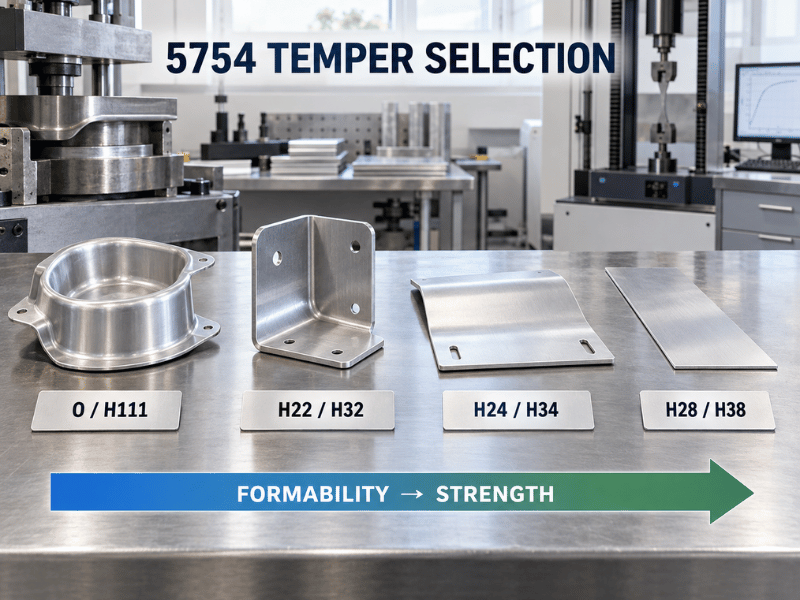
Values below are EN 485-2 requirements for sheet, strip, and plate. Note that both the strength range and the elongation minimum shift with thickness — the figures are for the commonly supplied 0.5–6 mm band.
| 脾气 | Tensile strength Rm (MPa) | Yield strength Rp0.2, min (MPa) | Elongation A50, min (%) | Hardness HBW |
|---|---|---|---|---|
| O / H111 | 190 – 240 | 80 | 12 – 18 | 52 |
| H112 (plate >6 mm) | ≥ 190 | 80 – 100 | 10 – 14 | 52 – 62 |
| H22 / H32 (quarter-hard) | 220 – 270 | 130 | 7 – 11 | 63 |
| H24 / H34 (half-hard) | 240 – 280 | 160 | 6 – 10 | 70 |
| H26 / H36 (three-quarter) | 265 – 305 | 190 | 4 – 6 | 78 |
| H28 / H38 (full-hard) | ≥ 290 | 230 | 2 – 4 | 87 |
Tempers: O, H111, H22/H32, H24/H34, and Beyond
The digits after the H carry the whole specification. The first digit is the hardness level — 2 is quarter-hard, 4 is half-hard, 6 is three-quarter, 8 is full-hard. The second digit is the thermal treatment: H1x is work-hardened only, H2x is work-hardened then partially annealed, H3x is work-hardened then stabilised. H2x tempers give slightly better forming behaviour than H1x at the same hardness level, which is why H22 and H24 are common on formed panels.
- O / H111: annealed, with H111 allowing slight work hardening from shaping. This is the condition to form in, and the standard temper for treadplate.
- H112: as-fabricated plate above 6 mm, with strength guaranteed on a thickness-dependent basis. Common for marine and structural plate.
- H22 / H32: quarter-hard — the general-purpose structural sheet condition.
- H24 / H34: half-hard, for flatter parts that still need some bend capacity.
- H26 / H36 and H28 / H38: progressively stronger and progressively less formable, used mostly in thin sheet where stiffness or dent resistance leads.
Because 5754 is not heat-treatable, anything that raises the metal into the 200–350 °C range softens it back toward the O condition. That is the mechanism behind the welding and service-temperature limits below.
物理特性
| 财产 | 价值 |
|---|---|
| 密度 | 2.66 克/立方厘米 |
| 熔化范围 | ~600 – 640 °C |
| 导热性 | ~125 – 135 W/m·K |
| 导电性 | ~32% IACS |
| 弹性模量 | ~68 – 70 GPa |
| Coefficient of thermal expansion (20–100 °C) | ~23.7 × 10⁻⁶ /K |
| 比热容 | ~900 J/kg-K |
| 泊松比 | ~0.33 |
The conductivity figures sit slightly below 5052’s (~138 W/m·K and ~35% IACS), which follows directly from the higher magnesium content. Neither number is why anyone specifies 5754, but both matter if the part doubles as a heat path or an electrical path.
Working With 5754: Forming, Welding, Machining, and Finishing
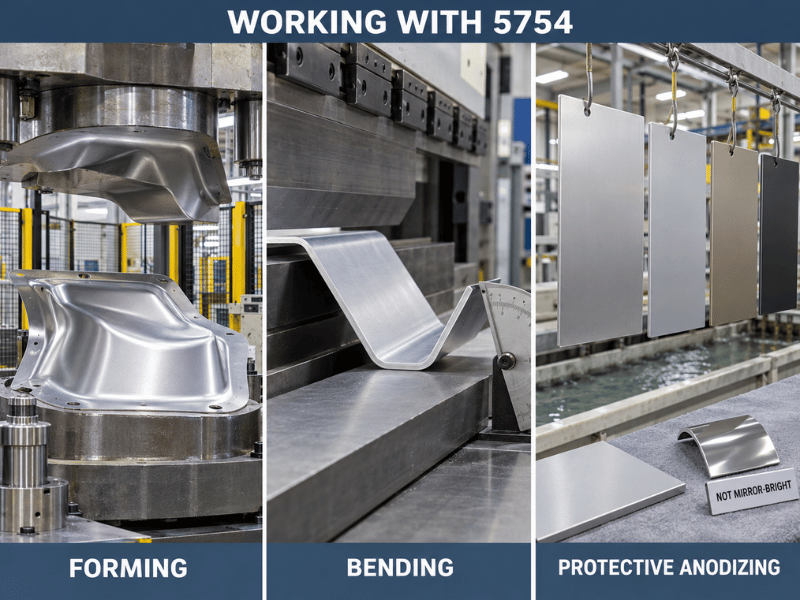
成形。. 5754 forms well, best in O/H111. EN 485-2 minimum bend radii give a usable starting point — roughly 0.5–2.0× thickness for a 180° bend in O/H111, 1.5–2.5× in H22/H32, and up to 3.0× in H24/H34, with tighter figures for thinner gauge. Confirm with a bend test on your own tooling, since the requirement shifts with thickness and bend direction relative to rolling.
焊接. This is where 5754 earns its reputation. TIG and MIG both give excellent results — 5356 is the usual filler, 5183 where higher weld strength is needed. Unlike 6xxx alloys, the heat-affected zone keeps its corrosion resistance after welding. The real design limit is strength: welding anneals the HAZ, so on H22/H32 material the zone beside the weld drops from the 220–270 MPa band to around 190–240 MPa, with yield falling from 130 MPa to about 80 MPa. Size any load path through the joint for the annealed value.
机加工。. Machinability is fair at best. The softer tempers are gummy and tend to tear rather than cut cleanly — sharp polished tools, high rake angles, positive feed, and plenty of coolant all help. Brazing is poor and generally avoided.
表面处理。. 5754 anodizes well, though bright anodizing isn’t its game. Mill data rates protective and hard anodizing as very good and colour anodizing as good, making it a legitimate decorative choice for architectural and vehicle panel work. But the mirror-bright finish that 5005, 5657, or 6063 deliver is only “acceptable” here, and the anodic layer can carry a slightly warm cast — if the spec calls for bright trim, pick one of those alloys instead. Powder coating, PVDF, and mechanical brushing all work well, and since Linsy runs anodizing and polishing in-house, the finish can be specified with the material in one order.
Where 5754 Is Used
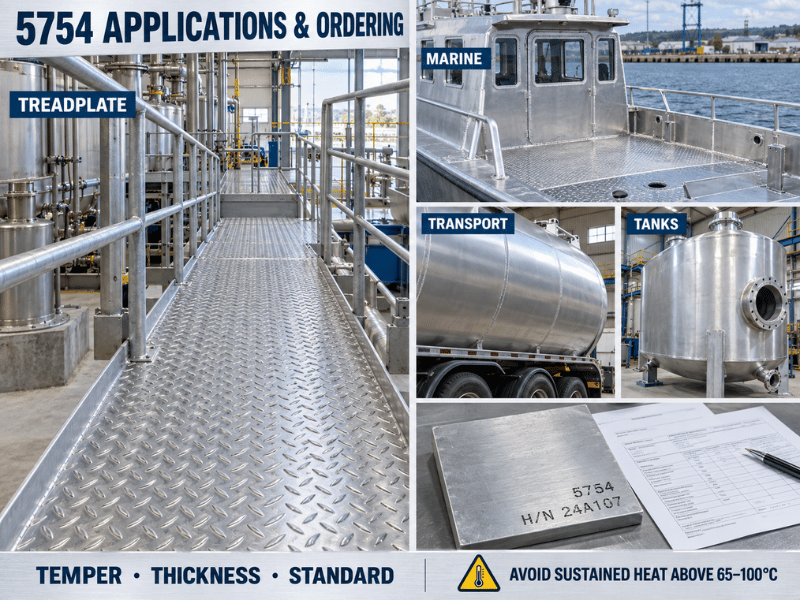
- Treadplate and flooring: H111 and H114 are the standard treadplate tempers, covering walkways, boat decks, vehicle floors, and industrial access platforms. This is one of 5754’s signature applications.
- Shipbuilding and marine: hull plating on smaller craft, superstructures, decks, and fittings where seawater resistance matters more than maximum strength.
- Vehicle bodies and transport: body panels, truck and trailer bodies, fuel tanks, and oil tanker shells.
- Process equipment: pressure vessels, storage tanks, and welded structures for chemical, food processing, and nuclear service.
- Rivets: 5754 is a standard rivet alloy, which matters when the fastener and the sheet need compatible corrosion behaviour.
- Architecture: coastal and industrial cladding, where the corrosion resistance and colour-anodizing response are the draw.
5754 vs 5052 vs 5083 vs 6061
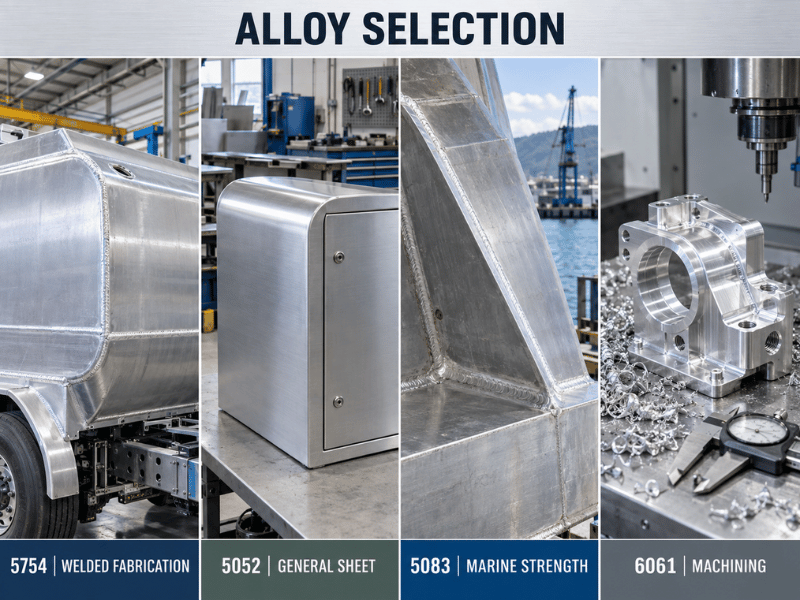
| 系数 | 5754 | 5052 | 5083 | 6061 |
|---|---|---|---|---|
| Principal alloying | Mg 2.6–3.6% | Mg 2.2–2.8% | Mg 4.0–4.9% | Mg 0.8–1.2%, Si 0.4–0.8% |
| 可热处理强化 | 否 | 否 | 否 | 是 |
| Tensile, annealed (O) | 190–240 MPa | 170–215 MPa | 290–345 MPa | — |
| Tensile, quarter-hard | 220–270 MPa (H22/H32) | 215–265 MPa (H32) | — | — |
| Tensile, strongest common | ≥290 MPa (H28/H38) | ~290 MPa (H38) | 305–380 MPa (H116/H321) | 310 MPa (T6) |
| Yield, quarter-hard | ≥130 MPa (H32) | ≥160 MPa (H32) | ≥215 MPa (H321) | 276 MPa (T6) |
| Seawater corrosion | 优秀 | 优秀 | Outstanding | 良好 |
| 焊接性 | 优秀 | 优秀 | 优秀 | 良好 |
| 成型性 | Excellent in O | 优秀 | 良好 | 中度 |
| 机械加工性能 | 公平 | 公平 | 公平 | 良好 |
| Sustained elevated temperature | Caution above ~65–100 °C | Better suited | Caution above ~65 °C | 良好 |
The H32 yield row needs a caveat: 5754 (≥130 MPa, EN 485-2) and 5052 (≥160 MPa, ASTM B209) come from different standards and aren’t directly comparable — ask for MTC values on the same basis before calculating. The real takeaway: 5754’s edge is clear annealed (190–240 vs 170–215 MPa), but by H32 the two overlap in tensile (220–270 vs 215–265 MPa). Cold work, not alloy, is doing the strengthening at that point — so blanket “10–20% stronger” claims don’t hold up.
- 5754 — welded marine, vehicle, and process fabrication; treadplate; formed panels needing more annealed strength than 5052.
- 5052 — general sheet metal work, fuel tanks, and the cheaper 5xxx default where 5754’s extra annealed strength is not needed.
- 5083 — class-certified marine hull plate and the strongest of the three, at higher cost and with a firmer 65 °C service ceiling.
- 6061 — heat-treatable strength and better machinability, with lower corrosion resistance in marine service.
Go / No-Go: When 5754 Is the Right Call
Choose 5754 when:
- The structure is welded and will see seawater, chemical, or industrial atmospheres — 5754 keeps its corrosion resistance through the HAZ.
- You need more annealed strength than 5052 gives for a formed panel.
- The part is treadplate, flooring, or a walkway — H111/H114 is the established temper.
- The application is a pressure vessel, tank, or truck body where weld integrity and corrosion resistance both matter.
- The budget will not stretch to 5083 but 5052 is marginal.
在以下情况下另寻他选:
- Service runs continuously above roughly 65–100 °C. With magnesium reaching 3.6%, 5754 sits at the range where the β phase can precipitate along grain boundaries and intergranular corrosion resistance drops. 5454 is the alloy designed for elevated-temperature 5xxx service; 5052 is the safer general choice.
- You need maximum strength in class-certified marine plate — 5083 H116 or H321.
- The design calls for heat-treatable strength — 6061.
- The finish specification is bright or mirror anodized — 5005, 5657, or 6063.
Sourcing 5754: What to Confirm Before Ordering
- Standard and thickness band: EN 485-2 values move with thickness, so quote the governing standard 和 the thickness range on the enquiry, not just the temper.
- Temper matched to the forming sequence: O/H111 for heavy forming and treadplate, H22/H32 for structural sheet, H24/H34 where the part stays relatively flat.
- 产品形态: sheet, strip, and plate are standard; rod, bar, tube, and profile are available. Treadplate is normally H111/H114.
- Availability: 5754 is an EN alloy. Outside European supply chains it is stocked far less widely than 5052, so build the lead time into the schedule for non-standard tempers or gauges.
- 文件资料: MTC with every order; SGS chemical, mechanical, and dimensional reports available on request for structural or export work.
Linsy Aluminum supplies 5754 across plate, sheet, coil, tube, and bar in O, H111, H22/H32, H24/H34, and other tempers on request, with in-house CNC machining, laser cutting, TIG and MIG welding, anodizing, and polishing. Custom dimensions run at low MOQ, with typical lead times of 10–60 days, and an MTC ships with every order.
结论
5754 is a welded-fabrication alloy, not a strength upgrade. Its real advantages are the annealed strength edge over 5052, seawater corrosion that survives welding, and a temper range from deep-drawn to full-hard. The tradeoff is fixed: no heat treatment, strength below 5083, and a service-temperature ceiling that rules out sustained hot duty.
Specify it right by quoting temper and thickness band together — EN 485-2 values move with both — and sizing welded joints for the annealed HAZ strength, not the temper on the order. Linsy Aluminum supplies 5754 in plate, sheet, coil, tube, and bar across the common tempers, with in-house machining, laser cutting, welding, anodizing, and polishing so material and finish are specified together.
Send your drawing, target temper, and service conditions for a grade-fit review and a quote.
常见问题
Is 5754 stronger than 5052?
In the annealed condition, yes — 5754 runs 190–240 MPa against 5052’s 170–215 MPa, roughly a 10–15% edge. At H32 the two converge to the point where the difference is marginal (220–270 MPa against 215–265 MPa), so the temper matters more than the alloy choice there. The “10–20% stronger across the board” claim that circulates in supplier summaries does not survive a look at the actual temper data.
Can 5754 be anodized for a decorative finish?
Yes, with one caveat. Mill data rates protective and hard anodizing as very good and colour anodizing as good, so 5754 is a legitimate decorative anodizing alloy. What it will not give you is a bright, mirror finish — bright anodizing is only rated acceptable, and the layer can carry a warmer cast. For bright trim, specify 5005, 5657, or 6063.
Does welding weaken 5754?
Corrosion resistance survives; strength does not, in the heat-affected zone. On H22/H32 material the HAZ drops from 220–270 MPa to annealed levels around 190–240 MPa, and yield falls from 130 MPa minimum to about 80 MPa. Design any load path through a weld for the annealed value. Filler is normally 5356, or 5183 for higher weld strength.
5754是否适用于海洋环境?
Yes. It has excellent seawater and industrial-atmosphere corrosion resistance and is used for hull plating, decks, superstructures, and fittings. For class-certified hull structure at maximum strength, 5083 in H116 or H321 is the usual step up.
Can 5754 be used at elevated temperature?
With caution. Magnesium reaches 3.6% at the top of the range, which is the level where β-phase precipitation along grain boundaries can reduce intergranular corrosion resistance during long exposure above roughly 65–100 °C. For sustained elevated-temperature service, 5454 is the alloy designed for it, and 5052 is the safer general alternative.