Qu'est-ce que l'aluminium 5754 ?
Le 5754 est un alliage corroyé aluminium-magnésium non traitable thermiquement, avec le magnésium (2,6–3,6 %) comme élément d'alliage principal et le manganèse ainsi que le chrome comme additions mineures contrôlées. C'est un alliage de norme EN d'abord et mondial ensuite — enregistré comme UNS A95754, mais bien plus profondément intégré dans les chaînes d'approvisionnement européennes que dans le stock nord-américain.
Sa résistance provient du durcissement par solution solide du magnésium ainsi que du durcissement par écrouissage résultant du travail à froid. Il n'y a pas de réponse au durcissement par précipitation, donc aucun équivalent T6 n'existe ; le revenu est le seul levier. Au sein de la famille 5xxx, le 5754 est plus résistant que le 5251, plus résistant que le 5052 à l'état recuit, et inférieur au 5083 en résistance absolue mais plus facile à former et moins coûteux.
Composition chimique du 5754
| Élément | Teneur (% en masse, max sauf indication contraire) | Rôle dans l'alliage |
|---|---|---|
| Magnésium (Mg) | 2.6 – 3.6 | Durcisseur principal ; détermine la réponse à l'écrouissage et le comportement à la corrosion |
| Manganèse (Mn) | 0.50 | Renforce la matrice, contrôle la taille des grains lors de la recristallisation |
| Chrome (Cr) | 0.30 | Forme des dispersoïdes fins qui limitent la croissance des grains |
| Mn + Cr (combinés) | 0.10 – 0.60 | Limite combinée — la plage qui maintient la stabilité structurale de l'alliage |
| Fer (Fe) | 0.40 | Impureté ; forme des intermétalliques cathodiques pouvant initier la piqûration |
| Silicium (Si) | 0.40 | Impureté ; se combine avec le fer et affecte l'aspect anodisé |
| Zinc (Zn) | 0.20 | Impureté, strictement limitée |
| Cuivre (Cu) | 0.10 | Strictement limité — le cuivre réduit la résistance à la corrosion générale |
| Titane (Ti) | 0.15 | Affineur de grain ajouté à la coulée |
| Autres (chaque / total) | 0.05 / 0.15 | Éléments traces contrôlés pour la constance des lots |
| Aluminium (Al) | Équilibre | Métal commun |
Deux plafonds comptent plus que les autres en service. Le cuivre est limité à 0,10 % car même de petites quantités réduisent la résistance à la corrosion générale en milieu chloruré, et le fer est plafonné à 0,40 % car les intermétalliques riches en fer agissent comme cathodes locales et amorcent la piqûration. Les deux expliquent la performance du 5754 en eau de mer.
Spécifications et désignations équivalentes
| Norme / registre | Désignation |
|---|---|
| EN (symboles chimiques) | EN AW-5754 / EN AW-AlMg3 |
| Normes EN | EN 573-3 (composition), EN 485-2 (propriétés mécaniques pour tôles, bandes et plaques) |
| DIN / Werkstoff-Nr. | 3.3535 |
| ISO | AlMg3 |
| UNS | A95754 |
| Normes de produits typiques | Tôles, bandes, plaques ; également barres, profilés, tubes et profilés extrudés |
Propriétés mécaniques selon le traitement thermique
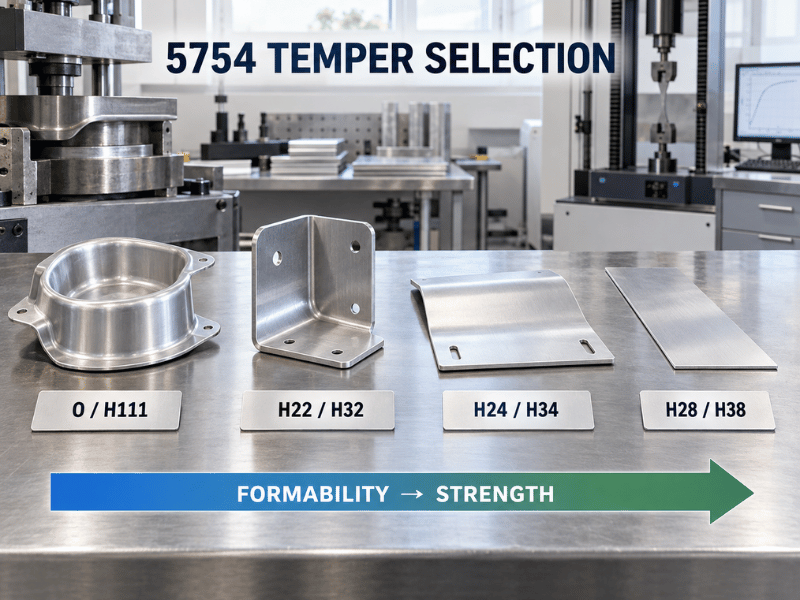
Les valeurs ci-dessous sont les exigences de l'EN 485-2 pour tôles, bandes et plaques. Notez que la plage de résistance et l'allongement minimum varient avec l'épaisseur — les chiffres correspondent à la bande couramment fournie de 0,5–6 mm.
| Tempérer | Résistance à la traction Rm (MPa) | Limite d'élasticité Rp0,2, min (MPa) | Allongement A50, min (%) | Dureté HBW |
|---|---|---|---|---|
| O / H111 | 190 – 240 | 80 | 12 – 18 | 52 |
| H112 (plaque >6 mm) | ≥ 190 | 80 – 100 | 10 – 14 | 52 – 62 |
| H22 / H32 (quart-dur) | 220 – 270 | 130 | 7 – 11 | 63 |
| H24 / H34 (demi-dur) | 240 – 280 | 160 | 6 – 10 | 70 |
| H26 / H36 (trois-quarts dur) | 265 – 305 | 190 | 4 – 6 | 78 |
| H28 / H38 (pleinement dur) | ≥ 290 | 230 | 2 – 4 | 87 |
États : O, H111, H22/H32, H24/H34, et au-delà
Les chiffres après le H portent toute la spécification. Le premier chiffre est le niveau de dureté — 2 est quart-dur, 4 est demi-dur, 6 est trois-quarts dur, 8 est pleinement dur. Le deuxième chiffre est le traitement thermique : H1x est écroui uniquement, H2x est écroui puis partiellement recuit, H3x est écroui puis stabilisé. Les états H2x offrent un comportement au formage légèrement meilleur que les H1x au même niveau de dureté, ce qui explique pourquoi H22 et H24 sont courants sur les panneaux formés.
- O / H111 : recuit, avec H111 permettant un léger écrouissage dû au formage. C'est l'état dans lequel former, et l'état standard pour les tôles antidérapantes.
- H112 : plaque brute de fabrication au-dessus de 6 mm, avec résistance garantie en fonction de l'épaisseur. Courant pour les plaques marines et structurelles.
- H22 / H32 : quart-dur — l'état de tôle structurelle à usage général.
- H24 / H34 : demi-dur, pour les pièces plus planes qui nécessitent encore une certaine capacité de pliage.
- H26 / H36 et H28 / H38 : progressivement plus résistants et progressivement moins formables, utilisés principalement en tôle mince où la rigidité ou la résistance aux chocs prime.
Comme le 5754 n'est pas traitable thermiquement, tout ce qui porte le métal dans la plage de 200–350 °C le ramollit vers l'état O. C'est le mécanisme derrière les limites de soudage et de température de service ci-dessous.
Propriétés physiques
| Propriété | Valeur |
|---|---|
| Densité | 2,66 g/cm³ |
| Intervalle de fusion | ~600 – 640 °C |
| Conductivité thermique | ~125 – 135 W/m·K |
| Conductivité électrique | ~32% IACS |
| Module d'élasticité | ~68 – 70 GPa |
| Coefficient de dilatation thermique (20–100 °C) | ~23,7 × 10⁻⁶ /K |
| Capacité thermique massique | ~900 J/kg-K |
| Coefficient de Poisson | ~0.33 |
Les valeurs de conductivité se situent légèrement en dessous de celles du 5052 (~138 W/m·K et ~35% IACS), ce qui découle directement de la teneur plus élevée en magnésium. Ni l’une ni l’autre de ces valeurs ne justifie à elle seule le choix du 5754, mais toutes deux importent si la pièce sert également de chemin thermique ou électrique.
Travailler le 5754 : formage, soudage, usinage et finition
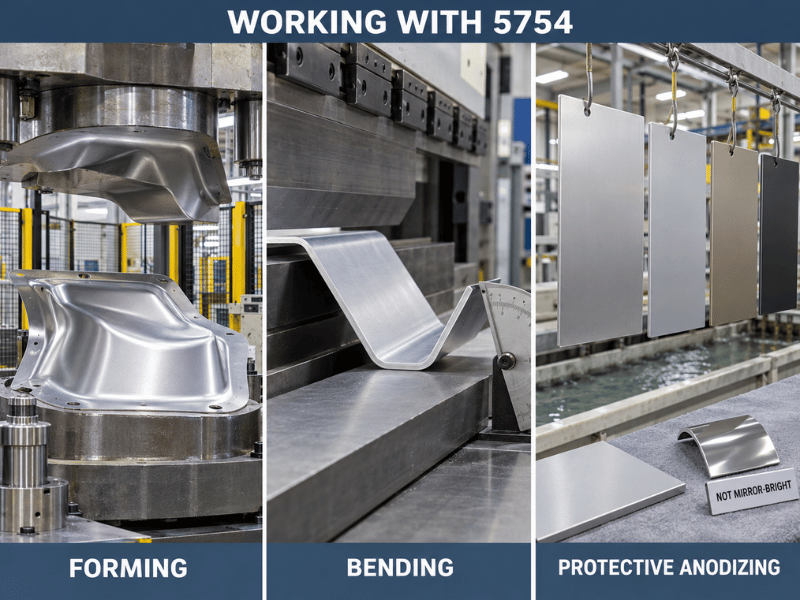
Formage. Le 5754 se forme bien, de manière optimale en O/H111. Les rayons de pliage minimaux de l’EN 485-2 constituent un point de départ utilisable — environ 0,5–2,0× l’épaisseur pour un pliage à 180° en O/H111, 1,5–2,5× en H22/H32, et jusqu’à 3,0× en H24/H34, avec des valeurs plus serrées pour les épaisseurs plus faibles. Confirmez par un essai de pliage avec votre propre outillage, car l’exigence varie selon l’épaisseur et la direction du pliage par rapport au laminage.
Soudage. C’est ici que le 5754 forge sa réputation. Le TIG et le MIG donnent tous deux d’excellents résultats — le 5356 est le métal d’apport habituel, le 5183 lorsque une résistance de soudure plus élevée est requise. Contrairement aux alliages 6xxx, la zone affectée thermiquement conserve sa résistance à la corrosion après soudage. La véritable limite de conception est la résistance mécanique : le soudage recuit la ZAT, de sorte que sur le matériau H22/H32, la zone adjacente à la soudure passe de la plage de 220–270 MPa à environ 190–240 MPa, avec une limite d’élasticité chutant de 130 MPa à environ 80 MPa. Dimensionnez tout chemin de charge traversant le joint pour la valeur recuite.
Usinage. L’usinabilité est tout au plus correcte. Les tempers les plus tendres sont collants et ont tendance à déchirer plutôt qu’à couper proprement — des outils tranchants polis, des angles de coupe élevés, une avance positive et un abondant lubrifiant réfrigérant aident tous. Le brasage est médiocre et généralement évité.
Finition. Le 5754 s’anodise bien, bien que l’anodisation brillante ne soit pas son point fort. Les données des producteurs classent l’anodisation protectrice et dure comme très bonne et l’anodisation colorée comme bonne, ce qui en fait un choix décoratif légitime pour les travaux de panneaux architecturaux et de véhicules. Mais la finition miroir brillante que procurent le 5005, le 5657 ou le 6063 n’est ici que “ acceptable ”, et la couche anodique peut présenter une légère teinte chaude — si le cahier des charges exige des garnitures brillantes, choisissez plutôt l’un de ces alliages. Le thermolaquage, le PVDF et le brossage mécanique fonctionnent tous bien, et comme Linsy réalise l’anodisation et le polissage en interne, la finition peut être spécifiée avec le matériau dans une seule commande.
Où le 5754 est utilisé
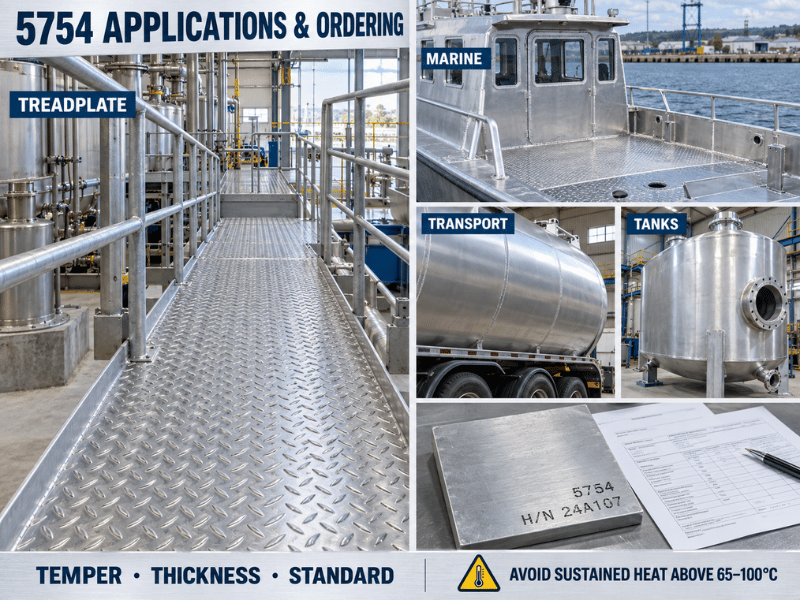
- Tôles antidérapantes et revêtements de sol : Les H111 et H114 sont les tempers standard pour tôles antidérapantes, couvrant les passerelles, les ponts de bateaux, les planchers de véhicules et les plateformes d’accès industrielles. C’est l’une des applications emblématiques du 5754.
- Construction navale et maritime : bordé de coque sur les petites embarcations, superstructures, ponts et accessoires où la résistance à l’eau de mer importe plus que la résistance maximale.
- Carrosseries de véhicules et transport : panneaux de carrosserie, caisses de camions et de remorques, réservoirs de carburant et coques de pétroliers.
- Équipements de procédé : récipients sous pression, réservoirs de stockage et structures soudées pour le service chimique, agroalimentaire et nucléaire.
- Rivets : Le 5754 est un alliage standard pour rivets, ce qui importe lorsque la fixation et la tôle doivent présenter un comportement à la corrosion compatible.
- Architecture : bardage côtier et industriel, où la résistance à la corrosion et la réponse à l’anodisation colorée constituent l’attrait.
5754 vs 5052 vs 5083 vs 6061
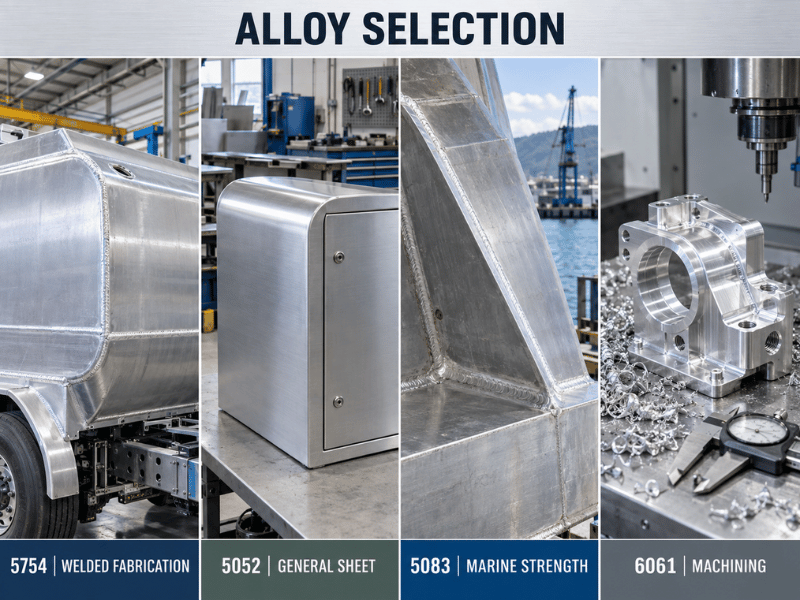
| Facteur | 5754 | 5052 | 5083 | 6061 |
|---|---|---|---|---|
| Éléments d’alliage principaux | Mg 2,6–3,6% | Mg 2,2–2,8% | Mg 4,0–4,9% | Mg 0,8–1,2%, Si 0,4–0,8% |
| Traitable thermiquement | Non | Non | Non | Oui |
| Résistance à la traction, recuit (O) | 190–240 MPa | 170–215 MPa | 290–345 MPa | — |
| Résistance à la traction, quart-dur | 220–270 MPa (H22/H32) | 215–265 MPa (H32) | — | — |
| Résistance à la traction, le plus résistant courant | ≥290 MPa (H28/H38) | ~290 MPa (H38) | 305–380 MPa (H116/H321) | 310 MPa (T6) |
| Limite d’élasticité, quart-dur | ≥130 MPa (H32) | ≥160 MPa (H32) | ≥215 MPa (H321) | 276 MPa (T6) |
| Corrosion en eau de mer | Excellent | Excellent | Exceptionnelle | Bon |
| Soudabilité | Excellent | Excellent | Excellent | Bon |
| Formabilité | Excellente en O | Excellent | Bon | Modéré |
| Usinabilité | Juste | Juste | Juste | Bon |
| Température élevée soutenue | Attention au-dessus d'environ 65–100 °C | Mieux adapté | Attention au-dessus d'environ 65 °C | Bon |
Les deux colonnes 5xxx sont référencées selon des normes différentes — EN 485-2 pour le 5754, ASTM B209 pour le 5052 — il faut donc lire chacune par rapport à sa propre norme plutôt que de soustraire un minimum de l'autre. Lu ainsi, le 5754-H22/H32 et le 5052-H32 se situent dans la même catégorie quart-dur (220–270 vs 215–265 MPa en traction), donc à l'état H32, le choix entre eux relève de la disponibilité, du prix et de la forme du produit plutôt que de la résistance. La véritable différence au niveau de l'alliage se situe aux extrémités de la gamme de traitements : environ 10–15 % à l'état recuit (190–240 vs 170–215 MPa), ce qui justifie la prime du 5754 — une pièce commandée en H32 ne la justifie pas.
- 5754 — fabrication marine, véhicules et procédés soudés ; tôles antidérapantes ; panneaux formés nécessitant une résistance à l'état recuit supérieure à celle du 5052.
- 5052 — tôlerie générale, réservoirs de carburant et choix 5xxx économique par défaut lorsque la résistance supplémentaire à l'état recuit du 5754 n'est pas nécessaire.
- 5083 — tôles de coque marine certifiées par classe et le plus résistant des trois, à coût plus élevé et avec un plafond de service plus strict de 65 °C.
- 6061 — résistance par traitement thermique et usinabilité améliorée, avec une résistance à la corrosion moindre en service marin.
Go / No-Go : Quand le 5754 est le bon choix
Choisir le 5754 lorsque :
- La structure est soudée et sera exposée à l'eau de mer, à des produits chimiques ou à des atmosphères industrielles — le 5754 conserve sa résistance à la corrosion à travers la ZAT.
- Vous avez besoin d'une résistance à l'état recuit supérieure à celle offerte par le 5052 pour un panneau formé.
- La pièce est une tôle antidérapante, un plancher ou une passerelle — H111/H114 est le traitement établi.
- L'application est un récipient sous pression, un réservoir ou une carrosserie de camion où l'intégrité des soudures et la résistance à la corrosion importent toutes deux.
- Le budget ne permet pas d'atteindre le 5083 mais le 5052 est marginal.
Cherchez ailleurs lorsque :
- Le service fonctionne en continu au-dessus d'environ 65–100 °C. Avec un magnésium atteignant 3,6 %, le 5754 se situe dans la plage où la phase β peut précipiter le long des joints de grains et la résistance à la corrosion intergranulaire chute. Le 5454 est l'alliage conçu pour le service 5xxx à température élevée ; le 5052 est le choix général plus sûr.
- Vous avez besoin d'une résistance maximale en tôle marine certifiée par classe — 5083 H116 ou H321.
- La conception exige une résistance par traitement thermique — 6061.
- La spécification de finition est un anodisage brillant ou miroir — 5005, 5657 ou 6063.
Approvisionnement en 5754 : Ce qu'il faut confirmer avant de commander
- Norme et gamme d'épaisseur : Les valeurs de l'EN 485-2 varient avec l'épaisseur, il faut donc indiquer la norme applicable et la plage d'épaisseur sur la demande, pas seulement le traitement.
- Traitement adapté à la séquence de formage : O/H111 pour le formage intensif et les tôles antidérapantes, H22/H32 pour la tôle structurelle, H24/H34 lorsque la pièce reste relativement plate.
- Forme du produit : la tôle, le feuillard et la plaque sont standard ; les barres rondes, barres, tubes et profilés sont disponibles. Les tôles antidérapantes sont normalement en H111/H114.
- Disponibilité : Le 5754 est un alliage EN. En dehors des chaînes d'approvisionnement européennes, il est stocké beaucoup moins largement que le 5052, il faut donc intégrer le délai de livraison dans le planning pour les traitements ou épaisseurs non standard.
- Documentation : MTC avec chaque commande ; rapports chimiques, mécaniques et dimensionnels SGS disponibles sur demande pour les travaux structurels ou d'exportation.
Linsy Aluminum fournit le 5754 en plaque, tôle, bobine, tube et barre dans les états O, H111, H22/H32, H24/H34 et autres traitements sur demande, avec usinage CNC intégré, découpe laser, soudage TIG et MIG, anodisation et polissage. Les dimensions personnalisées sont disponibles à faible MOQ, avec des délais de livraison typiques de 10–60 jours, et un MTC accompagne chaque commande.
Conclusion
Le 5754 est un alliage de fabrication soudée, pas une amélioration de résistance. Ses véritables avantages sont l'avantage de résistance à l'état recuit par rapport au 5052, une corrosion en eau de mer qui survit au soudage, et une gamme de traitements allant de l'emboutissage profond à l'écrouissage complet. Le compromis est fixe : pas de traitement thermique, résistance inférieure au 5083, et un plafond de température de service qui exclut tout service à chaud prolongé.
Spécifiez-le correctement en indiquant le traitement et la plage d'épaisseur ensemble — les valeurs de l'EN 485-2 varient selon les deux — et dimensionnez les joints soudés pour la résistance à l'état recuit de la ZAT, pas pour le traitement indiqué sur la commande. Linsy Aluminum fournit le 5754 en plaque, tôle, bobine, tube et barre dans les traitements courants, avec usinage, découpe laser, soudage, anodisation et polissage intégrés afin que le matériau et la finition soient spécifiés ensemble.
Envoyez votre plan, le traitement cible et les conditions de service pour une évaluation de compatibilité et un devis.
FAQ
Le 5754 est-il plus résistant que le 5052 ?
À l'état recuit, oui — le 5754 atteint 190–240 MPa contre 170–215 MPa pour le 5052, soit un avantage d'environ 10–15 %. À l'état H32, les deux convergent au point où la différence est marginale (220–270 MPa contre 215–265 MPa), le traitement importe donc plus que le choix de l'alliage à ce niveau. L'affirmation ’ 10–20 % plus résistant sur toute la ligne “ qui circule dans les résumés de fournisseurs ne résiste pas à un examen des données réelles de traitement.
Le 5754 peut-il être anodisé pour une finition décorative ?
Oui, avec une réserve. Les données d'usine classent l'anodisation protectrice et dure comme très bonne et l'anodisation couleur comme bonne, le 5754 est donc un alliage d'anodisation décorative légitime. Ce qu'il ne vous donnera pas, c'est une finition brillante ou miroir — l'anodisation brillante n'est classée qu'acceptable, et la couche peut présenter une teinte plus chaude. Pour les garnitures brillantes, spécifiez le 5005, le 5657 ou le 6063.
Le soudage affaiblit-il le 5754 ?
La résistance à la corrosion survit ; la résistance mécanique non, dans la zone affectée thermiquement. Sur le matériau H22/H32, la ZAT chute de 220–270 MPa à des niveaux recuits d'environ 190–240 MPa, et la limite d'élasticité passe d'un minimum de 130 MPa à environ 80 MPa. Concevez tout chemin de charge traversant une soudure pour la valeur à l'état recuit. Le métal d'apport est normalement le 5356, ou le 5183 pour une résistance de soudure plus élevée.
Le 5754 est-il adapté aux environnements marins ?
Oui. Il possède une excellente résistance à la corrosion en eau de mer et en atmosphère industrielle et est utilisé pour le bordé de coque, les ponts, les superstructures et les accessoires. Pour une structure de coque certifiée par classe à résistance maximale, le 5083 en H116 ou H321 est l'évolution habituelle.
Le 5754 peut-il être utilisé à température élevée ?
Avec prudence. Le magnésium atteint 3,6 % au sommet de la gamme, ce qui correspond au niveau où la précipitation de la phase β le long des joints de grains peut réduire la résistance à la corrosion intergranulaire lors d'une exposition prolongée au-dessus d'environ 65–100 °C. Pour un service prolongé à température élevée, le 5454 est l'alliage conçu pour cela, et le 5052 est l'alternative générale plus sûre.