O que é o Alumínio 5754?
O 5754 é uma liga de alumínio-magnésio forjada não tratável termicamente, com magnésio (2,6–3,6%) como principal elemento de liga e manganês mais crómio como adições menores controladas. É uma liga da norma EN em primeiro lugar e global em segundo — registada como UNS A95754, mas muito mais profundamente integrada nas cadeias de abastecimento europeias do que no stock norte-americano.
A sua resistência provém do endurecimento por solução sólida do magnésio mais o endurecimento por deformação a frio. Não há resposta ao endurecimento por precipitação, pelo que não existe equivalente T6; o temper é a única alavanca. Dentro da família 5xxx, o 5754 é mais resistente que o 5251, mais resistente que o 5052 no estado recozido, e abaixo do 5083 em resistência absoluta, mas mais fácil de conformar e menos dispendioso.
Composição Química do 5754
| Elemento | Teor (wt%, máx. salvo indicação em contrário) | Função na liga |
|---|---|---|
| Magnésio (Mg) | 2.6 – 3.6 | Principal endurecedor; determina a resposta ao endurecimento por deformação e o comportamento à corrosão |
| Manganês (Mn) | 0.50 | Reforça a matriz, controla o tamanho de grão durante a recristalização |
| Cromo (Cr) | 0.30 | Forma dispersoides finos que limitam o crescimento do grão |
| Mn + Cr (combinados) | 0.10 – 0.60 | Limite combinado — o intervalo que mantém a estrutura da liga estável |
| Ferro (Fe) | 0.40 | Impureza; forma intermetálicos catódicos que podem iniciar picadas |
| Silício (Si) | 0.40 | Impureza; combina-se com o ferro e afeta o aspeto anodizado |
| Zinco (Zn) | 0.20 | Impureza, rigorosamente limitada |
| Cobre (Cu) | 0.10 | Estritamente limitado — o cobre reduz a resistência à corrosão geral |
| Titânio (Ti) | 0.15 | Refinador de grão adicionado no vazamento |
| Outros (cada / total) | 0.05 / 0.15 | Elementos vestigiais controlados para consistência de lote |
| Alumínio (Al) | Equilíbrio | Metal base |
Dois limites máximos importam mais do que os restantes em serviço. O cobre é limitado a 0,10% porque mesmo pequenas quantidades reduzem a resistência à corrosão geral em ambientes com cloretos, e o ferro é limitado a 0,40% porque os intermetálicos ricos em ferro atuam como cátodos locais e iniciam picadas. Ambos são a razão pela qual o 5754 tem o desempenho que tem em água do mar.
Especificações e Designações Equivalentes
| Norma / registo | Designação |
|---|---|
| EN (símbolos químicos) | EN AW-5754 / EN AW-AlMg3 |
| Normas EN | EN 573-3 (composição), EN 485-2 (propriedades mecânicas para chapa, tira e placa) |
| DIN / Werkstoff-Nr. | 3.3535 |
| ISO | AlMg3 |
| UNS | A95754 |
| Normas de produto típicas | Chapa, tira, placa; também varão, barra, tubo e perfil |
Propriedades Mecânicas por Têmpera
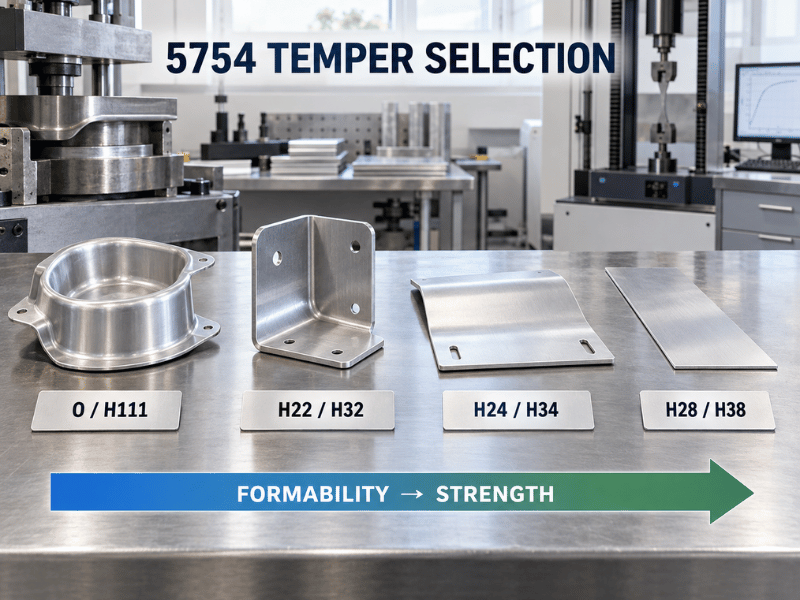
Os valores abaixo são requisitos da EN 485-2 para chapa, tira e placa. Note que tanto o intervalo de resistência como o alongamento mínimo variam com a espessura — os valores são para a banda de 0,5–6 mm habitualmente fornecida.
| Temperamento | Resistência à tração Rm (MPa) | Tensão de cedência Rp0,2, mín. (MPa) | Alongamento A50, mín. (%) | Dureza HBW |
|---|---|---|---|---|
| O / H111 | 190 – 240 | 80 | 12 – 18 | 52 |
| H112 (placa >6 mm) | ≥ 190 | 80 – 100 | 10 – 14 | 52 – 62 |
| H22 / H32 (quarto-duro) | 220 – 270 | 130 | 7 – 11 | 63 |
| H24 / H34 (meio-duro) | 240 – 280 | 160 | 6 – 10 | 70 |
| H26 / H36 (três quartos) | 265 – 305 | 190 | 4 – 6 | 78 |
| H28 / H38 (totalmente duro) | ≥ 290 | 230 | 2 – 4 | 87 |
Tempers: O, H111, H22/H32, H24/H34 e Além Destes
Os dígitos após o H contêm toda a especificação. O primeiro dígito é o nível de dureza — 2 é quarto-duro, 4 é meio-duro, 6 é três quartos, 8 é totalmente duro. O segundo dígito é o tratamento térmico: H1x é apenas endurecido por deformação, H2x é endurecido por deformação e depois parcialmente recozido, H3x é endurecido por deformação e depois estabilizado. Os tempers H2x proporcionam um comportamento de conformação ligeiramente melhor do que os H1x ao mesmo nível de dureza, razão pela qual H22 e H24 são comuns em painéis conformados.
- O / H111: recozido, com H111 permitindo leve encruamento a partir da conformação. Esta é a condição para conformar, e o temper padrão para chapa xadrez.
- H112: chapa como fabricada acima de 6 mm, com resistência garantida em base dependente da espessura. Comum para chapa naval e estrutural.
- H22 / H32: quarto-duro — a condição geral de chapa estrutural.
- H24 / H34: meio-duro, para peças mais planas que ainda precisam de alguma capacidade de dobra.
- H26 / H36 e H28 / H38: progressivamente mais resistentes e progressivamente menos conformáveis, usados principalmente em chapa fina onde rigidez ou resistência a amassados prevalece.
Como o 5754 não é tratável termicamente, qualquer coisa que eleve o metal à faixa de 200–350 °C o amolece de volta para a condição O. Esse é o mecanismo por trás dos limites de soldagem e de temperatura de serviço abaixo.
Propriedades físicas
| Propriedade | Valor |
|---|---|
| Densidade | 2,66 g/cm³ |
| Faixa de fusão | ~600 – 640 °C |
| Condutividade térmica | ~125 – 135 W/m·K |
| Condutividade elétrica | ~32% IACS |
| Módulo de elasticidade | ~68 – 70 GPa |
| Coeficiente de expansão térmica (20–100 °C) | ~23,7 × 10⁻⁶ /K |
| Capacidade térmica específica | ~900 J/kg-K |
| Coeficiente de Poisson | ~0.33 |
Os valores de condutividade ficam ligeiramente abaixo dos do 5052 (~138 W/m·K e ~35% IACS), o que decorre diretamente do maior teor de magnésio. Nenhum dos números é o motivo pelo qual alguém especifica o 5754, mas ambos importam se a peça também funcionar como caminho térmico ou caminho elétrico.
Trabalhando com o 5754: Conformação, Soldagem, Usinagem e Acabamento
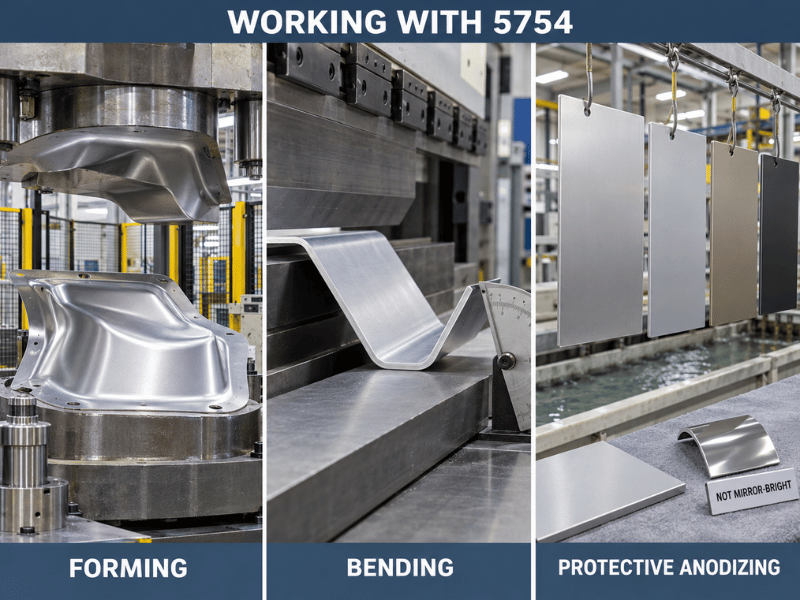
Conformação. O 5754 conforma-se bem, melhor em O/H111. Os raios mínimos de dobra da EN 485-2 fornecem um ponto de partida utilizável — aproximadamente 0,5–2,0× a espessura para uma dobra de 180° em O/H111, 1,5–2,5× em H22/H32, e até 3,0× em H24/H34, com valores mais justos para bitolas mais finas. Confirme com um teste de dobra no seu próprio ferramental, pois o requisito muda com a espessura e a direção da dobra em relação à laminação.
Soldagem. É aqui que o 5754 conquista sua reputação. TIG e MIG dão ambos excelentes resultados — 5356 é o consumível usual, 5183 onde maior resistência da solda é necessária. Diferentemente das ligas 6xxx, a zona afetada pelo calor mantém sua resistência à corrosão após a soldagem. O verdadeiro limite de projeto é a resistência: a soldagem recozia a ZAC, então em material H22/H32 a zona ao lado da solda cai da faixa de 220–270 MPa para cerca de 190–240 MPa, com o limite de escoamento caindo de 130 MPa para cerca de 80 MPa. Dimensione qualquer caminho de carga através da junta para o valor recozido.
Usinagem. A usinabilidade é razoável na melhor das hipóteses. Os tempers mais macios são gomosos e tendem a rasgar em vez de cortar limpo — ferramentas afiadas e polidas, ângulos de saída altos, avanço positivo e bastante fluido de corte ajudam. A brasagem é ruim e geralmente evitada.
Acabamento. O 5754 anodiza bem, embora a anodização brilhante não seja o seu forte. Dados de fábrica classificam a anodização protetora e dura como muito boa e a anodização colorida como boa, tornando-o uma escolha decorativa legítima para trabalhos de painéis arquitetônicos e veiculares. Mas o acabamento espelhado que o 5005, 5657 ou 6063 proporcionam é apenas “aceitável” aqui, e a camada anódica pode carregar um tom ligeiramente quente — se a especificação exigir acabamento brilhante, escolha uma dessas ligas. Pintura a pó, PVDF e escovação mecânica funcionam bem, e como a Linsy realiza anodização e polimento internamente, o acabamento pode ser especificado junto com o material em um único pedido.
Onde o 5754 É Usado
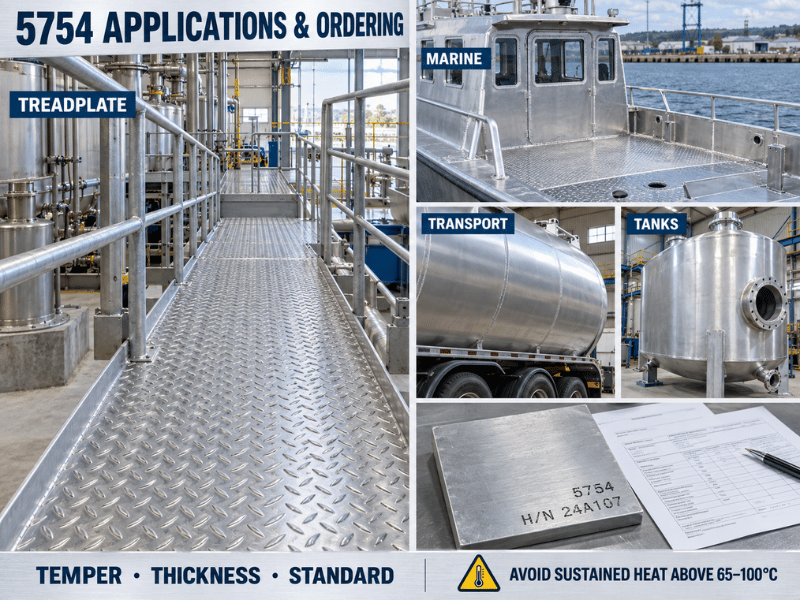
- Chapa xadrez e pisos: H111 e H114 são os tempers padrão de chapa xadrez, cobrindo passarelas, conveses de barcos, pisos de veículos e plataformas de acesso industriais. Esta é uma das aplicações marcantes do 5754.
- Construção naval e marítima: revestimento de casco em embarcações menores, superestruturas, conveses e acessórios onde a resistência à água do mar importa mais do que a resistência máxima.
- Carrocerias de veículos e transporte: painéis de carroceria, carrocerias de caminhões e reboques, tanques de combustível e cascos de navios-tanque de óleo.
- Equipamentos de processo: vasos de pressão, tanques de armazenamento e estruturas soldadas para serviço químico, de processamento de alimentos e nuclear.
- Rebites: O 5754 é uma liga padrão para rebites, o que importa quando o fixador e a chapa precisam de comportamento de corrosão compatível.
- Arquitetura: revestimento costeiro e industrial, onde a resistência à corrosão e a resposta à anodização colorida são o atrativo.
5754 vs 5052 vs 5083 vs 6061
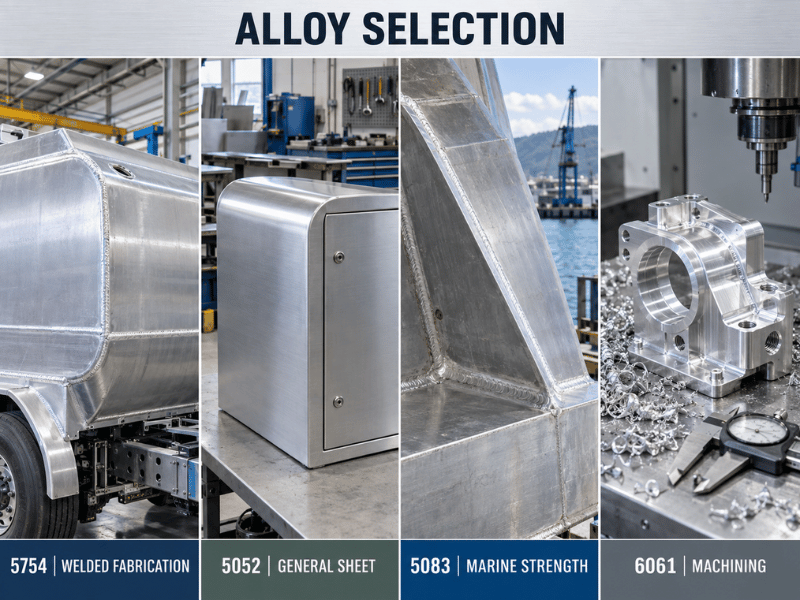
| Fator | 5754 | 5052 | 5083 | 6061 |
|---|---|---|---|---|
| Elemento de liga principal | Mg 2,6–3,6% | Mg 2,2–2,8% | Mg 4,0–4,9% | Mg 0,8–1,2%, Si 0,4–0,8% |
| Tratável termicamente | Não | Não | Não | Sim |
| Tração, recozido (O) | 190–240 MPa | 170–215 MPa | 290–345 MPa | — |
| Tração, quarto-duro | 220–270 MPa (H22/H32) | 215–265 MPa (H32) | — | — |
| Tração, mais resistente comum | ≥290 MPa (H28/H38) | ~290 MPa (H38) | 305–380 MPa (H116/H321) | 310 MPa (T6) |
| Limite de elasticidade, quarto-duro | ≥130 MPa (H32) | ≥160 MPa (H32) | ≥215 MPa (H321) | 276 MPa (T6) |
| Corrosão em água do mar | Excelente | Excelente | Excelente | Bom |
| Soldabilidade | Excelente | Excelente | Excelente | Bom |
| Formabilidade | Excelente em O | Excelente | Bom | Moderado |
| Usinabilidade | Justo | Justo | Justo | Bom |
| Temperatura elevada sustentada | Cuidado acima de ~65–100 °C | Mais adequado | Cuidado acima de ~65 °C | Bom |
As duas colunas da série 5xxx são citadas segundo normas diferentes — EN 485-2 para o 5754, ASTM B209 para o 5052 —, portanto leia cada uma em relação à sua própria norma, em vez de subtrair um mínimo do outro. Lida dessa forma, o 5754-H22/H32 e o 5052-H32 situam-se na mesma faixa de quarto-duro (220–270 vs 215–265 MPa de resistência à tração), pelo que, em H32, a escolha entre eles depende de disponibilidade, preço e forma do produto, e não de resistência. A verdadeira diferença ao nível da liga está nos extremos da faixa de têmpera: cerca de 10–15% no estado recozido (190–240 vs 170–215 MPa), que é onde o 5754 justifica o seu prémio — uma peça encomendada em H32 não o faz.
- 5754 — fabricação naval, de veículos e de processo soldada; chapa antiderrapante; painéis conformados que necessitem de mais resistência no estado recozido do que o 5052.
- 5052 — trabalho geral de chapa metálica, depósitos de combustível e a opção 5xxx mais económica por defeito, onde a resistência adicional no estado recozido do 5754 não é necessária.
- 5083 — chapa de casco marinho com certificação de classe e a mais resistente das três, a custo mais elevado e com um teto de serviço mais rigoroso de 65 °C.
- 6061 — resistência por tratamento térmico e melhor maquinabilidade, com menor resistência à corrosão em serviço marinho.
Vai / Não Vai: Quando o 5754 É a Escolha Certa
Escolha o 5754 quando:
- A estrutura é soldada e ficará exposta a água do mar, atmosferas químicas ou industriais — o 5754 mantém a sua resistência à corrosão através da ZTA.
- Necessita de mais resistência no estado recozido do que o 5052 proporciona para um painel conformado.
- A peça é chapa antiderrapante, pavimento ou passadiço — H111/H114 é a têmpera estabelecida.
- A aplicação é um vaso de pressão, depósito ou carroçaria de camião, onde a integridade da solda e a resistência à corrosão são ambas importantes.
- O orçamento não permite o 5083, mas o 5052 é marginal.
Procure outra opção quando:
- O serviço decorre continuamente acima de aproximadamente 65–100 °C. Com o magnésio a atingir 3,6%, o 5754 situa-se na faixa em que a fase β pode precipitar ao longo dos contornos de grão e a resistência à corrosão intergranular diminui. O 5454 é a liga concebida para serviço 5xxx a temperatura elevada; o 5052 é a escolha geral mais segura.
- Necessita de resistência máxima em chapa marinha com certificação de classe — 5083 H116 ou H321.
- O projeto exige resistência por tratamento térmico — 6061.
- A especificação de acabamento é anodização brilhante ou espelhada — 5005, 5657 ou 6063.
Abastecimento de 5754: O Que Confirmar Antes de Encomendar
- Norma e faixa de espessura: Os valores da EN 485-2 variam com a espessura, portanto indique a norma aplicável e e a faixa de espessura no pedido de cotação, não apenas a têmpera.
- Têmpera adequada à sequência de conformação: O/H111 para conformação pesada e chapa antiderrapante, H22/H32 para chapa estrutural, H24/H34 onde a peça permanece relativamente plana.
- Forma do produto: chapa fina, tira e chapa grossa são padrão; varão, barra, tubo e perfil estão disponíveis. A chapa antiderrapante é normalmente H111/H114.
- Disponibilidade: O 5754 é uma liga EN. Fora das cadeias de abastecimento europeias, é armazenado com muito menos amplitude do que o 5052, pelo que deve incorporar o prazo de entrega no planeamento para têmperas ou espessuras não padrão.
- Documentação: MTC com cada encomenda; relatórios químicos, mecânicos e dimensionais SGS disponíveis a pedido para trabalhos estruturais ou de exportação.
A Linsy Aluminum fornece 5754 em chapa grossa, chapa fina, bobina, tubo e barra nas têmperas O, H111, H22/H32, H24/H34 e outras a pedido, com maquinagem CNC interna, corte a laser, soldadura TIG e MIG, anodização e polimento. Dimensões personalizadas com MOQ baixo, prazos de entrega típicos de 10–60 dias, e um MTC acompanha cada encomenda.
Conclusão
O 5754 é uma liga para fabricação soldada, não um upgrade de resistência. As suas verdadeiras vantagens são a vantagem de resistência no estado recozido sobre o 5052, a resistência à corrosão em água do mar que sobrevive à soldadura, e uma faixa de têmpera desde a estampagem profunda até ao totalmente duro. O compromisso é fixo: sem tratamento térmico, resistência inferior ao 5083, e um teto de temperatura de serviço que exclui serviço quente sustentado.
Especifique-o corretamente indicando a têmpera e a faixa de espessura em conjunto — os valores da EN 485-2 variam com ambas — e dimensionando as juntas soldadas para a resistência da ZTA no estado recozido, não para a têmpera indicada na encomenda. A Linsy Aluminum fornece 5754 em chapa grossa, chapa fina, bobina, tubo e barra nas têmperas comuns, com maquinagem, corte a laser, soldadura, anodização e polimento internos, para que o material e o acabamento sejam especificados em conjunto.
Envie o seu desenho, têmpera pretendida e condições de serviço para uma avaliação de adequação ao grau e uma cotação.
PERGUNTAS FREQUENTES
O 5754 é mais resistente do que o 5052?
No estado recozido, sim — o 5754 apresenta 190–240 MPa contra 170–215 MPa do 5052, uma vantagem de aproximadamente 10–15%. Em H32, os dois convergem ao ponto de a diferença ser marginal (220–270 MPa contra 215–265 MPa), pelo que a têmpera importa mais do que a escolha da liga nesse caso. A afirmação de ’10–20% mais resistente em todos os aspetos“, que circula nos resumos dos fornecedores, não resiste a uma análise dos dados reais de têmpera.
O 5754 pode ser anodizado para um acabamento decorativo?
Sim, com uma ressalva. Os dados de fábrica classificam a anodização protetora e dura como muito boa e a anodização colorida como boa, pelo que o 5754 é uma liga legítima para anodização decorativa. O que não lhe dará é um acabamento brilhante e espelhado — a anodização brilhante é apenas classificada como aceitável, e a camada pode apresentar um tom mais quente. Para acabamentos brilhantes, especifique 5005, 5657 ou 6063.
A soldadura enfraquece o 5754?
A resistência à corrosão permanece; a resistência mecânica não, na zona afetada pelo calor. No material H22/H32, a ZAC cai de 220–270 MPa para níveis de recozimento em torno de 190–240 MPa, e o limite de escoamento cai de 130 MPa mínimos para cerca de 80 MPa. Projete qualquer caminho de carga através de uma solda para o valor recozido. O metal de adição é normalmente 5356, ou 5183 para maior resistência da solda.
A 5754 é adequada para ambientes marítimos?
Sim. Possui excelente resistência à corrosão em água do mar e atmosfera industrial e é utilizado para chapas de casco, conveses, superestruturas e acessórios. Para estrutura de casco com certificação de classe na resistência máxima, o 5083 em H116 ou H321 é o upgrade usual.
O 5754 pode ser utilizado em temperatura elevada?
Com cautela. O magnésio atinge 3,6% no topo da faixa, que é o nível em que a precipitação da fase β ao longo dos contornos de grão pode reduzir a resistência à corrosão intergranular durante exposição prolongada acima de aproximadamente 65–100 °C. Para serviço contínuo em temperatura elevada, o 5454 é a liga projetada para isso, e o 5052 é a alternativa geral mais segura.