Cos'è l'alluminio 5754?
5754 è una lega di alluminio-magnesio da deformazione non trattabile termicamente, con il magnesio (2,6–3,6%) come elemento legante principale e manganese più cromo come aggiunte minori controllate. È una lega di norma EN in primo luogo e globale in secondo luogo — registrata come UNS A95754, ma molto più profondamente radicata nelle catene di fornitura europee che nelle scorte nordamericane.
La sua resistenza deriva dal rafforzamento per soluzione solida da parte del magnesio più l'incrudimento da deformazione a freddo. Non vi è risposta all'indurimento per precipitazione, quindi non esiste un equivalente T6; la tempra è l'unica leva. All'interno della famiglia 5xxx, 5754 è più resistente di 5251, più resistente di 5052 allo stato ricotto, e inferiore a 5083 in resistenza assoluta ma più facile da formare e meno costosa.
Composizione chimica del 5754
| Elemento | Contenuto (% in peso, max salvo diversa indicazione) | Ruolo nella lega |
|---|---|---|
| Magnesio (Mg) | 2.6 – 3.6 | Rinforzante primario; guida la risposta all'incrudimento e il comportamento alla corrosione |
| Manganese (Mn) | 0.50 | Rinforza la matrice, controlla la dimensione del grano durante la ricristallizzazione |
| Cromo (Cr) | 0.30 | Forma dispersoidi fini che limitano la crescita del grano |
| Mn + Cr (combinati) | 0.10 – 0.60 | Limite combinato — l'intervallo che mantiene stabile la struttura della lega |
| Ferro (Fe) | 0.40 | Impurezza; forma intermetallici catodici che possono innescare la vaiolatura |
| Silicio (Si) | 0.40 | Impurezza; si combina con il ferro e influisce sull'aspetto anodizzato |
| Zinco (Zn) | 0.20 | Impurezza, strettamente limitata |
| Rame (Cu) | 0.10 | Strettamente limitato — il rame riduce la resistenza alla corrosione generale |
| Titanio (Ti) | 0.15 | Affinatore di grano aggiunto alla colata |
| Altri elementi (ciascuno / totale) | 0.05 / 0.15 | Elementi in tracce controllati per la coerenza del lotto |
| Alluminio (Al) | Equilibrio | Metallo comune |
Due limiti massimi contano più degli altri in esercizio. Il rame è mantenuto a 0,10% perché anche piccole quantità riducono la resistenza alla corrosione generale in ambienti clorurati, e il ferro è limitato a 0,40% perché gli intermetallici ricchi di ferro agiscono come catodi locali e avviano la vaiolatura. Entrambi sono la ragione per cui il 5754 si comporta così bene in acqua di mare.
Specifiche e designazioni equivalenti
| Norma / registro | Denominazione |
|---|---|
| EN (simboli chimici) | EN AW-5754 / EN AW-AlMg3 |
| Norme EN | EN 573-3 (composizione), EN 485-2 (proprietà meccaniche per lamiere, nastri e piastre) |
| DIN / Werkstoff-Nr. | 3.3535 |
| ISO | AlMg3 |
| UNS | A95754 |
| Norme di prodotto tipiche | Lamiera, nastro, piastra; anche barra, profilato, tubo e profilo |
Proprietà meccaniche in base al trattamento termico
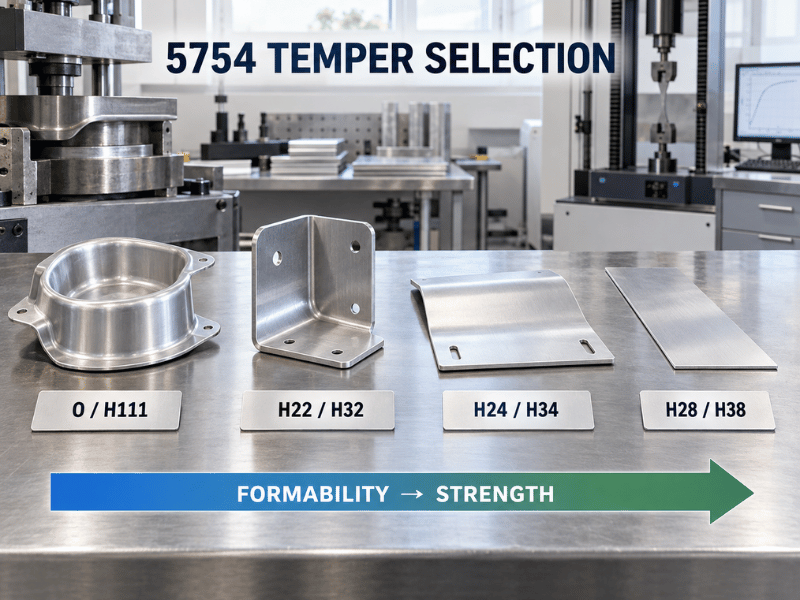
I valori seguenti sono requisiti EN 485-2 per lamiera, nastro e piastra. Si noti che sia l'intervallo di resistenza che l'allungamento minimo variano con lo spessore — i valori si riferiscono alla banda comunemente fornita da 0,5–6 mm.
| Temperamento | Resistenza a trazione Rm (MPa) | Carico di snervamento Rp0,2, min (MPa) | Allungamento A50, min (%) | Durezza HBW |
|---|---|---|---|---|
| O / H111 | 190 – 240 | 80 | 12 – 18 | 52 |
| H112 (piastra >6 mm) | ≥ 190 | 80 – 100 | 10 – 14 | 52 – 62 |
| H22 / H32 (quarto duro) | 220 – 270 | 130 | 7 – 11 | 63 |
| H24 / H34 (mezzo duro) | 240 – 280 | 160 | 6 – 10 | 70 |
| H26 / H36 (tre quarti) | 265 – 305 | 190 | 4 – 6 | 78 |
| H28 / H38 (pienamente duro) | ≥ 290 | 230 | 2 – 4 | 87 |
Tempra: O, H111, H22/H32, H24/H34 e oltre
Le cifre dopo la H portano l'intera specifica. La prima cifra è il livello di durezza — 2 è quarto duro, 4 è mezzo duro, 6 è tre quarti, 8 è pienamente duro. La seconda cifra è il trattamento termico: H1x è solo incrudito, H2x è incrudito poi parzialmente ricotto, H3x è incrudito poi stabilizzato. Le tempra H2x offrono un comportamento alla formatura leggermente migliore rispetto alle H1x allo stesso livello di durezza, motivo per cui H22 e H24 sono comuni sui pannelli formati.
- O / H111: ricotto, con H111 che consente un leggero incrudimento dalla formatura. Questa è la condizione in cui formare, e la tempra standard per la lamiera antiscivolo.
- H112: piastra come fabbricata sopra 6 mm, con resistenza garantita su base dipendente dallo spessore. Comune per piastre marine e strutturali.
- H22 / H32: quarto duro — la condizione generale per lamiera strutturale.
- H24 / H34: mezzo duro, per parti più piatte che necessitano ancora di una certa capacità di piegatura.
- H26 / H36 e H28 / H38: progressivamente più resistenti e progressivamente meno formabili, utilizzati principalmente in lamiera sottile dove la rigidità o la resistenza alle ammaccature è prioritaria.
Poiché il 5754 non è trattabile termicamente, qualsiasi cosa che porti il metallo nell'intervallo 200–350 °C lo ammorbidisce riportandolo verso la condizione O. Questo è il meccanismo alla base dei limiti di saldatura e temperatura di esercizio di seguito.
Proprietà fisiche
| Proprietà | Valore |
|---|---|
| Densità | 2,66 g/cm³ |
| Intervallo di fusione | ~600 – 640 °C |
| Conducibilità termica | ~125 – 135 W/m·K |
| Conducibilità elettrica | ~32% IACS |
| Modulo di elasticità | ~68 – 70 GPa |
| Coefficiente di dilatazione termica (20–100 °C) | ~23,7 × 10⁻⁶ /K |
| Capacità termica specifica | ~900 J/kg-K |
| Coefficiente di Poisson | ~0.33 |
I valori di conduttività si collocano leggermente al di sotto di quelli del 5052 (~138 W/m·K e ~35% IACS), il che deriva direttamente dal maggiore contenuto di magnesio. Nessuno dei due valori è il motivo per cui si specifica il 5754, ma entrambi contano se il componente funge anche da percorso termico o elettrico.
Lavorare con il 5754: formatura, saldatura, lavorazione meccanica e finitura
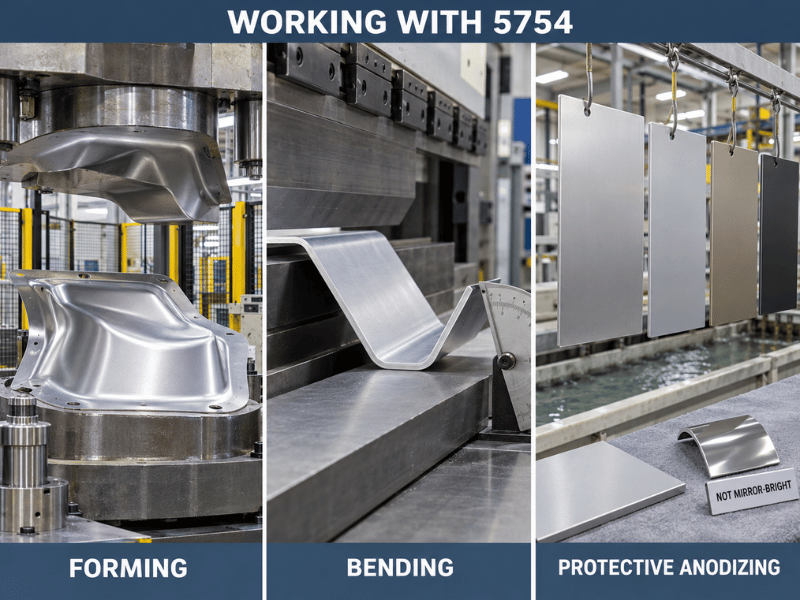
Formatura. Il 5754 si forma bene, soprattutto nelle condizioni O/H111. I raggi di piegatura minimi secondo EN 485-2 forniscono un punto di partenza utilizzabile — all'incirca 0,5–2,0× lo spessore per una piegatura a 180° in O/H111, 1,5–2,5× in H22/H32 e fino a 3,0× in H24/H34, con valori più contenuti per spessori sottili. Confermare con una prova di piegatura sulle proprie attrezzature, poiché il requisito varia con lo spessore e con la direzione di piegatura rispetto alla laminazione.
Saldatura. È qui che il 5754 si guadagna la sua reputazione. Sia il TIG che il MIG danno risultati eccellenti — il 5356 è il materiale d'apporto usuale, il 5183 dove serve maggiore resistenza della saldatura. A differenza delle leghe 6xxx, la zona termicamente alterata mantiene la sua resistenza alla corrosione dopo la saldatura. Il vero limite progettuale è la resistenza: la saldatura ricuoce la ZTA, quindi sul materiale H22/H32 la zona accanto alla saldatura scende dalla fascia 220–270 MPa a circa 190–240 MPa, con lo snervamento che cala da 130 MPa a circa 80 MPa. Dimensionare qualsiasi percorso di carico attraverso il giunto per il valore allo stato ricotto.
Lavorazione a macchina. La lavorabilità meccanica è nella migliore delle ipotesi discreta. I temperamenti più teneri sono gommosi e tendono a strappare anziché tagliare in modo netto — utensili affilati e lucidati, angoli di spoglia elevati, avanzamento positivo e abbondante refrigerante aiutano tutti. La brasatura è scarsa e generalmente evitata.
Finitura. Il 5754 si anodizza bene, anche se l'anodizzazione brillante non è il suo forte. I dati di produzione classificano l'anodizzazione protettiva e dura come molto buona e l'anodizzazione colorata come buona, rendendolo una scelta decorativa legittima per lavori architettonici e pannelli per veicoli. Tuttavia, la finitura a specchio che il 5005, il 5657 o il 6063 offrono qui è solo “accettabile”, e lo strato anodico può presentare una leggera tonalità calda — se la specifica richiede finiture brillanti, scegliere una di quelle leghe. La verniciatura a polvere, il PVDF e la spazzolatura meccanica funzionano tutti bene, e poiché Linsy esegue anodizzazione e lucidatura internamente, la finitura può essere specificata insieme al materiale in un unico ordine.
Dove viene utilizzato il 5754
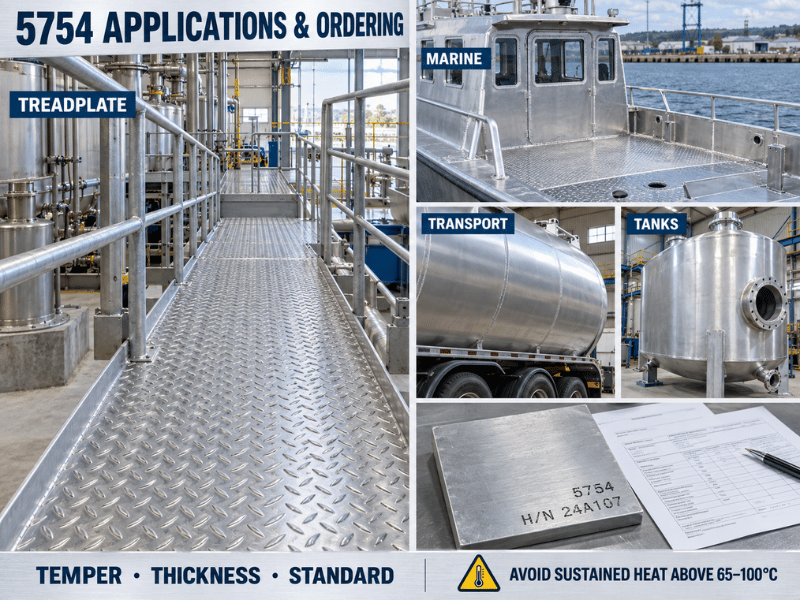
- Lamiera bugnata e pavimentazioni: H111 e H114 sono i temperamenti standard per lamiera bugnata, che coprono passerelle, ponti di imbarcazioni, pavimenti di veicoli e piattaforme di accesso industriali. Questa è una delle applicazioni distintive del 5754.
- Cantieristica navale e marino: fasciame di scafi di imbarcazioni più piccole, sovrastrutture, ponti e accessori dove la resistenza all'acqua di mare conta più della resistenza massima.
- Carrozzerie di veicoli e trasporti: pannelli di carrozzeria, casse di camion e rimorchi, serbatoi di carburante e fasciame di navi cisterna per il trasporto di petrolio.
- Apparecchiature di processo: recipienti a pressione, serbatoi di stoccaggio e strutture saldate per servizio chimico, alimentare e nucleare.
- Rivetti: Il 5754 è una lega standard per rivetti, il che conta quando il fissaggio e la lamiera devono avere un comportamento alla corrosione compatibile.
- Architettura: rivestimenti costieri e industriali, dove la resistenza alla corrosione e la risposta all'anodizzazione colorata sono l'attrattiva.
5754 vs 5052 vs 5083 vs 6061
| Fattore | 5754 | 5052 | 5083 | 6061 |
|---|---|---|---|---|
| Elemento di lega principale | Mg 2,6–3,6% | Mg 2,2–2,8% | Mg 4,0–4,9% | Mg 0,8–1,2%, Si 0,4–0,8% |
| Trattabile termicamente | No | No | No | Sì |
| Trazione, ricotto (O) | 190–240 MPa | 170–215 MPa | 290–345 MPa | — |
| Trazione, quarto duro | 220–270 MPa (H22/H32) | 215–265 MPa (H32) | — | — |
| Trazione, il più resistente tra i comuni | ≥290 MPa (H28/H38) | ~290 MPa (H38) | 305–380 MPa (H116/H321) | 310 MPa (T6) |
| Snervamento, quarto duro | ≥130 MPa (H32) | ≥160 MPa (H32) | ≥215 MPa (H321) | 276 MPa (T6) |
| Corrosione in acqua di mare | Eccellente | Eccellente | Eccezionale | Buono |
| Saldabilità | Eccellente | Eccellente | Eccellente | Buono |
| Formabilità | Eccellente in O | Eccellente | Buono | Moderato |
| Lavorabilità | Fiera | Fiera | Fiera | Buono |
| Temperatura elevata prolungata | Attenzione sopra ~65–100 °C | Più adatto | Attenzione sopra ~65 °C | Buono |
Le due colonne 5xxx sono quotate secondo norme diverse — EN 485-2 per il 5754, ASTM B209 per il 5052 — quindi ciascuna va letta rispetto al proprio standard, anziché sottrarre un minimo dall'altro. Letti in questo modo, il 5754-H22/H32 e il 5052-H32 si collocano nella stessa fascia di incrudimento quarto-duro (220–270 vs 215–265 MPa di resistenza a trazione), quindi a H32 la scelta tra i due riguarda disponibilità, prezzo e forma del prodotto, non la resistenza. La vera differenza a livello di lega si colloca agli estremi dell'intervallo di tempra: circa 10–15% allo stato ricotto (190–240 vs 170–215 MPa), ed è qui che il 5754 giustifica il suo premium — un particolare ordinato in H32 no.
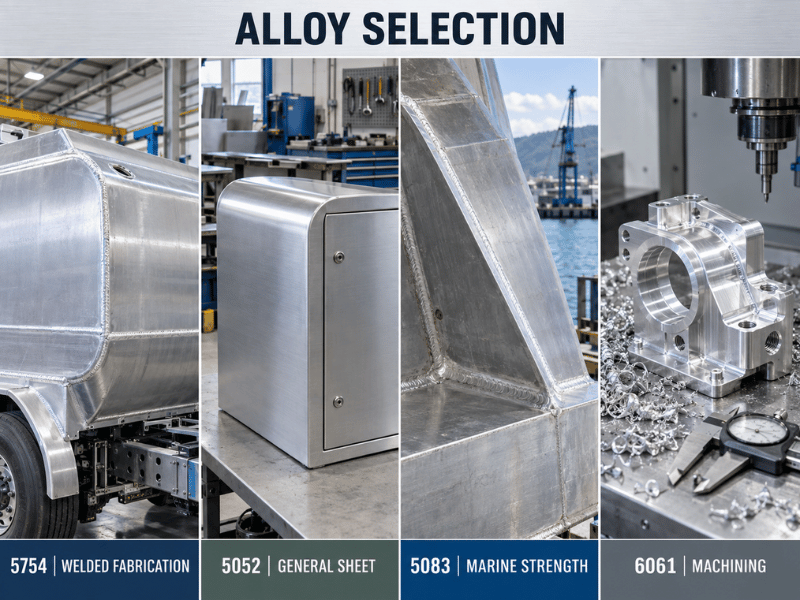
- 5754 — fabbricazione navale, veicoli e processi saldati; lamiera bugnata; pannelli formati che richiedono maggiore resistenza allo stato ricotto rispetto al 5052.
- 5052 — lavorazione generale della lamiera, serbatoi di carburante e il default 5xxx più economico dove la resistenza extra allo stato ricotto del 5754 non è necessaria.
- 5083 — lamiera per scafo navale certificata per classe e la più resistente delle tre, a costo superiore e con un limite di servizio più rigoroso di 65 °C.
- 6061 — resistenza ottenibile per trattamento termico e migliore lavorabilità, con minore resistenza alla corrosione in servizio marino.
Go / No-Go: Quando il 5754 È la Scelta Giusta
Scegliere il 5754 quando:
- La struttura è saldata e sarà esposta ad atmosfere marine, chimiche o industriali — il 5754 mantiene la sua resistenza alla corrosione attraverso la ZTA.
- È necessaria una resistenza allo stato ricotto superiore a quella fornita dal 5052 per un pannello formato.
- Il componente è lamiera bugnata, pavimentazione o passerella — H111/H114 è il temper stato consolidato.
- L'applicazione è un recipiente in pressione, serbatoio o carrozzeria di camion dove l'integrità della saldatura e la resistenza alla corrosione sono entrambe importanti.
- Il budget non consente il 5083 ma il 5052 è marginale.
Cercare altrove quando:
- Il servizio opera continuativamente sopra circa 65–100 °C. Con il magnesio che raggiunge il 3,6%, il 5754 si colloca nella gamma in cui la fase β può precipitare lungo i bordi dei grani e la resistenza alla corrosione intergranulare diminuisce. Il 5454 è la lega progettata per il servizio 5xxx ad alta temperatura; il 5052 è la scelta generale più sicura.
- È necessaria la massima resistenza in lamiera navale certificata per classe — 5083 H116 o H321.
- Il progetto richiede resistenza ottenibile per trattamento termico — 6061.
- La specifica di finitura è anodizzazione brillante o a specchio — 5005, 5657 o 6063.
Approvvigionamento del 5754: Cosa Confermare Prima di Ordinare
- Norma e fascia di spessore: I valori EN 485-2 variano con lo spessore, quindi citare la norma di riferimento e la gamma di spessore nella richiesta, non solo il temper.
- Temper abbinato alla sequenza di formatura: O/H111 per formatura pesante e lamiera bugnata, H22/H32 per lamiera strutturale, H24/H34 dove il componente rimane relativamente piatto.
- Forma del prodotto: lamiera, nastro e lastra sono standard; tondo, barra, tubo e profilo sono disponibili. La lamiera bugnata è normalmente H111/H114.
- Disponibilità: Il 5754 è una lega EN. Al di fuori delle catene di fornitura europee è stoccato molto meno ampiamente del 5052, quindi inserire il tempo di consegna nella pianificazione per temper o spessori non standard.
- Documentazione: MTC con ogni ordine; rapporti chimici, meccanici e dimensionali SGS disponibili su richiesta per lavori strutturali o di esportazione.
Linsy Aluminum fornisce 5754 in lastra, lamiera, coil, tubo e barra in O, H111, H22/H32, H24/H34 e altri temper su richiesta, con lavorazione CNC interna, taglio laser, saldatura TIG e MIG, anodizzazione e lucidatura. Dimensioni personalizzate a MOQ basso, con tempi di consegna tipici di 10–60 giorni, e un MTC spedito con ogni ordine.
Conclusione
Il 5754 è una lega per fabbricazione saldata, non un upgrade di resistenza. I suoi reali vantaggi sono il margine di resistenza allo stato ricotto rispetto al 5052, la resistenza alla corrosione marina che sopravvive alla saldatura e una gamma di temper dall'imbutitura profonda al completamente incrudito. Il compromesso è fisso: nessun trattamento termico, resistenza inferiore al 5083 e un limite di temperatura di servizio che esclude il servizio continuo a caldo.
Specificarlo correttamente citando temper e fascia di spessore insieme — i valori EN 485-2 variano con entrambi — e dimensionando i giunti saldati per la resistenza della ZTA allo stato ricotto, non per il temper sull'ordine. Linsy Aluminum fornisce 5754 in lastra, lamiera, coil, tubo e barra nei temper comuni, con lavorazione, taglio laser, saldatura, anodizzazione e lucidatura interne, così materiale e finitura sono specificati insieme.
Inviare il disegno, il temper target e le condizioni di servizio per una revisione di idoneità del grado e un preventivo.
FAQ
Il 5754 è più resistente del 5052?
Allo stato ricotto, sì — il 5754 va da 190–240 MPa contro 170–215 MPa del 5052, circa un margine del 10–15%. A H32 i due convergono al punto che la differenza è marginale (220–270 MPa contro 215–265 MPa), quindi il temper conta più della scelta della lega in quel caso. L'affermazione ’10–20% più resistente su tutta la linea“ che circola nei riepiloghi dei fornitori non regge a un esame dei dati reali sui temper.
Il 5754 può essere anodizzato per una finitura decorativa?
Sì, con una precisazione. I dati di produzione valutano l'anodizzazione protettiva e dura come molto buona e l'anodizzazione colorata come buona, quindi il 5754 è una lega legittima per anodizzazione decorativa. Ciò che non fornirà è una finitura brillante a specchio — l'anodizzazione brillante è valutata solo accettabile, e lo strato può presentare una tonalità più calda. Per finiture brillanti, specificare 5005, 5657 o 6063.
La saldatura indebolisce il 5754?
La resistenza alla corrosione sopravvive; la resistenza no, nella zona termicamente alterata. Sul materiale H22/H32 la ZTA scende da 220–270 MPa a livelli allo stato ricotto intorno a 190–240 MPa, e lo snervamento cade da 130 MPa minimo a circa 80 MPa. Progettare qualsiasi percorso di carico attraverso una saldatura per il valore allo stato ricotto. Il materiale d'apporto è normalmente 5356, o 5183 per maggiore resistenza della saldatura.
La 5754 è adatta per ambienti marini?
Sì. Ha un'eccellente resistenza alla corrosione in ambiente marino e industriale ed è utilizzato per fasciame dello scafo, ponti, sovrastrutture e accessori. Per strutture dello scafo certificate per classe alla massima resistenza, il 5083 in H116 o H321 è il passo successivo usuale.
Il 5754 può essere utilizzato ad alta temperatura?
Con cautela. Il magnesio raggiunge il 3,6% al limite superiore della gamma, che è il livello in cui la precipitazione della fase β lungo i bordi dei grani può ridurre la resistenza alla corrosione intergranulare durante l'esposizione prolungata sopra circa 65–100 °C. Per il servizio continuativo ad alta temperatura, il 5454 è la lega progettata allo scopo, e il 5052 è l'alternativa generale più sicura.