Was ist 5754 Aluminium?
5754 ist eine nicht aushärtbare Knetlegierung aus Aluminium und Magnesium, mit Magnesium (2,6–3,6%) als Hauptlegierungselement und Mangan sowie Chrom als kontrollierten Nebenbestandteilen. Es ist eine EN-Normlegierung an erster Stelle und eine globale an zweiter Stelle — registriert als UNS A95754, aber weit tiefer in europäische Lieferketten eingebettet als in nordamerikanische Bestände.
Ihre Festigkeit resultiert aus Mischkristallverfestigung durch Magnesium sowie Kaltverfestigung durch Kaltumformung. Es gibt keine Ausscheidungshärtungsreaktion, daher existiert kein T6-Äquivalent; die Zustandsform ist der einzige Hebel. Innerhalb der 5xxx-Familie ist 5754 fester als 5251, fester als 5052 im geglühten Zustand und liegt unter 5083 in der absoluten Festigkeit, ist aber leichter umformbar und kostengünstiger.
Chemische Zusammensetzung von 5754
| Element | Gehalt (Gew.%, max. sofern nicht anders angegeben) | Rolle in der Legierung |
|---|---|---|
| Magnesium (Mg) | 2.6 – 3.6 | Primäres Verfestigungselement; treibt die Kaltverfestigungsreaktion und das Korrosionsverhalten |
| Mangan (Mn) | 0.50 | Verfestigt die Matrix, kontrolliert die Korngröße während der Rekristallisation |
| Chrom (Cr) | 0.30 | Bildet feine Dispersoide, die das Kornwachstum begrenzen |
| Mn + Cr (kombiniert) | 0.10 – 0.60 | Kombiniertes Limit — der Bereich, der die Struktur der Legierung stabil hält |
| Eisen (Fe) | 0.40 | Verunreinigung; bildet kathodische Intermetallphasen, die Lochfraß auslösen können |
| Silizium (Si) | 0.40 | Verunreinigung; verbindet sich mit Eisen und beeinflusst das eloxierte Erscheinungsbild |
| Zink (Zn) | 0.20 | Verunreinigung, eng begrenzt |
| Kupfer (Cu) | 0.10 | Streng begrenzt — Kupfer verringert die allgemeine Korrosionsbeständigkeit |
| Titan (Ti) | 0.15 | Korngrenzverfeinerer, der beim Gießen zugesetzt wird |
| Sonstige (jeweils / gesamt) | 0.05 / 0.15 | Spurenelemente, die für Chargenkonsistenz kontrolliert werden |
| Aluminium (Al) | Bilanz | Unedles Metall |
Zwei Obergrenzen sind im Einsatz wichtiger als alle anderen. Kupfer wird auf 0,10% begrenzt, weil selbst kleine Mengen die allgemeine Korrosionsbeständigkeit in chloridhaltigen Umgebungen verringern, und Eisen wird auf 0,40% begrenzt, weil eisenreiche Intermetallphasen als lokale Kathoden wirken und Lochfraß auslösen. Beide sind der Grund, warum 5754 in Meerwasser so gut abschneidet.
Spezifikationen und äquivalente Bezeichnungen
| Norm / Register | Bezeichnung |
|---|---|
| EN (chemische Symbole) | EN AW-5754 / EN AW-AlMg3 |
| EN-Normen | EN 573-3 (Zusammensetzung), EN 485-2 (mechanische Eigenschaften für Blech, Band und Platte) |
| DIN / Werkstoff-Nr. | 3.3535 |
| ISO | AlMg3 |
| UNS | A95754 |
| Typische Produktnormen | Blech, Band, Platte; auch Stangen, Stäbe, Rohre und Profile |
Mechanische Eigenschaften je nach Temperierung
Die untenstehenden Werte sind EN 485-2-Anforderungen für Blech, Band und Platte. Beachten Sie, dass sich sowohl der Festigkeitsbereich als auch die Mindestdehnung mit der Dicke verschieben — die Zahlen gelten für das üblicherweise gelieferte Band von 0,5–6 mm.
| Temperament | Zugfestigkeit Rm (MPa) | Streckgrenze Rp0,2, min. (MPa) | Bruchdehnung A50, min. (%) | Härte HBW |
|---|---|---|---|---|
| O / H111 | 190 – 240 | 80 | 12 – 18 | 52 |
| H112 (Platte >6 mm) | ≥ 190 | 80 – 100 | 10 – 14 | 52 – 62 |
| H22 / H32 (viertelhart) | 220 – 270 | 130 | 7 – 11 | 63 |
| H24 / H34 (halbfest) | 240 – 280 | 160 | 6 – 10 | 70 |
| H26 / H36 (dreiviertelhart) | 265 – 305 | 190 | 4 – 6 | 78 |
| H28 / H38 (vollhart) | ≥ 290 | 230 | 2 – 4 | 87 |
Zustandsformen: O, H111, H22/H32, H24/H34 und darüber hinaus
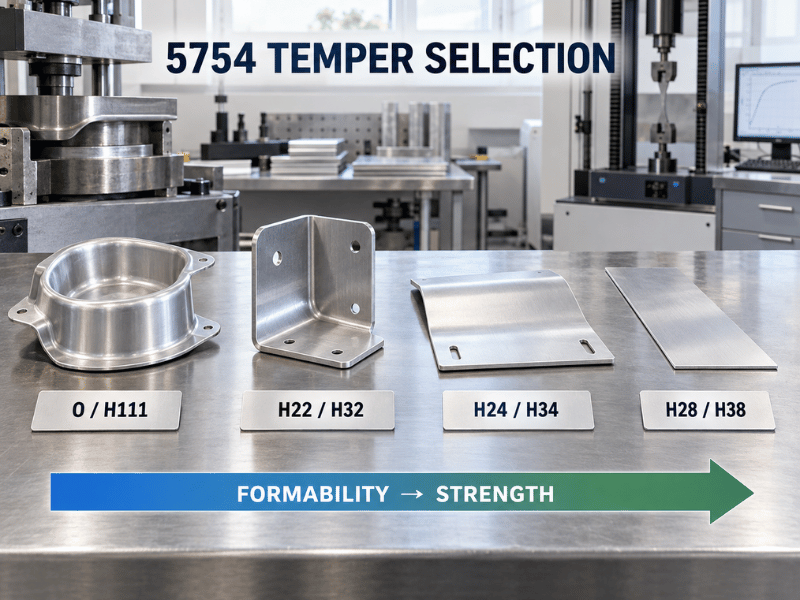
Die Ziffern nach dem H tragen die gesamte Spezifikation. Die erste Ziffer ist der Härtegrad — 2 ist viertelhart, 4 ist halbfest, 6 ist dreiviertelhart, 8 ist vollhart. Die zweite Ziffer ist die Wärmebehandlung: H1x ist nur kaltverfestigt, H2x ist kaltverfestigt und dann teilgeglüht, H3x ist kaltverfestigt und dann stabilisiert. H2x-Zustände bieten bei gleichem Härtegrad etwas besseres Umformverhalten als H1x, weshalb H22 und H24 bei umgeformten Bauteilen üblich sind.
- O / H111: geglüht, wobei H111 eine leichte Kaltverfestigung durch Umformung zulässt. Dies ist der Zustand, in dem umgeformt wird, und die Standardzustandsform für Riffelblech.
- H112: wie gefertigte Platte über 6 mm, mit garantierter Festigkeit auf dickebhängiger Basis. Üblich für Marine- und Strukturplatten.
- H22 / H32: viertelhart — der universelle Strukturblechzustand.
- H24 / H34: halbfest, für flachere Teile, die noch etwas Biegevermögen benötigen.
- H26 / H36 und H28 / H38: zunehmend fester und zunehmend weniger umformbar, hauptsächlich verwendet in dünnem Blech, wo Steifigkeit oder Beulwiderstand im Vordergrund stehen.
Da 5754 nicht aushärtbar ist, erweicht alles, was das Metall in den Bereich von 200–350 °C bringt, es wieder in Richtung des O-Zustands. Das ist der Mechanismus hinter den untenstehenden Schweiß- und Einsatztemperaturgrenzen.
Physikalische Eigenschaften
| Eigentum | Wert |
|---|---|
| Dichte | 2,66 g/cm³ |
| Schmelzbereich | ~600 – 640 °C |
| Wärmeleitfähigkeit | ~125 – 135 W/m·K |
| Elektrische Leitfähigkeit | ~32% IACS |
| Elastizitätsmodul | ~68 – 70 GPa |
| Wärmeausdehnungskoeffizient (20–100 °C) | ~23,7 × 10⁻⁶ /K |
| Spezifische Wärmekapazität | ~900 J/kg-K |
| Querkontraktionszahl | ~0.33 |
Die Leitfähigkeitswerte liegen etwas unter denen von 5052 (~138 W/m·K und ~35% IACS), was direkt auf den höheren Magnesiumgehalt zurückzuführen ist. Keiner der beiden Werte ist der Grund, warum jemand 5754 spezifiziert, aber beide sind relevant, wenn das Bauteil gleichzeitig als Wärmepfad oder elektrischer Pfad dient.
Arbeiten mit 5754: Umformen, Schweißen, Zerspanen und Oberflächenbehandlung
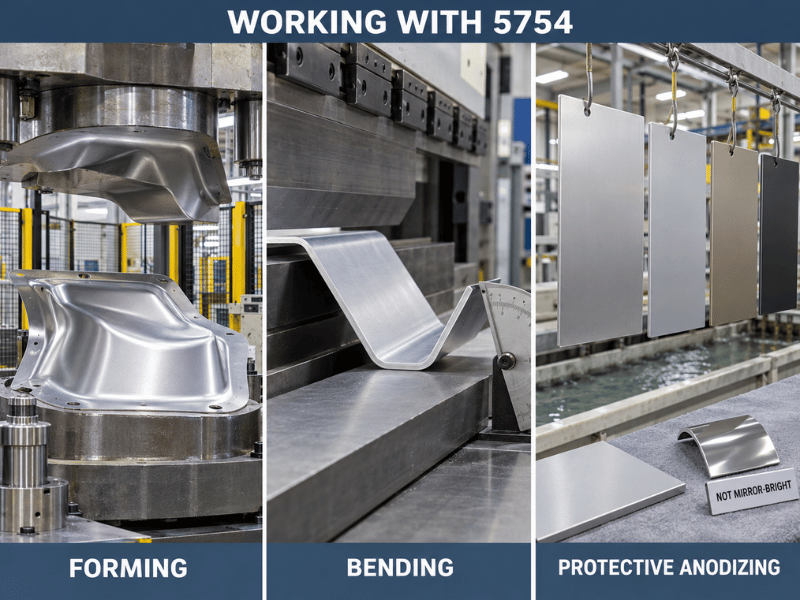
Umformen. 5754 lässt sich gut umformen, am besten in O/H111. Die Mindestbiegeradien nach EN 485-2 bieten einen brauchbaren Ausgangspunkt — etwa 0,5–2,0× der Dicke für eine 180°-Biegung in O/H111, 1,5–2,5× in H22/H32 und bis zu 3,0× in H24/H34, mit engeren Werten für dünnere Stärken. Bestätigen Sie dies mit einem Biegeversuch an Ihrem eigenen Werkzeug, da die Anforderung mit der Dicke und der Biegerichtung relativ zur Walzrichtung variiert.
Schweißen. Hier verdient sich 5754 seinen Ruf. WIG und MIG liefern beide ausgezeichnete Ergebnisse — 5356 ist das übliche Zusatzmaterial, 5183, wo höhere Schweißnahtfestigkeit benötigt wird. Anders als bei 6xxx-Legierungen behält die wärmebeeinflusste Zone nach dem Schweißen ihre Korrosionsbeständigkeit. Die eigentliche Konstruktionsgrenze ist die Festigkeit: Das Schweißen glüht die WEZ weich, sodass bei H22/H32-Material die Zone neben der Schweißnaht vom Bereich 220–270 MPa auf etwa 190–240 MPa abfällt, wobei die Streckgrenze von 130 MPa auf etwa 80 MPa sinkt. Dimensionieren Sie jeden Lastpfad durch die Verbindung für den geglühten Wert.
Zerspanung. Die Zerspanbarkeit ist bestenfalls mäßig. Die weicheren Zustände sind schmierig und neigen zum Reißen statt zum sauberen Schneiden — scharfe polierte Werkzeuge, hohe Spanwinkel, positiver Vorschub und reichlich Kühlmittel helfen alle. Das Löten ist schlecht und wird im Allgemeinen vermieden.
Oberflächenbehandlung. 5754 lässt sich gut anodisieren, obwohl Glanzanodisieren nicht seine Stärke ist. Werksdaten bewerten Schutz- und Hartanodisieren als sehr gut und Farbanodisieren als gut, was es zu einer legitimen dekorativen Wahl für Architektur- und Fahrzeugpaneelarbeiten macht. Aber das spiegelglänzende Finish, das 5005, 5657 oder 6063 liefern, ist hier nur “akzeptabel”, und die anodische Schicht kann einen leicht warmen Farbton aufweisen — wenn die Spezifikation helles Zierprofil verlangt, wählen Sie stattdessen eine dieser Legierungen. Pulverbeschichtung, PVDF und mechanisches Bürsten funktionieren alle gut, und da Linsy Anodisieren und Polieren im Haus durchführt, kann das Finish zusammen mit dem Material in einer Bestellung spezifiziert werden.
Wo 5754 verwendet wird
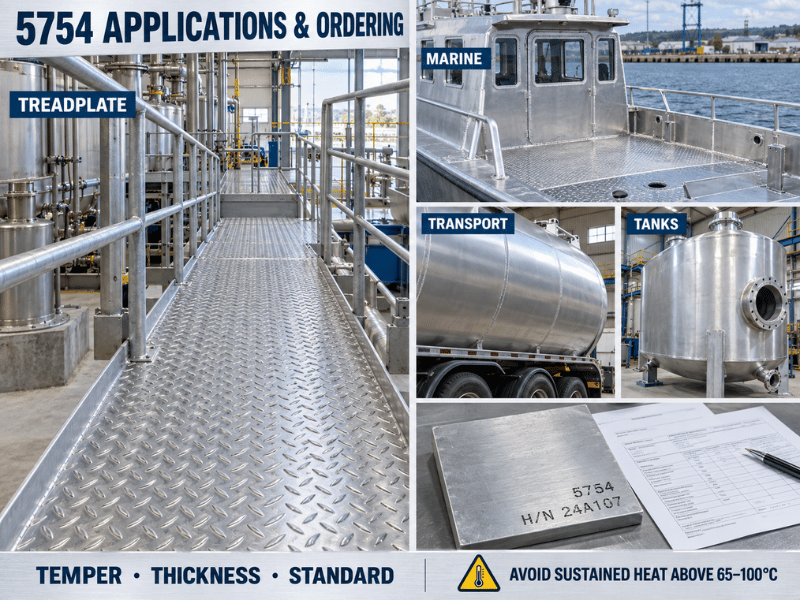
- Riffelblech und Bodenbeläge: H111 und H114 sind die Standard-Riffelblechzustände und decken Gehwege, Bootsdecks, Fahrzeugböden und industrielle Zugangsplattformen ab. Dies ist eine der Signature-Anwendungen von 5754.
- Schiffbau und Marine: Rumpfbeplankung bei kleineren Wasserfahrzeugen, Aufbauten, Decks und Beschlägen, wo Meerwasserbeständigkeit wichtiger ist als maximale Festigkeit.
- Fahrzeugkarosserien und Transport: Karosseriebleche, Lkw- und Anhängeraufbauten, Kraftstofftanks und Öltankerhüllen.
- Verfahrenstechnische Ausrüstung: Druckbehälter, Lagertanks und geschweißte Konstruktionen für chemische, lebensmittelverarbeitende und nukleare Anwendungen.
- Nieten: 5754 ist eine Standard-Nietlegierung, was wichtig ist, wenn das Befestigungselement und das Blech kompatibles Korrosionsverhalten benötigen.
- Architektur: Küsten- und Industrieverschalungen, wo die Korrosionsbeständigkeit und das Farbanodisierverhalten die Attraktion sind.
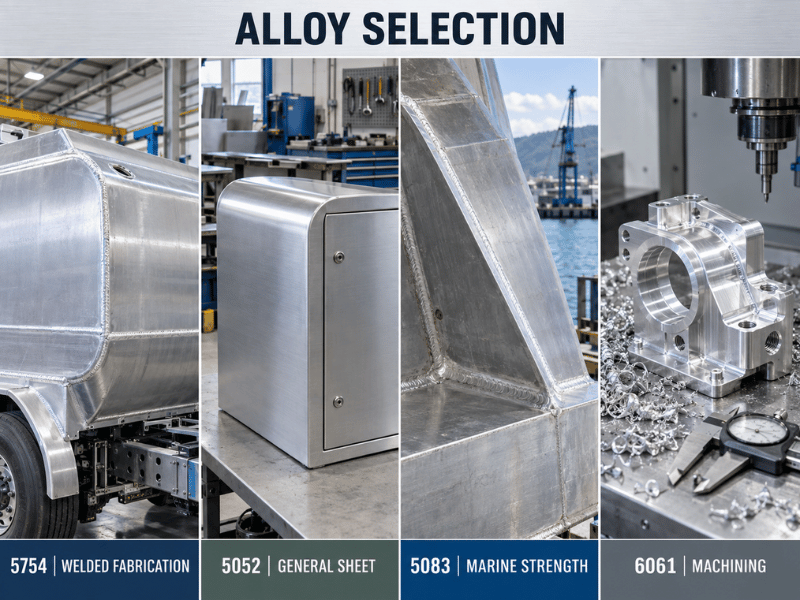
5754 vs. 5052 vs. 5083 vs. 6061
| Faktor | 5754 | 5052 | 5083 | 6061 |
|---|---|---|---|---|
| Hauptlegierungselement | Mg 2,6–3,6% | Mg 2,2–2,8% | Mg 4,0–4,9% | Mg 0,8–1,2%, Si 0,4–0,8% |
| Wärmebehandelbar | Nein | Nein | Nein | Ja |
| Zugfestigkeit, geglüht (O) | 190–240 MPa | 170–215 MPa | 290–345 MPa | — |
| Zugfestigkeit, viertelhart | 220–270 MPa (H22/H32) | 215–265 MPa (H32) | — | — |
| Zugfestigkeit, stärkster gängiger Zustand | ≥290 MPa (H28/H38) | ~290 MPa (H38) | 305–380 MPa (H116/H321) | 310 MPa (T6) |
| Streckgrenze, viertelhart | ≥130 MPa (H32) | ≥160 MPa (H32) | ≥215 MPa (H321) | 276 MPa (T6) |
| Meerwasserkorrosion | Ausgezeichnet | Ausgezeichnet | Hervorragend | Gut |
| Schweißeignung | Ausgezeichnet | Ausgezeichnet | Ausgezeichnet | Gut |
| Verformbarkeit | Hervorragend in O | Ausgezeichnet | Gut | Mäßig |
| Bearbeitbarkeit | Messe | Messe | Messe | Gut |
| Anhaltend erhöhte Temperatur | Vorsicht über ~65–100 °C | Besser geeignet | Vorsicht über ~65 °C | Gut |
Die beiden 5xxx-Spalten werden nach unterschiedlichen Normen angegeben — EN 485-2 für 5754, ASTM B209 für 5052 —, daher ist jede gegen ihre eigene Norm zu lesen, anstatt einen Mindestwert vom anderen abzuziehen. So gelesen liegen 5754-H22/H32 und 5052-H32 im selben Viertelhärtungsbereich (220–270 vs. 215–265 MPa Zugfestigkeit), sodass bei H32 die Wahl zwischen ihnen eher von Verfügbarkeit, Preis und Produktform abhängt als von der Festigkeit. Der eigentliche Unterschied auf Legierungsebene liegt an den Enden des Zustandsbereichs: etwa 10–15 % im geglühten Zustand (190–240 vs. 170–215 MPa), wo 5754 seinen Aufpreis rechtfertigt — ein in H32 bestelltes Teil nicht.
- 5754 — geschweißte Marine-, Fahrzeug- und Verfahrenstechnik-Fertigung; Riffelblech; umgeformte Bleche, die mehr geglühte Festigkeit als 5052 benötigen.
- 5052 — allgemeine Blecharbeiten, Kraftstofftanks und die günstigere 5xxx-Standardwahl, wo 5754s zusätzliche geglühte Festigkeit nicht benötigt wird.
- 5083 — klassenzertifiziertes Marineschiffbau-Blech und die stärkste der drei, bei höheren Kosten und mit einer festeren Betriebsobergrenze von 65 °C.
- 6061 — wärmebehandelbare Festigkeit und bessere Zerspanbarkeit, mit geringerer Korrosionsbeständigkeit im Marineeinsatz.
Go / No-Go: Wann 5754 die richtige Wahl ist
Wählen Sie 5754, wenn:
- Die Konstruktion geschweißt wird und Meerwasser, chemischen oder industriellen Atmosphären ausgesetzt ist — 5754 behält seine Korrosionsbeständigkeit durch die Wärmeeinflusszone hindurch.
- Sie mehr geglühte Festigkeit benötigen, als 5052 für ein umgeformtes Blech bietet.
- Das Teil Riffelblech, Bodenbelag oder ein Laufsteg ist — H111/H114 ist der etablierte Zustand.
- Die Anwendung ein Druckbehälter, Tank oder LKW-Aufbau ist, bei dem sowohl Schweißintegrität als auch Korrosionsbeständigkeit wichtig sind.
- Das Budget nicht für 5083 reicht, aber 5052 grenzwertig ist.
Suchen Sie woanders, wenn:
- Der Betrieb kontinuierlich über etwa 65–100 °C läuft. Mit einem Magnesiumgehalt von 3,6 % liegt 5754 in dem Bereich, in dem die β-Phase entlang der Korngrenzen ausgeschieden werden kann und die Beständigkeit gegen interkristalline Korrosion sinkt. 5454 ist die Legierung, die für erhöhte Temperaturen im 5xxx-Einsatz entwickelt wurde; 5052 ist die sicherere allgemeine Wahl.
- Sie maximale Festigkeit in klassenzertifiziertem Marineblech benötigen — 5083 H116 oder H321.
- Die Konstruktion wärmebehandelbare Festigkeit erfordert — 6061.
- Die Oberflächenspezifikation glänzend oder spiegelblank eloxiert ist — 5005, 5657 oder 6063.
Beschaffung von 5754: Was vor der Bestellung zu bestätigen ist
- Norm und Dickenbereich: EN 485-2-Werte ändern sich mit der Dicke, daher ist die maßgebliche Norm anzugeben und der Dickenbereich in der Anfrage, nicht nur der Zustand.
- Zustand passend zur Umformfolge: O/H111 für starke Umformung und Riffelblech, H22/H32 für Strukturblech, H24/H34 wo das Teil relativ flach bleibt.
- Produktform: Blech, Band und Platte sind Standard; Stangen, Stäbe, Rohre und Profile sind verfügbar. Riffelblech ist normalerweise H111/H114.
- Verfügbarkeit: 5754 ist eine EN-Legierung. Außerhalb europäischer Lieferketten wird sie weit weniger breit gelagert als 5052, daher ist die Vorlaufzeit für nicht standardmäßige Zustände oder Stärken in die Planung einzubeziehen.
- Dokumentation: MTC mit jeder Bestellung; SGS-Berichte zu Chemie, Mechanik und Abmessungen auf Anfrage für Struktur- oder Exportarbeiten erhältlich.
Linsy Aluminum liefert 5754 in Platte, Blech, Coil, Rohr und Stange in O, H111, H22/H32, H24/H34 und anderen Zuständen auf Anfrage, mit hauseigener CNC-Bearbeitung, Laserschneiden, WIG- und MIG-Schweißen, Eloxieren und Polieren. Kundenspezifische Abmessungen laufen bei niedriger MOQ, mit typischen Vorlaufzeiten von 10–60 Tagen, und ein MTC wird mit jeder Bestellung geliefert.
Schlussfolgerung
5754 ist eine Legierung für geschweißte Konstruktionen, kein Festigkeits-Upgrade. Ihre wirklichen Vorteile sind der Vorsprung bei geglühter Festigkeit gegenüber 5052, Meerwasserkorrosionsbeständigkeit, die das Schweißen übersteht, und ein Zustandsbereich von tiefgezogen bis vollhart. Der Kompromiss ist festgelegt: keine Wärmebehandlung, Festigkeit unter 5083 und eine Betriebstemperaturobergrenze, die einen dauerhaften Heißbetrieb ausschließt.
Spezifizieren Sie sie richtig, indem Sie Zustand und Dickenbereich zusammen angeben — EN 485-2-Werte ändern sich mit beiden — und bemessen Sie Schweißverbindungen für die geglühte WEZ-Festigkeit, nicht für den Zustand auf der Bestellung. Linsy Aluminum liefert 5754 in Platte, Blech, Coil, Rohr und Stange über die gängigen Zustände, mit hauseigener Bearbeitung, Laserschneiden, Schweißen, Eloxieren und Polieren, sodass Werkstoff und Oberfläche zusammen spezifiziert werden.
Senden Sie Ihre Zeichnung, den Zielzustand und die Einsatzbedingungen für eine Eignungsprüfung und ein Angebot.
FAQ
Ist 5754 stärker als 5052?
Im geglühten Zustand ja — 5754 liegt bei 190–240 MPa gegenüber 5052s 170–215 MPa, etwa 10–15 % Vorsprung. Bei H32 konvergieren die beiden bis zu dem Punkt, an dem der Unterschied marginal ist (220–270 MPa gegenüber 215–265 MPa), sodass dort der Zustand mehr zählt als die Legierungswahl. Die Behauptung ’10–20 % stärker durchgängig“, die in Lieferantenzusammenfassungen kursiert, hält einer Prüfung der tatsächlichen Zustandsdaten nicht stand.
Kann 5754 für eine dekorative Oberfläche eloxiert werden?
Ja, mit einem Vorbehalt. Werksdaten bewerten Schutz- und Harteloxieren als sehr gut und Farbeeloxieren als gut, sodass 5754 eine legitime Legierung für dekoratives Eloxieren ist. Was sie Ihnen nicht bietet, ist eine glänzende, spiegelnde Oberfläche — Glanzeloxieren wird nur als akzeptabel bewertet, und die Schicht kann einen wärmeren Farbton aufweisen. Für glänzende Zierleisten spezifizieren Sie 5005, 5657 oder 6063.
Schwächt Schweißen 5754?
Die Korrosionsbeständigkeit bleibt erhalten; die Festigkeit nicht, in der Wärmeeinflusszone. Bei H22/H32-Material fällt die WEZ von 220–270 MPa auf geglühte Werte um 190–240 MPa, und die Streckgrenze sinkt von mindestens 130 MPa auf etwa 80 MPa. Auslegen jedes Lastpfads durch eine Schweißnaht für den geglühten Wert. Zusatzwerkstoff ist normalerweise 5356 oder 5183 für höhere Schweißfestigkeit.
Ist 5754 für Meeresumgebungen geeignet?
Ja. Sie hat hervorragende Beständigkeit gegen Meerwasser und Industrieatmosphäre und wird für Rumpfbeplattung, Decks, Aufbauten und Beschläge verwendet. Für klassenzertifizierte Rumpfstrukturen bei maximaler Festigkeit ist 5083 in H116 oder H321 die übliche Steigerung.
Kann 5754 bei erhöhter Temperatur verwendet werden?
Mit Vorsicht. Magnesium erreicht 3,6 % am oberen Ende des Bereichs, was dem Niveau entspricht, auf dem β-Phasen-Ausscheidung entlang der Korngrenzen die Beständigkeit gegen interkristalline Korrosion bei langer Exposition über etwa 65–100 °C verringern kann. Für dauerhaften Einsatz bei erhöhter Temperatur ist 5454 die dafür entwickelte Legierung, und 5052 ist die sicherere allgemeine Alternative.