¿Qué es el aluminio 5754?
El 5754 es una aleación de aluminio-magnesio forjada no tratable térmicamente, con el magnesio (2,6–3,6%) como elemento de aleación principal y el manganeso más el cromo como adiciones menores controladas. Es una aleación de norma EN en primer lugar y global en segundo — registrada como UNS A95754, pero mucho más profundamente integrada en las cadenas de suministro europeas que en el stock norteamericano.
Su resistencia proviene del endurecimiento por solución sólida del magnesio más el endurecimiento por deformación en frío. No existe respuesta al endurecimiento por precipitación, por lo que no hay equivalente T6; el temple es la única palanca. Dentro de la familia 5xxx, el 5754 es más resistente que el 5251, más resistente que el 5052 en estado recocido, y por debajo del 5083 en resistencia absoluta pero más fácil de conformar y menos costoso.
Composición química del 5754
| Elemento | Contenido (% en peso, máx. salvo indicación) | Función en la aleación |
|---|---|---|
| Magnesio (Mg) | 2.6 – 3.6 | Endurecedor primario; impulsa la respuesta al endurecimiento por deformación y el comportamiento frente a la corrosión |
| Manganeso (Mn) | 0.50 | Refuerza la matriz, controla el tamaño de grano durante la recristalización |
| Cromo (Cr) | 0.30 | Forma dispersoides finos que limitan el crecimiento de grano |
| Mn + Cr (combinados) | 0.10 – 0.60 | Límite combinado — el rango que mantiene estable la estructura de la aleación |
| Hierro (Fe) | 0.40 | Impureza; forma intermetálicos catódicos que pueden iniciar picaduras |
| Silicio (Si) | 0.40 | Impureza; se combina con el hierro y afecta el aspecto anodizado |
| Zinc (Zn) | 0.20 | Impureza, estrictamente limitada |
| Cobre (Cu) | 0.10 | Estrictamente limitado — el cobre reduce la resistencia general a la corrosión |
| Titanio (Ti) | 0.15 | Refinador de grano añadido en la colada |
| Otros (cada uno / total) | 0.05 / 0.15 | Oligoelementos controlados para la consistencia entre lotes |
| Aluminio (Al) | Saldo | Metal común |
Dos límites máximos importan más que el resto en servicio. El cobre se limita a 0,10% porque incluso pequeñas cantidades reducen la resistencia general a la corrosión en ambientes con cloruros, y el hierro se limita a 0,40% porque los intermetálicos ricos en hierro actúan como cátodos locales e inician picaduras. Ambos son la razón por la que el 5754 se comporta tan bien como lo hace en agua de mar.
Especificaciones y designaciones equivalentes
| Norma / registro | Denominación |
|---|---|
| EN (símbolos químicos) | EN AW-5754 / EN AW-AlMg3 |
| Normas EN | EN 573-3 (composición), EN 485-2 (propiedades mecánicas para chapa, banda y placa) |
| DIN / Werkstoff-Nr. | 3.3535 |
| ISO | AlMg3 |
| UNS | A95754 |
| Normas de producto típicas | Chapa, banda, placa; también barra, perfil, tubo y perfil estructural |
Propiedades mecánicas según el estado de templado
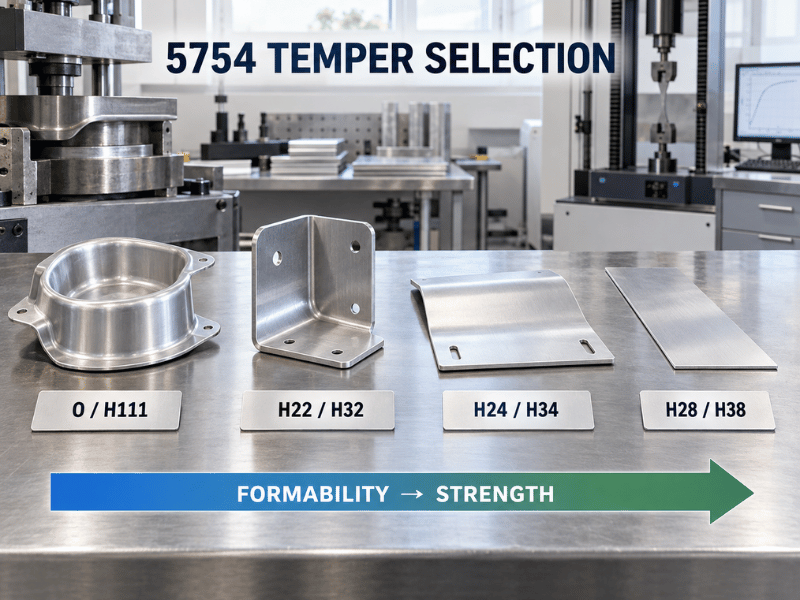
Los valores a continuación son requisitos de la EN 485-2 para chapa, banda y placa. Nótese que tanto el rango de resistencia como el alargamiento mínimo varían con el espesor — las cifras corresponden a la banda de 0,5–6 mm habitualmente suministrada.
| Temple | Resistencia a la tracción Rm (MPa) | Límite elástico Rp0,2, mín. (MPa) | Alargamiento A50, mín. (%) | Dureza HBW |
|---|---|---|---|---|
| O / H111 | 190 – 240 | 80 | 12 – 18 | 52 |
| H112 (placa >6 mm) | ≥ 190 | 80 – 100 | 10 – 14 | 52 – 62 |
| H22 / H32 (cuarto duro) | 220 – 270 | 130 | 7 – 11 | 63 |
| H24 / H34 (medio duro) | 240 – 280 | 160 | 6 – 10 | 70 |
| H26 / H36 (tres cuartos) | 265 – 305 | 190 | 4 – 6 | 78 |
| H28 / H38 (duro completo) | ≥ 290 | 230 | 2 – 4 | 87 |
Tempers: O, H111, H22/H32, H24/H34 y más allá
Los dígitos después de la H conllevan toda la especificación. El primer dígito es el nivel de dureza — 2 es cuarto duro, 4 es medio duro, 6 es tres cuartos, 8 es duro completo. El segundo dígito es el tratamiento térmico: H1x es solo endurecido por deformación, H2x es endurecido por deformación y luego recocido parcialmente, H3x es endurecido por deformación y luego estabilizado. Los tempers H2x dan un comportamiento de conformado ligeramente mejor que los H1x al mismo nivel de dureza, por lo que H22 y H24 son comunes en paneles conformados.
- O / H111: recocido, con H111 permitiendo un ligero endurecimiento por deformación debido al conformado. Esta es la condición para conformar, y el temple estándar para chapa antideslizante.
- H112: placa tal como se fabrica por encima de 6 mm, con resistencia garantizada sobre una base dependiente del espesor. Común para placa marina y estructural.
- H22 / H32: cuarto duro — la condición de chapa estructural de uso general.
- H24 / H34: medio duro, para piezas más planas que aún necesitan cierta capacidad de plegado.
- H26 / H36 y H28 / H38: progresivamente más resistentes y progresivamente menos conformables, usados mayormente en chapa fina donde la rigidez o la resistencia a las abolladuras es lo principal.
Dado que el 5754 no es tratable térmicamente, cualquier cosa que eleve el metal al rango de 200–350 °C lo ablanda de vuelta hacia la condición O. Ese es el mecanismo detrás de los límites de soldadura y temperatura de servicio a continuación.
Propiedades físicas
| Propiedad | Valor |
|---|---|
| Densidad | 2,66 g/cm³ |
| Rango de fusión | ~600 – 640 °C |
| Conductividad térmica | ~125 – 135 W/m·K |
| Conductividad eléctrica | ~32% IACS |
| Módulo de elasticidad | ~68 – 70 GPa |
| Coeficiente de expansión térmica (20–100 °C) | ~23,7 × 10⁻⁶ /K |
| Capacidad calorífica específica | ~900 J/kg-K |
| Coeficiente de Poisson | ~0.33 |
Los valores de conductividad se sitúan ligeramente por debajo de los del 5052 (~138 W/m·K y ~35% IACS), lo cual se deriva directamente del mayor contenido de magnesio. Ninguno de los dos valores es la razón por la que alguien especifica el 5754, pero ambos importan si la pieza también funciona como vía térmica o vía eléctrica.
Trabajar con 5754: Conformado, Soldadura, Mecanizado y Acabado
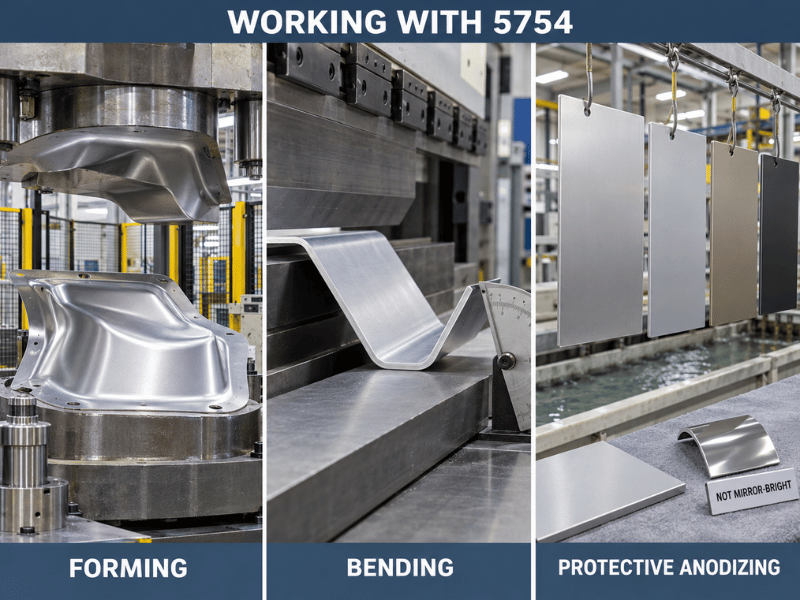
Conformado. El 5754 se conforma bien, mejor en O/H111. Los radios de plegado mínimos de la EN 485-2 ofrecen un punto de partida utilizable — aproximadamente 0,5–2,0× el espesor para un plegado de 180° en O/H111, 1,5–2,5× en H22/H32, y hasta 3,0× en H24/H34, con cifras más ajustadas para espesores más finos. Confirme con un ensayo de plegado en su propio utillaje, ya que el requisito cambia con el espesor y la dirección de plegado respecto a la laminación.
Soldadura. Aquí es donde el 5754 se gana su reputación. Tanto TIG como MIG dan resultados excelentes — el 5356 es el material de aporte habitual, el 5183 donde se necesita mayor resistencia de soldadura. A diferencia de las aleaciones 6xxx, la zona afectada térmicamente conserva su resistencia a la corrosión después de soldar. El verdadero límite de diseño es la resistencia: la soldadura recuece la ZAT, por lo que en material H22/H32 la zona junto a la soldadura cae de la banda de 220–270 MPa a alrededor de 190–240 MPa, con el límite elástico bajando de 130 MPa a unos 80 MPa. Dimensione cualquier trayectoria de carga a través de la unión para el valor recocido.
Mecanizado. La maquinabilidad es aceptable como mucho. Los temple más blandos son pegajosos y tienden a desgarrar en lugar de cortar limpiamente — herramientas afiladas y pulidas, ángulos de desprendimiento altos, avance positivo y abundante refrigerante ayudan. La soldadura fuerte es pobre y generalmente se evita.
Acabado. El 5754 se anodiza bien, aunque el anodizado brillante no es lo suyo. Los datos de fábrica califican el anodizado protector y duro como muy bueno y el anodizado coloreado como bueno, lo que lo convierte en una opción decorativa legítima para trabajos de paneles arquitectónicos y de vehículos. Pero el acabado brillante como espejo que ofrecen el 5005, 5657 o 6063 aquí solo es “aceptable”, y la capa anódica puede presentar un tono ligeramente cálido — si la especificación exige molduras brillantes, elija una de esas aleaciones en su lugar. El recubrimiento en polvo, el PVDF y el cepillado mecánico funcionan bien, y dado que Linsy realiza el anodizado y el pulido internamente, el acabado puede especificarse junto con el material en un solo pedido.
Dónde se utiliza el 5754
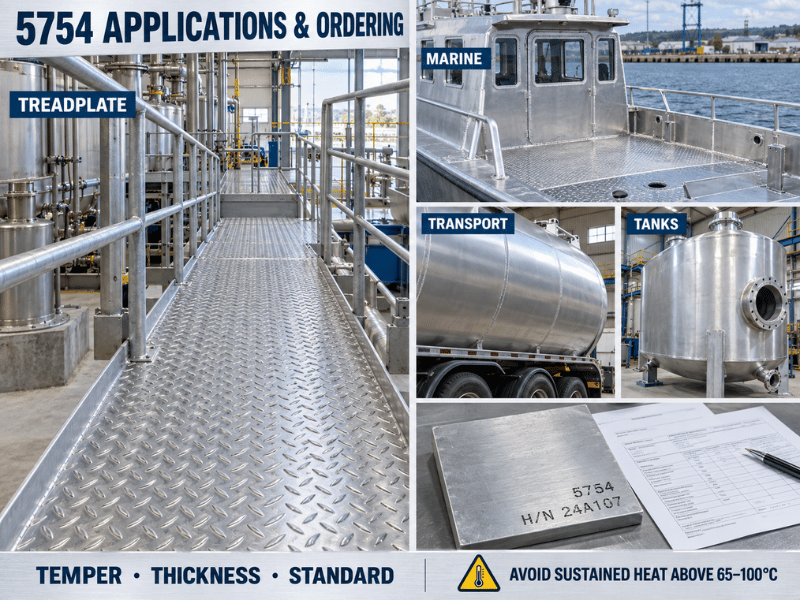
- Chapa antideslizante y pavimentos: H111 y H114 son los temple estándar para chapa antideslizante, cubriendo pasarelas, cubiertas de embarcaciones, pisos de vehículos y plataformas de acceso industriales. Esta es una de las aplicaciones emblemáticas del 5754.
- Construcción naval y marina: forro del casco en embarcaciones menores, superestructuras, cubiertas y accesorios donde la resistencia al agua de mar importa más que la resistencia máxima.
- Carrocerías de vehículos y transporte: paneles de carrocería, carrocerías de camiones y remolques, tanques de combustible y cascos de buques cisterna.
- Equipos de proceso: recipientes a presión, tanques de almacenamiento y estructuras soldadas para servicio químico, de procesamiento de alimentos y nuclear.
- Remaches: El 5754 es una aleación estándar para remaches, lo cual importa cuando el sujetador y la chapa necesitan un comportamiento frente a la corrosión compatible.
- Arquitectura: revestimiento costero e industrial, donde la resistencia a la corrosión y la respuesta al anodizado coloreado son el atractivo.
5754 vs 5052 vs 5083 vs 6061
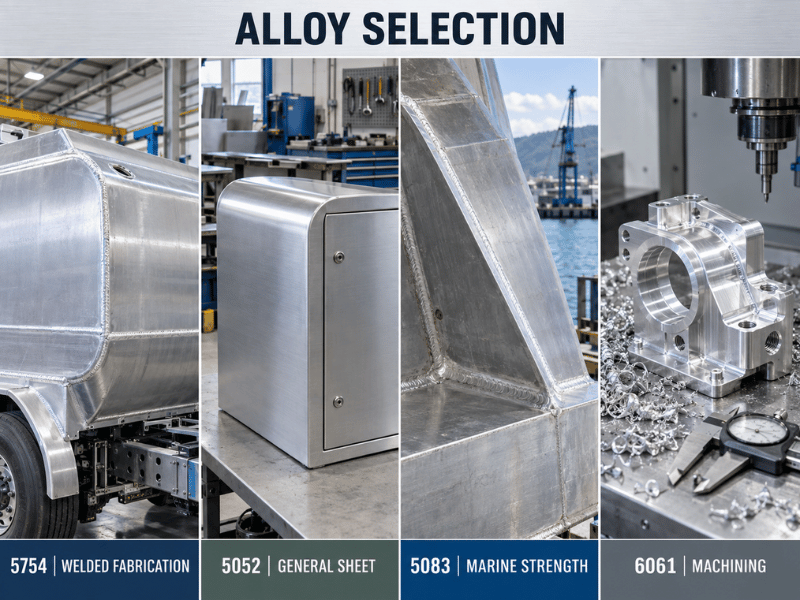
| Factor | 5754 | 5052 | 5083 | 6061 |
|---|---|---|---|---|
| Aleación principal | Mg 2,6–3,6% | Mg 2,2–2,8 % | Mg 4,0–4,9% | Mg 0,8–1,2 %, Si 0,4–0,8 % |
| Tratable térmicamente | No | No | No | Sí |
| Tracción, recocido (O) | 190–240 MPa | 170–215 MPa | 290–345 MPa | — |
| Tracción, cuarto duro | 220–270 MPa (H22/H32) | 215–265 MPa (H32) | — | — |
| Tracción, más resistente común | ≥290 MPa (H28/H38) | ~290 MPa (H38) | 305–380 MPa (H116/H321) | 310 MPa (T6) |
| Límite elástico, cuarto duro | ≥130 MPa (H32) | ≥160 MPa (H32) | ≥215 MPa (H321) | 276 MPa (T6) |
| Corrosión en agua de mar | Excelente | Excelente | Sobresaliente | Bien |
| Soldabilidad | Excelente | Excelente | Excelente | Bien |
| Formabilidad | Excelente en O | Excelente | Bien | Moderado |
| Maquinabilidad | Feria | Feria | Feria | Bien |
| Temperatura elevada sostenida | Precaución por encima de ~65–100 °C | Mejor adaptado | Precaución por encima de ~65 °C | Bien |
Las dos columnas 5xxx se citan según normas diferentes — EN 485-2 para el 5754, ASTM B209 para el 5052 —, por lo que cada una debe leerse frente a su propia norma en lugar de restar un mínimo del otro. Leído así, el 5754-H22/H32 y el 5052-H32 se sitúan en el mismo intervalo de semi-duro (220–270 vs 215–265 MPa de resistencia a la tracción), por lo que en H32 la elección entre ambos depende de la disponibilidad, el precio y la forma del producto, no de la resistencia. La verdadera diferencia a nivel de aleación se encuentra en los extremos del intervalo de temple: aproximadamente un 10–15 % en la condición recocida (190–240 vs 170–215 MPa), que es donde el 5754 justifica su prima — una pieza pedida en H32 no lo hace.
- 5754 — fabricación soldada marina, de vehículos y de proceso; chapa antideslizante; paneles conformados que necesitan más resistencia en estado recocido que el 5052.
- 5052 — trabajo general de chapa metálica, depósitos de combustible y la opción 5xxx más económica por defecto cuando no se necesita la resistencia adicional en estado recocido del 5754.
- 5083 — chapa de casco marino con certificación de clase y la más resistente de las tres, a mayor coste y con un límite de servicio más estricto de 65 °C.
- 6061 — resistencia tratable térmicamente y mejor mecanibilidad, con menor resistencia a la corrosión en servicio marino.
Ir / No ir: cuándo el 5754 es la elección correcta
Elija 5754 cuando:
- La estructura esté soldada y vaya a estar expuesta a agua de mar, atmósferas químicas o industriales — el 5754 conserva su resistencia a la corrosión a través de la ZAT.
- Necesite más resistencia en estado recocido que la que ofrece el 5052 para un panel conformado.
- La pieza sea chapa antideslizante, pavimento o pasarela — H111/H114 es el temple establecido.
- La aplicación sea un recipiente a presión, un tanque o una carrocería de camión donde tanto la integridad de la soldadura como la resistencia a la corrosión sean importantes.
- El presupuesto no alcance para el 5083 pero el 5052 sea marginal.
Busque otra opción cuando:
- El servicio funcione continuamente por encima de aproximadamente 65–100 °C. Con el magnesio alcanzando el 3,6 %, el 5754 se sitúa en el intervalo donde la fase β puede precipitar a lo largo de los límites de grano y la resistencia a la corrosión intergranular disminuye. El 5454 es la aleación diseñada para servicio 5xxx a temperatura elevada; el 5052 es la opción general más segura.
- Necesite la máxima resistencia en chapa marina con certificación de clase — 5083 H116 o H321.
- El diseño exija resistencia tratable térmicamente — 6061.
- La especificación de acabado sea anodizado brillante o espejo — 5005, 5657 o 6063.
Abastecimiento del 5754: qué confirmar antes de pedir
- Norma y banda de espesor: Los valores de la EN 485-2 varían con el espesor, por lo que hay que citar la norma aplicable y el intervalo de espesor en la consulta, no solo el temple.
- Temple adaptado a la secuencia de conformado: O/H111 para conformado pesado y chapa antideslizante, H22/H32 para chapa estructural, H24/H34 donde la pieza permanezca relativamente plana.
- Forma del producto: chapa, fleje y placa son estándar; redondo, barra, tubo y perfil están disponibles. La chapa antideslizante es normalmente H111/H114.
- Disponibilidad: El 5754 es una aleación EN. Fuera de las cadenas de suministro europeas se almacena mucho menos ampliamente que el 5052, por lo que hay que incorporar el plazo de entrega en la planificación para temples o calibres no estándar.
- Documentación: MTC con cada pedido; informes químicos, mecánicos y dimensionales de SGS disponibles bajo solicitud para trabajos estructurales o de exportación.
Linsy Aluminum suministra 5754 en placa, chapa, bobina, tubo y barra en O, H111, H22/H32, H24/H34 y otros temples bajo solicitud, con mecanizado CNC, corte por láser, soldadura TIG y MIG, anodizado y pulido propios. Las dimensiones personalizadas se ejecutan con MOQ bajo, con plazos de entrega típicos de 10–60 días, y se envía un MTC con cada pedido.
Conclusión
El 5754 es una aleación para fabricación soldada, no una mejora de resistencia. Sus ventajas reales son la ventaja de resistencia en estado recocido frente al 5052, una resistencia a la corrosión en agua de mar que sobrevive a la soldadura y un intervalo de temples desde embutición profunda hasta totalmente endurecido. La contrapartida es fija: sin tratamiento térmico, resistencia inferior al 5083 y un límite de temperatura de servicio que descarta el servicio en caliente sostenido.
Especifíquelo correctamente citando el temple y la banda de espesor juntos — los valores de la EN 485-2 varían con ambos — y dimensionando las uniones soldadas para la resistencia de la ZAT en estado recocido, no para el temple del pedido. Linsy Aluminum suministra 5754 en placa, chapa, bobina, tubo y barra en los temples comunes, con mecanizado, corte por láser, soldadura, anodizado y pulido propios, de modo que el material y el acabado se especifican conjuntamente.
Envíe su plano, temple objetivo y condiciones de servicio para una revisión de idoneidad de grado y un presupuesto.
PREGUNTAS FRECUENTES
¿Es el 5754 más resistente que el 5052?
En la condición recocida, sí — el 5754 va de 190–240 MPa frente a los 170–215 MPa del 5052, aproximadamente una ventaja del 10–15 %. En H32 los dos convergen hasta el punto en que la diferencia es marginal (220–270 MPa frente a 215–265 MPa), por lo que el temple importa más que la elección de aleación en ese caso. La afirmación de ’un 10–20 % más resistente en todos los aspectos“ que circula en los resúmenes de proveedores no resiste un examen de los datos reales de temple.
¿Se puede anodizar el 5754 para un acabado decorativo?
Sí, con una salvedad. Los datos de fábrica califican el anodizado protector y duro como muy bueno y el anodizado en color como bueno, por lo que el 5754 es una aleación legítima para anodizado decorativo. Lo que no le dará es un acabado brillante tipo espejo — el anodizado brillante solo se califica como aceptable, y la capa puede presentar un tono más cálido. Para molduras brillantes, especifique 5005, 5657 o 6063.
¿Debilita la soldadura el 5754?
La resistencia a la corrosión se mantiene; la resistencia no, en la zona afectada por el calor. En material H22/H32 la ZAT cae de 220–270 MPa a niveles de recocido en torno a 190–240 MPa, y el límite elástico baja de 130 MPa mínimos a unos 80 MPa. Diseñe cualquier trayectoria de carga a través de una soldadura para el valor en estado recocido. El material de aporte es normalmente 5356, o 5183 para mayor resistencia de la soldadura.
¿Es el 5754 adecuado para entornos marinos?
Sí. Tiene una excelente resistencia a la corrosión en agua de mar y en atmósfera industrial y se utiliza para chapas de casco, cubiertas, superestructuras y accesorios. Para estructura de casco con certificación de clase a máxima resistencia, el 5083 en H116 o H321 es el siguiente escalón habitual.
¿Se puede utilizar el 5754 a temperatura elevada?
Con precaución. El magnesio alcanza el 3,6 % en el extremo superior del intervalo, que es el nivel en el que la precipitación de fase β a lo largo de los límites de grano puede reducir la resistencia a la corrosión intergranular durante una exposición prolongada por encima de aproximadamente 65–100 °C. Para servicio sostenido a temperatura elevada, el 5454 es la aleación diseñada para ello, y el 5052 es la alternativa general más segura.