4040 is the workhorse of modular aluminium framing. It is a 40 × 40 mm square profile with T-slots on its faces, sitting in the middle of the range — large enough to carry a machine frame or a workstation, small enough to keep the assembly light and affordable.
Treat “4040” as a cross-section size, not a material. Two 4040 profiles can differ in slot width, wall thickness, and the alloy they are pressed from — and those three things decide whether your accessories fit, how much the frame can carry, and what it costs.
What Is 4040 Aluminum Extrusion?
4040 aluminium extrusion is a square aluminium profile measuring 40 mm × 40 mm, pressed with T-slots running along its length so brackets, nuts, and hinges can be fixed anywhere without drilling.
The section is normally extruded from 6063-T5 and supplied in 6 m bars, then cut to length. The slots give the system its speed: a T-nut slides into the channel, a bolt tightens it, and a rigid joint is made in minutes with hand tools.
It Is a Profile Size, Not an Alloy Grade
“4040” describes geometry. It says nothing about chemistry, and there is no 4040 wrought aluminium alloy.
The number belongs to the T-slot framing series — 2020, 3030, 4040, 4080, 8080 — where the first two digits give the section width in millimetres. That naming has no connection to alloy designations such as 6063 or 6061.
So a drawing that says “4040 aluminium” is only half a specification. It still has to state the alloy, the temper, and the slot width.
How the T-Slot System Works
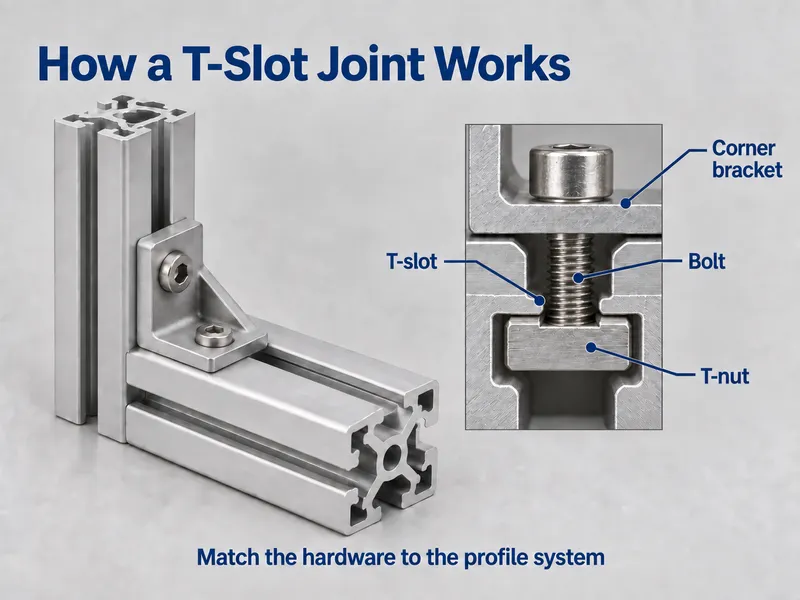
A T-slot is a channel with a narrow mouth and a wider internal cavity. A nut or bolt head slides along the cavity, and tightening it clamps the part wherever you stopped.
That single detail is what separates framing profile from ordinary tube. No welding and no drilling are needed, joints can be repositioned, and a frame can be dismantled and rebuilt somewhere else.
Typical hardware: T-nuts and T-bolts for structural joints, corner brackets and gussets for right angles, end caps and joint connectors for finishing, and hinges or castors for moving parts. Most of it is tightened with a hex key.
8 mm vs 10 mm Slots
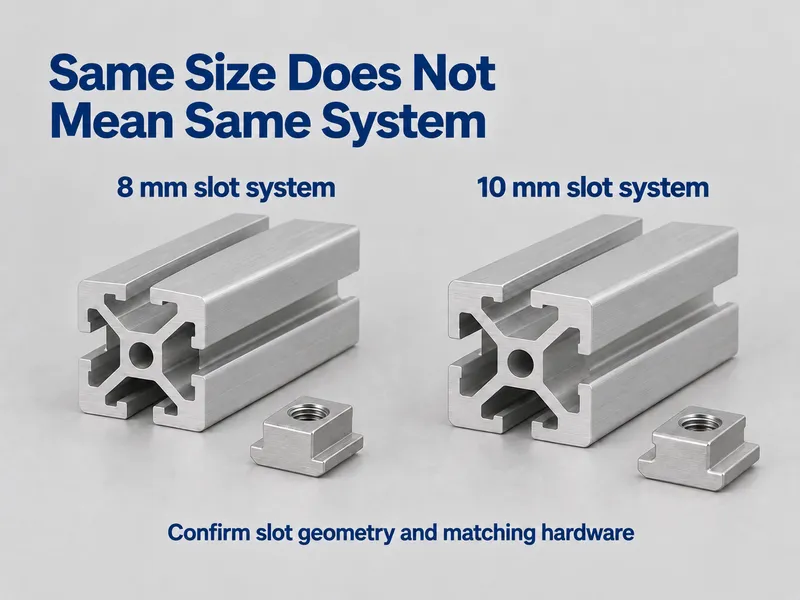
The 40-series is sold in two slot standards, and accessories do not interchange between them. The metric European standard is the 8 mm slot, which dominates machine building and automation framing; some ranges use a 10 mm slot instead.
Measure the slot mouth before buying anything that has to sit in it. A batch of 8 mm T-nuts will not fit a 10 mm channel, and the mistake only shows up when the frame is being assembled.
Material: Alloy and Temper
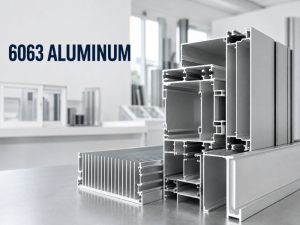
Almost all 4040 profile is extruded from 6063, a heat-treatable Al-Mg-Si alloy chosen for extrudability and surface finish rather than peak strength. The 6063 extrusion guide covers how that alloy is pressed into profiles. 6061 is the alternative when a frame carries heavier loads.
Chemical Composition
Ranges follow EN 573-3 (EN AW-6063 / AlMg0.7Si) and ASTM B221.
| Element | Content (% by weight) | Role |
| Silicon (Si) | 0.20–0.60 | Forms the Mg₂Si strengthening phase |
| Magnesium (Mg) | 0.45–0.90 | Main age-hardening element |
| Iron (Fe) | ≤0.35 | Impurity limit |
| Copper (Cu) | ≤0.10 | Impurity limit; excess harms corrosion |
| Manganese (Mn) | ≤0.10 | Impurity limit |
| Chromium (Cr) | ≤0.10 | Impurity limit |
| Zinc (Zn) | ≤0.10 | Impurity limit |
| Titanium (Ti) | ≤0.10 | Grain refiner |
| Others (each / total) | ≤0.05 / ≤0.15 | Trace limits |
| Aluminium (Al) | Balance | Base metal |
Mechanical Properties by Temper
These are the minimum values for extruded profile under EN 755-2 and ASTM B221. Typical production runs test above them — a 6063-T5 profile commonly measures around 185 MPa tensile and 145 MPa yield.
| Alloy / temper | Tensile, min (MPa) | Yield, min (MPa) | Elongation (%) |
| 6063-T5 | 145 | 110 | 8 |
| 6063-T6 | 205 | 170 | 8 |
| 6061-T6 | 260 | 240 | 8 |
T5 is the default for framing. The profile is cooled from the press and aged, which is cheap and leaves a clean surface. T6 adds a water quench and a stretch correction, lifting yield by roughly 50% at the cost of a little finish quality and a higher price.
Choose 6061-T6 only when the frame is genuinely load-bearing. It carries about twice the yield of 6063-T5, but it extrudes more slowly, shows more die lines, and anodises less evenly — so it is a poor fit for decorative enclosures.
Physical Properties
| Property | Typical value |
| Density | 2.70 g/cm³ |
| Elastic modulus | ~69 GPa |
| Thermal conductivity | ~200 W/m·K |
| Melting range | ~615–655 °C |
The elastic modulus is the one that governs stiffness, and it is essentially the same for every 6xxx alloy. A frame that is too springy cannot be fixed by switching from 6063 to 6061 — the fix is a deeper section or a shorter span.
4040 Specifications and Section Properties
Slot width is fixed by the system, but wall thickness is not. Suppliers offer light, standard, and heavy versions of the same 40 × 40 outline, and the difference shows up in weight and stiffness.
| Variant | Wall build | Weight (kg/m) | Ix = Iy (cm⁴) | Wx = Wy (cm³) |
| Light | Thin wall, 4 slots | ~1.25–1.35 | ~6.2–6.4 | ~3.2–4.4 |
| Standard | Medium wall, 4 slots | ~1.45–1.65 | ~7.1–8.7 | ~3.6–4.4 |
| Heavy | Thick wall, 4 slots | ~1.85–2.20 | ~10.0–10.4 | ~5.0–5.2 |
These are typical figures from published 40-series catalogues and vary with each profile design, so use the supplier’s datasheet for structural work. Ix and Iy are the second moments of area about the two principal axes; Wx and Wy are the section moduli used for bending stress.
Standard bars are 6 m. Dimensional tolerances on extruded profile are set by EN 755-9, and the allowance depends on the dimension and wall thickness — so state which faces are critical when you order.
4040 vs Other T-Slot Series
Choosing a series is mostly about load, span, and how much weight the finished structure can tolerate.
| Series | Section (mm) | Typical slot | Weight (kg/m) | Where it fits |
| 2020 | 20 × 20 | 6 mm | ~0.5 | Light enclosures, guards, small fixtures |
| 3030 | 30 × 30 | 8 mm | ~0.9–1.0 | Light frames and workstations |
| 4040 | 40 × 40 | 8 mm (10 mm on some ranges) | 1.25–2.2 | Machine frames, workstations, automation |
| 4080 | 40 × 80 | 8 mm | 2.2–3.3 | Gantries, cantilever arms, heavy frames |
| 8080 | 80 × 80 | 8 mm | 3.9–5.1 | Machine bases and heavy load structures |
4040 is the default for a reason. Below it, 3030 frames flex over anything but short spans; above it, 4080 and 8080 add stiffness at roughly double the weight and cost per metre.
The step up is often needed in one direction only. A machine gantry that must resist bending in a single plane is usually built from 4080 rather than 8080, because the extra depth is doing the work and the extra width is not.
What Sets the Load Capacity of a 4040 Frame
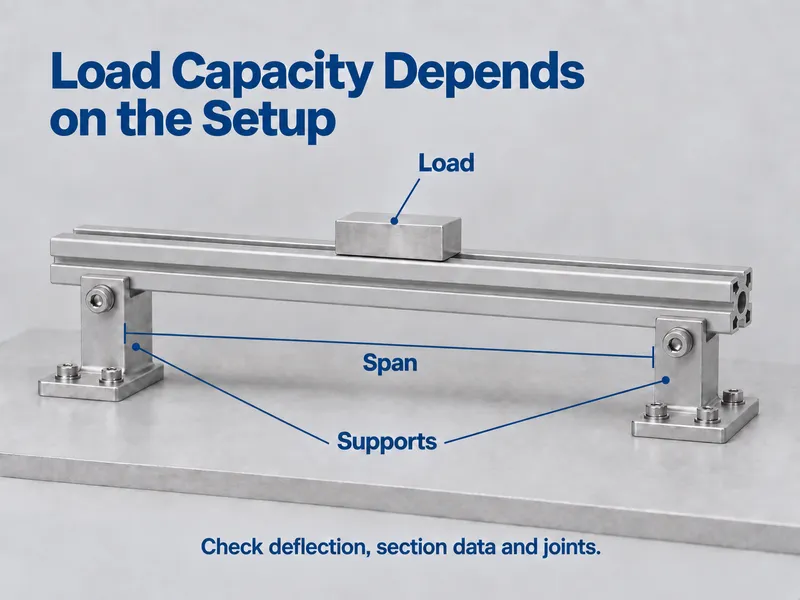
There is no single load rating for 4040, because capacity depends on the span, the end conditions, and how the load is applied. Any figure quoted without those three is not usable for design.
In most framing applications, deflection governs before stress does. A beam that is strong enough can still be too springy, and an operator notices the movement long before anything yields.
Deflection falls in proportion to the second moment of area, so the wall build matters more than the alloy. On the same 1 m span with the same load, a heavy 4-slot profile at about 10 cm⁴ deflects roughly a third less than a light one at about 6.4 cm⁴. Doubling the span, by contrast, increases deflection eightfold.
Two practical consequences follow. Use a short span and a deeper section before reaching for a stronger alloy, and treat the published section properties as the design input, not the alloy name.
Surface Finish and Corrosion
6063 resists atmospheric corrosion well and needs no coating indoors. Anodising hardens the surface and gives a uniform colour; the coating thickness for architectural and machine-guard use is typically 10–25 μm to ISO 7599.
Powder coating covers the full RAL range and suits outdoor frames and equipment housings. Mill finish is the cheapest option and the right one for parts that will be painted or hidden.
Whichever finish you choose, note that it applies to the whole bar. Frame members are usually cut after finishing, so cut ends are bare unless you specify otherwise.
Applications
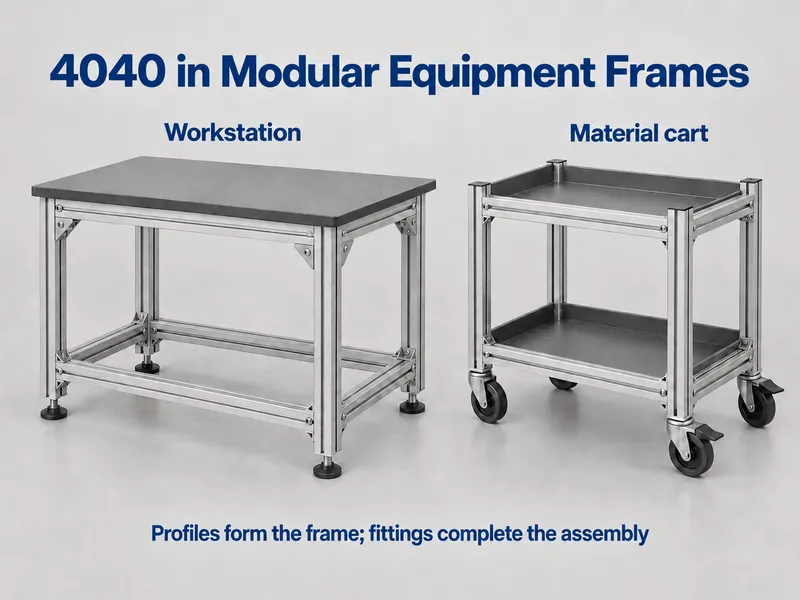
- Machine frames, guards, and safety enclosures
- Workstations, assembly benches, and material handling carts
- Automation frames, robotic cells, and linear motion support
- 3D printer and CNC router gantries and beds
- Display stands, exhibition structures, and test rigs
- Warehouse racking, trolleys, and light structural framing
Go/No-Go
Go — 4040 is usually the right call when:
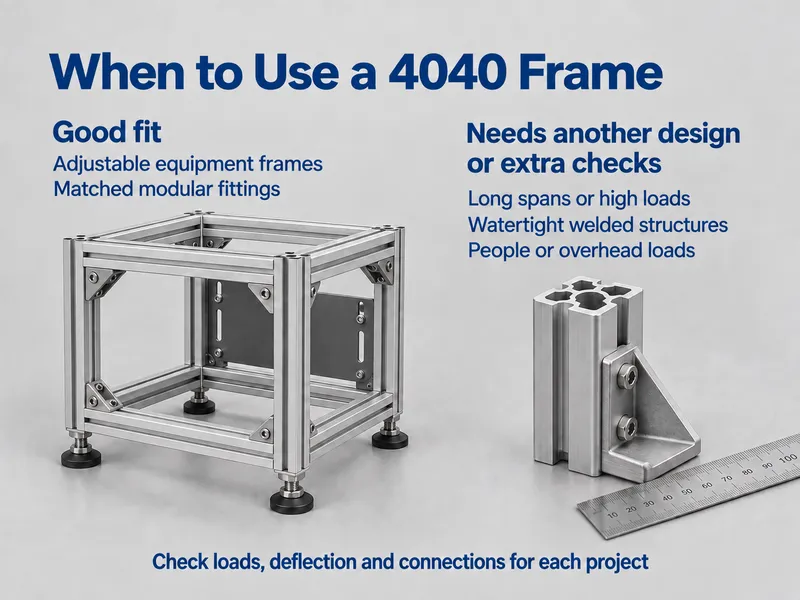
- The frame spans roughly 0.5–1.5 m between supports and is assembled rather than welded.
- The structure has to be adjustable, extendable, or rebuilt later.
- Accessories off the shelf (brackets, hinges, castors, panels) will do the joining.
- The frame carries equipment, not people, and deflection can be checked against your own limit.
No-Go — step away from 4040 when:
- Spans run well past about 1.5 m under load. Move to 4080 or 8080 instead of adding supports.
- The joint must be welded and watertight. A pressed profile with slots is the wrong starting point.
- The frame is a primary structural member carrying people or overhead loads. Use a designed section and a qualified engineer.
- Vibration or shock dominates. Slotted connections can creep; add cross-bracing and check the fasteners.
- The profile will be machined heavily after anodising. Cutting and drilling expose bare metal at the joint faces.
What to Confirm Before You Order
Five details decide whether the order works. Get them on the enquiry and the quotation will be accurate the first time.
- Slot system — 8 mm or 10 mm, measured at the mouth.
- Alloy and temper — 6063-T5 for most frames, 6063-T6 or 6061-T6 for heavier duty.
- Wall build — light, standard, or heavy, quoted with the weight per metre.
- Cut list — finished lengths, end cuts, and hole or tapping positions if drilling is required.
- Finish and documentation — anodised, powder coated, or mill; MTC with the order.
Accessories are worth ordering with the profile. Nuts, brackets, and hinges have to match both the slot width and the series, and a mixed order avoids a second shipment.
Conclusion
4040 is the middle of the T-slot range, and for most machine frames, workstations, and automation structures it is the right size — a 40 × 40 mm section in 6063-T5 that assembles with hand tools and needs no welding. Its trade-off is that “4040” fixes only the geometry: slot width, wall thickness, and alloy still vary between suppliers, and a light-wall profile that looks identical on a price list will deflect noticeably more under load.
We supply 6063-T5 and 6061-T6 4040 profile in both 8 mm and 10 mm slot versions, cut to length, with matched nuts, brackets and hinges, and low-MOQ custom production on non-standard colours and lengths. Every order ships with an MTC.
Send us the frame drawing with the slot system and the load case, and we will confirm the profile, wall thickness, and cut list.
Frequently Asked Questions
Can I use 8 mm and 10 mm slot accessories on the same 4040 frame?
No. The slot width sets which T-nuts, brackets, hinges and castors fit, and the two systems are not interchangeable. Decide the slot at the frame design stage, then order the profile and the accessories together so the hardware matches.
Can I get 4040 extrusion cut to length, and what is the minimum order?
Yes. Profile is supplied in 6 m bars and cut to your finished lengths, with drilling and tapping available. Standard sizes and mill finish carry low minimum quantities; non-standard colours and heavy-wall sections are quoted per project.
Which wall build should I order for a frame that carries equipment?
It depends on span and load case, not on the series number. Light, standard and heavy wall builds share the same 40 × 40 mm footprint but carry different second moments of area, so deflection changes with the wall while the outside looks identical.
What documents come with a 4040 profile order?
A mill test certificate reporting the chemistry and mechanical results for the heat, included with every order. Where a project requires independent verification, SGS reports can be arranged on request at additional testing cost.