4040 is het werkpaard van modulaire aluminium framebouw. Het is een vierkant profiel van 40 × 40 mm met T-sleuven op de zijden, precies in het midden van het assortiment — groot genoeg om een machineframe of werkstation te dragen, klein genoeg om de constructie licht en betaalbaar te houden.
Beschouw “4040” als een doorsnedeafmeting, niet als een materiaal. Twee 4040-profielen kunnen verschillen in sleufbreedte, wanddikte en de legering waaruit ze zijn geperst — en die drie factoren bepalen of uw accessoires passen, hoeveel het frame kan dragen en wat het kost.
Wat is 4040 aluminium extrusie?
4040 aluminium extrusie is een vierkant aluminium profiel van 40 mm × 40 mm, geperst met T-sleuven over de lengte, zodat beugels, moeren en scharnieren overal bevestigd kunnen worden zonder te boren.
De sectie wordt normaal geëxtrudeerd uit 6063-T5 en geleverd in staven van 6 m, die vervolgens op lengte worden gezaagd. De sleuven geven het systeem zijn snelheid: een T-moer schuift in het kanaal, een bout draait hem vast, en een starre verbinding is binnen enkele minuten gemaakt met handgereedschap.
Het is een profielmaat, geen legeringskwaliteit
“4040” beschrijft de geometrie. Het zegt niets over de chemische samenstelling, en er bestaat geen 4040 smeedaluminiumlegering.
Het getal behoort tot de T-sleuf framereeks — 2020, 3030, 4040, 4080, 8080 — waarbij de eerste twee cijfers de sectiebreedte in millimeters aangeven. Die naamgeving heeft geen verband met legeringaanduidingen zoals 6063 of 6061.
Een tekening die “4040 aluminium” vermeldt, is dus slechts een halve specificatie. De legering, de warmtebehandeling en de sleufbreedte moeten nog worden opgegeven.
Hoe het T-sleufsysteem werkt
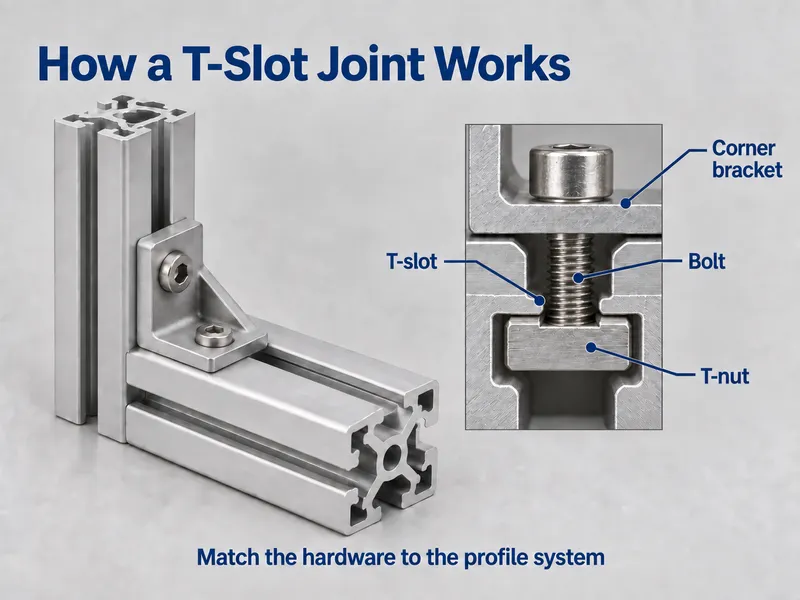
Een T-sleuf is een kanaal met een nauwe opening en een bredere inwendige holte. Een moer of boutkop schuift langs de holte, en bij het vastdraaien klemt deze het onderdeel vast op de positie waar u bent gestopt.
Dat ene detail onderscheidt frameprofiel van gewone buis. Er is geen lassen en geen boren nodig, verbindingen kunnen worden verplaatst en een frame kan worden gedemonteerd en elders opnieuw opgebouwd.
Typische bevestigingsmiddelen: T-moeren en T-bouten voor structurele verbindingen, hoekbeugels en verstijvingsplaten voor haakse hoeken, eindkappen en verbindingsstukken voor de afwerking, en scharnieren of zwenkwielen voor bewegende delen. Het meeste wordt vastgedraaid met een inbussleutel.
8 mm vs 10 mm sleuven
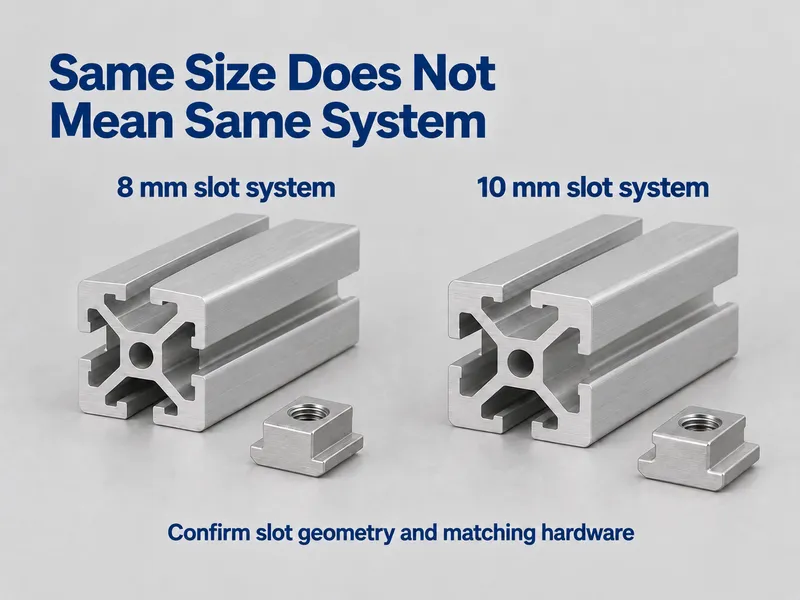
De 40-serie wordt verkocht in twee sleufstandaarden, en accessoires zijn niet uitwisselbaar tussen beide. De metrische Europese standaard is de 8 mm sleuf, die domineert in machinebouw en automatiseringsframebouw; sommige reeksen gebruiken een 10 mm sleuf.
Meet de sleufopening voordat u iets koopt dat erin moet passen. Een partij 8 mm T-moeren past niet in een 10 mm kanaal, en de fout komt pas aan het licht bij het monteren van het frame.
Materiaal: legering en warmtebehandeling
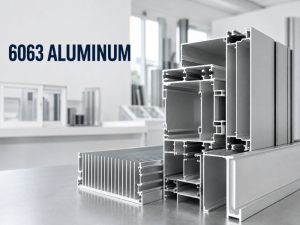
Bijna alle 4040-profiel wordt geëxtrudeerd uit 6063, een warmtebehandelbare Al-Mg-Si-legering die is gekozen om zijn extrudeerbaarheid en oppervlakteafwerking rather dan om zijn pieksterkte. De 6063 extrusiegids behandelt hoe die legering tot profielen wordt geperst. 6061 is het alternatief wanneer een frame zwaardere belastingen draagt.
Chemische samenstelling
Reeksen volgen EN 573-3 (EN AW-6063 / AlMg0,7Si) en ASTM B221.
| Element | Gehalte (% per gewicht) | Rol |
| Silicium (Si) | 0.20–0.60 | Vormt de Mg₂Si-versterkingsfase |
| Magnesium (Mg) | 0.45–0.90 | Belangrijkste uithardend element |
| IJzer (Fe) | ≤0,35 | Onzuiverheidslimiet |
| Koper (Cu) | ≤0,10 | Onzuiverheidslimiet; overmaat schaadt de corrosiebestendigheid |
| Mangaan (Mn) | ≤0,10 | Onzuiverheidslimiet |
| Chroom (Cr) | ≤0,10 | Onzuiverheidslimiet |
| Zink (Zn) | ≤0,10 | Onzuiverheidslimiet |
| Titanium (Ti) | ≤0,10 | Korrelverfijner |
| Overige (elk / totaal) | ≤0,05 / ≤0,15 | Sporengrenzen |
| Aluminium (Al) | Saldo | Onedel metaal |
Mechanische eigenschappen per hardingsgraad
Dit zijn de minimumwaarden voor geëxtrudeerd profiel onder EN 755-2 en ASTM B221. Typische productieruns testen boven deze waarden — een 6063-T5-profiel meet gewoonlijk ongeveer 185 MPa treksterkte en 145 MPa vloeigrens.
| Legering / temper | Treksterkte, min. (MPa) | Vloeigrens, min. (MPa) | Rek (%) |
| 6063-T5 | 145 | 110 | 8 |
| 6063-T6 | 205 | 170 | 8 |
| 6061-T6 | 260 | 240 | 8 |
T5 is de standaard voor framebouw. Het profiel wordt gekoeld vanaf de pers en kunstmatig verouderd, wat goedkoop is en een schoon oppervlak oplevert. T6 voegt een waterafschrikking en een strekcorrectie toe, waardoor de vloeigrens met ongeveer 50% stijgt ten koste van een iets mindere oppervlaktekwaliteit en een hogere prijs.
Kies alleen 6061-T6 wanneer het frame werkelijk dragend is. Het heeft ongeveer tweemaal de vloeigrens van 6063-T5, maar het extrudeert langzamer, vertoont meer matrijsstrepen en laat zich minder gelijkmatig anodiseren — het is dus minder geschikt voor decoratieve behuizingen.
Fysische eigenschappen
| Eigendom | Typische waarde |
| Dichtheid | 2,70 g/cm³ |
| Elasticiteitsmodulus | ~69 GPa |
| Thermische geleidbaarheid | ~200 W/m-K |
| Smelttraject | ~615–655 °C |
De elasticiteitsmodulus is de eigenschap die de stijfheid bepaalt, en deze is in wezen gelijk voor elke 6xxx-legering. Een frame dat te veerkrachtig is, kan niet worden verholpen door over te stappen van 6063 naar 6061 — de oplossing is een diepere sectie of een kortere overspanning.
4040 specificaties en sectie-eigenschappen
De sleufbreedte wordt door het systeem bepaald, maar de wanddikte niet. Leveranciers bieden lichte, standaard en zware versies van dezelfde 40 × 40 omtrek aan, en het verschil blijkt uit gewicht en stijfheid.
| Variant | Wandopbouw | Gewicht (kg/m) | Ix = Iy (cm⁴) | Wx = Wy (cm³) |
| Licht | Dunne wand, 4 sleuven | ~1,25–1,35 | ~6,2–6,4 | ~3,2–4,4 |
| Standaard | Middelmatige wand, 4 sleuven | ~1,45–1,65 | ~7,1–8,7 | ~3,6–4,4 |
| Zwaar | Dikke wand, 4 sleuven | ~1,85–2,20 | ~10,0–10,4 | ~5,0–5,2 |
These are typical figures from published 40-series catalogues and vary with each profile design, so use the supplier’s datasheet for structural work. Ix and Iy are the second moments of area about the two principal axes; Wx and Wy are the section moduli used for bending stress.
Standard bars are 6 m. Dimensional tolerances on extruded profile are set by EN 755-9, and the allowance depends on the dimension and wall thickness — so state which faces are critical when you order.
4040 vs Other T-Slot Series
Choosing a series is mostly about load, span, and how much weight the finished structure can tolerate.
| Serie | Section (mm) | Typical slot | Gewicht (kg/m) | Where it fits |
| 2020 | 20 × 20 | 6 mm | ~0.5 | Light enclosures, guards, small fixtures |
| 3030 | 30 × 30 | 8 mm | ~0.9–1.0 | Light frames and workstations |
| 4040 | 40 × 40 | 8 mm (10 mm on some ranges) | 1.25–2.2 | Machine frames, workstations, automation |
| 4080 | 40 × 80 | 8 mm | 2.2–3.3 | Gantries, cantilever arms, heavy frames |
| 8080 | 80 × 80 | 8 mm | 3.9–5.1 | Machine bases and heavy load structures |
4040 is the default for a reason. Below it, 3030 frames flex over anything but short spans; above it, 4080 and 8080 add stiffness at roughly double the weight and cost per metre.
The step up is often needed in one direction only. A machine gantry that must resist bending in a single plane is usually built from 4080 rather than 8080, because the extra depth is doing the work and the extra width is not.
What Sets the Load Capacity of a 4040 Frame
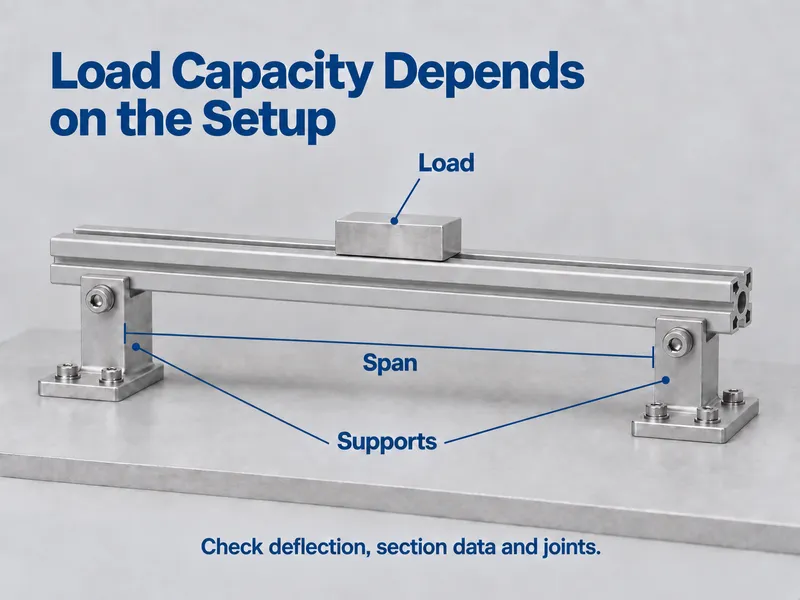
There is no single load rating for 4040, because capacity depends on the span, the end conditions, and how the load is applied. Any figure quoted without those three is not usable for design.
In most framing applications, deflection governs before stress does. A beam that is strong enough can still be too springy, and an operator notices the movement long before anything yields.
Deflection falls in proportion to the second moment of area, so the wall build matters more than the alloy. On the same 1 m span with the same load, a heavy 4-slot profile at about 10 cm⁴ deflects roughly a third less than a light one at about 6.4 cm⁴. Doubling the span, by contrast, increases deflection eightfold.
Two practical consequences follow. Use a short span and a deeper section before reaching for a stronger alloy, and treat the published section properties as the design input, not the alloy name.
Surface Finish and Corrosion
6063 resists atmospheric corrosion well and needs no coating indoors. Anodising hardens the surface and gives a uniform colour; the coating thickness for architectural and machine-guard use is typically 10–25 μm to ISO 7599.
Powder coating covers the full RAL range and suits outdoor frames and equipment housings. Mill finish is the cheapest option and the right one for parts that will be painted or hidden.
Whichever finish you choose, note that it applies to the whole bar. Frame members are usually cut after finishing, so cut ends are bare unless you specify otherwise.
Toepassingen
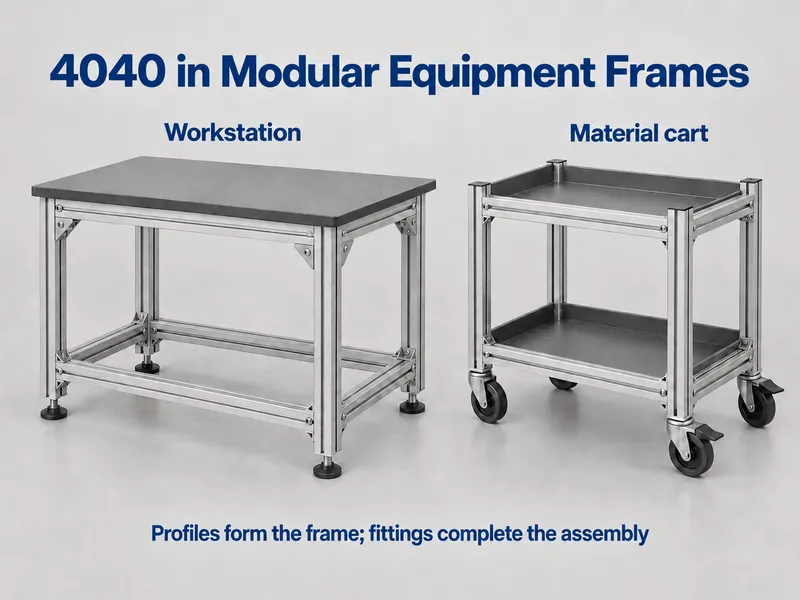
- Machine frames, guards, and safety enclosures
- Workstations, assembly benches, and material handling carts
- Automation frames, robotic cells, and linear motion support
- 3D printer and CNC router gantries and beds
- Display stands, exhibition structures, and test rigs
- Warehouse racking, trolleys, and light structural framing
Go/No-Go
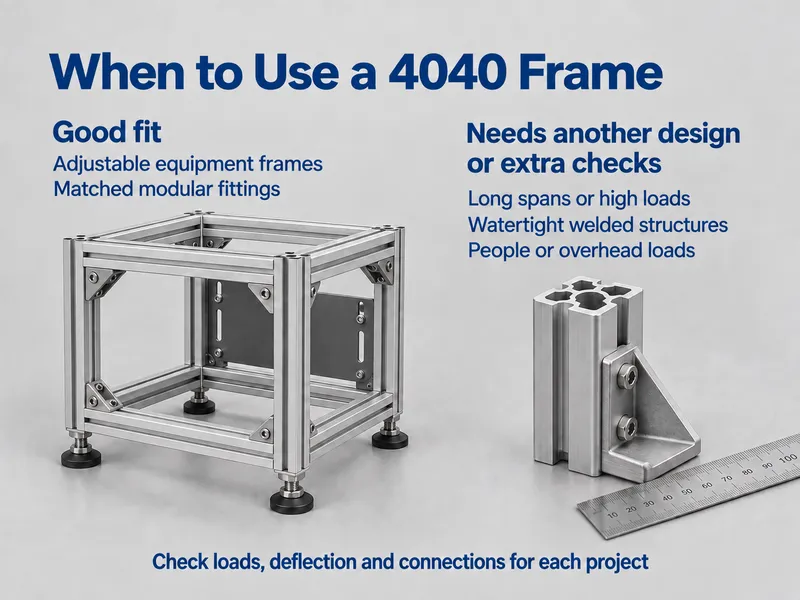
Go — 4040 is usually the right call when:
- The frame spans roughly 0.5–1.5 m between supports and is assembled rather than welded.
- The structure has to be adjustable, extendable, or rebuilt later.
- Accessories off the shelf (brackets, hinges, castors, panels) will do the joining.
- The frame carries equipment, not people, and deflection can be checked against your own limit.
No-Go — step away from 4040 when:
- Spans run well past about 1.5 m under load. Move to 4080 or 8080 instead of adding supports.
- The joint must be welded and watertight. A pressed profile with slots is the wrong starting point.
- The frame is a primary structural member carrying people or overhead loads. Use a designed section and a qualified engineer.
- Vibration or shock dominates. Slotted connections can creep; add cross-bracing and check the fasteners.
- The profile will be machined heavily after anodising. Cutting and drilling expose bare metal at the joint faces.
What to Confirm Before You Order
Five details decide whether the order works. Get them on the enquiry and the quotation will be accurate the first time.
- Slot system — 8 mm or 10 mm, measured at the mouth.
- Legering en tempering — 6063-T5 for most frames, 6063-T6 or 6061-T6 for heavier duty.
- Wandopbouw — light, standard, or heavy, quoted with the weight per metre.
- Cut list — finished lengths, end cuts, and hole or tapping positions if drilling is required.
- Finish and documentation — anodised, powder coated, or mill; MTC with the order.
Accessories are worth ordering with the profile. Nuts, brackets, and hinges have to match both the slot width and the series, and a mixed order avoids a second shipment.
Conclusie
4040 is the middle of the T-slot range, and for most machine frames, workstations, and automation structures it is the right size — a 40 × 40 mm section in 6063-T5 that assembles with hand tools and needs no welding. Its trade-off is that “4040” fixes only the geometry: slot width, wall thickness, and alloy still vary between suppliers, and a light-wall profile that looks identical on a price list will deflect noticeably more under load.
We supply 6063-T5 and 6061-T6 4040 profile in both 8 mm and 10 mm slot versions, cut to length, with matched nuts, brackets and hinges, and low-MOQ custom production on non-standard colours and lengths. Every order ships with an MTC.
Send us the frame drawing with the slot system and the load case, and we will confirm the profile, wall thickness, and cut list.
Veelgestelde vragen
Can I use 8 mm and 10 mm slot accessories on the same 4040 frame?
No. The slot width sets which T-nuts, brackets, hinges and castors fit, and the two systems are not interchangeable. Decide the slot at the frame design stage, then order the profile and the accessories together so the hardware matches.
Can I get 4040 extrusion cut to length, and what is the minimum order?
Yes. Profile is supplied in 6 m bars and cut to your finished lengths, with drilling and tapping available. Standard sizes and mill finish carry low minimum quantities; non-standard colours and heavy-wall sections are quoted per project.
Which wall build should I order for a frame that carries equipment?
It depends on span and load case, not on the series number. Light, standard and heavy wall builds share the same 40 × 40 mm footprint but carry different second moments of area, so deflection changes with the wall while the outside looks identical.
What documents come with a 4040 profile order?
A mill test certificate reporting the chemistry and mechanical results for the heat, included with every order. Where a project requires independent verification, SGS reports can be arranged on request at additional testing cost.