6013은 하나의 설계 문제를 위해 존재합니다: 2024-T3급 강도가 필요하지만 용접해야 하는 부품입니다. 6061은 용접이 가능하지만, T6 상태에서 310 MPa 바로 위에서 강도가 한계에 도달합니다. 2024-T3는 강도를 갖추고 있지만 융합 용접 합금이 아니며 사용 환경에서 견디려면 클래딩이나 도장이 필요합니다.
6013은 6xxx 계열 측면에서 이 문제를 해결합니다. 이것은 열처리 가능한 Al-Mg-Si-Cu 합금으로, T6 항복 강도, 파괴 인성 및 피로 거동이 2024-T3 판재에 근접하며, 6xxx 등급처럼 접합되고 보호 클래딩이 필요하지 않습니다.
그런 다음 두 가지 한계가 규격을 결정합니다. 6013을 6061보다 강하게 만드는 구리는 또한 입계 부식 경향을 높이며, 최대 강도는 공정 경로에 명시해야 하는 열처리 단계 후에야 도달합니다.
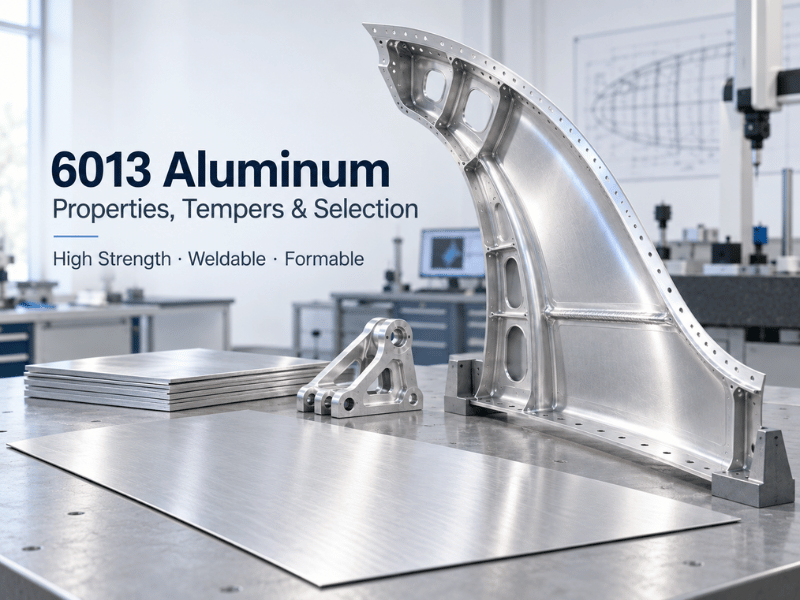
6013 알루미늄이란?
이 합금의 강도는 냉간 가공이 아닌 석출 시효에서 비롯됩니다. 마그네슘과 규소가 결합하여 Mg₂Si를 형성하고, 구리 첨가는 강도와 피로 저항을 모두 일반 Al-Mg-Si 합금이 도달하는 수준 이상으로 높이는 추가적인 Cu 함유 상을 형성합니다.
이것은 6xxx 계열에 비교적 최근에 추가된 것으로 여전히 틈새 등급입니다. 6061만큼 널리 재고로 유통되지 않으며, 6061 대비 프리미엄은 실재합니다. 구매자들이 이를 지정하는 이유는 두 가지입니다: 용접 가능한 합금에서 6061보다 더 높은 강도가 필요하거나, 용접해야 하거나 2024의 부식 거동을 감당할 수 없는 부품에서 2024-T3급 특성이 필요하기 때문입니다.
화학 성분
| 요소 | 범위 (중량 기준 %) |
| 실리콘(Si) | 0.60 – 1.0 |
| 마그네슘(Mg) | 0.80 – 1.2 |
| 구리(Cu) | 0.60 – 1.1 |
| 망간(Mn) | 0.20 – 0.80 |
| 철(Fe) | ≤ 0.50 |
| 아연(Zn) | ≤ 0.25 |
| 크롬(Cr) | ≤ 0.10 |
| 티타늄(Ti) | ≤ 0.10 |
| 기타 (각각 / 전체) | ≤ 0.05 / ≤ 0.15 |
| 알루미늄(Al) | 잔여량 (94.8 – 97.8) |
숫자 자체보다 두 가지 점이 더 중요합니다. 규소와 마그네슘은 Mg₂Si 형성을 위해 거의 균형 잡힌 비율로 존재하며, 이것이 이 합금을 인공 시효에 반응하게 만듭니다.
구리 함량이 다른 한 가지 점입니다. 최대 1.1%에서 이것은 6061이 허용하는 양의 약 3~5배이며, 이는 6013이 6061보다 강한 이유와 내식성이 더 낮은 이유를 모두 설명합니다.
규격 및 등가 명칭
| 규격 체계 | 명칭 |
| UNS | A96013 |
| ISO | AlMg1Si0.8CuMn |
| ASTM | B209 (판재 및 후판), B221 (압출 바, 로드, 튜브, 프로파일) |
| AMS | 4216 (6013-T6 판재), 4347 (6013-T4 판재) |
| GB/T | 3190 |
구매 주문서를 작성할 때는 규격과 조질 상태를 함께 명시하십시오. “6013”만으로는 강도 수준이 정의되지 않습니다 — 6013-T4와 6013-T6는 항복 강도에서 약 100 MPa 차이가 나며, 이는 부품이 견디는지 못 견디는지의 차이입니다.
열처리 상태에 따른 기계적 특성
| 성질 | 인장 강도(MPa) | 항복 강도(MPa) | 신장 | 피로 강도 (MPa) | 전단 강도 (MPa) | 경도(HB) |
| T4 | ~310 | ~170 | ~22% | ~98 | ~190 | — |
| T6 | 379 – 410 | ~350 | ~9% | ~140 | ~240 | ~130 |
| T651 | ≥ 379 | ≥ 359 | ≥ 5% | ~110 | 240 – 248 | 130 |
T651 행은 후판에 대한 알루미늄 생산업체 최소값에서 발췌한 것입니다; T6 판재는 일반적으로 해당 범위의 상한 쪽으로 시험됩니다. 이 표를 스크리닝 도구로 취급하고 밀 테스트 성적서를 관리 문서로 간주하십시오 — 보증 최소값은 두께와 제품 형태에 따라 달라집니다.
주목할 점: T6는 세 가지 조질 상태 중 가장 높은 피로 강도(약 140 MPa)를 가지며, T651은 정적 강도가 약간 더 높음에도 불구하고 약 110 MPa로 더 낮습니다. 부품이 정적 한계가 아닌 피로 한계인 경우, 항복 수치가 아닌 이 차이가 조질 상태 결정을 이끌어야 합니다.
물리적 속성
| 속성 | 가치 |
| 밀도 | 2.71 – 2.72 g/cm³ |
| 용융 범위 | ~579 – 650 °C |
| 열 전도성 | ~150 – 164 W/m·K |
| 전기 전도성 | ~35% IACS |
| 열팽창 계수 | 23.4 × 10⁻⁶ /°C (20 – 100 °C) |
| 탄성 계수 | 69 – 71 GPa |
| 최대 사용 온도 | ~160 °C |
전기 전도도는 가장 자주 잘못 인용되는 값입니다. 구리 함량 때문에 6013은 약 35% IACS에 위치합니다 — 6061보다 낮으며, 높지 않습니다. 강도보다 전도도에 의존하는 응용 분야라면 대신 6061, 6063 또는 6101을 검토해야 합니다.
조질 상태: T4, T6, T651
T4 는 용체화 열처리 후 자연 시효된 상태입니다. 세 가지 중 가장 연하며 성형 작업을 하는 상태입니다 — T4에서의 성형성은 2024-O와 대체로 유사한 것으로 보고됩니다. 연신율은 약 22%로, 이것이 급격한 굽힘과 깊은 드로잉을 가능하게 합니다.
T6 는 용체화 열처리 후 최대 강도까지 인공 시효된 상태입니다. 대부분의 구조 부품 및 판재에 대한 납품 상태입니다.
T651 는 응력 완화 단계가 추가된 T6입니다 — 인공 시효 전에 재료를 제어된 양만큼 인장합니다. 인장이 가공 중 및 가공 후 치수 안정성을 향상시키므로, T651은 중절삭될 후판에 대한 호칭입니다. 판재는 일반적으로 T651이 아닌 T6로 공급되는데, 인장 단계가 후판 및 바 작업이기 때문입니다.
성형 후 시효 경로
이것이 많은 작업장에서 6013을 지정하는 이유이며, 대부분의 데이터시트가 빠뜨리는 점입니다. T4에서의 자연 시효는 천천히 진행되므로, 부품을 T4에서 성형한 후 직접 T6 최대 강도까지 시효할 수 있습니다 두 번째 용체화 열처리 없이.
비교하자면, 2024-W는 성형성을 유지하기 위해 냉장 보관해야 하며, 성형 후 시효하는 대부분의 6xxx 부품은 먼저 재용체화 처리가 필요합니다. 6013에서 이 재급랭을 건너뛰면 교정할 왜곡이 줄어들고, 공정 단계가 줄어들며, 결정립 구조를 재제어할 필요가 없습니다. 부품이 크거나 얇거나 왜곡에 민감한 경우, 이 경로만으로도 합금 프리미엄을 정당화할 수 있습니다.
6013 작업하기
성형
T4에서 성형하십시오. T6에서 이 합금은 굽힘 능력이 제한적이며 냉간 성형은 강도 수준에 의해 제약됩니다; T4에서 쉽게 성형되는 복잡한 형상은 T6에서 균열이 발생합니다. 툴링을 확정하기 전에 실제 두께와 조질 상태에 대해 최소 굽힘 반경을 확인하십시오.
용접
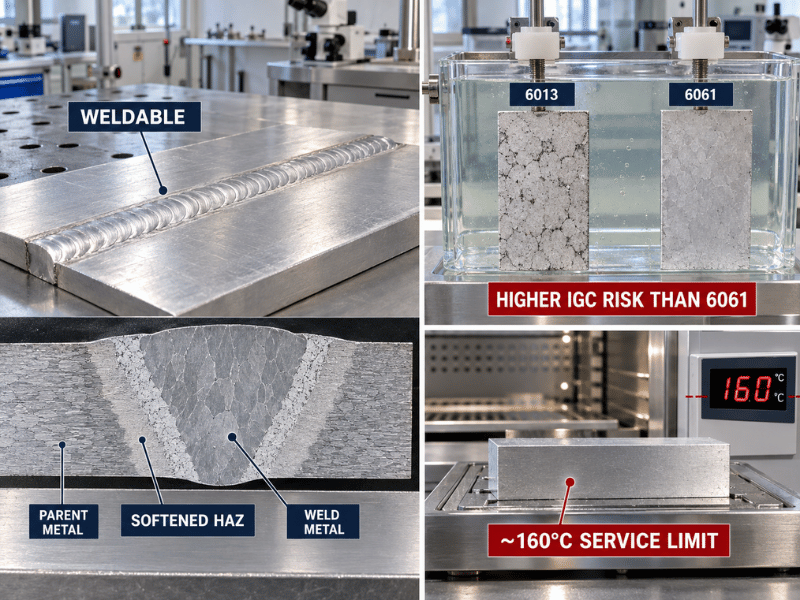
6013은 용접성이 좋습니다. 알루미늄 생산업체 데이터는 용접성을 최고 등급으로 평가하며 기존 용접 및 브레이징 방법으로 쉽게 접합된다고 설명합니다 — 이것은 융합 용접 가능한 것으로 간주되지 않는 2024에 비해 이 합금의 주요 장점 중 하나입니다.
일반적인 주의사항이 여전히 적용됩니다: 6xxx 용접부는 용접 열이 용접부 내부 및 근처의 석출물 구조를 과시효시키거나 재용체화시키기 때문에 국부적으로 강도를 잃습니다. 용접 상태를 기준으로 설계하고 가능한 한 최대 응력 위치에서 멀리 용접부를 배치하십시오. 용가재 선택은 접합부 요구사항 및 적용 가능한 절차 인증을 따라야 합니다 — 용가재 선택이 모재 및 사용 환경과 어떻게 상호작용하는지는 알루미늄 용접 와이어 선택 가이드 를 참조하십시오.
가공
기계 가공성은 양호하며, 쾌삭 합금이 약 90에 위치하는 표준 0–100 척도에서 약 70으로 평가됩니다. T651은 응력 완화 때문에 중절삭 후판에 일반적으로 선호됩니다.
표면 처리
6013은 아노다이징 및 도장이 잘 됩니다. 밝은 아노다이징 장식용 합금은 아닙니다 — 외관이 중요한 밝은 트림이 요구사항이라면 5005, 5657 또는 6063이 표준 답입니다. 보호 아노다이징 및 도장 전처리의 경우, 6013은 특별한 취급 없이 성능을 발휘합니다.
부식 및 온도 한계
솔직한 설명은 이것입니다: 6013은 양호한 corrosion resistance for a copper-bearing alloy, and less general corrosion resistance than 6061. Published comparisons note a higher tendency toward intergranular corrosion in 6013 than in 6061, particularly where processing is not properly controlled — with reported knock-on effects on fatigue resistance, ductility and strength if it is left unchecked.
Stress-corrosion cracking resistance is rated at the top of the producer scale, which is a genuine improvement over the 2xxx alloys 6013 competes with. But 6013 is not a marine alloy. For immersed or splash-zone saltwater service, the 5xxx grades remain the correct family — see our marine-grade aluminium selection guide.
On temperature, the practical ceiling is about 160 °C. Precipitation-hardened alloys lose strength as temperature rises, and 6013 is not an elevated-temperature material despite common assumptions about aerospace grades.
Where 6013 Is Used
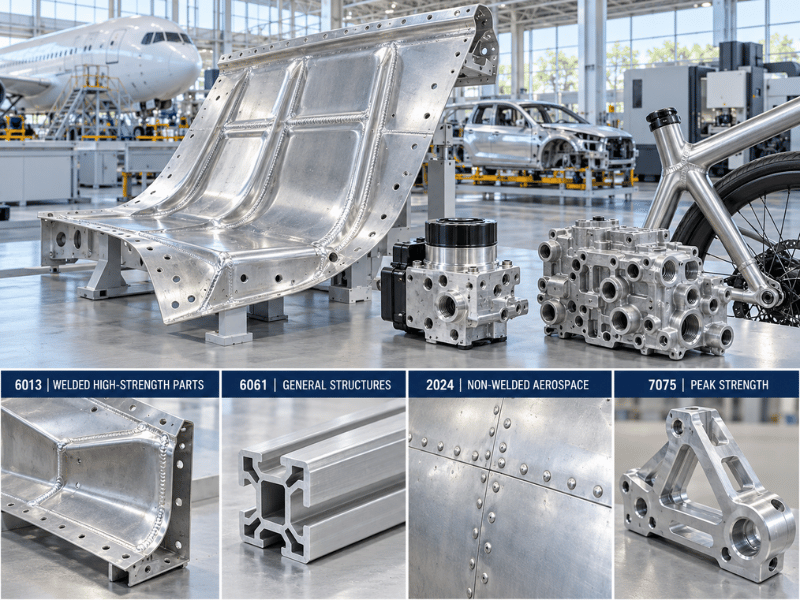
Producer application listings for 6013 include hydraulic components, valve bodies, machine parts, ABS braking system components, and munitions. Beyond those, the two volume applications are:
- 항공우주 — aircraft skins and structural panels, where the alloy is evaluated as a candidate to replace 2024 sheet, particularly where welding or corrosion behaviour rules 2024 out.
- Automotive and transport — structural and body panels, and bicycle frames, handlebars and wheel components, where higher-than-6061 strength is needed in a joinable alloy.
6013 vs. 6061 vs. 2024 vs. 7075
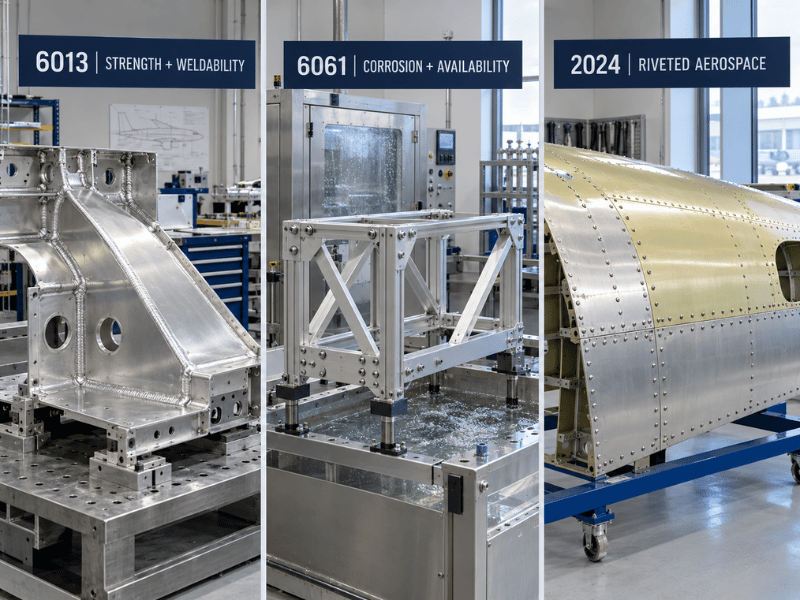
| 합금 | Key alloying | 인장 강도(MPa) | General corrosion | 용접성 | Fits when |
| 6013-T6 | Mg-Si-Cu | 379 – 410 | Good (higher IGC tendency than 6061) | Good | 2024-class strength in a weldable part |
| 6061-T6 | Mg-Si | 240 – 310 | 매우 우수 | 우수 | General structural work, best all-round availability |
| 2024-T3 | Cu-Mg | 400 – 480 | Poor | Not fusion weldable | Maximum 2xxx strength where welding is not required |
| 7075-T6 | Zn-Mg-Cu | 500 – 570 | Poor | Poor | Peak strength, corrosion and welding not driving |
The two comparisons that decide most jobs:
6013 vs 6061. 6013 is meaningfully stronger. 6061 is more corrosion-tolerant, cheaper, and available everywhere. Choose 6013 when the strength margin is what fails the design, not as a default upgrade. If corrosion resistance is the priority, 6061 is the better answer — see our complete guide to 6061 aluminium.
6013 vs 2024. Strength, fracture toughness and fatigue in 6013-T6 land close to 2024-T3 plate, with better corrosion resistance and lower density. The deciding factor is usually joining: if the assembly is welded, 6013 wins; if it is riveted and corrosion is managed by cladding or finishing, 2024 may still be specified.
Go / No-Go
Go — specify 6013 when:
- A welded joint is required in a part that needs strength beyond 6061. Typical parts: welded aerospace assemblies, hydraulic manifolds, structural brackets.
- The part can be formed in T4 and aged directly to T6, avoiding a re-solution treatment. Typical parts: large distortion-sensitive panels, drawn structural shapes.
- Fatigue resistance is a design driver and T6’s ~140 MPa fatigue strength clears the duty cycle. Typical parts: dynamically loaded brackets, transport structures.
- 2024-T3-class properties are needed but the service environment rules out a bare 2xxx alloy.
- Heavily machined plate where dimensional stability matters — specify T651.
No-Go — look elsewhere when:
- Maximum corrosion resistance is the priority. 6061 or a 5xxx alloy will outperform 6013; the copper content works against you.
- The part sees continuous service above roughly 160 °C.
- Immersed or splash-zone saltwater is the primary exposure. Use 5083 or 5086 — start with our 5083 aluminium guide.
- 7075-class strength is genuinely required, and welding and corrosion are not binding constraints.
- Tight bend radii are needed in the delivered condition. Form in T4 and age, or pick a more formable alloy.
- Availability and cost dominate. 6061 is stocked far more widely and is the safer default.
Sourcing Checks
6013 is not a commodity grade, so the order needs more definition than a 6061 line item. Before releasing a purchase order, confirm:
- Specification and temper together — ASTM B209 or the applicable AMS sheet callout (4216 for T6, 4347 for T4), plus the temper. 6013-T6 and 6013-T651 are not interchangeable on a drawing.
- Thickness band — guaranteed mechanical minimums vary with thickness. State the range you will accept.
- Heat treatment route — if you intend to form in T4 and age to T6, say so at order stage so the material is supplied in a condition that supports it.
- MTC scope — request the certificate with chemistry and mechanical results, and confirm the temper and specification appear on it.
- 제3자 검사 — where the application is aerospace or pressurised, agree the additional test scope up front rather than after production.
Linsy Aluminium supplies 6013 in sheet and plate, and supports CNC machining, TIG and MIG welding, laser cutting and surface finishing in-house, so material and first-stage processing can be handled on one order. See the 6013 aluminium alloy product page for available tempers and dimensions.
결론
6013 earns its place when a welded, fatigue-loaded part needs more strength than 6061 carries, and when forming in T4 and ageing straight to T6 — no re-solution treatment, no extra quench — is worth the premium. The trade-off is availability: copper raises the intergranular corrosion tendency above 6061, the grade costs more, and most mills hold far less of it than 6061 or 2024.
We supply 6013 sheet and plate to the standard specifications and run low-MOQ custom production for tempers and dimensions outside them, with a 10–60 day lead time on custom lines. Every order ships with an MTC.
Send us the drawing, temper and thickness requirement for a technical review and quotation.
자주 묻는 질문
What forms does 6013 come in?
Sheet, plate and coil are the rolled forms. Tube, bar and non-standard sections are produced to your drawing, so the grade is not limited to flat product. Name the temper alongside the form, because not every temper runs in every product.
What filler should I use to weld 6013?
ER4043 (AlSi5) or ER5356 (AlMg5Cr) to AWS A5.10. ER4043 is the usual first choice on 6xxx base metal because its higher silicon content lowers hot-cracking sensitivity. Move to ER5356 where the joint needs a stronger as-welded deposit.
How does 6013 compare with 6061 on cost and availability?
It costs more and is stocked far less widely. 6061 is a commodity grade held by most service centres, while 6013 is a niche aerospace alloy, so lead time depends on whether your temper and thickness are held or produced. Budget for the premium and confirm stock before you commit to a delivery date.
Can 6013 be cut or machined to drawing before shipment?
Yes. Cutting to length, CNC machining, laser cutting and bending are handled in-house, so parts can arrive close to finished size. Send the drawing with your enquiry and the tolerance and surface callouts are quoted alongside the material.