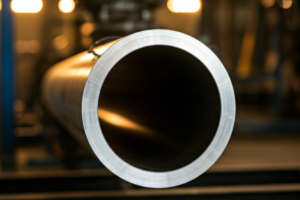
What Is 2024 Aluminum Extrusion
2024 aluminum extrusion forces a heated 2024 billet through a shaped die to make long, constant-cross-section profiles — bars, structural sections, and hollow shapes — that keep the alloy’s high strength-to-weight ratio. The process turns a copper-rich, heat-treatable alloy into finished lengths that aircraft and vehicle structures use where stiffness per kilo matters.
Extrusion is only half the story: 2024 leaves the press soft and must be heat-treated to reach its rated strength, and its corrosion and welding behavior set hard limits on where the profile can go. The sections below walk through the process, the temper choices, and the trade-offs so you can decide whether 2024 extrusion fits the job before you spec it.
Why 2024 for Extruded Shapes
2024 earns its place through strength and fatigue resistance that most extrudable alloys cannot match. With copper at 3.8–4.9% and magnesium plus manganese completing the mix, typical tempers reach 470–483 MPa ultimate tensile and 325–345 MPa yield — well above 6061 and 6082 in the same profile form.
That strength comes with three costs you must plan around. First, 2024’s extrudability is lower than 6xxx series: the high copper content makes the metal stiffer to push, so press speeds are slower and surface defect risk is higher. Second, thermal conductivity is only about 121 W/m·K, roughly 25% below 6061-T6, so it is a poor choice for heat-sinking. Third, corrosion resistance is low, and welding can crack the heat-affected zone, which steers assembly toward rivets, adhesives, or mechanical fasteners.
The Extrusion Process Step by Step
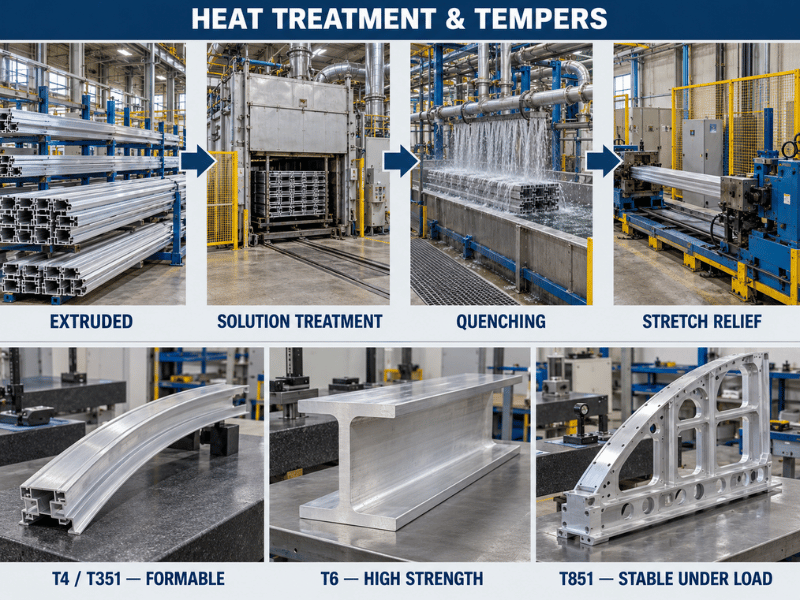
Extrusion starts with a round 2024 billet cut to length and heated to roughly 400–480°C (750–900°F). This softens the alloy enough to flow through the die without tearing, though it stays well below the solution-treatment temperature.
The heated billet loads into the press container, and a hydraulic ram drives it through the die opening. The emerging profile is cooled, usually water-quenched for ages like T3/T4/T6, then stretched slightly to straighten it and relieve residual stress, and finally sawn to length. Temperature, speed, and quench timing all affect the final grain and properties, so they are held to a tight window for aerospace-grade output.
Direct vs Indirect Extrusion
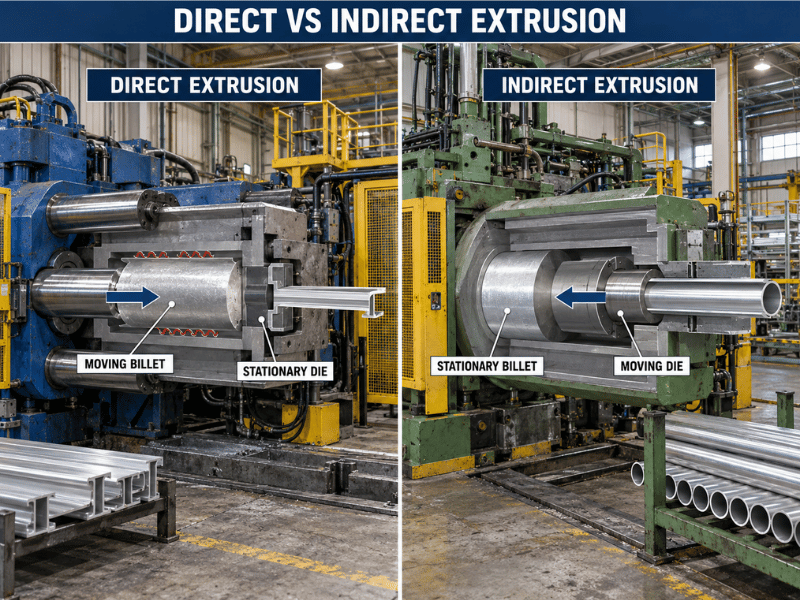
Two press layouts dominate aluminum extrusion, and the difference is which part moves. In direct (forward) extrusion, the ram pushes the billet through a stationary die; the billet slides the full length of the container, so wall friction adds force and the load peaks early then falls as the billet shortens. In indirect (backward) extrusion, the billet stays put in the container while a hollow ram carries the die into it, so there is almost no billet-to-container friction.
| Feature | Direct Extrusion | Indirect Extrusion |
|---|---|---|
| Billet Movement | Moves through container | Stationary in container |
| Die Movement | Stationary | Moves with hollow ram |
| Friction | High (billet scrapes wall) | Very low (no wall slip) |
| Force Required | Higher | ~25–30% lower |
| Profile Length | Long runs practical | Limited by hollow ram bore |
| Best For | Standard solid sections, long parts | Thin walls, hollow, fine surface |
Indirect extrusion gives better surface finish and lower residual stress, which helps anodizing appearance, but the hollow ram caps section size and raises tooling cost. Direct extrusion stays the workhorse for most 2024 profiles because it is simpler and handles longer lengths.
Heat Treatment for Extruded 2024
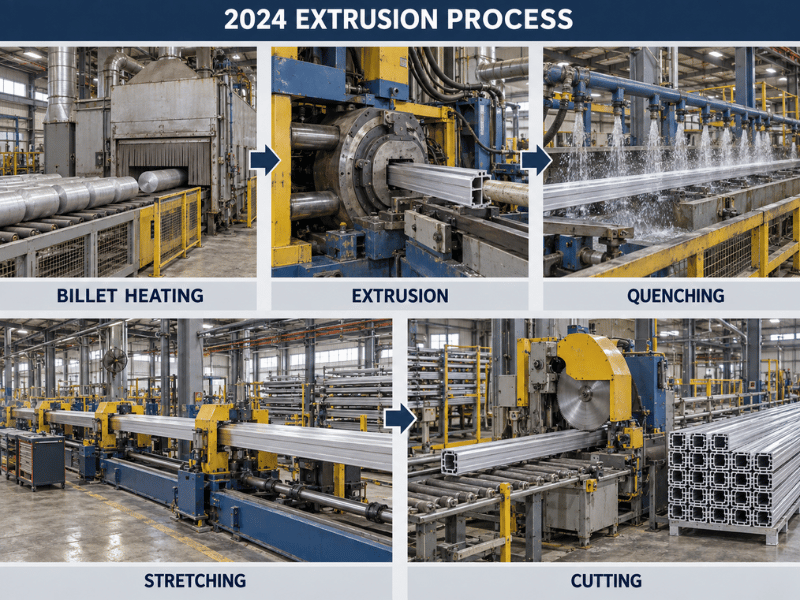
Extruded 2024 is soft (near the O condition) until heat-treated. Solution treatment heats it to about 493°C (919°F) to dissolve the copper and magnesium into a uniform solid solution, then rapid water or polymer quench locks those elements in place. Artificial aging at roughly 190°C (375°F) then precipitates fine Al₂Cu particles that lift strength and hardness.
Common extrusion tempers are:
- T3 / T4 — solution-treated, cold-worked (T3) or not (T4), then naturally aged; high formability, favored where the section is bent after extrusion.
- T351 / T3511 — solution-treated, stress-relieved by stretching (T3511 also straightened), naturally aged; the typical as-extruded structural temper with 470/325 MPa typical.
- T6 / T851 — solution-treated and artificially aged (T851 also stretch-relieved); higher yield (~393–400 MPa) for maximum-strength parts.
Working With Extruded 2024
Machining is a strength of 2024: it rates about 70% on the standard machinability scale, better than 6061, and produces short chips that are easy on tooling. CNC milling and turning hold tight tolerances for aerospace and automotive fittings.
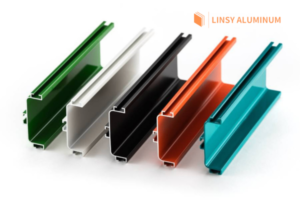
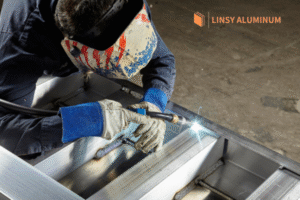
Welding is the weak point. The heat-affected zone (HAZ — the band next to the weld that heats and cools fast) is prone to hot cracking, so fusion welding needs 2319 filler and careful procedure, and many structural jobs avoid it entirely in favor of rivets, adhesives, or bolts. Surface finishing matters because 2024 corrodes in service: anodizing (Type I chromic or Type II sulfuric) or cladding with a pure-aluminum layer builds the protection, and powder coating adds a chip-resistant barrier for outdoor parts.
2024 Extrusion vs 6061 and 7075
| Property | 2024 (T351/T6) | 6061 (T6) | 7075 (T6) |
|---|---|---|---|
| Ultimate Tensile (MPa) | 470–483 | 310 | 572 |
| Yield (MPa) | 325–393 | 276 | 503 |
| Thermal Conductivity (W/m·K) | ~121 | 154–167 | ~130 |
| Extrudability | Moderate (lower) | High | Low |
| Corrosion Resistance | Low | Good | Moderate–low |
| Weldability | Poor (HAZ crack) | Good | Poor |
| Machinability | Good | Good | Fair |
Pick 2024 when strength-to-weight and fatigue outrank corrosion and welding. Pick 6061 when you need to weld, dissipate heat, or extrude complex thin sections cheaply. Pick 7075 only when you need peak strength and can machine rather than weld.
Where 2024 Extrusions Are Used
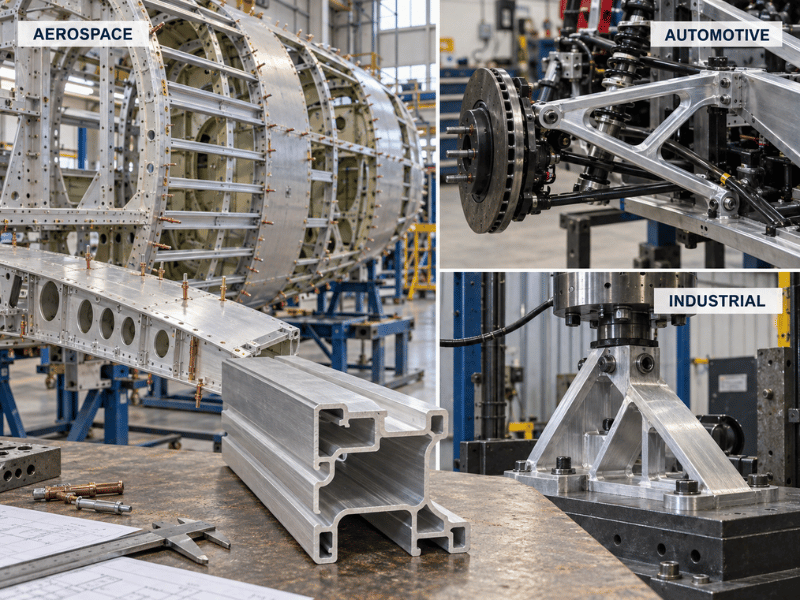
Aerospace leads consumption: fuselage stringers, wing spars and ribs, and skin panels use 2024 extrusions for their fatigue life at low weight. Defense and commercial airframes rely on the same tempers for structural frames.
Automotive and rail use 2024 for suspension arms, chassis cross-members, and truck wheels where strength per kilo cuts mass. General engineering specs it for high-load brackets and fixtures that see repeated load but sit in a protected or coated environment.
Go/No-Go
- Go if the part needs 450+ MPa strength in a long profile and lives in a low-corrosion or clad/coated environment.
- Go if assembly uses rivets, bolts, or adhesives rather than fusion welds.
- Go if fatigue life under vibration matters more than thermal spread.
- No-Go if the section must shed heat (heat sinks, cooling plates) — choose 6061 or 6063 for their ~150–200 W/m·K conductivity.
- No-Go if fusion welding is the only join method and the load is structural — HAZ cracking will govern.
- No-Go if the part sees salt spray unprotected — 2024’s low corrosion resistance will drive early failure without cladding or coating.
Pros & Limitations
| Pros | Limitations |
|---|---|
| High strength-to-weight among extrudables | Lower extrudability than 6xxx (slower, defect-prone) |
| Excellent fatigue resistance | Low corrosion resistance, needs cladding/coating |
| Good machinability (better than 6061) | Poor weldability, HAZ hot-cracking |
| Multiple tempers for form vs strength | Thermal conductivity too low for heat sinks |
Conclusion
2024 aluminum extrusion gives you aerospace-grade strength in long, constant-section profiles, but only if you respect its limits: slower extrusion than 6xxx, mandatory heat treatment, cladding or coating for corrosion, and rivets or fasteners instead of welds. Match the temper to the job — T351/T4 for forming, T6/T851 for maximum yield — and keep it out of heat-sink and unprotected marine roles.
Linsy Aluminum supplies 2024 in plate, bar, tube, wire, coil, profile, and block forms with in-house CNC machining, TIG/MIG welding, laser cutting, and surface finishing, plus MTC on every order and SGS reports on request; low-MOQ custom extrusions typically run 10–60 days. To spec your 2024 extrusion — alloy, temper, and section — send your drawing or requirements to our team for a quote.
Frequently Asked Questions
Can 2024 aluminum be extruded like 6061?
Yes, but with lower extrudability: the high copper content needs slower press speeds and tighter process control, and surface defects are more likely. It is a standard extrudable alloy, just not as fast or cheap to run as 6xxx series.
Which temper should I specify for a 2024 extrusion?
T351 or T3511 for structural sections that may be bent after extrusion, T4 where natural aging is enough, and T6 or T851 when you need the highest yield (about 393–400 MPa) and can machine rather than weld.
Why is 2024 not used for heat sinks?
Its thermal conductivity is only about 121 W/m·K because copper scatters heat-carrying electrons, well below 6061-T6 (154–167) and 6063 (200). For heat transfer, pick 6061, 6063, or 1050/1100 instead.
Is 2024 aluminum weldable?
Fusion welding is poor because the heat-affected zone cracks. Use 2319 filler with controlled procedure when welding is unavoidable, but rivets, adhesives, or mechanical fasteners are preferred for structural joints.
How does 2024 extrusion compare with 7075?
7075 is stronger (572 MPa UTS) but even harder to extrude and weld; 2024 trades some peak strength for better machinability and fatigue life. Choose 2024 for fatigue-critical structures, 7075 for maximum static strength you will machine.
Does 2024 extrusion need corrosion protection?
Yes. Bare 2024 corrodes readily, especially in salt or industrial atmospheres. Anodizing, alclad (pure-aluminum) cladding, or powder coating is standard, and cladding is common on aircraft sheet and sections.