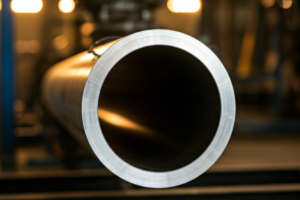
Was ist 2024-Aluminium-Strangpressen
2024 Aluminium Beim Strangpressen wird ein erwärmter 2024-Bolzen durch eine formgebende Matrize gepresst, um lange Profile mit konstantem Querschnitt herzustellen — Stangen, Strukturprofile und Hohlprofile —, die das hohe Festigkeits-Gewichts-Verhältnis der Legierung beibehalten. Der Prozess verwandelt eine kupferreiche, aushärtbare Legierung in Fertigungslängen, die in Flugzeug- und Fahrzeugstrukturen eingesetzt werden, wo Steifigkeit pro Kilo entscheidend ist.
Das Strangpressen ist nur die halbe Geschichte: 2024 verlässt die Presse weich und muss wärmebehandelt werden, um seine Nennfestigkeit zu erreichen, und sein Korrosions- und Schweißverhalten setzt harte Grenzen dafür, wo das Profil eingesetzt werden kann. Die folgenden Abschnitte erläutern den Prozess, die Zustandswahlen und die Kompromisse, damit Sie entscheiden können, ob 2024-Strangpressprofile für die Aufgabe geeignet sind, bevor Sie sie spezifizieren.
Warum 2024 für stranggepresste Profile
2024 verdient seinen Platz durch Festigkeit und Ermüdungsbeständigkeit, die die meisten strangpressbaren Legierungen nicht erreichen. Mit Kupfer bei 3,8–4,9 % und Magnesium plus Mangan, die die Mischung vervollständigen, erreichen typische Zustände 470–483 MPa Zugfestigkeit und 325–345 MPa Streckgrenze — deutlich über 6061 und 6082 in derselben Profilform.
Diese Festigkeit bringt drei Kosten mit sich, die eingeplant werden müssen. Erstens ist die Strangpressbarkeit von 2024 geringer als die der 6xxx-Serie: Der hohe Kupfergehalt macht das Metall steifer beim Pressen, sodass die Pressgeschwindigkeiten langsamer und das Risiko von Oberflächenfehlern höher ist. Zweitens beträgt die Wärmeleitfähigkeit nur etwa 121 W/m·K, rund 25 % unter 6061-T6, sodass es eine schlechte Wahl für die Wärmeableitung ist. Drittens ist die Korrosionsbeständigkeit gering, und Schweißen kann die wärmebeeinflusste Zone rissig machen, was die Montage in Richtung Nieten, Klebstoffe oder mechanische Befestigungselemente lenkt.
Der Strangpressprozess Schritt für Schritt
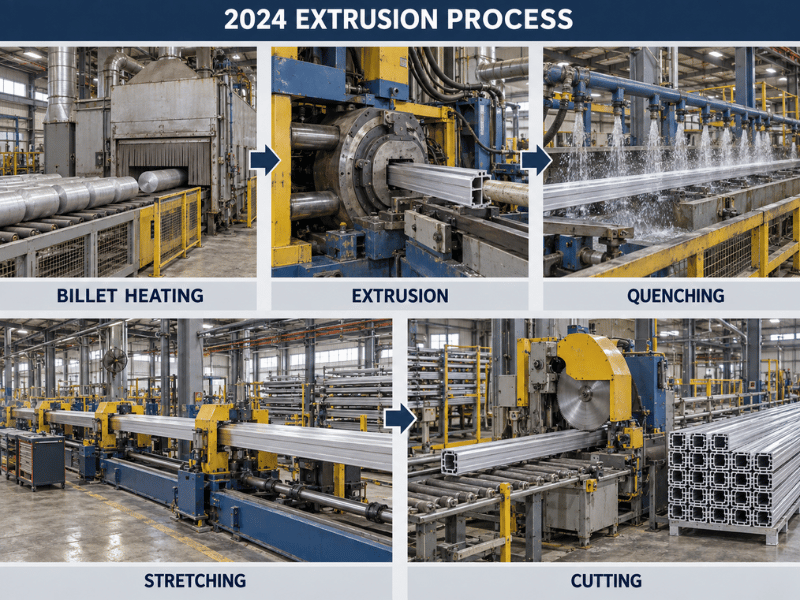
Das Strangpressen beginnt mit einem runden 2024-Bolzen, der auf Länge geschnitten und auf etwa 400–480 °C (750–900 °F) erwärmt wird. Dies erweicht die Legierung ausreichend, damit sie ohne Reißen durch die Matrize fließt, bleibt jedoch deutlich unter der Lösungsglühtemperatur.
Der erwärmte Bolzen wird in den Pressbehälter geladen, und ein Hydraulikstempel treibt ihn durch die Matrizenöffnung. Das austretende Profil wird abgekühlt, üblicherweise wasserabgeschreckt für Zustände wie T3/T4/T6, dann leicht gereckt, um es zu richten und Eigenspannungen abzubauen, und schließlich auf Länge gesägt. Temperatur, Geschwindigkeit und Abschreckzeitpunkt beeinflussen alle das finale Gefüge und die Eigenschaften, daher werden sie für luftfahrttaugliche Ergebnisse in einem engen Fenster gehalten.
Direktes vs. indirektes Strangpressen
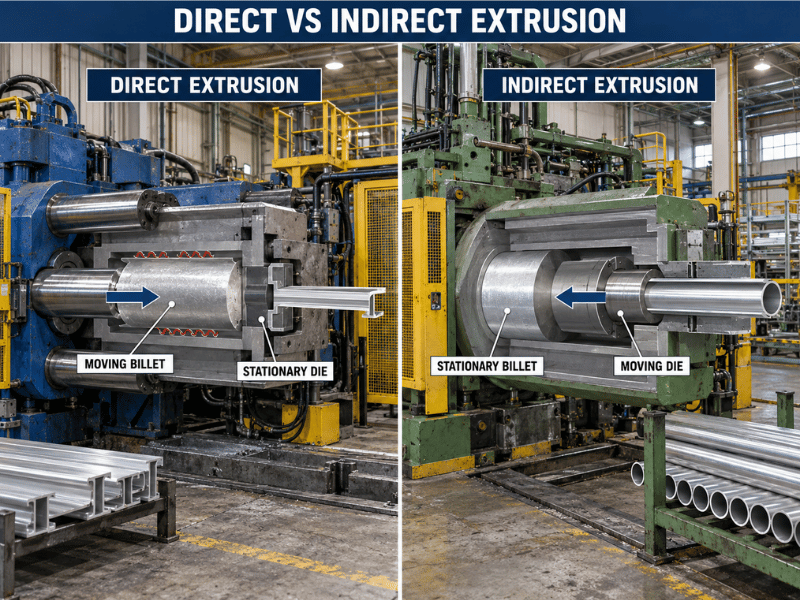
Zwei Pressenlayouts dominieren das Aluminium-Strangpressen, und der Unterschied liegt darin, welches Teil sich bewegt. Beim direkten (Vorwärts-)Strangpressen, drückt der Stempel den Bolzen durch eine stationäre Matrize; der Bolzen gleitet über die gesamte Länge des Behälters, sodass Wandreibung Kraft hinzufügt und die Last früh ihren Höhepunkt erreicht und dann abfällt, während der Bolzen kürzer wird. Beim indirekten (Rückwärts-)Strangpressen, bleibt der Bolzen im Behälter stehen, während ein Hohlstempel die Matrize in ihn hineinträgt, sodass nahezu keine Reibung zwischen Bolzen und Behälter entsteht.
| Merkmal | Direkte Extrusion | Indirektes Strangpressen |
|---|---|---|
| Knüppelbewegung | Bewegt sich durch den Behälter | Stationär im Behälter |
| Die Bewegung | Stationär | Bewegt sich mit Hohlstempel |
| Reibung | Hoch (Bolzen schleift an der Wand) | Sehr niedrig (kein Wandgleiten) |
| Erforderliche Kraft | Höher | ~25–30 % niedriger |
| Profillänge | Lange Läufe praktikabel | Begrenzt durch Hohlstempelbohrung |
| Am besten für | Standard-Vollprofile, lange Teile | Dünne Wände, hohl, feine Oberfläche |
Indirektes Strangpressen liefert eine bessere Oberflächengüte und geringere Eigenspannungen, was dem Anodisierbild zugutekommt, aber der Hohlstempel begrenzt die Profilgröße und erhöht die Werkzeugkosten. Direktes Strangpressen bleibt der Arbeitstier für die meisten 2024-Profile, weil es einfacher ist und längere Längen bewältigt.
Wärmebehandlung für stranggepresstes 2024
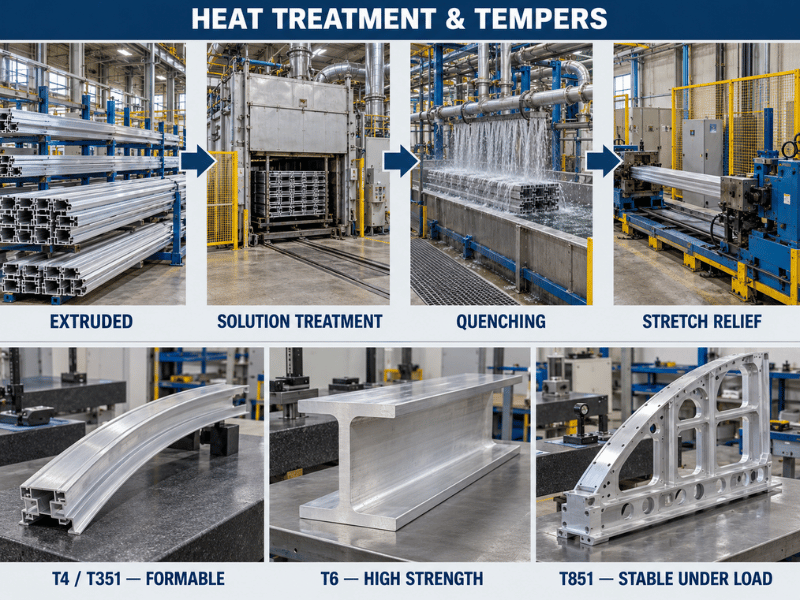
Stranggepresstes 2024 ist weich (nahe dem O-Zustand), bis es wärmebehandelt wird. Das Lösungsglühen erhitzt es auf etwa 493 °C (919 °F), um Kupfer und Magnesium in eine gleichmäßige feste Lösung zu überführen, dann schließt schnelles Wasser- oder Polymerabschrecken diese Elemente ein. Künstliche Alterung bei etwa 190 °C (375 °F) scheidet dann feine Al₂Cu-Partikel aus, die Festigkeit und Härte steigern.
Häufige Strangpresszustände sind:
- T3 / T4 — lösungsgeglüht, kaltverfestigt (T3) oder nicht (T4), dann natürlich gealtert; hohe Umformbarkeit, bevorzugt wo das Profil nach dem Strangpressen gebogen wird.
- T351 / T3511 — lösungsgeglüht, durch Recken spannungsarm geglüht (T3511 zusätzlich gerichtet), natürlich gealtert; der typische stranggepresste Strukturzustand mit typischen 470/325 MPa.
- T6 / T851 — lösungsgeglüht und künstlich gealtert (T851 zusätzlich reckentlastet); höhere Streckgrenze (~393–400 MPa) für Teile mit maximaler Festigkeit.
Arbeiten mit stranggepresstem 2024
Die Zerspanung ist eine Stärke von 2024: Es erreicht etwa 70 % auf der Standard-Zerspanbarkeitsskala, besser als 6061, und erzeugt kurze Späne, die werkzeugschonend sind. CNC-Fräsen und -Drehen halten enge Toleranzen für Luftfahrt- und Automobilkomponenten.
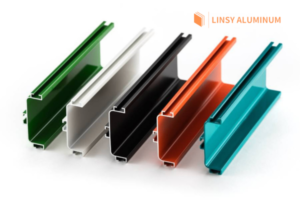
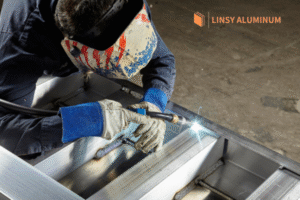
Schweißen ist der Schwachpunkt. Die wärmebeeinflusste Zone (WEZ — das Band neben der Schweißnaht, das schnell erhitzt und abkühlt) neigt zu Heißrissen, sodass Schmelzschweißen 2319-Zusatzwerkstoff und ein sorgfältiges Verfahren erfordert, und viele Strukturanwendungen es ganz vermeiden zugunsten von Nieten, Klebstoffen oder Schrauben. Die Oberflächenbehandlung ist wichtig, weil 2024 im Einsatz korrodiert: Anodisieren (Typ I chromsauer oder Typ II schwefelsauer) oder Plattieren mit einer Reinaluminiumschicht baut den Schutz auf, und Pulverbeschichtung fügt eine abplatzfeste Barriere für Außenteile hinzu.
2024-Strangpressprofil vs. 6061 und 7075
| Eigentum | 2024 (T351/T6) | 6061 (T6) | 7075 (T6) |
|---|---|---|---|
| Zugfestigkeit (MPa) | 470–483 | 310 | 572 |
| Streckgrenze (MPa) | 325–393 | 276 | 503 |
| Wärmeleitfähigkeit (W/m-K) | ~121 | 154–167 | ~130 |
| Extrudierbarkeit | Mäßig (niedriger) | Hoch | Niedrig |
| Korrosionsbeständigkeit | Niedrig | Gut | Mäßig–niedrig |
| Schweißeignung | Schlecht (WEZ-Riss) | Gut | Schlecht |
| Bearbeitbarkeit | Gut | Gut | Messe |
Wählen Sie 2024, wenn Festigkeits-Gewichts-Verhältnis und Ermüdung vor Korrosion und Schweißbarkeit rangieren. Wählen Sie 6061, wenn Sie schweißen, Wärme ableiten oder komplexe dünne Profile kostengünstig strangpressen müssen. Wählen Sie 7075 nur, wenn Sie Spitzenfestigkeit benötigen und zerspanen statt schweißen können.
Wo 2024-Strangpressprofile eingesetzt werden
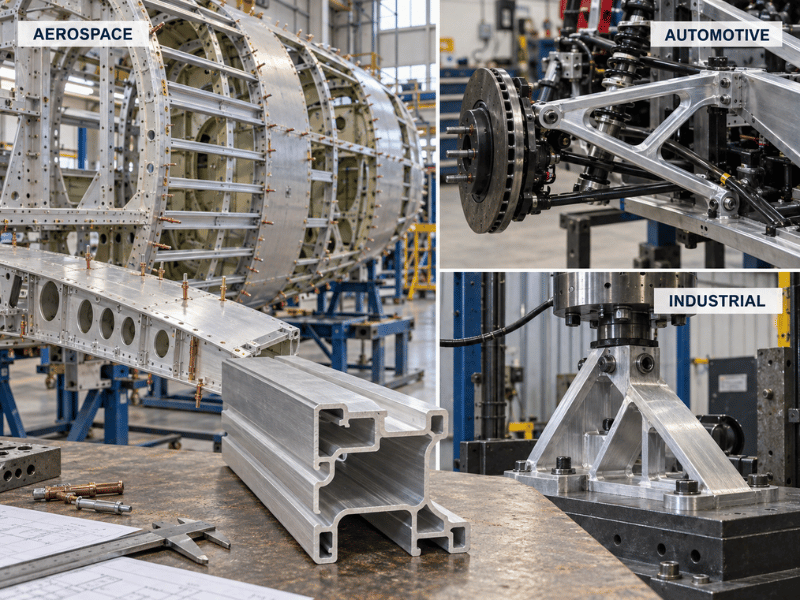
Die Luftfahrt führt den Verbrauch an: Rumpfstringer, Flügelholme und -rippen sowie Hautfelder verwenden 2024-Strangpressprofile wegen ihrer Ermüdungslebensdauer bei geringem Gewicht. Verteidigungs- und Verkehrsflugzeugzellen verlassen sich auf dieselben Zustände für Strukturrahmen.
Automobil- und Schienenverkehr nutzen 2024 für Aufhängungsarme, Chassis-Querträger und LKW-Räder, wo Festigkeit pro Kilo Masse einspart. Der allgemeine Maschinenbau spezifiziert es für hochbelastete Halterungen und Vorrichtungen, die wiederholte Lasten sehen, aber in einer geschützten oder beschichteten Umgebung sitzen.
Go/No-Go
- Go wenn das Teil 450+ MPa Festigkeit in einem langen Profil benötigt und in einer Umgebung mit geringer Korrosion oder in einer plattierten/beschichteten Umgebung eingesetzt wird.
- Go wenn die Montage Nieten, Schrauben oder Klebstoffe anstelle von Schmelzschweißverbindungen verwendet.
- Go wenn die Ermüdungslebensdauer unter Vibration wichtiger ist als die Wärmeausbreitung.
- No-Go wenn der Querschnitt Wärme abführen muss (Kühlkörper, Kühlplatten) — wählen Sie 6061 oder 6063 wegen ihrer ~150–200 W/m·K Leitfähigkeit.
- No-Go wenn Schmelzschweißen die einzige Fügemethode ist und die Last strukturell ist — HAZ-Rissbildung wird maßgebend sein.
- No-Go wenn das Teil ungeschützt Salzsprühnebel ausgesetzt ist — die geringe Korrosionsbeständigkeit von 2024 wird ohne Plattierung oder Beschichtung zu vorzeitigem Versagen führen.
Vorteile & Einschränkungen
| Profis | Beschränkungen |
|---|---|
| Hohe Festigkeit-zu-Gewicht unter den strangpressbaren Legierungen | Geringere Strangpressbarkeit als 6xxx (langsamer, fehleranfällig) |
| Ausgezeichnete Ermüdungsbeständigkeit | Geringe Korrosionsbeständigkeit, benötigt Plattierung/Beschichtung |
| Gute Zerspanbarkeit (besser als 6061) | Schlechte Schweißbarkeit, HAZ-Heißrissbildung |
| Mehrere Zustände für Umformung vs. Festigkeit | Wärmeleitfähigkeit zu niedrig für Kühlkörper |
Schlussfolgerung
2024-Aluminiumstrangpressprofile bieten Ihnen Festigkeit in Luft- und Raumfahrtqualität in langen Profilen mit konstantem Querschnitt, aber nur, wenn Sie seine Grenzen respektieren: langsameres Strangpressen als 6xxx, obligatorische Wärmebehandlung, Plattierung oder Beschichtung für Korrosionsschutz und Nieten oder Befestigungselemente anstelle von Schweißnähten. Wählen Sie den Zustand passend zur Aufgabe — T351/T4 zum Umformen, T6/T851 für maximale Streckgrenze — und halten Sie es von Kühlkörper- und ungeschützten marinen Anwendungen fern.
Linsy Aluminum liefert 2024 in Platten-, Stangen-, Rohr-, Draht-, Coil-, Profil- und Blockformen mit hauseigener CNC-Bearbeitung, TIG/MIG-Schweißen, Laserschneiden und Oberflächenveredelung, plus MTC bei jeder Bestellung und SGS-Berichte auf Anfrage; kundenspezifische Strangpressprofile mit niedriger MOQ dauern typischerweise 10–60 Tage. Um Ihr 2024-Strangpressprofil zu spezifizieren — Legierung, Zustand und Querschnitt — senden Sie Ihre Zeichnung oder Anforderungen an unser Team für ein Angebot.
Häufig gestellte Fragen
Kann 2024-Aluminium wie 6061 stranggepresst werden?
Ja, aber mit geringerer Strangpressbarkeit: Der hohe Kupfergehalt erfordert langsamere Pressgeschwindigkeiten und engere Prozesskontrolle, und Oberflächenfehler sind wahrscheinlicher. Es ist eine standardmäßig strangpressbare Legierung, nur nicht so schnell oder kostengünstig zu verarbeiten wie die 6xxx-Serie.
Welchen Zustand sollte ich für ein 2024-Strangpressprofil spezifizieren?
T351 oder T3511 für strukturelle Querschnitte, die nach dem Strangpressen gebogen werden könnten, T4 wo natürliche Alterung ausreicht, und T6 oder T851 wenn Sie die höchste Streckgrenze (etwa 393–400 MPa) benötigen und bearbeiten statt schweißen können.
Warum wird 2024 nicht für Kühlkörper verwendet?
Seine Wärmeleitfähigkeit beträgt nur etwa 121 W/m·K, weil Kupfer wärmetragende Elektronen streut, deutlich unter 6061-T6 (154–167) und 6063 (200). Für Wärmeübertragung wählen Sie stattdessen 6061, 6063 oder 1050/1100.
Ist 2024er Aluminium schweißbar?
Schmelzschweißen ist schlecht, weil die wärmebeeinflusste Zone reißt. Verwenden Sie 2319-Zusatzwerkstoff mit kontrolliertem Verfahren, wenn Schweißen unvermeidbar ist, aber Nieten, Klebstoffe oder mechanische Befestigungselemente sind für strukturelle Verbindungen vorzuziehen.
Wie schneidet 2024-Strangpressprofil im Vergleich zu 7075 ab?
7075 ist stärker (572 MPa Zugfestigkeit), aber noch schwieriger zu strangpressen und zu schweißen; 2024 tauscht etwas Spitzenfestigkeit gegen bessere Zerspanbarkeit und Ermüdungslebensdauer. Wählen Sie 2024 für ermüdungskritische Strukturen, 7075 für maximale statische Festigkeit, die Sie bearbeiten werden.
Benötigt 2024-Strangpressprofil Korrosionsschutz?
Ja. Blankes 2024 korrodiert leicht, besonders in Salz- oder Industrieatmosphären. Anodisieren, Alclad-(Reinaluminium-)Plattierung oder Pulverbeschichtung ist Standard, und Plattierung ist üblich bei Luftfahrtblechen und -profilen.