2014 aluminum alloy is the grade you reach for when a part has to be machined from solid, carry heavy load, and never see a weld. Its 3.9–5.0% copper delivers T6 strength in the same class as 2024, at a price: bare corrosion resistance is poor, and fusion welding is off the table.
Choosing between 2014, 2024, 6061 and 7075 usually turns on four questions — how much strength the design needs, whether the part gets welded, what it will be exposed to, and how much machining it takes. This guide works through those four, using the temper values that actually apply rather than the ones most often republished.
2014 Alüminyum Alaşımı Nedir?
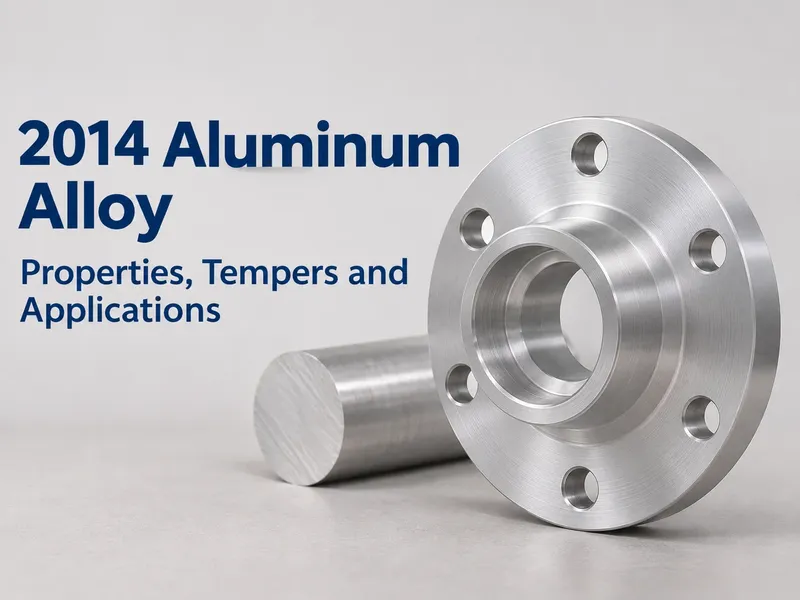
2014 is a 2xxx-series alloy built on copper rather than zinc or magnesium. That choice sets everything downstream: high strength after aging, good machinability, poor corrosion resistance in the bare condition, and a weldability problem no heat treatment rescues.
Copper is not the only active element. Because 2014 also carries 0.50–1.2% silicon, aging precipitates θ′ (Al₂Cu) and S′ (Al₂CuMg), with Mg₂Si and Q-phase (Al₅Cu₂Mg₈Si₆) forming as well. The free silicon is what makes 2014 break chips well in the shop. It is also part of why the grade carries lower fracture toughness than 2024.
Kimyasal Bileşim
| Element | İçerik (ağırlıkça %) | Ne yapar |
| Bakır | 3.9 – 5.0 | Primary strengthener |
| Magnezyum | 0.20 – 0.80 | Raises the aging response |
| Silikon | 0.50 – 1.2 | Improves machinability, lowers toughness |
| Manganez | 0.40 – 1.2 | Grain control and secondary strengthening |
| Demir | 0,70 maks | Impurity; lowers toughness |
| Çinko | 0,25 maks. | Safsızlık |
| Titanyum | 0,15 maks. | Tane inceltici |
| Krom | 0,10 maks. | Safsızlık |
| Diğerleri | Her biri en fazla 0,05, toplam en fazla 0,15 | — |
The manganese floor is the figure buyers most often get wrong: it is 0.40%, not 0.20%. The 0.20% figure is magnesium’s lower limit, and the two rows sit next to each other in most published tables. A mill certificate showing under 0.40% Mn is not 2014.
Temperlere Göre Mekanik Özellikler
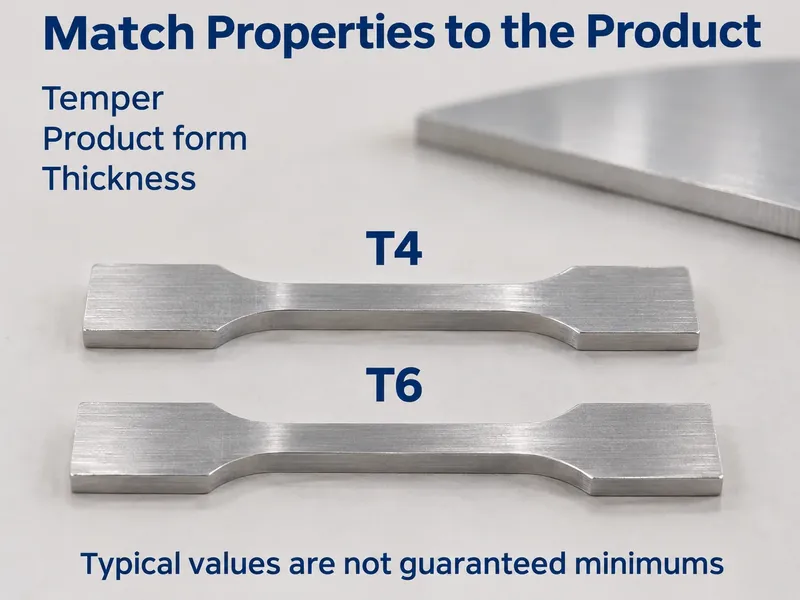
The most common error in published 2014 data is quoting T4 numbers as T6. The 427 MPa tensile and 290 MPa yield that appear everywhere labelled “2014-T6” are the T4/T451 minimums — 62 ksi and 42 ksi in AMS 4121. Design to those values while specifying T6, and the yield strength you are relying on sits about 30% below what T6 actually delivers.
| Temper | Tensile, minimum | Yield, minimum | Tensile / yield, typical | Uzama, tipik | Sertlik |
| T4 / T451 | 427 MPa (62 ksi) | 290 MPa (42 ksi) | 470 / 325 MPa | 20% | 105 HB |
| T6 / T651, plate | 448 – 462 MPa (65 – 67 ksi) | 379 – 407 MPa (55 – 59 ksi) | 483 / 414 MPa | 13% | 135 HB |
| T6 / T651, cold-finished bar | 483 MPa (70 ksi) | 414 MPa (60 ksi) | 483 / 414 MPa | 13% | 135 HB |
Minimums move with product form and thickness, so treat the bands as the range you will actually see on a certificate rather than one fixed number. For plate and bar in T6, design against the lower end — 448 MPa tensile and 379 MPa yield — and let the mill certificate confirm where in the band your heat landed.
Fiziksel Özellikler
Thermal conductivity is the second figure that gets misquoted. The 192 W/m·K value belongs to annealed 2014-O; in T6 it falls to about 155 W/m·K, with electrical conductivity down to about 40% IACS, because copper held in solid solution scatters electrons. T4 is lower still, near 134 W/m·K, since almost all of the copper stays dissolved. Size a heat sink from the annealed figure and you overstate dissipation by close to a quarter.
| Mülkiyet | Value (T6 / T651) | Not |
| Yoğunluk | 2,80 g/cm³ | Same in all tempers |
| Elastisite modülü | 73 GPa | MMPDS design value 69.6 GPa |
| Termal iletkenlik | 155 W/m·K | Annealed 2014-O: 192 W/m·K |
| Elektriksel iletkenlik | 40% IACS | Annealed 2014-O: 50% IACS |
| Erime aralığı | 507 – 638 °C | Same in all tempers |
| Sertlik | 135 HB (≈155 HV) | T4: 105 HB |
| Termal genleşme | 23 µm/m·K | Same in all tempers |
Where 2014 Is Used
2014 earns its place where a part is machined from solid and loaded hard. The applications below all share that shape: cut from stock, assembled mechanically, and protected from the environment by design rather than by luck.
Aircraft Wheels, Brake Parts and Fittings
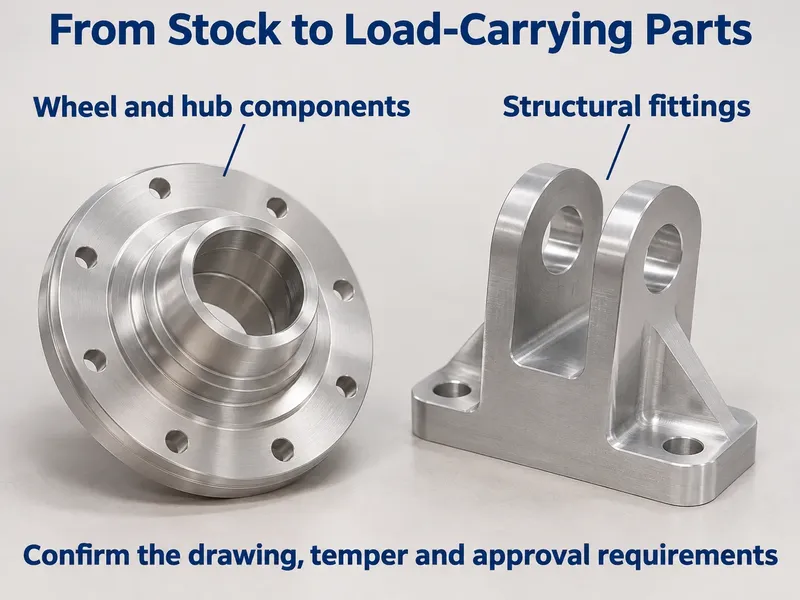
2014-T6 forgings are the standard choice for aircraft wheels and wheel hubs, brake components, landing-gear parts and structural fittings. Brake and hub service runs warm, and 2014-T6 holds usable strength there. It is not a high-temperature alloy, though: by 150 °C its yield strength has already fallen by more than 40%, and sustained heat calls for a different grade entirely. Wing spars and fuselage frames are a different story — those are normally 7075 or 2024, and attributing them to 2014 is a common mix-up.
Ordnance, Missiles and Industrial Parts
In military hardware, 2014 goes into ordnance and missile components, not vehicle protection. Aluminum armor is a separate family specified to MIL-DTL-46027 (5083-H131), MIL-DTL-46063 (7039-T64) and MIL-DTL-46192 (2519-T87); 2014 appears in none of them. On the industrial side, truck wheel hubs, equalizer beams and precision machined components are the bread-and-butter work.
How 2014 Compares with 2024, 6061 and 7075
| Özellik | 2014 | 2024 | 6061 | 7075 |
| Ana alaşım elementi | Cu 3.9–5.0, Si 0.50–1.2 | Cu 3.8–4.9, Mg 1.2–1.8, Mn 0.30–0.9 | Mg 0.8–1.2, Si 0.40–0.8, Cu 0.15–0.40 | Zn 5,1–6,1, Mg 2,1–2,9, Cu 1,2–2,0 |
| Tensile, typical | 483 MPa (T6) | 470 MPa (T3) | 310 MPa (T6) | 570 MPa (T6) |
| Corrosion, bare | Zayıf | Zayıf | Çok iyi | Orta düzeyde |
| Kaynaklanabilirlik | Önerilmez | Önerilmez | Mükemmel | Önerilmez |
| İşlenebilirlik | Good — free silicon aids chip control | İyi | İyi | İyi |
| Kırılma tokluğu | Low, KIC ≈19–24 MPa√m (T6) | Moderate, ≈30–44 MPa√m (T3) | Yüksek | Orta düzeyde |
| Tipik kullanım | Wheels, brake parts, fittings | Skins, structures | Frames, marine, piping | Aircraft, military |
Every strength in this table is an Aluminum Association typical value, and the specified minimums sit up to about 10% below them — do not read 483 MPa as a guaranteed floor. The trade it makes visible is toughness against everything else: the same silicon that helps 2014 break chips is part of why it carries the lowest fracture toughness in this group.
Go/No-Go: When to Specify 2014
Use 2014 when:
- The part is machined from solid and the cut is the expensive operation. The free silicon in 2014 breaks chips, which keeps tool life and cycle time out of trouble.
- Strength matters and the part is assembled by riveting, bolting or bonding rather than welding.
- Service temperature stays below roughly 150 °C. Past that the 2xxx grades fall away quickly, and a heat-resistant forging alloy such as 2618 becomes the better question.
- A protective finish is already in the plan — Alclad sheet, anodizing, primer or powder coat.
Do not use 2014 when:
- The design requires fusion welding. The alloy is not covered by AWS D1.2, where 2219 is the only 2xxx grade, and ASM rates its arc weldability D — 6061 is the weldable substitute for most of these parts.
- The part stays bare in saltwater, chemical or humid marine service. Bare 2014 corrodes at about the rate of 2024, which is to say quickly.
- Fracture toughness or damage tolerance drives the design. Low toughness is 2014’s structural weak point, not a secondary consideration.
- The joint has to survive sustained vibration with a known crack-growth requirement. Choose 2024 veya bir 7075-grade alloy instead.
Bare or Alclad is the decision that most often gets skipped. Alclad 2014 performs well in atmospheric service, while bare 2014 needs a finish it rarely gets in a machine shop. Form and temper combinations are listed on the 2014 alüminyum alaşımı ürün sayfası.
Sonuç
2014 puts 2024-class strength into a grade that machines cleanly, and charges for it in two places: bare corrosion resistance is poor, and the alloy cannot be fusion welded. Neither cost can be engineered away after the fact — the part has to be designed around them from the start.
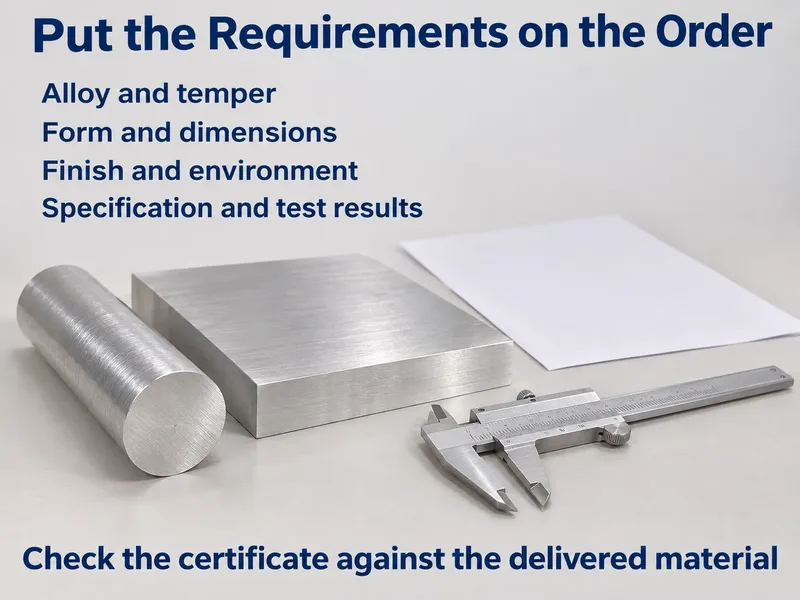
We supply 2014 bare or Alclad in the temper your drawing calls for, and we will flag a welded joint before the order reaches production, because that joint is usually better riveted or bonded. Every order ships with an MTC.
Send the drawing with the temper and the service environment marked, and we will confirm the form and finish that fit.