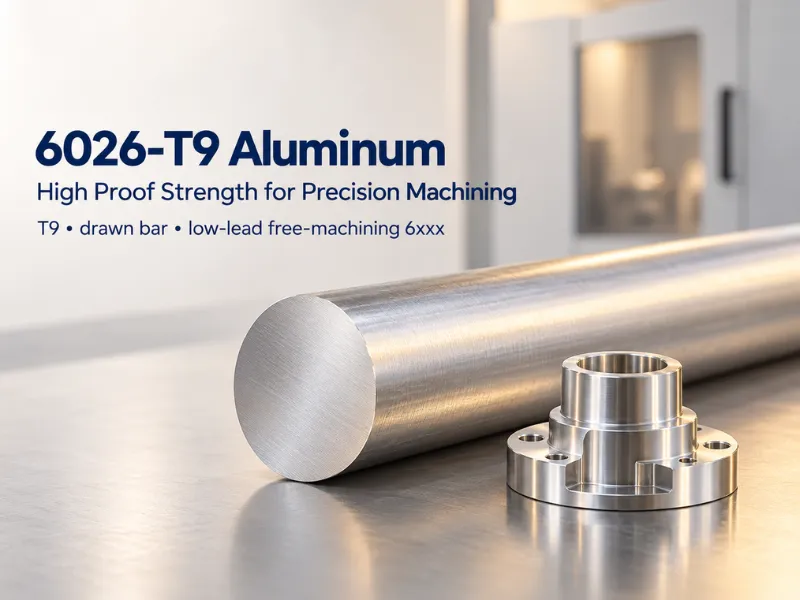
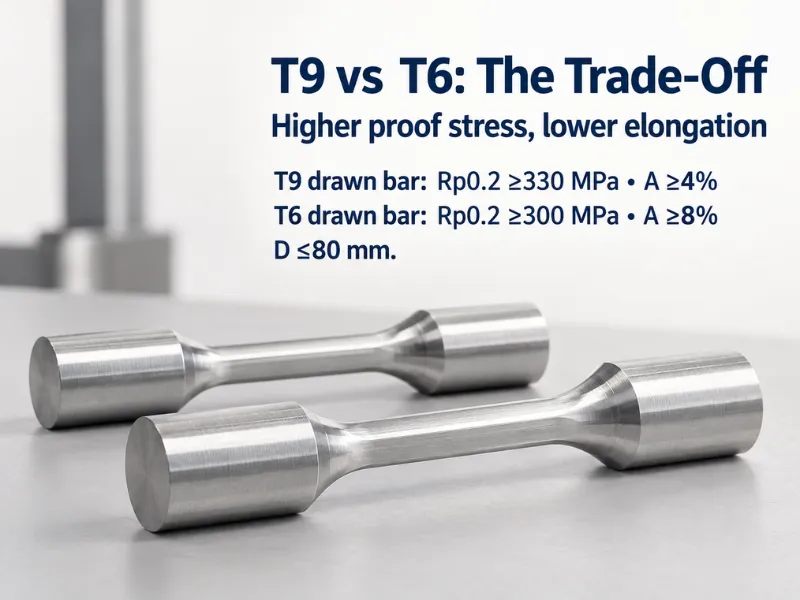
6026-T9은 가공 부품이 이 합금이 허용하는 한 영구 변형에 저항해야 하고 이후 절대 구부러지지 않아야 할 때 지정하는 조질 상태이며, 시효 후 봉재를 냉간 가공하면 0.2% 항복 강도가 330 MPa로 T6보다 30 MPa 높아지고 연신율은 8% 대신 4%로 남습니다.
강도는 결정의 절반에 불과합니다. 생산 순서는 또한 각 조질 상태가 어떤 형태로 공급 가능한지를 결정하며, 당사가 생산할 수 없는 형태의 조질 상태는 귀하가 발주할 수 있는 규격이 아닙니다.
6026이란 무엇인가
6026은 인공 시효 중 Mg₂Si 석출로 강도를 얻는 6xxx Al–Mg–Si 합금입니다. 이 합금의 정의적 특징은 무료 가공 첨가물입니다: 0.50–1.50%의 비스무트가 칩을 끊어주는 반면, 납은 메커니즘이 아니라 0.40%로 상한이 설정되어 있습니다. 이는 일반 6xxx의 내식성과 양극산화 반응을 유지하면서 쾌삭 등급의 칩 제어를 추가합니다 — 6262와 6012가 담당했던 역할을 비스무트가 칩 끊기를 수행하며 대체하는 것입니다.
트레이드오프는 합금이 무엇을 할 수 있는지가 아니라 어디에 위치하는지에 있습니다. 비스무트는 강도를 높이지 않으므로 6026은 가공 등급이 우선이고 구조 등급이 그 다음입니다; 최대 강도가 주된 목표인 경우 6082나 7075가 그 역할을 더 잘 수행합니다. 실제로 6026 부품을 결정하는 것은 조질 상태인데, T6, T8, T9, T6510/T6511에 걸친 편차가 항복 강도 300~330 MPa, 연신율 8%~4%에 이르기 때문에 — 부품의 성형 가능 여부를 결정할 만큼 충분히 넓습니다.
화학 조성 (EN 573-3)
비스무트는 의도적 첨가물이며, 주석과 납은 불순물 상한에 위치합니다. 이 구분은 제강 증명서를 읽을 때 중요합니다. 높은 주석 수치는 무료 가공 이점이 아니라 오염 신호이기 때문입니다.
| 요소 | 6026 (EN 573-3, 중량%) | 기능 |
|---|---|---|
| Si | 0.60–1.40 | Mg와 함께 Mg₂Si 형성 — 강도 원천 |
| Fe | 0.70 max | 불순물; 표면 조도와 인성에 영향 |
| Cu | 0.20-0.50 | 강도 상승 및 석출물 경화 |
| Mn | 0.20–1.00 | 결정립 구조와 재결정 제어 |
| Mg | 0.60–1.20 | Si와 균형을 이루어 Mg₂Si로 형성 |
| Cr | 0.30 최대 | 이 등급에서 불순물 |
| Zn | 0.30 최대 | 불순물 |
| Ti | 0.20 최대 | 晶粒细化剂 |
| Bi | 0.50–1.50 | 무료 가공 첨가물 — 칩 끊기 |
| Pb | 0.40 최대 | 잔류물; ELV 및 RoHS 면제가 허용하는 상한 |
| Sn | 최대 0.05 | 첨가물이 아닌 불순물 상한 |
| 기타 | 각각 최대 0.05, 총합 최대 0.15 | — |
| Al | 잔액 | — |
히트를 승인하기 전에 증명서에서 세 줄을 확인하십시오: Bi는 0.50–1.50% 이내, Sn은 0.05% 이하, Pb는 0.40% 이하. Bi가 0.50% 미만인 히트는 길고 끈적하게 가공되며; Sn이 0.05% 초과인 히트는 설계 변경이 아니라 스크랩 오염을 나타냅니다.
T 조질 상태의 생산 방법
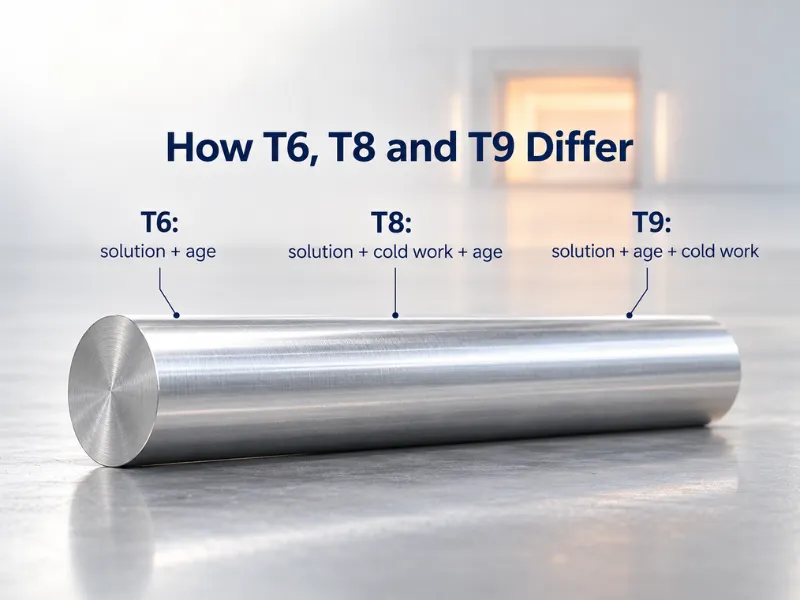
모든 시효 경화 6xxx 조질 상태는 동일하게 시작합니다: 빌렛을 용체화 열처리하여 합금 원소를 용해시키고, 급랭하여 과포화 용액에 가둔 다음, 시효시켜 미세 입자로 석출시킵니다. T 뒤의 접미사는 그 핵심 순서 주변에서 일어나는 일을 기록하며 — 시효 대비 냉간 가공의 순서가 T8과 T9를 구분합니다.
- T6 — 용체화 열처리 후 인공 시효. 냉간 가공 없음.
- T8 — 용체화 열처리, 냉간 가공, 그 후 인공 시효. 냉간 가공이 시효 전에 옴.
- T9 — 용체화 열처리, 인공 시효, 그 후 냉간 가공. 냉간 가공이 최종 공정.
- T6510 — T6 후 인장에 의한 응력 제거, 봉재, 바, 프로파일, 튜브에서 영구 변형 1–3% (인발 튜브에서 0.5–3%), 인장 후 추가 교정 없음.
- T6511 — T6510과 동일하나, 치수 공차를 충족하기 위해 인장 후 경미한 교정이 허용됨.
T9는 다섯 가지 중 유일하게 시효 후 봉재를 냉간 가공합니다. 시효가 이미 석출물을 설정했고; 냉간 인발이 그 위에 전위 강화를 추가하며 동일 패스에서 직경을 고정합니다. T9 봉재는 치수와 잔류 응력이 이미 확정된 상태로 도착하므로 정밀 선삭 부품은 보통 T9로 지정됩니다 — 가공하는 직경이 봉재가 유지하는 직경이기 때문입니다.
T8은 그 순서를 뒤집습니다. 냉간 가공이 시효 전에 들어가므로, 봉재는 시효 후 인발되는 것이 아니라 인발된 크기에서 시효됩니다. T8 봉재는 항복 강도 315 MPa, 인장 강도 345 MPa, 연신율 4%에 도달합니다 — T6보다 항복 강도가 높고, T9보다 15 MPa 낮습니다.
수치로 본 6026-T9
아래 최솟값은 냉간 인발 봉재의 EN 754-2와 압출 제품의 EN 755-2에서 가져온 것입니다. T9는 인발 제품으로만 존재하며; T6510과 T6511은 압출 제품으로만 존재하고, 각 사이즈 밴드에서 T6와 동일한 강도 라인을 가집니다.
| 성질 | 형태 및 표준 | 크기 범위 | Rm 최소 (MPa) | Rp0.2 최소 (MPa) | A 최소 (%) | HB (대표값) |
|---|---|---|---|---|---|---|
| T6 | 인발 봉재, EN 754-2 | D ≤ 80 mm | 370 | 300 | 8 | 95 |
| T8 | 인발 봉재, EN 754-2 | D ≤ 80 mm | 345 | 315 | 4 | 95 |
| T9 | 인발 봉재, EN 754-2 | D ≤ 80 mm | 360 | 330 | 4 | 95 |
| T6 / T6510 / T6511 | 압출, EN 755-2 | D ≤ 140 mm | 370 | 300 | 8 | 95 |
| T6 / T6510 / T6511 | 압출, EN 755-2 | 140 < D ≤ 200 mm | 340 | 250 | 8 | 90 |
| T6 / T6510 / T6511 | 압출, EN 755-2 | 200 < D ≤ 250 mm | 300 | 200 | 8 | 90 |
인장 강도 열이 아닌 항복 강도 열로 선택하십시오. T9는 330 MPa로 최고 항복 강도를 유지하며 T6보다 30 MPa 높은 반면, 인장 강도 최솟값 360 MPa는 실제로 10 MPa 아래에 T6의 370보다 위치합니다 — 시효된 구조에 대한 냉간 가공은 영구 변형 저항을 얻고 그 대가로 인장 강도와 연신율을 포기합니다.
물리적 특성은 6xxx가 일반적으로 위치하는 곳에 있습니다; 이는 최솟값이 아닌 대표값입니다: 밀도 2.72 g/cm³, 탄성 계수 약 69–70 GPa, 열전도율 172 W/(m·K), 전기전도율 약 26 MS/m (대략 44% IACS), 20~100 °C 사이 열팽창 계수 23.4 × 10⁻⁶/K. 응고 범위는 대략 575–650 °C입니다.
T9 vs T6 vs T8 vs T6510/T6511
| 성질 | 시퀀스 | Rm 최소 | Rp0.2 최소 | A min | 지정 시점 |
|---|---|---|---|---|---|
| T6 | 용체화 + 시효 | 370 | 300 | 8% | You need the best tensile-elongation balance, or the part is extruded rather than drawn |
| T8 | Solution + cold work + age | 345 | 315 | 4% | The bar is already cold drawn and the part needs more proof stress than T6 at the same 4% elongation |
| T9 | Solution + age + cold work | 360 | 330 | 4% | The finished part is cut, not formed, and must hold its set under the highest load the grade allows |
| T6510 | T6 + stretch, no re-straightening | 370 | 300 | 8% | A large extruded section is machined flat or square and residual stress would move it |
| T6511 | T6510 + light straightening | 370 | 300 | 8% | Same as T6510, but the section needs straightening inside standard tolerance after the stretch |
T9 is the right call when the part is produced entirely by machining and the design load is carried below the yield point. The 330 MPa proof stress is the highest the alloy offers, and the cold-finished diameter means the bar is already where the tolerance wants it. The cost is 4% elongation: T9 leaves almost no room for a bend, a swage, or a crimp after delivery.
T6 covers the widest range of work. Its 370 MPa tensile and 8% elongation give room to form or straighten after heat treatment, and it is the temper extruded tube and profile come in. If the part needs any deformation after aging, T6 or one of its stress-relieved versions is the one that can still take it.
T8 sits between them and is easy to overlook. It is a drawn-bar temper like T9, but with cold work ahead of aging: 315 MPa proof stress and 345 MPa tensile, still at 4% elongation. Specify T8 when the drawing calls for more proof stress than T6 and the part will not be formed — but T9 is available, it gives 15 MPa more proof stress at the same elongation, so T8 usually loses that comparison on a like-for-like drawing.
T6510 and T6511 are the stress-relieved versions of T6 and exist only for extruded product. They change residual stress, not the strength line, so the choice between them and T6 is about distortion after machining rather than load capacity. T6510 forbids straightening after the stretch; T6511 allows light straightening to hold tolerance, which is why it appears more often on standard extruded sections.
Shapes and Sizes
The temper usually decides the form. T9 and T8 are drawn-bar tempers; T6510 and T6511 are extruded; T6 exists in both. Where a drawing needs a temper the standard form does not carry, the route changes — the order does not get refused.
- Bar and rod — round 6–400 mm, hex and square 6–200 mm, length 1000–6000 mm. T9 is normally a cold-drawn round bar.
- Sheet and plate — 0.5–120 mm thick, 1000–2600 mm wide, length 1000–6000 mm.
- 튜브 — outer diameter 10–300 mm, wall 0.5–30 mm.
- 코일 — supplied on enquiry. Tell us the required temper, width and coil weight and we confirm what the mill can run; coil is not a standing stock form for this grade.
- Custom profiles — extruded to your section drawing (how custom extrusion profiles are produced covers the route from drawing to die).
Non-standard sections and sizes are produced to order. Low-MOQ custom runs typically take 10–60 days depending on size and processing; what a size outside the standard range changes is the production route and the lead time, not whether we will quote it.
Go / No-Go
- Go when the part is turned or milled in volume, the enquiry has to clear RoHS or ELV, and 6061-T6 is short on strength while a 2xxx or 7xxx grade would be more than the design needs. The bismuth chip control is what pays for the alloy, and it pays most on automatic lathes running long batches.
- Go when the part needs an anodized finish and free-machining behavior at the same time; a leaded free-machining grade dulls that finish and carries its own compliance burden. Note the qualification: 6026 meets ELV and RoHS under the lead exemption for aluminum alloys, which permits up to 0.40% Pb. It is a low-lead grade, not a zero-lead grade, and the distinction matters if your compliance file treats exemptions differently from substance bans.
- No-go when the drawing fixes T9 or T8 on a part that still has to be formed. That is a temper mismatch rather than an alloy limitation — 6026 forms in O and T4, and the drawing changes temper, not grade.
- No-go when the service environment needs the seawater performance of a 5xxx alloy, or when 6061 or 6063 already meets the drawing. 6026 costs more than either, and the premium only returns where the free-machining behavior and the compliance position are both being used.
Specifying and Sourcing 6026
Four lines on the enquiry prevent most wrong deliveries:
- Name the standard, not only the alloy.
6026-T9 to EN 754-2fixes the product form, the size band and the property table;6026-T9on its own leaves all three open. - Pair the temper with a form the standard carries. T9 and T8 belong to drawn bar under EN 754-2; T6, T6510 and T6511 belong to extruded product under EN 755-2. Asking for
T9 extruded profilesends the enquiry back for clarification. - Give the size band, not just the nominal. The EN 755-2 minimums step down at 140 mm and again at 200 mm, so a 210 mm bar is specified against 300 MPa tensile, not 370.
- EN 10204 3.1을 요구하십시오. That certificate carries the heat’s actual chemistry and mechanical results, signed at the producing mill, and it is the only document that lets you check Bi, Sn and Pb against the limits above.
우리의 6026 알루미늄 합금 page lists the forms and tempers we run, so the size and temper can be checked before you write the enquiry.
결론
T9 gives 6026 its highest proof stress at 330 MPa and its lowest elongation at 4%, so it suits a part that is machined to final form and loaded below yield, and rules out anything that still has to bend. T6, T8 and T6510/T6511 trade that yield back for formability or for lower residual stress in large sections.
We draw and supply 6026 in T6, T8, T9, T6510 and T6511 across bar, sheet, tube and custom profiles, with MTC on every order and coil quoted on enquiry.
Send your drawing with the standard, temper and size band, and we will confirm the production route and lead time before you commit.
자주 묻는 질문
What is 6026 T9 aluminum?
6026 is a low-lead free-machining 6xxx alloy, and T9 is the temper produced by aging the bar and then cold working it. Because the cold draw is the last step, the bar arrives strengthened and dimensionally finished — which is why T9 suits precision turned parts.
Is 6026 T9 stronger than T6?
It depends which strength you mean. T9 reaches a higher 0.2% proof stress, 330 MPa against T6’s 300, so it resists permanent set better. Its tensile minimum is 360 MPa against T6’s 370 — 10 MPa lower — and its elongation drops from 8% to 4%.
Can 6026 T9 be welded?
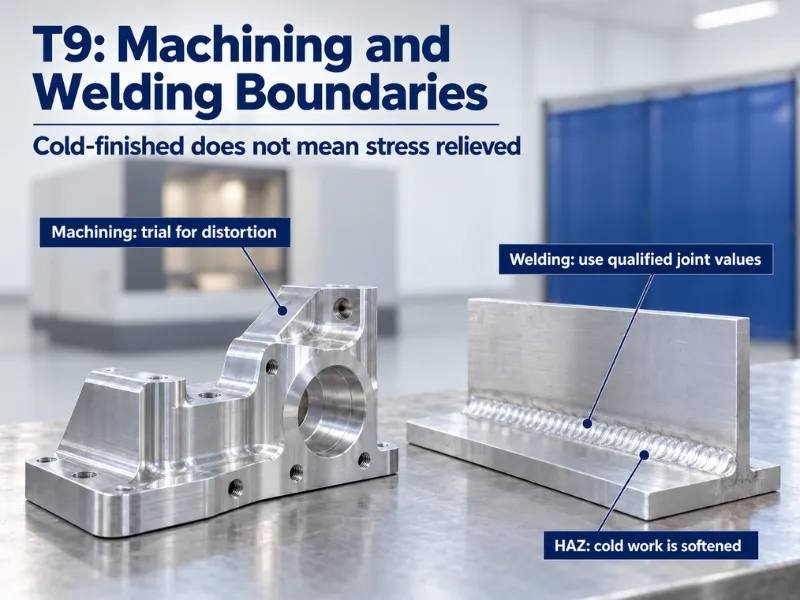
Yes, by TIG or MIG, but the joint will not hold T9 properties. The heat-affected zone reverts toward the annealed condition, and no post-weld aging treatment restores the T9 structure in this grade. If the finished assembly must carry T9 strength across a weld, change the design to a mechanical joint or pick a temper you can accept losing.
Which tempers do you supply, and what is the minimum order?
We supply bar, sheet, tube and custom profiles in T6, T8, T9, T6510 and T6511. Coil is quoted on enquiry. Round bar runs 6–400 mm and sheet 0.5–120 mm thick.
Non-standard sizes go to low-MOQ custom production, typically 10–60 days. Send the drawing, temper and size band for a route and a price.