What Is 5050 Aluminum Alloy?
5050 is a 5xxx-series wrought alloy where magnesium (1.1–1.8%) is the primary strengthening element. Like all 5xxx alloys, it is non-heat-treatable: strength comes from solid-solution strengthening by magnesium plus strain hardening (cold work), not from precipitation heat treatment the way 6xxx or 2xxx alloys behave.
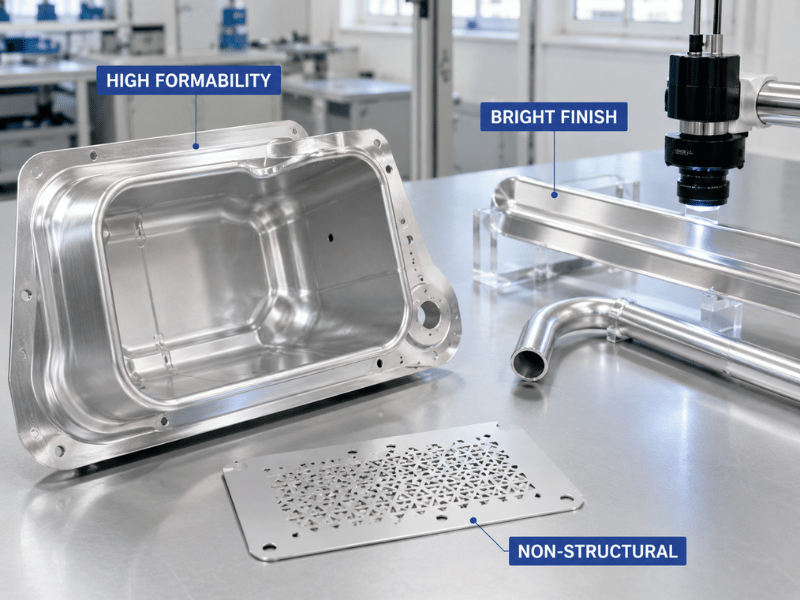
It carries less magnesium than 5052, and that single difference defines its character. Lower magnesium gives 5050 better formability and a brighter, more uniform anodized finish, but at the cost of lower strength and fatigue resistance. Pick 5050 when the part will be deeply formed, bent, or shown — and reach for 5052 or 6061 when the design is structural.
5050 Aluminum Chemical Composition
5050 is controlled by impurity ceilings that protect corrosion resistance and surface quality, with magnesium set as the main strength contributor.
| Element | Content (max unless noted) | Role in the alloy |
|---|---|---|
| Aluminum (Al) | 97.2–98.6% (balance) | Lightweight, corrosion-resistant base |
| Magnesium (Mg) | 1.1–1.8% | Primary strength contributor; drives cold-work hardening |
| Manganese (Mn) | 0.10% | Supports grain structure and intergranular corrosion resistance |
| Chromium (Cr) | 0.10% | Improves corrosion resistance, suppresses grain growth |
| Iron (Fe) | 0.70% | Kept low to preserve ductility and forming quality |
| Silicon (Si) | 0.40% | Limited to keep mechanical properties consistent |
| Copper (Cu) | 0.20% | Minimal — higher levels reduce corrosion resistance |
| Zinc (Zn) | 0.25% | Limited to preserve corrosion behavior |
| Others (each / total) | 0.05% / 0.15% | Trace elements controlled for alloy consistency |
The magnesium-and-chromium combination is what gives 5050 its good atmospheric corrosion resistance, while the low copper and silicon ceilings keep the anodized layer clear rather than cloudy.
5050 Aluminum Physical and Mechanical Properties
The defining numbers for 5050 are its low-to-moderate strength and its high formability, not its conductivity or hardness.
| Property | Value |
|---|---|
| Density | 2.68–2.69 g/cm³ |
| Melting range | ~605–650 °C |
| Modulus of elasticity | ~69 GPa (10 × 10⁶ psi) |
| Coefficient of thermal expansion | ~23.7 × 10⁻⁶ /K |
| Thermal conductivity | ~140–160 W/(m·K) |
| Electrical conductivity | ~35% IACS |
| Corrosion resistance | Very good — suitable for marine-atmospheric and humid environments |
| Weldability | Good — compatible with common welding methods |
| Formability | Good in O; decreasing with cold work |
| Tensile strength, O temper | 140–180 MPa |
| Tensile strength, H32 temper | 175–215 MPa |
| Tensile strength, H34 temper | 200–240 MPa |
| Yield strength, O / H32 / H34 | 55–70 / 125–160 / 160–200 MPa |
The strength figures scale with temper because 5050 is strain-hardened, not heat-treated: the O condition is fully annealed and soft, while H32 and H34 apply increasing cold reduction. Values above are typical for rolled product; exact minima per ASTM B209 or GB/T 3880 depend on thickness and form.
Available Tempers: O, H32, and H34
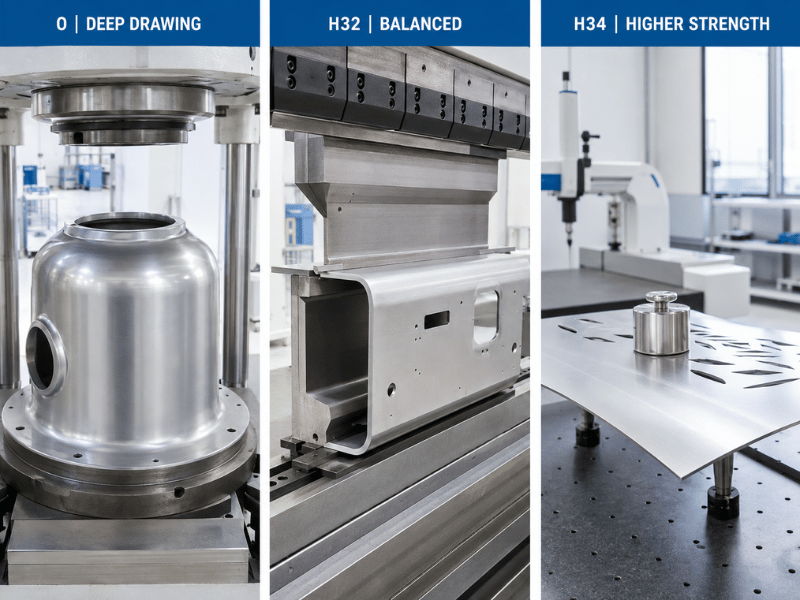
Because 5050 is non-heat-treatable, the temper designation defines the degree of cold work and the resulting strength-versus-formability balance.
| Temper | Condition | Typical UTS (MPa) | Yield (MPa) | Best for |
|---|---|---|---|---|
| O | Fully annealed, softest | 140–180 | 55–70 | Deep drawing, complex forming, spinning |
| H32 | Quarter-hard, stabilized | 175–215 | 125–160 | Moderate bending plus some post-forming strength |
| H34 | Half-hard, stabilized | 200–240 | 160–200 | Flat or gently curved parts where strength leads |
The temper choice follows the forming sequence: start with O when heavy drawing or tight bends are required, move to H32 when the part needs moderate strength but still some forming, and use H34 only when forming is minimal and strength is the priority. H34 is not a deep-drawing temper — its reduced elongation will crack in tight-radius work.
Common Applications of 5050 Aluminum
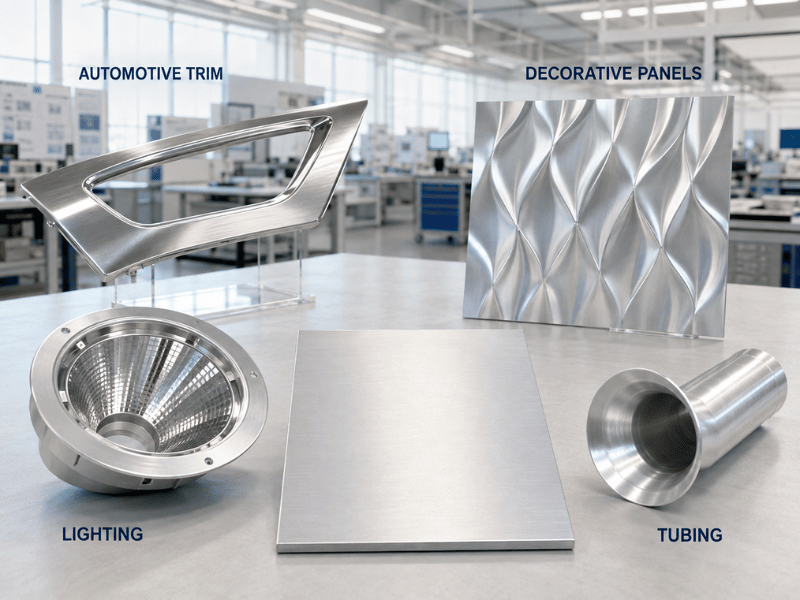
5050’s formability and surface finish drive its commercial use in visible and non-structural parts.
- Automotive trim and brightwork: interior trim, decorative moldings, and non-structural body panels where forming ease matters more than strength.
- Architectural and decorative panels: cladding, interior trim profiles, and ceiling systems that benefit from corrosion resistance and a clean anodized appearance.
- Lighting fixtures: good reflectivity and formability suit reflector housings and light covers.
- Appliance interiors: refrigerator linings and control-panel backs where corrosion resistance and forming quality fit enclosure panels.
- Nameplates and signage: a bright anodized finish is achievable with proper surface preparation.
- Tubing: hydraulic lines, fuel-system tubing, and decorative tubular components where the alloy’s formability allows bending, flaring, and end-forming.
5050 vs 5052 vs 3003 vs 6061
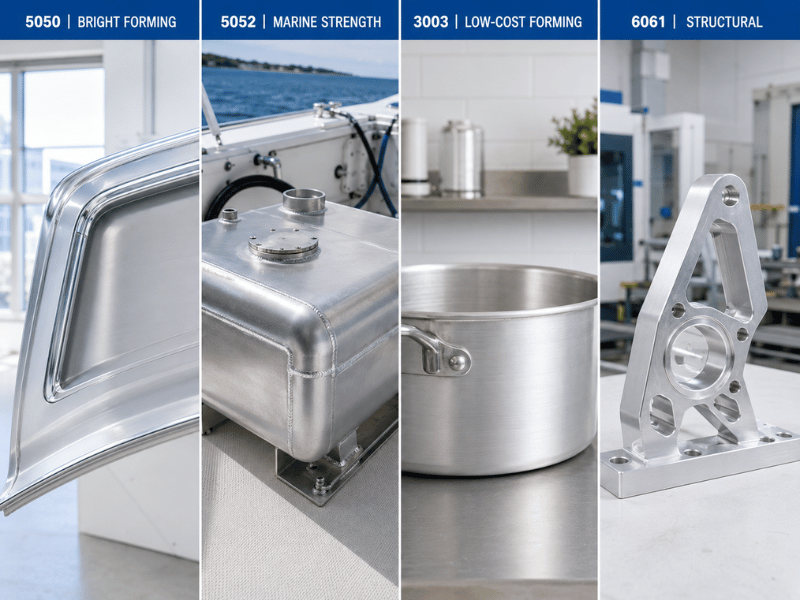
5050 occupies a specific window in the 5000-series: lower strength than 5052 but better surface finish and forming for decorative, light-gauge work.
| Alloy | Key characteristics | Strength | Corrosion | Weldability | Typical use |
|---|---|---|---|---|---|
| 5050 | Non-heat-treatable, high formability, bright finish | Low–moderate (~140–240 MPa) | Very good | Good | Sheet metal, automotive trim, tubing, signage |
| 5052 | Non-heat-treatable, high fatigue resistance | Moderate (~190–260 MPa) | Excellent | Good | Marine parts, fuel tanks, pressure vessels |
| 3003 | Non-heat-treatable, excellent formability | Low (~110–200 MPa) | Very good | Excellent | Cookware, chemical equipment, general sheet |
| 6061 | Heat-treatable, balanced strength | Moderate (T6 ~310 MPa) | Very good | Good | Structural components, marine fittings |
Selection summary: choose 5050 for decorative and light-gauge sheet where formability and bright finish lead; 5052 when you need higher strength, fatigue resistance, or saltwater service; 3003 when maximum formability and lowest cost outweigh surface finish; 6061 when the part must carry load.
Working With 5050 Aluminum
5050 behaves like a typical medium-Mg 5xxx alloy in fabrication — easy to form and weld, moderate to machine.
Forming and drawing. The O temper supports deep drawing, spinning, and complex bends without cracking. As cold work increases through H32 to H34, minimum bend radius opens up and elongation drops, so form the part in O when possible and only specify H34 for flat or gently curved geometry.
Welding and joining. 5050 welds readily by GTAW (TIG) and GMAW (MIG). Because there is no precipitation hardening, the heat-affected zone does not soften the way it would in a 6xxx alloy, but distortion still needs fixturing. Use 5xxx filler metals (for example 5356 or 4043 depending on post-weld strength and color-after-anodize needs) to preserve corrosion resistance.
Machining. Machinability is moderate — similar to other 5xxx alloys and cleaner than high-strength grades, but not as free-cutting as pure aluminum. Carbide tooling with positive rake and good chip evacuation controls built-up edge and work hardening near the surface.
Anodizing and finishing. 5050 is known for a bright, uniform anodic layer, which is why it appears in architectural trim and nameplates. Mill finish, anodizing, polishing, and PVC protective film are all applicable; anodize-quality surface preparation matters more here than for a hidden structural part.
Go/No-Go: When to Specify 5050
Go — specify 5050 when:
- The part is non-structural and formability or deep drawing is the dominant requirement.
- A bright, uniform anodized finish is part of the product (trim, signage, lighting).
- You need tubing that will be bent, flared, or end-formed.
- Moderate strength (up to ~240 MPa in H34) is enough for the load case.
No-Go — avoid 5050 when:
- The part is load-bearing, fatigue-critical, or sees sustained structural stress — use 5052 or 6061.
- The application is long-term direct saltwater immersion — 5052’s higher magnesium gives better long-term corrosion performance.
- You need the highest formability at the lowest cost — 3003 is more formable and usually cheaper.
- The design calls for heat-treatable strength or hard-anodize wear resistance — 6061 is the structural choice.
Sourcing 5050 Aluminum from Linsy
Linsy Aluminum, a Shenzhen-based factory with more than 20 years of experience, supplies 5050 in sheet, plate, coil, bar, tube, and wire across the 1000–8000 series alloy range, in O, H32, and H34 tempers. Material is supplied to ASTM B209 and GB/T 3880, with chemical and mechanical verification available through MTC documentation issued for every order.
SGS chemical-composition, mechanical-property, dimensional-inspection, and ultrasonic test reports are available on request at additional testing cost. For non-stock sizes, Linsy supports low-MOQ custom production with typical lead times of 10–60 days, and in-house processing including CNC machining, laser cutting, TIG/MIG welding, and surface finishing (anodizing, polishing, powder coating). ISO 9001, ISO 14001, and ISO 45001 management systems support consistent quality from raw material to finished product.
Conclusion
5050 aluminum is a practical non-heat-treatable alloy that delivers very good formability, good corrosion resistance, and a bright anodized finish — but its trade-off is moderate strength, with tensile values reaching only about 240 MPa in H34, so it is not a structural grade. Parts that require load-bearing capacity or fatigue resistance should turn to 5052 or 6061 instead.
For projects where formability, surface quality, and corrosion resistance match the design intent, Linsy Aluminum supplies 5050 in sheet, plate, coil, bar, tube, and wire across O, H32, and H34 tempers, with MTC for every order, SGS reports on request, and low-MOQ custom production on a 10–60 day lead time backed by in-house CNC, laser, welding, and finishing. If your specification calls for 5050 in a particular temper or product form, send the drawing or requirement for a grade-fit review and quote.
Frequently Asked Questions
Can 5050 aluminum be heat treated to increase strength?
No. 5050 is a non-heat-treatable 5xxx alloy. All strength comes from magnesium solid-solution strengthening plus strain hardening through the temper (O, H32, H34). If you need higher strength in a similar family, move to 5052-H34 or to the heat-treatable 6061-T6.
What is the difference between 5050 H32 and H34 temper?
Both are strain-hardened and stabilized, but H34 receives roughly twice the cold reduction of H32. H34 reaches higher tensile and yield strength (about 200–240 MPa vs 175–215 MPa) at the cost of reduced ductility and tighter bending limits. Choose H32 when some forming remains; choose H34 for flat or gently curved parts.
Is 5050 aluminum suitable for outdoor or marine use?
5050 performs well in marine-atmospheric and humid environments; its magnesium and chromium content provides good resistance to general corrosion without protective coatings. For direct, long-term saltwater immersion or aggressive industrial exposure, 5052 (higher magnesium) offers better long-term corrosion performance.
What product forms is 5050 aluminum available in?
5050 is most commonly supplied as sheet and coil for forming and decorative trim, with plate and bar available for thicker or machined parts. Linsy Aluminum also supplies 5050 in tube and wire, with custom dimensions available at low MOQ.
How does 5050 compare to 3003 for sheet metal work?
Both are non-heat-treatable forming alloys, but 5050 offers slightly higher strength and a better surface finish, making it more suitable for decorative and bright-finished parts. 3003 is slightly more formable and usually lower cost, so it dominates general-purpose sheet metal, cookware, and chemical equipment. The choice hinges on whether surface appearance or maximum formability is the priority.