Aluminum 5050 Specifications: Composition, Properties, Tempers and Applications

308751729937665_.pic

免费样品

308771729937665_.pic

中国制造商

308781729937665_.pic

快速反应

308761729937665_.pic

批量购买折扣

308771729937665_.pic

中国制造商

导言

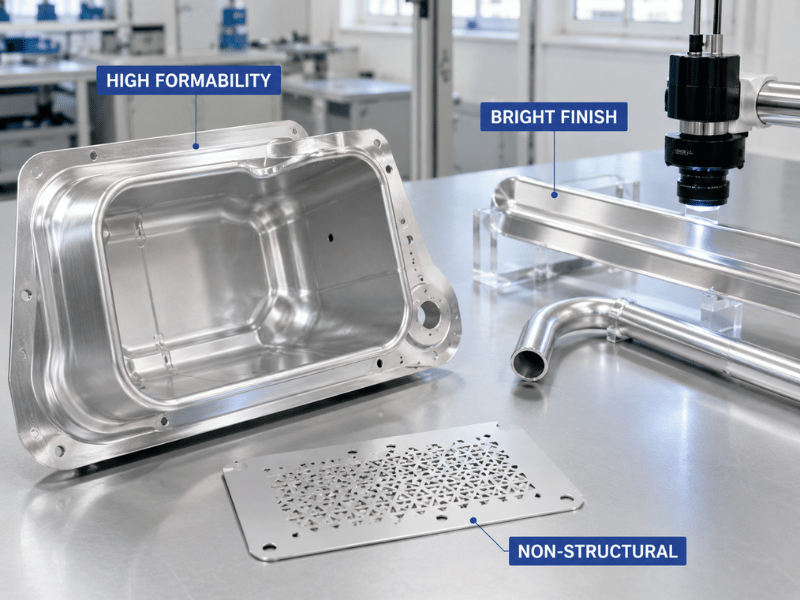
5050 铝 is a wrought alloy in the Aluminum Association 5000 series, where magnesium (1.1%–1.8%) serves as the primary alloying element. It offers good formability, very good corrosion resistance, and moderate strength — making it a practical choice for sheet metal work, decorative trim, and lighting fixtures where deep drawing and a bright surface finish matter more than peak structural strength.

This guide covers the chemical composition, physical and mechanical properties, available tempers, common applications, and how 5050 compares to alloys like 5052, 3003, and 6061.

5050 aluminum coil and sheet products


什么是 5050 铝合金?

5050 铝合金

5050 aluminum alloy belongs to the Aluminum Association’s wrought alloy category and was first standardized in 1954. It sits within the non-heat-treatable 5000 series, where magnesium drives strength through solid-solution strengthening rather than precipitation hardening.

The alloy’s balance of moderate strength and very good formability makes it useful in applications that prioritize shaping and appearance over load-bearing capacity. Unlike heat-treatable 6000-series alloys, 5050 gains most of its mechanical properties from cold working rather than thermal processing.


5050 铝的化学成分

The alloy’s behavior — formability, corrosion resistance, and weldability — is determined by its controlled chemistry. Magnesium (1.1%–1.8%) provides strength and work-hardening response. Chromium and manganese, present in trace amounts, help suppress intergranular corrosion. Iron, silicon, copper, and zinc are kept low to maintain corrosion resistance and forming quality.

要素 成分范围(按重量计为 %) Role in the Alloy
铝 (Al) 97.2 - 98.6 Primary component — lightweight, corrosion-resistant base
镁(Mg) 1.1 - 1.8 Main strength contributor; drives cold-work hardening
锰 (Mn) 0.1(最大值) Supports grain structure and intergranular corrosion resistance
铬 (Cr) 0.1(最大值) Improves corrosion resistance and suppresses grain growth
铁(Fe) 0.7(最大值) Kept low to preserve ductility and forming quality
硅 (Si) 0.4(最大值) Limited to maintain consistent mechanical properties
铜 (Cu) 0.2(最大值) Minimal — higher levels reduce corrosion resistance
锌 (Zn) 0.25(最大值) Limited to preserve corrosion behavior
其他(每项) 0.05(最大值) Trace elements, controlled for alloy consistency
其他(共计) 0.15(最大值) Total minor elements kept low for performance stability

主要物理特性

5050 aluminum delivers a combination of light weight, good thermal conductivity, and strong corrosion resistance that suits sheet metal and decorative applications.

财产 Value / Description
密度 2.68 克/立方厘米
熔点 ~605-650°C
拉伸强度(O 型温度) ~140-180 兆帕
屈服强度(O 温度) ~50-70 兆帕
耐腐蚀性 Very good — suitable for marine atmospheric and humid environments
导热性 ~140-160 W/m-K
导电性 ~35-40% IACS
焊接性 Good — compatible with common welding methods
成型性 Good — well suited to sheet forming and wire drawing
热膨胀率 23.7 × 10-⁶ /°C

Key takeaways from the property set:

  • 重量轻 At 2.68 g/cm³, 5050 is comparable to other 5000-series alloys and about one-third the density of steel.
  • 耐腐蚀: Performs well in marine atmospheres and humid environments without protective coatings.
  • 成型性 The O temper supports deep drawing and complex sheet forming operations.
  • 焊接性 Accepts standard aluminum welding processes for reliable assembly.
  • 中等强度: Tensile strength of 140–180 MPa in O temper places it in the lower end of the 5000 series — adequate for non-structural work but unsuitable for load-bearing applications.

常见应用

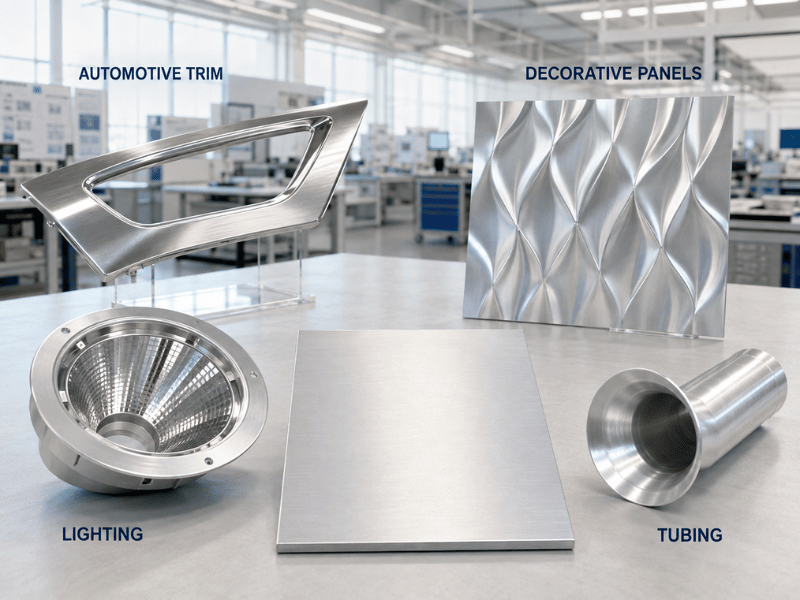
5050 aluminum’s formability and surface finish drive its main commercial uses. In automotive, it appears in interior trim, decorative brightwork, and non-structural body panels where forming ease matters more than strength. In architecture and construction, it serves as cladding, decorative panels, and interior trim profiles that benefit from corrosion resistance and a clean appearance.

Other common applications include:

  • Lighting fixtures: Good reflectivity and formability support reflector and housing production.
  • Refrigerator linings: Corrosion resistance and forming quality fit appliance interior panels.
  • 一般钣金工作: Covers, enclosures, and housings where moderate strength is sufficient.
  • Nameplates and signage: Bright anodized finish is achievable with proper surface preparation.

5050 aluminum sheet metal and decorative trim products


5050 铝与其他合金的对比

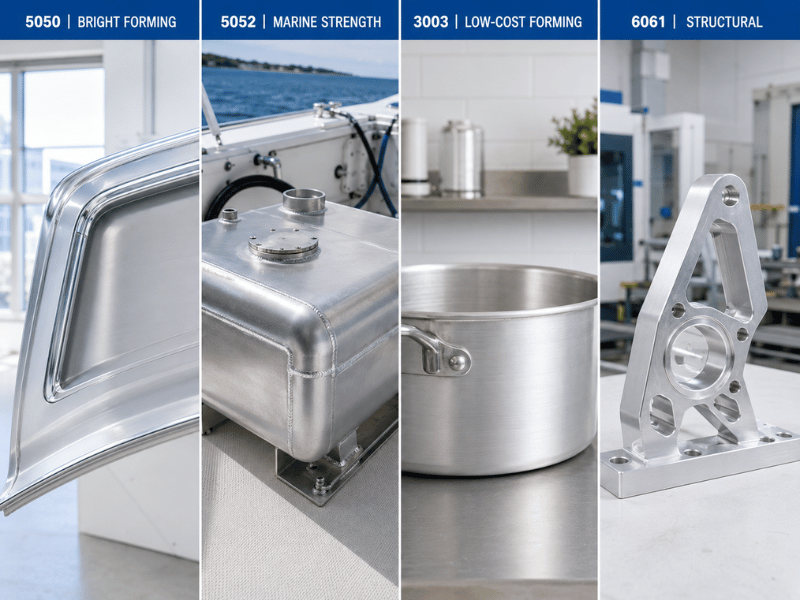
5050 occupies a specific window in the 5000-series: lower strength than 5052 but better surface finish and forming characteristics for decorative and light-gauge applications. The table below compares it with 5052, 3003, and 6061 across key selection criteria.

合金 主要特点 实力 耐腐蚀性 焊接性 典型应用
5050 不可热处理、成型性好、强度适中 Low (~140–210 MPa) 非常好 良好 金属板、汽车饰件、冰箱内衬
5052 不可热处理、抗疲劳性强、成型性好 中等(~190-260 兆帕) 优秀 良好 Marine components, fuel tanks, pressure vessels
3003 不可热处理、成型性优异、加工性良好 Low (~110–200 MPa) 非常好 优秀 炊具、化工设备、普通金属板
6061 可热处理、用途广泛、强度和成型性均衡 中度(T6:~310 兆帕) 非常好 良好 Structural components, marine fittings, general fabrication

Selection summary:

  • 5050: Best for decorative and light-gauge sheet metal where formability and bright finish matter — not for structural or fatigue-critical parts.
  • 5052: The marine-grade alternative with higher strength and better fatigue resistance at slightly lower formability.
  • 3003: The general-purpose forming alloy — more formable than 5050 but with lower strength.
  • 6061: The structural heat-treatable option — significantly stronger than 5050 but harder to form in thin sections.

5050 O、H32 和 H34 温度比较

5050 is a non-heat-treatable alloy, so all strength increases come from strain hardening (cold working). The temper designation — O, H32, or H34 — defines the degree of cold work and the resulting balance between strength and formability.

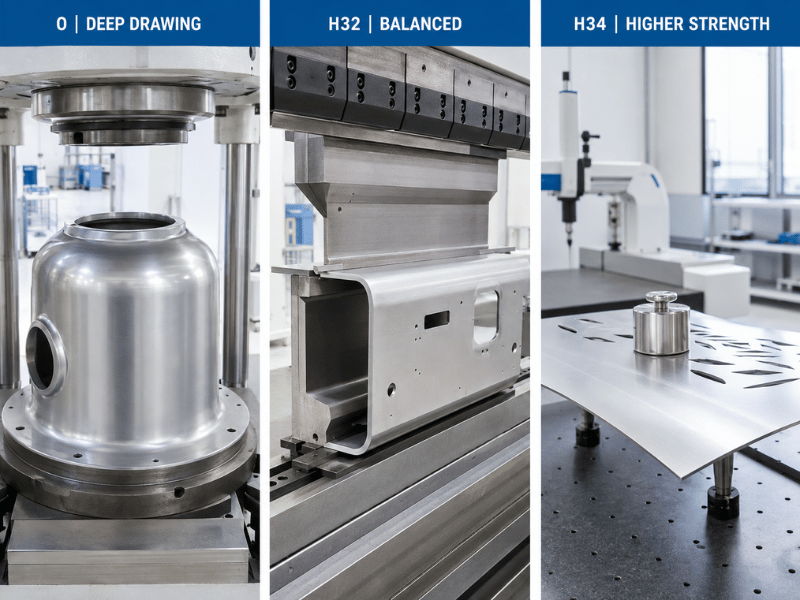
  • O 温度(退火): The softest condition, produced by full annealing. Tensile strength of 140–180 MPa and yield strength of 50–70 MPa. Offers maximum formability for deep drawing and complex shaping. This is the best starting point for parts that will be heavily formed before assembly.
  • H32 Temper: Strain-hardened and stabilized to a quarter-hard condition. Strength increases to roughly 160–210 MPa while retaining good workability. A practical choice when the part needs moderate strength but still requires some forming or bending during fabrication.
  • H34 Temper: Strain-hardened to a half-hard condition. Strength reaches approximately 175–220 MPa, with a corresponding reduction in ductility and formability compared to H32. Suitable for flat or gently curved parts that prioritize strength over shaping flexibility.

The temper choice usually comes down to the forming sequence: start with O temper if heavy drawing is required, move to H32 if the part needs moderate post-forming strength, and use H34 only when forming is minimal and strength is the priority.


采购 5050 铝的技巧

  1. Verify alloy specifications: Confirm the alloy meets the required standard for your application. Linsy Aluminum supplies 5050 aluminum in compliance with ASTM B209 and GB/T 3880, with chemical and mechanical property verification available through MTC documentation.
  2. Match the temper to the forming process: Select O temper for deep drawing, H32 for general forming with moderate strength, and H34 for flat-sheet applications where formability is less critical. Linsy stocks 5050 in O, H32, and H34 tempers.
  3. Confirm available product forms: 5050 is most commonly supplied as sheet and coil for sheet metal and decorative work. Linsy provides 5050 aluminum in plate, sheet, coil, and tube forms, with custom dimensions available at low MOQ and typical lead times of 10–60 days.
  4. Check documentation requirements: MTC is provided with every order as standard. SGS chemical composition, mechanical properties, and dimensional inspection reports are available on request at additional testing cost.
  5. Assess total supply capability: A supplier that can handle mixed-spec orders and harder-to-find tempers reduces procurement complexity. Linsy supports project-based purchasing across the 1000–8000 series alloy range with in-house processing including CNC machining, laser cutting, and surface finishing.

结论

5050 aluminum is a practical non-heat-treatable alloy that delivers very good formability, good corrosion resistance, and a bright surface finish. Its trade-off is moderate strength — with tensile values in the 140–220 MPa range depending on temper, it is not a structural alloy. Parts that require load-bearing capacity or fatigue resistance should look toward 5052 or 6061 instead.

For projects where formability, surface quality, and corrosion resistance match the design intent, Linsy Aluminum supplies 5050 aluminum in plate, sheet, coil, and tube forms across O, H32, and H34 tempers. Custom dimensions are available with low minimum order quantities and typical lead times of 10–60 days. Every order includes MTC documentation, and SGS test reports covering chemical composition, mechanical properties, and dimensional inspection are available on request at extra cost. ISO 9001, ISO 14001, and ISO 45001 management systems support consistent quality from raw material to finished product.

If your project requires 5050 aluminum in specific tempers and dimensions, send the drawing or specification for a grade-fit review and quote.


常见问题

Can 5050 aluminum be heat treated to increase strength?

No. 5050 is a non-heat-treatable alloy in the 5000 series. All strength increases come from strain hardening (cold working), controlled through the temper designation — O (annealed), H32 (quarter-hard), and H34 (half-hard). If higher strength is required in a similar alloy family, consider 5052 H32 or H34 instead.

What is the difference between 5050 H32 and H34 temper?

Both are strain-hardened and stabilized, but H34 receives roughly twice the cold reduction of H32. H34 produces higher tensile and yield strength (approximately 175–220 MPa vs. 160–210 MPa) at the cost of reduced ductility and tighter bending limits. Choose H32 when some forming is still required; choose H34 for flat or gently curved parts.

Is 5050 aluminum suitable for outdoor or marine use?

5050 performs very well in marine atmospheric environments and humid conditions. Its magnesium and chromium content provides good resistance to general corrosion without protective coatings. However, for direct saltwater immersion or highly acidic industrial environments, 5052 (with higher magnesium content) offers better long-term corrosion performance.

What product forms is 5050 aluminum available in?

5050 is most commonly available as sheet and coil, which match the alloy’s primary use in sheet metal forming and decorative trim. Plate and tube can also be sourced depending on supplier capability. Linsy Aluminum supplies 5050 in plate, sheet, coil, and tube forms, with custom dimensions available at low MOQ.

How does 5050 compare to 3003 for sheet metal work?

Both are non-heat-treatable forming alloys, but 5050 offers slightly higher strength and better surface finish quality, making it more suitable for decorative and bright-finished parts. 3003 is slightly more formable and is more commonly used for general-purpose sheet metal, cookware, and chemical equipment. The choice depends on whether surface appearance or maximum formability is the priority.

黄大卫

David Huang 是中国铝合金行业备受尊敬的专家,在先进铝合金的开发、制造和应用方面拥有十多年的经验。他曾成功地为航空航天、汽车和建筑等不同领域的全球领先企业提供项目解决方案和专业技术知识。此外,David 还是中国多家主要铝材制造商值得信赖的顾问。

全天候服务 10 分钟内响应!

如需更多产品目录、详细信息和报价,请直接与我们联系!

WhatsApp 电话