Co to jest stop aluminium 5050?
5050 to stop 5xxx z serii stopów kutych, w którym magnez (1,1–1,8%) jest głównym pierwiastkiem wzmacniającym. Podobnie jak wszystkie stopy 5xxx, nie podlega obróbce cieplnej: wytrzymałość pochodzi z umocnienia roztworowego przez magnez oraz umocnienia odkształceniowego (obróbki na zimno), a nie z utwardzania wydzieleniowego, jak w przypadku stopów 6xxx czy 2xxx.
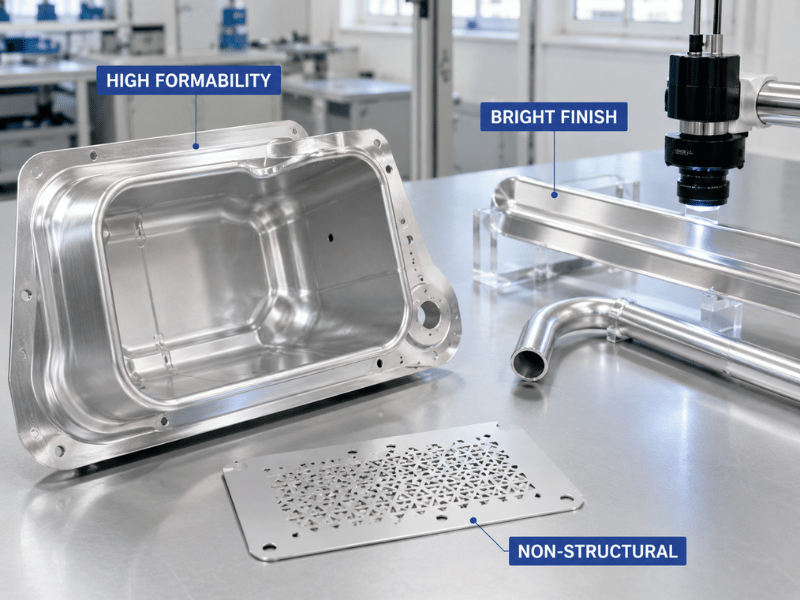
Zawiera mniej magnezu niż 5052 i ta pojedyncza różnica definiuje jego charakter. Niższa zawartość magnezu daje 5050 lepszą podatność na formowanie i jaśniejsze, bardziej jednolite wykończenie anodowane, ale kosztem niższej wytrzymałości i odporności na zmęczenie. Wybierz 5050, gdy część będzie poddawana głębokiemu formowaniu, gięciu lub będzie widoczna — a sięgnij po 5052 lub 6061, gdy projekt ma charakter konstrukcyjny.
Skład chemiczny aluminium 5050
5050 jest kontrolowane przez górne granice zanieczyszczeń, które chronią odporność korozyjną i jakość powierzchni, przy czym magnez jest ustalony jako główny czynnik wytrzymałościowy.
| Element | Zawartość (maks. o ile nie zaznaczono inaczej) | Rola w stopie |
|---|---|---|
| Aluminium (Al) | 97,2–98,6% (reszta) | Lekka, odporna na korozję osnowa |
| Magnez (Mg) | 1.1–1.8% | Główny czynnik wytrzymałościowy; napędza umocnienie odkształceniowe |
| Mangan (Mn) | 0.10% | Wspiera strukturę ziarna i odporność na korozję międzykrystaliczną |
| Chrom (Cr) | 0.10% | Poprawia odporność korozyjną, hamuje rozrost ziaren |
| Żelazo (Fe) | 0.70% | Utrzymywany na niskim poziomie w celu zachowania ciągliwości i jakości formowania |
| Krzem (Si) | 0.40% | Ograniczony w celu zachowania spójności właściwości mechanicznych |
| Miedź (Cu) | 0.20% | Minimalny — wyższe poziomy obniżają odporność na korozję |
| Cynk (Zn) | 0.25% | Ograniczony w celu zachowania właściwości korozyjnych |
| Inne (każdy / łącznie) | 0.05% / 0.15% | Pierwiastki śladowe kontrolowane dla spójności stopu |
Połączenie magnezu i chromu nadaje 5050 dobrą odporność na korozję atmosferyczną, podczas gdy niskie górne granice miedzi i krzemu utrzymują warstwę anodowaną przezroczystą, a nie mętną.
Właściwości fizyczne i mechaniczne aluminium 5050
Decydującymi liczbami dla 5050 są jego niska do umiarkowanej wytrzymałość i wysoka podatność na formowanie, a nie przewodność czy twardość.
| Nieruchomość | Wartość |
|---|---|
| Gęstość | 2,68–2,69 g/cm³ |
| Zakres topnienia | ~605–650 °C |
| Moduł sprężystości | ~69 GPa (10 × 10⁶ psi) |
| Współczynnik rozszerzalności cieplnej | ~23,7 × 10⁻⁶ /K |
| Przewodność cieplna | ~140–160 W/(m·K) |
| Przewodność elektryczna | ~35% IACS |
| Odporność na korozję | Bardzo dobra — odpowiednia do środowisk morskich, atmosferycznych i wilgotnych |
| Spawalność | Dobra — kompatybilna z powszechnymi metodami spawania |
| Formowalność | Dobra w stanie O; maleje wraz z obróbką na zimno |
| Wytrzymałość na rozciąganie, stan O | 140–180 MPa |
| Wytrzymałość na rozciąganie, stan H32 | 175–215 MPa |
| Wytrzymałość na rozciąganie, stan H34 | 200–240 MPa |
| Granica plastyczności, O / H32 / H34 | 55–70 / 125–160 / 160–200 MPa |
Wartości wytrzymałości skalują się ze stanem, ponieważ 5050 jest umacniany odkształceniowo, a nie obróbką cieplną: stan O jest w pełni wyżarzony i miękki, podczas gdy H32 i H34 stosują coraz większe zgniot na zimno. Powyższe wartości są typowe dla wyrobów walcowanych; dokładne wartości minimalne według ASTM B209 lub GB/T 3880 zależą od grubości i kształtu.
Dostępne stany: O, H32 i H34
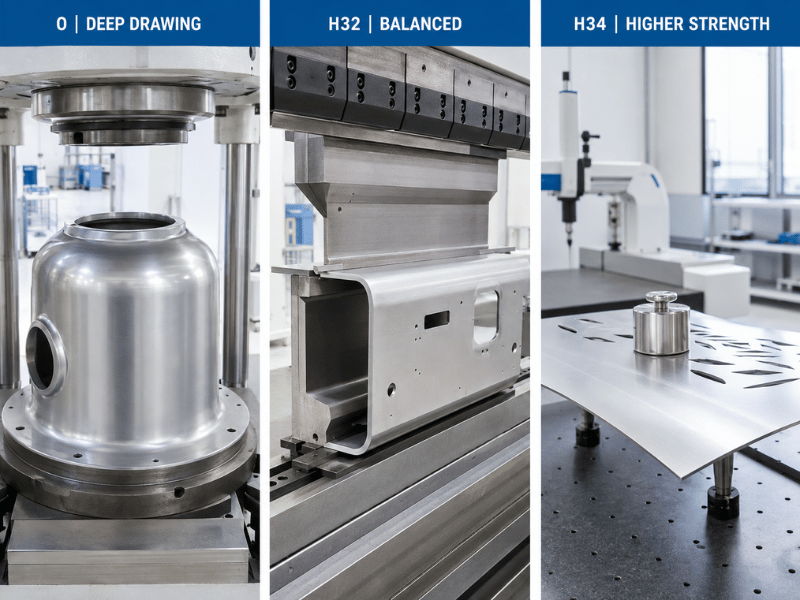
Ponieważ 5050 nie podlega obróbce cieplnej, oznaczenie stanu definiuje stopień obróbki na zimno i wynikającą z tego równowagę między wytrzymałością a podatnością na formowanie.
| Temperament | Stan | Typowa wytrzymałość na rozciąganie (MPa) | Granica plastyczności (MPa) | Najlepsze dla |
|---|---|---|---|---|
| O | W pełni wyżarzony, najmiększy | 140–180 | 55–70 | Głębokie tłoczenie, złożone formowanie, wyoblanie |
| H32 | Ćwierćtwardy, stabilizowany | 175–215 | 125–160 | Umiarkowane gięcie plus pewna wytrzymałość po formowaniu |
| H34 | Półtwardy, stabilizowany | 200–240 | 160–200 | Części płaskie lub łagodnie zakrzywione, gdzie wytrzymałość jest priorytetem |
Wybór stanu wynika z sekwencji formowania: zacznij od O, gdy wymagane jest intensywne tłoczenie lub ciasne gięcia, przejdź do H32, gdy część potrzebuje umiarkowanej wytrzymałości, ale wciąż pewnego formowania, i użyj H34 tylko wtedy, gdy formowanie jest minimalne, a wytrzymałość jest priorytetem. H34 nie jest stanem do głębokiego tłoczenia — jego zmniejszone wydłużenie spowoduje pęknięcia przy pracy z ciasnym promieniem.
Typowe zastosowania aluminium 5050
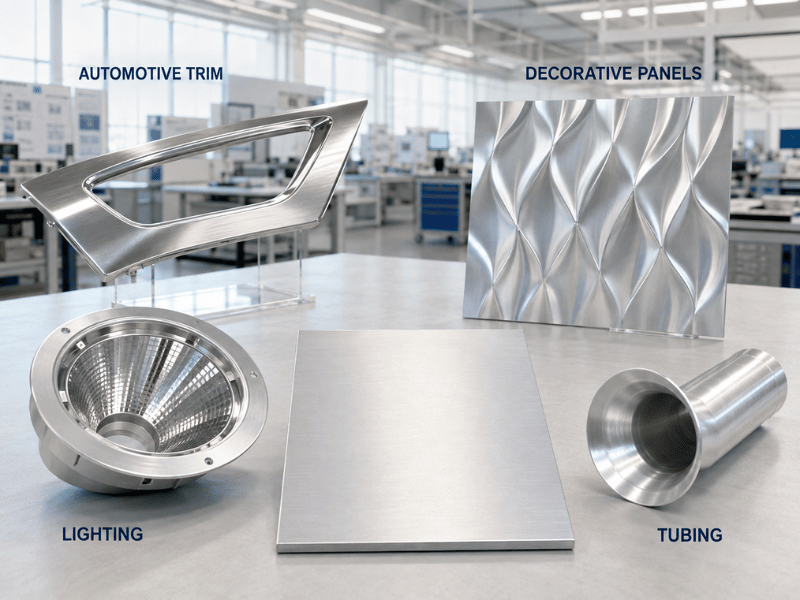
Podatność na formowanie i wykończenie powierzchni 5050 napędzają jego komercyjne zastosowanie w widocznych i niekonstrukcyjnych częściach.
- Elementy ozdobne i wykończeniowe motoryzacyjne: elementy wnętrza, listwy dekoracyjne i niekonstrukcyjne panele nadwozia, gdzie łatwość formowania ma większe znaczenie niż wytrzymałość.
- Panele architektoniczne i dekoracyjne: okładziny, profile do wnętrz i systemy sufitowe, które korzystają z odporności korozyjnej i czystego wyglądu po anodowaniu.
- Oprawy oświetleniowe: dobra refleksyjność i podatność na formowanie pasują do obudów reflektorów i osłon świateł.
- Wnętrza urządzeń AGD: wykładziny chłodziarek i tylne panele sterowania, gdzie odporność korozyjna i jakość formowania pasują do paneli obudów.
- Tabliczki znamionowe i oznakowanie: jasne wykończenie anodowane jest osiągalne przy odpowiednim przygotowaniu powierzchni.
- Rury: przewody hydrauliczne, rury układu paliwowego i dekoracyjne elementy rurowe, gdzie podatność stopu na formowanie pozwala na gięcie, kielichowanie i formowanie końców.
5050 vs 5052 vs 3003 vs 6061
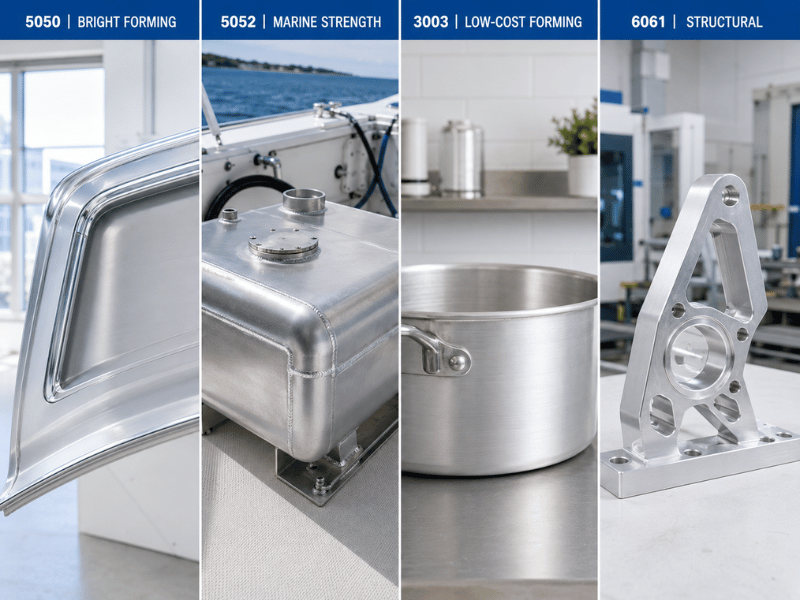
5050 zajmuje określone okno w serii 5000: niższa wytrzymałość niż 5052, ale lepsze wykończenie powierzchni i formowanie do dekoracyjnych, cienkościennych zastosowań.
| Stop | Kluczowe cechy | Siła | Odporność korozyjna | Spawalność | Typowe zastosowanie |
|---|---|---|---|---|---|
| 5050 | Nieutwardzalny cieplnie, wysoka podatność na formowanie, jasne wykończenie powierzchni | Niska–umiarkowana (~140–240 MPa) | Bardzo dobra | Dobry | Blacha, elementy wykończeniowe samochodów, rury, oznakowanie |
| 5052 | Nieutwardzalny cieplnie, wysoka odporność na zmęczenie | Umiarkowany (~190-260 MPa) | Doskonały | Dobry | Części morskie, zbiorniki paliwa, zbiorniki ciśnieniowe |
| 3003 | Nieutwardzalny cieplnie, doskonała podatność na formowanie | Niska (~110–200 MPa) | Bardzo dobra | Doskonały | Naczynia kuchenne, sprzęt chemiczny, blacha ogólnego przeznaczenia |
| 6061 | Utwardzalny cieplnie, zrównoważona wytrzymałość | Umiarkowana (T6 ~310 MPa) | Bardzo dobra | Dobry | Elementy konstrukcyjne, osprzęt morski |
Podsumowanie doboru: wybierz 5050 do elementów dekoracyjnych i cienkościennych blach, gdzie kluczowa jest podatność na formowanie i jasne wykończenie; 5052 gdy potrzebna jest wyższa wytrzymałość, odporność na zmęczenie lub praca w środowisku słonej wody; 3003 gdy maksymalna podatność na formowanie i najniższy koszt przewyższają znaczenie wykończenia powierzchni; 6061 gdy część musi przenosić obciążenie.
Praca z aluminium 5050
5050 zachowuje się jak typowy stop serii 5xxx o średniej zawartości Mg podczas obróbki — łatwo się formuje i spawa, umiarkowanie obrabia mechanicznie.
Formowanie i ciągnienie. Stan O umożliwia głębokie ciągnienie, wyoblanie i złożone gięcie bez pękania. W miarę wzrostu zgniotu od H32 do H34 minimalny promień gięcia rośnie, a wydłużenie spada, dlatego w miarę możliwości należy formować część w stanie O, a stan H34 określać tylko dla geometrii płaskiej lub łagodnie zakrzywionej.
Spawanie i łączenie. 5050 dobrze się spawa metodami GTAW (TIG) i GMAW (MIG). Ponieważ nie występuje utwardzanie wydzieleniowe, strefa wpływu ciepła nie mięknie tak jak w stopie 6xxx, ale odkształcenia nadal wymagają stosowania oprzyrządowania. Należy stosować materiały dodatkowe serii 5xxx (na przykład 5356 lub 4043, w zależności od wymaganej wytrzymałości po spawaniu i koloru po anodowaniu), aby zachować odporność korozyjną.
Obróbka skrawaniem. Skrawalność jest umiarkowana — podobna do innych stopów 5xxx i lepsza niż w stopach wysokowytrzymałych, ale nie tak dobra jak w czystym aluminium. Narzędzia z węglików spiekanych o dodatnim kącie natarcia i dobrym odprowadzaniu wiórów ograniczają narastanie krawędzi skrawającej i umocnienie odkształceniowe przy powierzchni.
Anodowanie i wykańczanie. 5050 jest znane z jasnej, jednolitej warstwy anodowej, dlatego znajduje zastosowanie w elementach wykończeniowych architektonicznych i tabliczkach znamionowych. Wykończenie walcownicze, anodowanie, polerowanie i folia ochronna PVC są wszystkie stosowalne; przygotowanie powierzchni o jakości pod anodowanie ma tutaj większe znaczenie niż w przypadku ukrytej części konstrukcyjnej.
Go/No-Go: Kiedy określać 5050
Go — określ 5050, gdy:
- Część jest niekonstrukcyjna, a podatność na formowanie lub głębokie ciągnienie jest wymaganiem dominującym.
- Jasne, jednolite wykończenie anodowane jest częścią produktu (elementy wykończeniowe, oznakowanie, oświetlenie).
- Potrzebne są rury, które będą gięte, rozkładane lub formowane na końcach.
- Umiarkowana wytrzymałość (do ~240 MPa w H34) jest wystarczająca dla danego przypadku obciążenia.
No-Go — unikaj 5050, gdy:
- Część przenosi obciążenia, jest krytyczna pod względem zmęczenia lub podlega trwałym naprężeniom konstrukcyjnym — użyj 5052 lub 6061.
- Zastosowanie obejmuje długotrwałe bezpośrednie zanurzenie w słonej wodzie — wyższa zawartość magnezu w 5052 zapewnia lepszą długoterminową odporność korozyjną.
- Potrzebna jest najwyższa podatność na formowanie przy najniższym koszcie — 3003 jest bardziej podatne na formowanie i zwykle tańsze.
- Projekt wymaga wytrzymałości uzyskiwanej przez obróbkę cieplną lub odporności na zużycie przez twarde anodowanie — 6061 jest wyborem konstrukcyjnym.
Zaopatrzenie w aluminium 5050 od Linsy
Linsy Aluminum, fabryka z siedzibą w Shenzhen z ponad 20-letnim doświadczeniem, dostarcza 5050 w postaci blachy, płyt, kręgów, prętów, rur i drutu w całym zakresie stopów serii 1000–8000, w stanach O, H32 i H34. Materiał jest dostarczany zgodnie z ASTM B209 i GB/T 3880, z weryfikacją chemiczną i mechaniczną dostępną poprzez dokumentację MTC wystawianą dla każdego zamówienia.
Raporty SGS dotyczące składu chemicznego, właściwości mechanicznych, kontroli wymiarów i badań ultradźwiękowych są dostępne na życzenie przy dodatkowym koszcie badań. Dla rozmiarów niebędących w magazynie Linsy obsługuje produkcję niestandardową przy niskim MOQ z typowymi czasami realizacji 10–60 dni oraz obróbką wewnętrzną obejmującą obróbkę CNC, cięcie laserowe, spawanie TIG/MIG i wykończanie powierzchni (anodowanie, polerowanie, malowanie proszkowe). Systemy zarządzania ISO 9001, ISO 14001 i ISO 45001 wspierają spójną jakość od surowca do produktu gotowego.
Wnioski
Aluminium 5050 to praktyczny stop nieutwardzalny cieplnie, który zapewnia bardzo dobrą podatność na formowanie, dobrą odporność korozyjną i jasne wykończenie anodowane — jednak jego kompromisem jest umiarkowana wytrzymałość, z wartościami wytrzymałości na rozciąganie sięgającymi jedynie około 240 MPa w H34, więc nie jest to stop konstrukcyjny. Części wymagające nośności lub odporności na zmęczenie powinny zamiast tego sięgać po 5052 lub 6061.
W przypadku projektów, w których podatność na formowanie, jakość powierzchni i odporność korozyjna odpowiadają zamierzeniu projektowemu, Linsy Aluminum dostarcza 5050 w postaci blachy, płyt, kręgów, prętów, rur i drutu w stanach O, H32 i H34, z MTC dla każdego zamówienia, raportami SGS na życzenie oraz produkcją niestandardową przy niskim MOQ z czasem realizacji 10–60 dni, wspieraną wewnętrzną obróbką CNC, laserową, spawalniczą i wykończeniową. Jeśli specyfikacja wymaga 5050 w określonym stanie lub formie produktu, prześlij rysunek lub wymagania w celu przeglądu dopasowania gatunku i wyceny.
Często zadawane pytania
Czy aluminium 5050 można poddać obróbce cieplnej w celu zwiększenia wytrzymałości?
Nie. 5050 to stop 5xxx nieutwardzalny cieplnie. Cała wytrzymałość pochodzi z umocnienia roztworowego magnezu oraz umocnienia odkształceniowego poprzez stan (O, H32, H34). Jeśli potrzebna jest wyższa wytrzymałość w podobnej rodzinie, przejdź na 5052-H34 lub na utwardzalny cieplnie 6061-T6.
Jaka jest różnica między stanami umocnienia 5050 H32 i H34?
Oba są umocnione odkształceniowo i stabilizowane, ale H34 otrzymuje około dwukrotnie większy zgniot na zimno niż H32. H34 osiąga wyższą wytrzymałość na rozciąganie i granicę plastyczności (około 200–240 MPa vs 175–215 MPa) kosztem zmniejszonej ciągliwości i ciaśniejszych ograniczeń gięcia. Wybierz H32, gdy pozostaje jeszcze formowanie; wybierz H34 dla części płaskich lub łagodnie zakrzywionych.
Czy aluminium 5050 nadaje się do zastosowań zewnętrznych lub morskich?
5050 dobrze sprawdza się w środowisku morskim atmosferycznym i wilgotnym; jego zawartość magnezu i chromu zapewnia dobrą odporność na korozję ogólną bez powłok ochronnych. W przypadku bezpośredniego, długotrwałego zanurzenia w słonej wodzie lub agresywnej ekspozycji przemysłowej 5052 (wyższa zawartość magnezu) oferuje lepszą długoterminową odporność korozyjną.
W jakich formach produktowych dostępne jest aluminium 5050?
5050 jest najczęściej dostarczane jako blacha i kręgi do formowania i elementów dekoracyjnych, z płytami i prętami dostępnymi dla grubszych lub obrabianych części. Linsy Aluminum dostarcza również 5050 w postaci rur i drutu, z niestandardowymi wymiarami dostępnymi przy niskim MOQ.
Jak stop 5050 wypada w porównaniu ze stopem 3003 w pracach z blachą?
Oba są nieutwardzalnymi cieplnie stopami do formowania, ale 5050 oferuje nieco wyższą wytrzymałość i lepsze wykończenie powierzchni, co czyni go bardziej odpowiednim do części dekoracyjnych i o jasnym wykończeniu. 3003 jest nieco bardziej podatne na formowanie i zwykle tańsze, dlatego dominuje w blachach ogólnego przeznaczenia, naczyniach kuchennych i sprzęcie chemicznym. Wybór zależy od tego, czy priorytetem jest wygląd powierzchni, czy maksymalna podatność na formowanie.