Key Highlights
Here’s a fast overview of what you get in this guide. You’ll learn everything you need to choose the right aluminum for your CNC project
- Different types of aluminum alloys suit various needs—whether you require high strength, corrosion resistance, weldability, or premium aesthetics.
- Not all aluminum works equally well with surface finishes—6061 anodizes beautifully, while 7075 often needs Chem Film instead.
- The right material helps you achieve tight tolerances and complex geometries without warping or tool wear issues.
- Choose based on your application: aerospace, marine, consumer electronics, fixtures, or prototypes—each has an ideal alloy.
- Linsy Aluminum stocks a full range of CNC-ready aluminum in plate, bar, and tube—with Mill Test Certificates (MTCs), free samples, and expert technical support.

What Is Aluminum CNC Machining?
Aluminum CNC machining is a manufacturing process that uses computer-controlled machines to cut and shape solid aluminum blocks into precise parts. It’s called “subtractive” because material is removed—layer by layer—until the final part is formed.
While the machine does the cutting, the quality of the final part starts with the right aluminum. Not all aluminum alloys behave the same under the tool—some chip cleanly, some warp after cutting, and some won’t take a smooth finish. That’s why choosing a truly CNC-machinable aluminum matters.
Defining CNC Machinable Aluminum
Pure aluminum is too soft for most engineering applications. So we use aluminum alloys—mixtures of aluminum with elements like magnesium, silicon, or zinc—to achieve the right balance of strength, stability, and machinability.
A good CNC-machinable aluminum should:
- Cut smoothly with minimal tool wear
- Hold tight tolerances without warping
- Accept surface finishes like anodizing or bead blasting
- Be consistent in structure (no hidden voids or impurities)
Common examples include 6061-T6 (versatile and reliable) and 7075-T6 (ultra-strong but less forgiving). The “T6” means it’s been heat-treated for optimal performance.
💡 At Linsy Aluminum, we supply only certified, stress-relieved alloys that are proven to perform well in CNC environments—so you spend less time troubleshooting and more time building great parts.
How Aluminum CNC Machining Works
- Design: You create a 3D model of your part (e.g., in CAD software).
- Programming: The design is converted into machine instructions (G-code).
- Machining: A CNC mill or lathe precisely cuts the aluminum stock based on those instructions.
- Finishing: The part may be deburred, anodized, or otherwise treated for function or appearance.
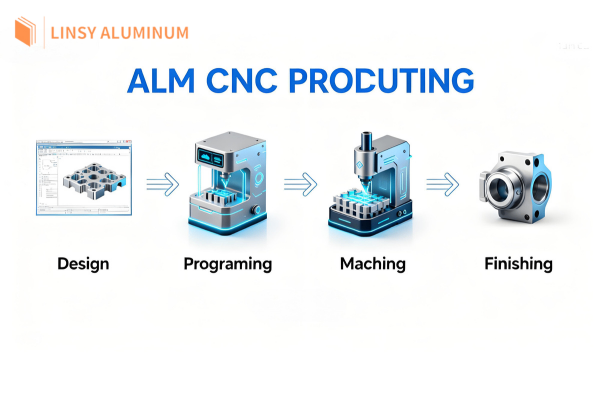
The whole process is fast, repeatable, and highly accurate—but it all depends on starting with high-quality, consistent aluminum. Poor material = unpredictable results, even on the best machines.
Why Choose Aluminum for CNC Projects?
When it comes to CNC machining, aluminum isn’t just popular—it’s the smart default choice for prototypes, functional parts, and end-use components across industries.
But not all metals offer the same balance of performance, cost, and ease of use. Aluminum stands out because it lets you machine faster, finish better, and ship sooner—without sacrificing strength or reliability.
Comparison With Other Metals in CNC Machining
When choosing a material for your CNC project, consider aluminum alloys and stainless steel. Both are commonly used, but their mechanical properties differ, affecting their suitability.
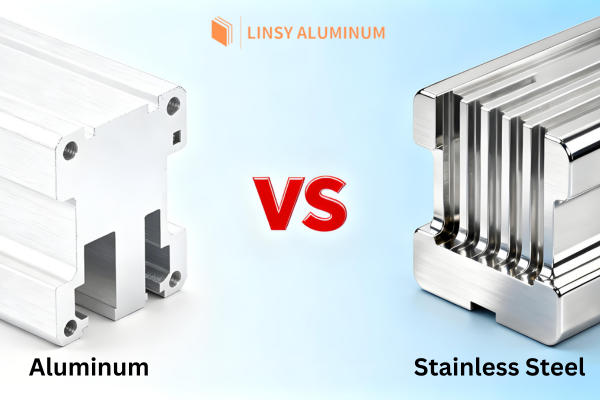
Aluminum is easier and quicker to cut, reducing costs and time. Stainless Steel is stronger and more durable, resisting bending and deformation under heat or pressure. When selecting, consider weight, strength, price, and corrosion resistance, as each may suit different jobs.
Here is a simple comparison between the two:
|
Property |
Aluminum |
Stainless Steel |
|---|---|---|
|
Machinability |
Excellent; 3-4x faster than steel |
Good, but slower and requires more power |
|
Strength-to-Weight |
Excellent; very lightweight for its strength |
Good, but much heavier and denser |
|
Corrosion Resistance |
Good to excellent, especially with certain alloys |
Excellent, especially in its natural state |
|
Cost |
Generally less expensive than stainless steel |
Typically more expensive than aluminum |
|
Surface Finishes |
Very receptive to anodizing and other finishes |
It can be polished to a high sheen, but it is less versatile |
Best Aluminum Alloys for CNC Machining
💡 Pro Tip: The most significant mistake? Assuming “all aluminum is the same.” A poorly matched alloy can lead to warping, poor surface finish, or failed anodizing. Start with the right material—and everything else gets easier.
Many aluminum alloys are suitable for various applications: rapid prototyping, aerospace parts, CNC machining, etc. The following sections cover the most common alloys and help you choose the right one.
✅ General-Purpose & Prototyping → 6061-T6
If you’ve worked with machined aluminum, you’ve probably used 6061-T6—it’s a favorite for a good reason. It strikes an excellent balance of strength, ease of machining, and corrosion resistance, making it an excellent choice for everything from practical prototypes to final products.
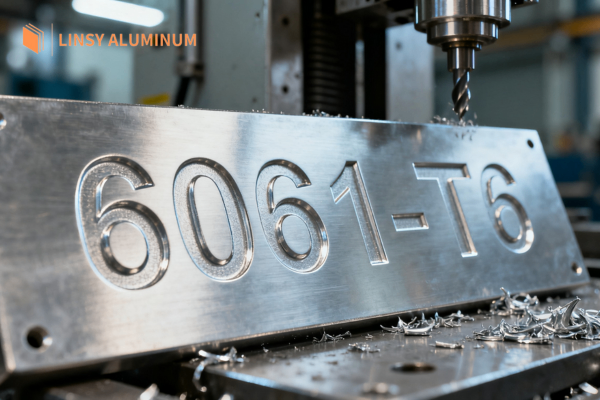
6061-T6 machines smoothly and predictably on CNC mills, maintains tight tolerances, and responds well to surface treatments such as anodizing. Its dependability, broad availability, and affordability make it the go-to material for brackets, enclosures, automotive parts, and various engineering projects. For most endeavors that don’t require extreme strength or tough-environment performance, 6061-T6 is a fantastic starting point.
📦 Linsy Advantage: We keep 6061-T6 in stock as plate, bar, and cut-to-size blanks—with certified Mill Test Reports (MTCs). Request a free sample or get a quote in under 4 hours.
✅ High-Strength Demands → 7075-T6 / T651
When maximum strength-to-weight ratio is critical, 7075-T6 (often called “aircraft-grade aluminum”) is the top choice. Alloyed primarily with zinc as the primary alloying element, it delivers tensile strength comparable to many steels—yet weighs only one-third as much.

This makes it indispensable in aerospace (e.g., wing spars, fuselage fittings), high-performance robotics, defense systems, and premium sporting goods. However, 7075-T6 is less forgiving than 6061: it’s harder to machine, not weldable without special procedures. It has lower corrosion resistance—often requiring protective coatings like Chem Film or paint for outdoor use. Use it when strength is non-negotiable; otherwise, 6061 may be more practical.
📦 Linsy Advantage: Premium-grade 7075-T6/T651 in plate and bar—stress-relieved for minimal distortion. Free samples available, and we provide same-day quotes for urgent projects.
✅ Outdoor / Marine / Chemical Environments → 5052-H32
For parts exposed to saltwater, chemicals, or humid conditions, 5052-H32 stands out for its exceptional corrosion resistance. Unlike 6061 or 7075, it’s a non-heat treatment alloy, strengthened through cold working—and it’s the strongest in its class.

Its magnesium-rich composition provides excellent durability without sacrificing formability, making it ideal for marine hardware, fuel tanks, chemical storage vessels, and outdoor enclosures. While it doesn’t match 6061 in machinability or 7075 in strength, 5052-H32 excels in fatigue resistance where long-term environmental resistance matters most.
📦 Linsy Advantage: 5052-H32 in sheet and plate form, ready to ship. Need to test corrosion performance? Order a free sample today—and get a competitive quote within hours.
✅ Premium Aesthetics & Architectural Parts → 6063-T5/T6
When appearance is as important as function, choose 6063-T5/T6—often referred to as “architectural aluminum.” It produces an exceptionally smooth surface finish, making it perfect for visible components that require a refined look.
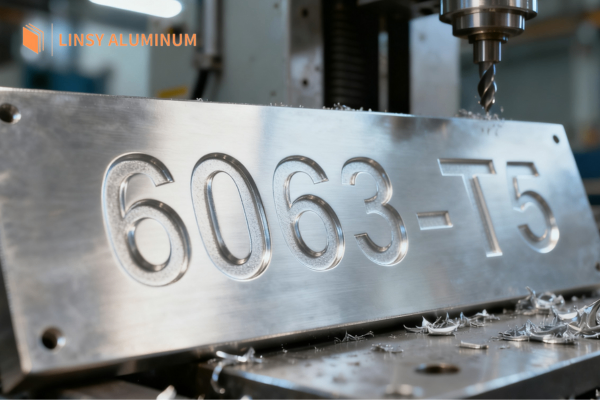
Commonly used in window frames, door systems, lighting housings, and consumer electronics trims, 6063 accepts anodizing beautifully—delivering rich, uniform colors and durable matte or glossy finishes. Though its mechanical strength is lower than 6061, it’s more than sufficient for structural applications in buildings or decorative hardware. If your priority is visual quality, surface consistency, and high machinability, 6063 is the clear winner.
📦 Linsy Advantage: Surface-ready 6063-T5/T6 with fine-grain structure for flawless anodizing. In stock and available as custom-cut pieces. Request a sample + fast quote now.
Surface Finishes & Aluminum Compatibility
Aluminum’s real power lies not just in its strength or light weight, but in how well it works with surface treatments. However, not all aluminum alloys respond the same way to finishing processes. Choosing the wrong grade can lead to uneven color, poor adhesion, or premature corrosion—even with a perfect finish process.
Below is a practical guide to common surface finishes, which alloys work best, and what to watch out for.
As-Machined
The “as-machined” finish is exactly what it sounds like: the raw surface left after computer numerical control (CNC) cutting. It shows fine tool marks (often spiral patterns), but feels smooth to the touch and maintains precise dimensions—no post-processing means no risk of tolerance shift.

This finish is ideal for:
- Internal components
- Functional prototypes
- High-volume parts where cost and speed matter most
Type II (Standard) Anodizing (Color Anodize)
Type II anodizing creates a thin, porous oxide layer that enhances corrosion resistance and accepts dyes beautifully—making it the go-to for colored consumer parts, enclosures, and architectural hardware.

- Best on: 6061-T6 and 6063-T5/T6
- Avoid: 7075-T6 (tends to turn dark or blotchy due to high zinc content)
The result? A durable, non-chipping finish that won’t peel like paint—and adds minimal thickness.
Type III (Hardcoat) Anodizing
Hardcoat anodizing builds a much thicker, harder oxide layer—up to 3x harder than Type II—ideal for parts exposed to abrasion, extreme environments, or heavy use (e.g., aerospace brackets, military housings, industrial fixtures), providing high wear resistance.

While it can be dyed, colors appear darker due to the dense layer. Most applications use it in clear or black for maximum durability.
- Best on: 6061-T6 (most reliable)
- Use caution with: 7075 (may crack under thick hardcoat due to internal stresses)
Chem Film (Alodine)
Unlike anodizing, Chem Film (or Alodine) is a thin chemical conversion coating that preserves electrical conductivity while offering mild corrosion resistance. It’s commonly used on:
- EMI/RFI shielding enclosures
- Electronic chassis
- Parts requiring paint or adhesive bonding
It adds almost no thickness—critical for tight-tolerance assemblies—but offers less wear protection than anodizing.
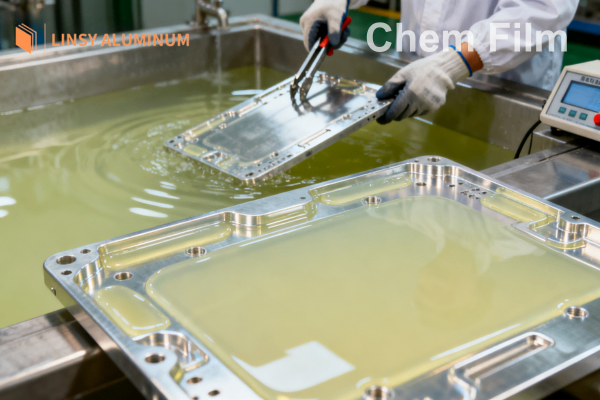
Works well on: All major alloys, especially 7075-T6 (which often can’t be anodized effectively)
Bead Blast + Clear Anodize
This two-step process delivers the sought-after “Apple-style” matte look:
- Bead blasting removes machining marks and creates a uniform satin texture.
- Clear anodizing seals the surface, locking in the finish while adding corrosion and scratch resistance.
The result is sleek, professional, and highly durable—popular in medical devices, premium electronics, and high-end consumer goods.

- Best on: 6061-T6 or 6063-T6 (for consistent texture and color)
- Avoid: Alloys with inconsistent grain or impurities—they’ll show blotches after blasting.
Choosing the Right Grade for Your Project
For beginners starting aluminum CNC projects, it’s essential to select the right alloy that meets these criteria. Always verify material quality before machining, ensure your tools are appropriate for aluminum, and account for proper cooling and chip removal. Paying attention to these details will help you achieve tight tolerances and superior surface finishes.
🔧 Need Maximum Strength? → 7075-T6/T651
When strength-to-weight ratio and excellent strength are non-negotiable—such as in aerospace, defense, or high-performance sports equipment—7075-T6/T651 is the top choice. It delivers tensile strength comparable to many steels while remaining lightweight and fatigue-resistant. However, it’s harder to machine, not weldable with standard methods, and requires protective coatings for corrosion resistance.
| Property | Value |
|---|---|
| Tensile Strength | ~570 MPa (one of the highest for aluminum) |
| Machinability | Fair – accelerates tool wear |
| Weldability | Poor – not recommended |
| Corrosion Resistance | Low – typically requires Chem Film or paint |
| Common Uses | Aircraft fittings, drone frames, and climbing gear |
⚙️ Need to Weld or Anodize? → 6061-T6
The most versatile CNC aluminum, 6061-T6, offers an excellent balance of strength, machinability, weldability, and finish compatibility. It’s ideal for structural parts, enclosures, and prototypes that require reliable performance and a clean final appearance—especially when anodizing or welding is involved.
| Property | Value |
|---|---|
| Tensile Strength | ~310 MPa |
| Machinability | Excellent |
| Weldability | Good – works with TIG/MIG |
| Corrosion Resistance | Good – suitable for indoor/outdoor use |
| Anodizing Result | Uniform, accepts color well |
| Common Uses | Brackets, chassis, automotive parts, prototypes |
🌊 Exposed to Saltwater or Harsh Environments? → 5052-H32
For marine applications, chemical, or outdoor applications where corrosion is a major concern, 5052-H32 stands out. As the strongest non-heat-treatable aluminum, it resists salt spray and chemicals far better than 6061 or 7075, while remaining highly formable—ideal for tanks, boat components, and outdoor enclosures.
| Property | Value |
|---|---|
| Tensile Strength | ~225 MPa (highest among non-heat-treatable) |
| Machinability | Moderate |
| Weldability | Excellent |
| Corrosion Resistance | Excellent – especially in saltwater |
| Heat Treatable? | No – strengthened by cold working |
| Common Uses | Marine hardware, fuel tanks, chemical vessels |
Making a Sleek Consumer Product? → 6063-T5/T6
When aesthetics drive your design—think premium electronics, architectural trim, or visible hardware—6063-T5/T6 delivers a flawless surface. Known as “architectural aluminum,” it provides a smooth, consistent base for anodizing and creates that clean, modern look brands demand.
| Property | Value |
|---|---|
| Tensile Strength | ~170–210 MPa |
| Machinability | Good |
| Surface Finish | Exceptionally smooth |
| Anodizing Result | Highly uniform; ideal for colored finishes |
| Structural Strength | Moderate – best for non-load-bearing parts |
| Common Uses | Window frames, smartphone housings, lighting trims |
Why Source Your CNC Aluminum From Us?
With 20 years of experience and a robust annual production capacity of 300,000 tons, we stock popular aluminum grades—including 6061, 7075, 5052, and 6063—in plate, bar, tube, and sheet forms. Our precision CNC cut-to-size service minimizes waste and accelerates machining, while full Mill Test Reports (MTRs) ensure traceability and quality with every order.
We support everything from one-off prototypes to high-volume runs, offer custom dimensions, and accommodate low MOQs to fit your exact needs.
Conclusion
Choosing the right aluminum alloy isn’t just a materials decision—it’s a strategic one that impacts performance, durability, cost, and time-to-market. Whether you prioritize strength (7075), versatility (6061), corrosion resistance (5052), or premium aesthetics (6063), the right grade of aluminum—paired with the optimal surface finish—ensures your CNC-machined parts meet both functional and visual expectations.