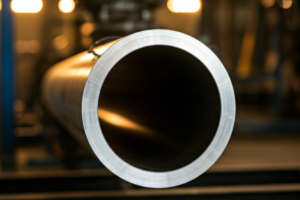
What Is 7075-T6 Aluminum Forging?
7075 is a 7xxx-series alloy built on a zinc-magnesium-copper system, and it delivers the highest strength of any common wrought aluminum — ultimate tensile strength reaches about 572 MPa in the T6 temper. That strength comes at the cost of corrosion behavior: T6 offers only moderate general corrosion resistance and the weakest stress-corrosion-cracking (SCC) resistance of the 7075 family, so most service calls for coating or an overaged temper.
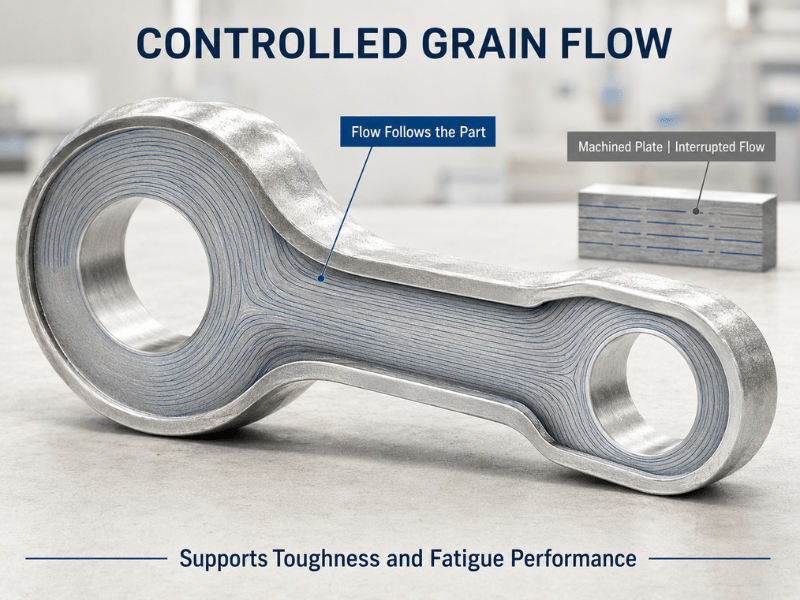
Forging is the process that turns that strength into a structural part. Squeezing the heated billet between dies closes internal voids and forces the grain to follow the part’s outline, which raises toughness and fatigue life well beyond what casting or machining from plate can achieve. That grain-flow advantage is exactly why 7075-T6 forgings, not just 7075-T6 plate, are specified for the most demanding airframe and suspension loads.
Understanding the T6 Temper
The “T6” label describes a fixed heat-treatment route, not the as-forged condition. A forging leaves the die soft; only the T6 cycle brings it to full strength.
Solution heat treatment heats the part to 465–485°C for 1–4 hours so the zinc, magnesium, and copper dissolve into a single-phase solid solution. Rapid water quenching (above 100°C/s, inside 30 seconds) locks those elements in place before they can precipitate. Artificial aging at 120°C for roughly 24 hours then precipitates fine η′ (MgZn₂) particles that block dislocation movement and raise strength.
T6 vs T652 for Forgings
T652 is the forging-relevant variant of T6. After quenching, the part receives 1–5% compressive stress relief — a 500–3000-ton press squeezes out the 60–90 MPa quench residual stress — then ages. Mechanical strength stays near T6 levels, but residual stress drops to 20–40 MPa and dimensional stability improves, which is why forged aircraft parts are usually specified as T652 rather than plain T6.
7075-T6 Mechanical Properties
These are typical values for T6 forgings and plate. Confirm against the mill test certificate for the specific section and temper.
| Property | 7075-T6 | Notes |
|---|---|---|
| Ultimate Tensile Strength (UTS) | 572 MPa (83 ksi) | Peak among common wrought Al |
| Yield Strength (YS) | 503 MPa (73 ksi) | ~80% above 6061-T6 |
| Elongation | 8–11% | Drops in T652 |
| Hardness | ~150 HB | — |
| Modulus of Elasticity | ~72 GPa | — |
| Fatigue Strength (10⁷ cycles) | ~160 MPa | Grain flow raises it in forgings |
| Density | 2.81 g/cm³ | — |
The number that drives most decisions is yield strength. At 503 MPa, 7075-T6 carries about 80% more load than 6061-T6 before it yields, which is why it replaces steel in weight-critical structures — but that same precipitation-strengthened microstructure is what makes it sensitive to SCC and hard to weld.
The 7075-T6 Forging Process
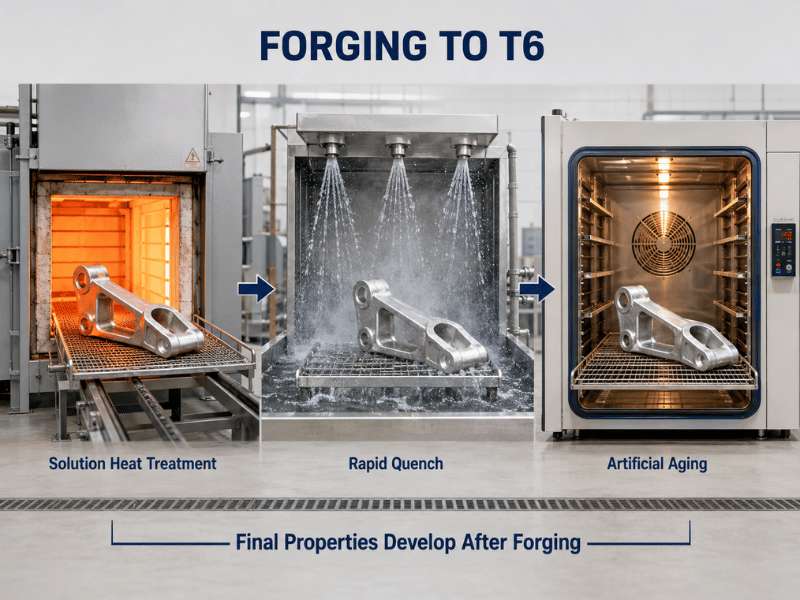
Forging 7075-T6 follows a controlled sequence: heat the billet, deform it between dies, then apply the T6 heat treatment. Small deviations in temperature or reduction rewrite the microstructure, so the window is tight.
Open-Die vs Closed-Die Forging
| Factor | Open-Die | Closed-Die |
|---|---|---|
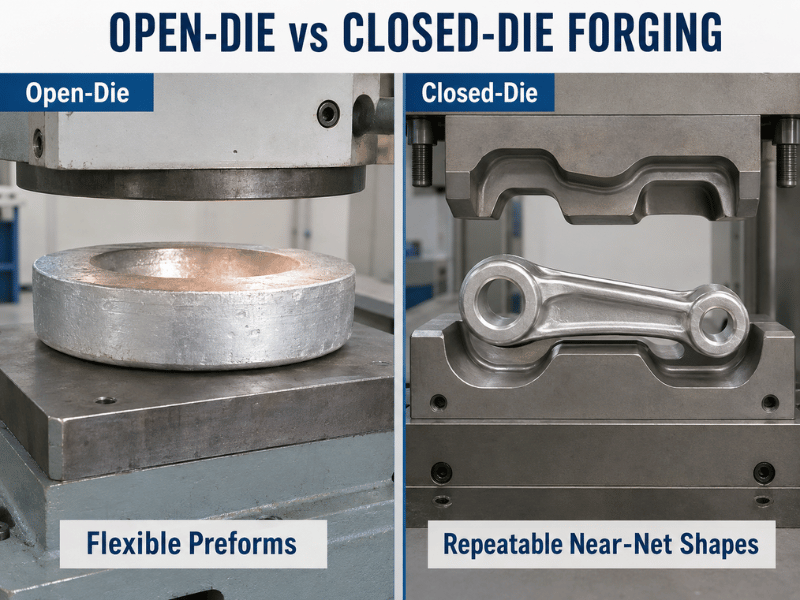
| Best for | Discs, rings, blocks, preforms | Complex, near-net shapes |
| Machining allowance | 5–10 mm | 0.5–2 mm |
| Material utilization | 60–70% | 80–95% |
| Die cost | Low — suits small batches | High — suits production runs |
Closed-die forging is the default for finished aerospace parts because the cavity defines the shape and the grain follows the contour. Open-die work stays useful for rings, blocks, and preforms that are later machined.
Forging Parameters and Steps
Billet preheating runs 370–420°C and forging itself stays in the 370–450°C window. Below that range the metal cracks or flows poorly; above it the grains coarsen and strength falls. Each stroke adds deformation, and the cumulative reduction ratio should reach at least 4:1 to 6:1 to break up the cast structure and build a fine, directional grain.
After forging and controlled cooling, the part goes through the T6 cycle above (solution → quench → age). For T652, the compression stress-relief step is inserted right after quench. Final properties depend as much on this heat treatment as on the forging itself, so the forge shop and heat-treater must work to one specification.
Where Forged 7075-T6 Is Used
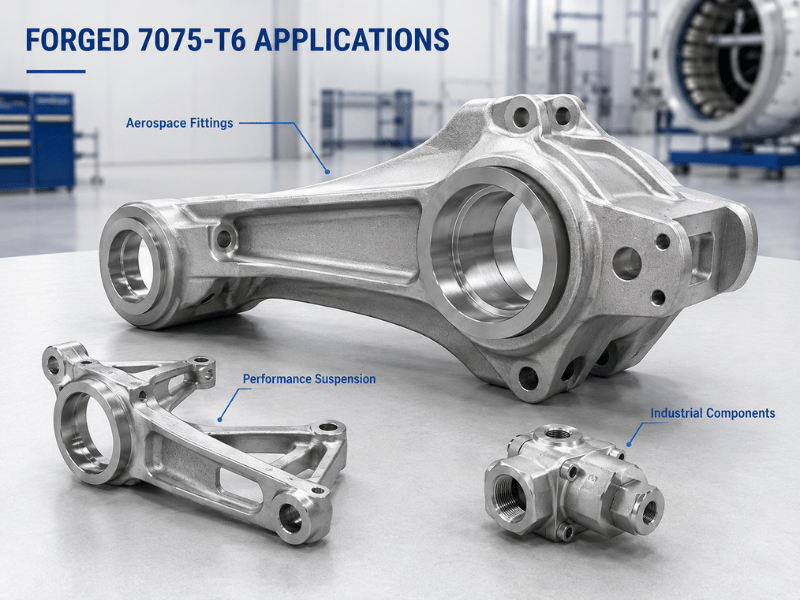
Forged 7075-T6 earns its place wherever strength, fatigue life, and weight sit on the same critical path.
Aerospace and Defense
Landing-gear components, wing spars, ribs, and fuselage fittings use forged 7075-T6 because the aligned grain flow resists the cyclic loads these parts see for decades. SCC-critical sections move to the T73 or T7352 temper; the rest stay at T6 or T652 with coating.
Automotive and Performance Suspension
Control arms, knuckles, and uprights use forged 7075-T6 to cut unsprung mass without giving up the stiffness needed under impact and cornering loads. As lightweighting pushes beyond bolt-on parts, forged 7075-T6 moves from race cars into higher-volume performance lines.
Industrial and Sporting Goods
Hydraulic components, molds, and tooling benefit from the alloy’s hardness and dimensional stability after stress relief. Climbing hardware, bicycle cranks, and baseball bats use it where a small, strong, fatigue-resistant part matters more than low cost.
T6 vs Other 7075 Tempers — How to Choose
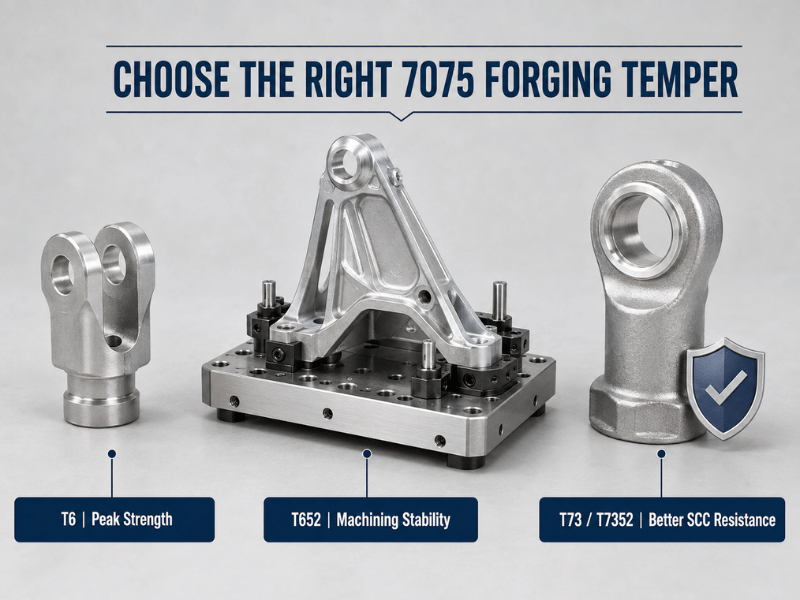
| Temper | Treatment | UTS / YS (MPa) | Best for | Avoid when |
|---|---|---|---|---|
| T6 | Solution + quench + age | 572 / 503 | Peak strength, non-SCC parts | SCC exposure, tight tolerances after machining |
| T651 | T6 + stretch (plate) | 572 / 503 | Plate that must stay flat | Forgings (use T652) |
| T652 | T6 + compression relief | ~570 / ~500 | Forgings needing stability | Lowest cost is the priority |
| T73 | Overaged | ~483 / ~414 | Thick, SCC-critical parts | Maximum strength is required |
When T6 Is the Right Call
- The part sees high static load but no sustained tensile stress in a corrosive environment — landing-gear links, structural brackets.
- Weight reduction from steel is the project goal and the geometry can be coated or clad for corrosion protection.
When Another Temper Fits Better
T73 and T7352 trade 15–20% strength for markedly better SCC resistance, which is the standard call for thick sections in humid or saline service. T652 is the forging default when post-machining dimensional stability matters more than the last few MPa of yield.
Working with Forged 7075-T6 — What You Need to Know
Machining is straightforward with the right setup. Carbide tooling, rigid fixturing, and flood coolant keep the work-hardenable surface from smearing; 7075-T6 produces clean chips and holds tight tolerances.
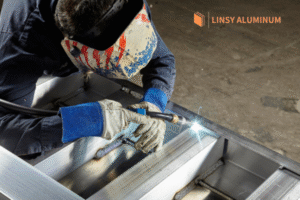
Welding is generally avoided. The copper and zinc content causes hot cracking, and the heat-affected zone loses much of its strength; welded joints also perform poorly on corrosion and SCC. Rivets, bolts, and adhesive bonding are the normal joining routes.
Corrosion protection is mandatory in most environments. T6 resists indoor atmosphere but pits in chloride exposure, so anodizing, painting, or cladding is standard; for any saline or sustained-moisture service, move to T73 rather than relying on coating alone.
Design for the process early. Hold a reduction ratio of at least 4:1, use generous fillets and draft angles, avoid thin sections that cool too fast, and orient the part so the grain flow runs along the main stress path. These choices decide whether the forging beats a machined plate on fatigue.
Pros and Limitations at a Glance
| Dimension | Strength | Watch-out |
|---|---|---|
| Strength-to-weight | Highest of common wrought Al | Higher material and forging cost |
| Fatigue life | Excellent with aligned grain flow | Depends on forging quality |
| Machinability | Good with carbide + coolant | Work-hardens the surface |
| Corrosion | Moderate general, poor SCC (T6) | Needs coating; T73 for saline |
| Weldability | Poor — joining by fasteners | Limits repair options |
| Availability | Common in aerospace supply | Thick T73 forgings cost more |
| Cost | Higher than 6xxx alloys | Justified by load/weight gain |
Conclusion
7075-T6 forging converts the strongest common wrought aluminum into dense, fatigue-resistant parts whose grain follows the load path — the trade-off is real: T6 gives peak strength but the weakest SCC resistance of the family, only moderate general corrosion resistance, and essentially no weldability, so coating and mechanical joining are the norm.
Linsy Aluminum, a Shenzhen-based factory with more than 20 years of experience, supplies 7075-T6 and T652 forgings and related tempers with full MTC documentation per order and SGS test reports available on request; typical custom lead time runs 10–60 days depending on size and processing. Send the forging drawing for a feasibility and grade-fit review — Linsy Aluminum supports low-MOQ custom forgings across the 1000–8000 series with in-house heat treatment and finishing.
Frequently Asked Questions
What is the difference between 7075-T6 and T652 forgings?
Both reach near-identical strength, but T652 adds 1–5% compressive stress relief right after quenching. That cuts residual stress from 60–90 MPa to 20–40 MPa and improves dimensional stability, so T652 is the usual spec for machined aerospace forgings while T6 suits less critical parts.
Can 7075-T6 aluminum be welded?
Welding is generally avoided. Copper and zinc cause hot cracking, the heat-affected zone loses much of its strength, and the joint is vulnerable to corrosion and SCC. Rivets, bolts, or adhesive bonding are the standard joining methods.
What temperature is used to forge 7075-T6?
Billet preheating runs 370–420°C and forging stays within 370–450°C. Staying in that window keeps the metal flowing without coarsening the grain; quench and age afterward complete the T6 temper.
Is forged 7075-T6 suitable for marine or saltwater use?
Not in the T6 temper. It pits in chloride environments and T6 has the worst SCC resistance of the 7075 family. For saline or sustained-moisture service, specify the overaged T73 or T7352 temper and still apply coating.
How does a forged 7075-T6 part compare to machining from plate?
Forging closes internal voids and aligns the grain with the part shape, raising toughness and fatigue life versus a machined plate of the same alloy and temper. It also saves material through near-net shape, though closed-die tooling adds upfront cost that pays off in production volume.