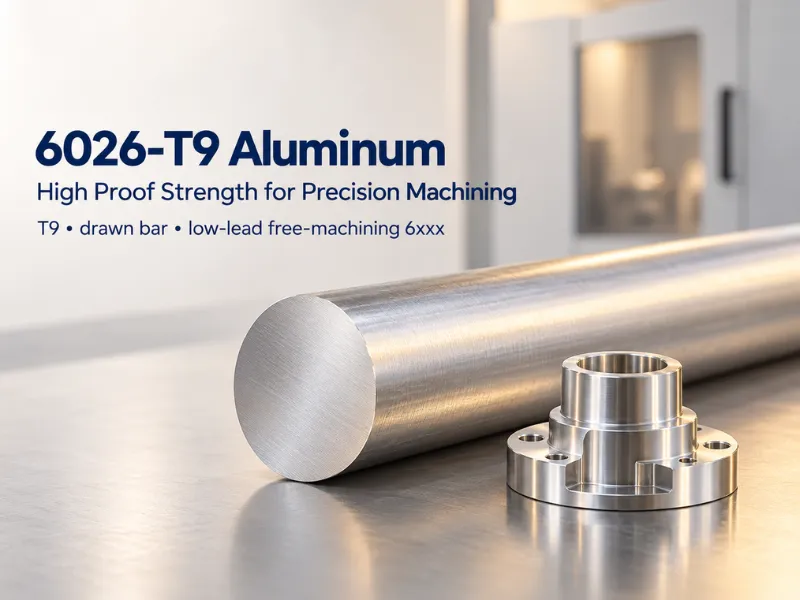
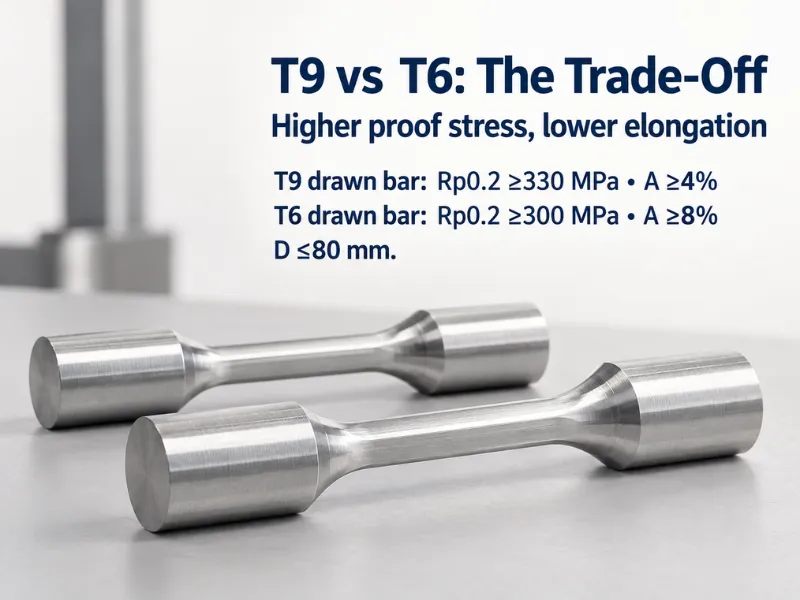
6026-T9 is de temper die u moet specificeren wanneer een bewerkt onderdeel weerstand moet bieden tegen blijvende vervorming voor zover deze legering dat toelaat, en daarna nooit meer wordt gebogen. Koudvervormen van de staf na het verouderen brengt de 0,2%-rekgrens naar 330 MPa, 30 MPa boven T6, en laat 4% rek over om mee te werken in plaats van 8%.
Sterkte is slechts de helft van de beslissing. De productiesequentie bepaalt ook in welke vorm elke temper beschikbaar is, en een temper op een vorm die wij niet kunnen produceren is geen specificatie die u kunt plaatsen.
Wat 6026 is
6026 is een 6xxx Al–Mg–Si-legering die sterkte ontleent aan Mg₂Si dat neerslaat tijdens kunstmatig verouderen. Het kenmerkende aspect is de vrijsnijdende toevoeging: bismut bij 0,50–1,50% breekt de spaander, terwijl lood is begrensd op 0,40% in plaats van het mechanisme te zijn. Dat behoudt de corrosieweerstand en het anodiseergedrag van een gewone 6xxx terwijl de spaanderbeheersing van een vrijsnijdende kwaliteit wordt toegevoegd — de rol die 6262 en 6012 vervulden, met bismut dat de spaander breekt.
De afweging zit in waar de legering staat, niet in wat hij kan. Bismut verhoogt de sterkte niet, dus 6026 is in de eerste plaats een bewerkingskwaliteit en in de tweede plaats een constructiekwaliteit; waar maximale sterkte de drijfveer is, doen 6082 of 7075 dat werk beter. Wat in de praktijk een 6026-onderdeel bepaalt, is de temper, omdat de spreiding over T6, T8, T9 en T6510/T6511 loopt van 300 tot 330 MPa in rekgrens en van 8% tot 4% in rek — breed genoeg om te bepalen of het onderdeel überhaupt kan worden gevormd.
Chemische samenstelling (EN 573-3)
Bismut is de bewuste toevoeging; tin en lood zitten op onzuiverheidsplafonds. Dat onderscheid is van belang bij het lezen van een walscertificaat, omdat een hoog tingehalte een signaal van besmetting is, niet een voordeel voor vrijsnijden.
| Element | 6026 (EN 573-3, gew.%) | Wat het doet |
|---|---|---|
| Si | 0.60–1.40 | Vormt Mg₂Si met Mg — de sterktebron |
| Fe | 0,70 max | Onzuiverheid; beïnvloedt oppervlakteafwerking en taaiheid |
| Cu | 0.20-0.50 | Verhoogt sterkte en hardt het precipitaat |
| Mn | 0.20–1.00 | Regelt korrelstructuur en rekristallisatie |
| Mg | 0.60–1.20 | Balanceert met Si tot Mg₂Si |
| Cr | 0,30 max | Onzuiverheid in deze kwaliteit |
| Zn | 0,30 max | Onzuiverheid |
| Ti | maximaal 0,20 | Korrelverfijner |
| Bi | 0.50–1.50 | Vrijsnijdende toevoeging — breekt de spaander |
| Pb | 0,40 max | Restgehalte; het plafond dat de ELV- en RoHS-uitzonderingen toelaten |
| Sn | 0,05 max | Onzuiverheidsplafond, geen toevoeging |
| Anderen | Elk max. 0,05, totaal max. 0,15 | - |
| Al | Saldo | - |
Controleer drie regels op het certificaat voordat u een warmte accepteert: Bi binnen 0,50–1,50%, Sn op of onder 0,05% en Pb op of onder 0,40%. Een warmte met Bi onder 0,50% bewerkt lang en vezelig; een met Sn boven 0,05% duidt op schrootbesmetting rather dan een ontwerpwijziging.
Hoe de T-tempers worden geproduceerd
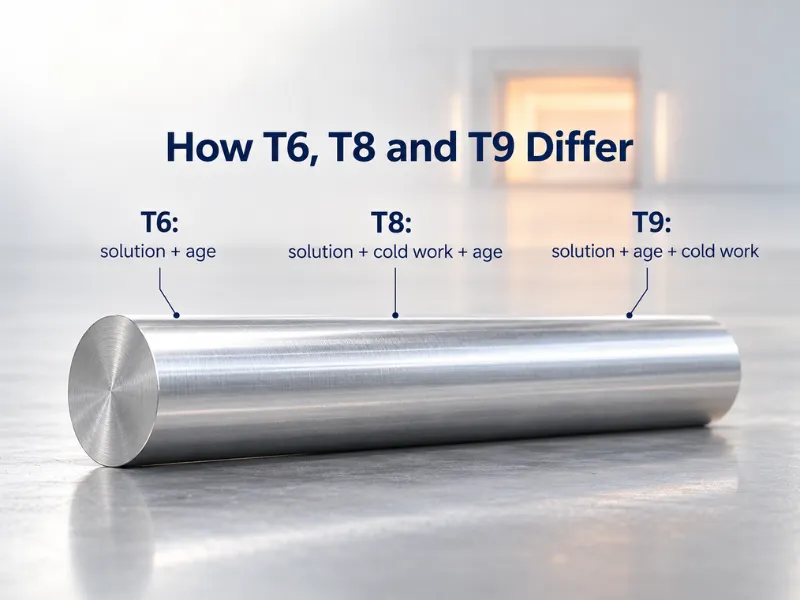
Elke warmteverharde 6xxx-temper begint op dezelfde manier: het blok wordt oplossingsgegloeid om de legeringselementen op te lossen, afgeschrikt om ze in oververzadigde oplossing vast te houden, en vervolgens verouderd zodat ze als fijne deeltjes neerslaan. Het achtervoegsel na T registreert wat er rond die kernsequentie gebeurt — en de volgorde van koudvervorming ten opzichte van veroudering is wat T8 van T9 scheidt.
- T6 — oplossingsgegloeid, vervolgens kunstmatig verouderd. Geen koudvervorming.
- T8 — oplossingsgegloeid, koudvervormd, vervolgens kunstmatig verouderd. Koudvervorming komt vóór veroudering.
- T9 — oplossingsgegloeid, kunstmatig verouderd, vervolgens koudvervormd. Koudvervorming is de laatste bewerking.
- T6510 — T6 gevolgd door spanningsverlichting door strekken, blijvende vervorming 1–3% op ronde staven, staven, profielen en buizen (0,5–3% op getrokken buis), zonder verdere richting na het strekken.
- T6511 — hetzelfde als T6510, behalve dat lichte richting na het strekken is toegestaan om dimensionale toleranties te halen.
T9 is de enige van de vijf die de staf na het verouderen koudvervormt. Veroudering heeft het precipitaat al gevormd; het koudtrekken voegt daar dislocatieversterking aan toe en legt de diameter in dezelfde doorgang vast. Een T9-staf arriveert met zijn afmetingen en zijn restspanning al vastgelegd, wat de reden is dat precisagedraaide onderdelen gewoonlijk in T9 worden gespecificeerd — de diameter die u bewerkt is de diameter die de staf aanhoudt.
T8 keert die volgorde om. Koudvervorming gaat erin vóór veroudering, dus de staf wordt op zijn getrokken maat verouderd in plaats van na veroudering getrokken. Een T8-staf bereikt 315 MPa rekgrens en 345 MPa treksterkte bij 4% rek — meer rekgrens dan T6, 15 MPa minder dan T9.
6026-T9 in cijfers
De onderstaande minimumwaarden zijn afkomstig uit EN 754-2 voor koudgetrokken staf en EN 755-2 voor geëxtrudeerd product. T9 bestaat alleen als getrokken product; T6510 en T6511 bestaan alleen als geëxtrudeerd product, en zij dragen dezelfde sterktelijn als T6 per maatband.
| Temper | Vorm en norm | Maatbereik | Rm min (MPa) | Rp0,2 min (MPa) | A min (%) | HB (typ.) |
|---|---|---|---|---|---|---|
| T6 | Getrokken staf, EN 754-2 | D ≤ 80 mm | 370 | 300 | 8 | 95 |
| T8 | Getrokken staf, EN 754-2 | D ≤ 80 mm | 345 | 315 | 4 | 95 |
| T9 | Getrokken staf, EN 754-2 | D ≤ 80 mm | 360 | 330 | 4 | 95 |
| T6 / T6510 / T6511 | Geëxtrudeerd, EN 755-2 | D ≤ 140 mm | 370 | 300 | 8 | 95 |
| T6 / T6510 / T6511 | Geëxtrudeerd, EN 755-2 | 140 < D ≤ 200 mm | 340 | 250 | 8 | 90 |
| T6 / T6510 / T6511 | Geëxtrudeerd, EN 755-2 | 200 < D ≤ 250 mm | 300 | 200 | 8 | 90 |
Kies op de rekgrenskolom, niet op de treksterktekolom. T9 houdt de hoogste vloeigrens op 330 MPa, 30 MPa boven T6, terwijl zijn treksterkteminimum van 360 MPa feitelijk 10 MPa onder T6’s 370 ligt — koudvervorming op een verouderde structuur koopt weerstand tegen blijvende vervorming en geeft treksterkte en rek op om dat te bereiken.
Fysische eigenschappen zitten waar een 6xxx normaal zit; dit zijn typische waarden, geen minimumwaarden: dichtheid 2,72 g/cm³, elasticiteitsmodulus ongeveer 69–70 GPa, thermische geleidbaarheid 172 W/(m·K), elektrische geleidbaarheid rond 26 MS/m (ongeveer 44% IACS), en een thermische uitzettingscoëfficiënt van 23,4 × 10⁻⁶/K tussen 20 en 100 °C. Stolling verloopt ongeveer van 575–650 °C.
T9 vs T6 vs T8 vs T6510/T6511
| Temper | Volgorde | Rm min | Rp0,2 min | A min | Specificeer het wanneer |
|---|---|---|---|---|---|
| T6 | Oplossing + veroudering | 370 | 300 | 8% | You need the best tensile-elongation balance, or the part is extruded rather than drawn |
| T8 | Solution + cold work + age | 345 | 315 | 4% | The bar is already cold drawn and the part needs more proof stress than T6 at the same 4% elongation |
| T9 | Solution + age + cold work | 360 | 330 | 4% | The finished part is cut, not formed, and must hold its set under the highest load the grade allows |
| T6510 | T6 + stretch, no re-straightening | 370 | 300 | 8% | A large extruded section is machined flat or square and residual stress would move it |
| T6511 | T6510 + light straightening | 370 | 300 | 8% | Same as T6510, but the section needs straightening inside standard tolerance after the stretch |
T9 is the right call when the part is produced entirely by machining and the design load is carried below the yield point. The 330 MPa proof stress is the highest the alloy offers, and the cold-finished diameter means the bar is already where the tolerance wants it. The cost is 4% elongation: T9 leaves almost no room for a bend, a swage, or a crimp after delivery.
T6 covers the widest range of work. Its 370 MPa tensile and 8% elongation give room to form or straighten after heat treatment, and it is the temper extruded tube and profile come in. If the part needs any deformation after aging, T6 or one of its stress-relieved versions is the one that can still take it.
T8 sits between them and is easy to overlook. It is a drawn-bar temper like T9, but with cold work ahead of aging: 315 MPa proof stress and 345 MPa tensile, still at 4% elongation. Specify T8 when the drawing calls for more proof stress than T6 and the part will not be formed — but T9 is available, it gives 15 MPa more proof stress at the same elongation, so T8 usually loses that comparison on a like-for-like drawing.
T6510 and T6511 are the stress-relieved versions of T6 and exist only for extruded product. They change residual stress, not the strength line, so the choice between them and T6 is about distortion after machining rather than load capacity. T6510 forbids straightening after the stretch; T6511 allows light straightening to hold tolerance, which is why it appears more often on standard extruded sections.
Shapes and Sizes
The temper usually decides the form. T9 and T8 are drawn-bar tempers; T6510 and T6511 are extruded; T6 exists in both. Where a drawing needs a temper the standard form does not carry, the route changes — the order does not get refused.
- Bar and rod — round 6–400 mm, hex and square 6–200 mm, length 1000–6000 mm. T9 is normally a cold-drawn round bar.
- Sheet and plate — 0.5–120 mm thick, 1000–2600 mm wide, length 1000–6000 mm.
- Buis — outer diameter 10–300 mm, wall 0.5–30 mm.
- Rol — supplied on enquiry. Tell us the required temper, width and coil weight and we confirm what the mill can run; coil is not a standing stock form for this grade.
- Custom profiles — extruded to your section drawing (how custom extrusion profiles are produced covers the route from drawing to die).
Non-standard sections and sizes are produced to order. Low-MOQ custom runs typically take 10–60 days depending on size and processing; what a size outside the standard range changes is the production route and the lead time, not whether we will quote it.
Go / No-Go
- Go when the part is turned or milled in volume, the enquiry has to clear RoHS or ELV, and 6061-T6 is short on strength while a 2xxx or 7xxx grade would be more than the design needs. The bismuth chip control is what pays for the alloy, and it pays most on automatic lathes running long batches.
- Go when the part needs an anodized finish and free-machining behavior at the same time; a leaded free-machining grade dulls that finish and carries its own compliance burden. Note the qualification: 6026 meets ELV and RoHS under the lead exemption for aluminum alloys, which permits up to 0.40% Pb. It is a low-lead grade, not a zero-lead grade, and the distinction matters if your compliance file treats exemptions differently from substance bans.
- No-go when the drawing fixes T9 or T8 on a part that still has to be formed. That is a temper mismatch rather than an alloy limitation — 6026 forms in O and T4, and the drawing changes temper, not grade.
- No-go when the service environment needs the seawater performance of a 5xxx alloy, or when 6061 or 6063 already meets the drawing. 6026 costs more than either, and the premium only returns where the free-machining behavior and the compliance position are both being used.
Specifying and Sourcing 6026
Four lines on the enquiry prevent most wrong deliveries:
- Name the standard, not only the alloy.
6026-T9 to EN 754-2fixes the product form, the size band and the property table;6026-T9on its own leaves all three open. - Pair the temper with a form the standard carries. T9 and T8 belong to drawn bar under EN 754-2; T6, T6510 and T6511 belong to extruded product under EN 755-2. Asking for
T9 extruded profilesends the enquiry back for clarification. - Give the size band, not just the nominal. The EN 755-2 minimums step down at 140 mm and again at 200 mm, so a 210 mm bar is specified against 300 MPa tensile, not 370.
- Eis EN 10204 3.1. That certificate carries the heat’s actual chemistry and mechanical results, signed at the producing mill, and it is the only document that lets you check Bi, Sn and Pb against the limits above.
Onze 6026 aluminiumlegering page lists the forms and tempers we run, so the size and temper can be checked before you write the enquiry.
Conclusie
T9 gives 6026 its highest proof stress at 330 MPa and its lowest elongation at 4%, so it suits a part that is machined to final form and loaded below yield, and rules out anything that still has to bend. T6, T8 and T6510/T6511 trade that yield back for formability or for lower residual stress in large sections.
We draw and supply 6026 in T6, T8, T9, T6510 and T6511 across bar, sheet, tube and custom profiles, with MTC on every order and coil quoted on enquiry.
Send your drawing with the standard, temper and size band, and we will confirm the production route and lead time before you commit.
Veelgestelde vragen
What is 6026 T9 aluminum?
6026 is a low-lead free-machining 6xxx alloy, and T9 is the temper produced by aging the bar and then cold working it. Because the cold draw is the last step, the bar arrives strengthened and dimensionally finished — which is why T9 suits precision turned parts.
Is 6026 T9 stronger than T6?
It depends which strength you mean. T9 reaches a higher 0.2% proof stress, 330 MPa against T6’s 300, so it resists permanent set better. Its tensile minimum is 360 MPa against T6’s 370 — 10 MPa lower — and its elongation drops from 8% to 4%.
Can 6026 T9 be welded?
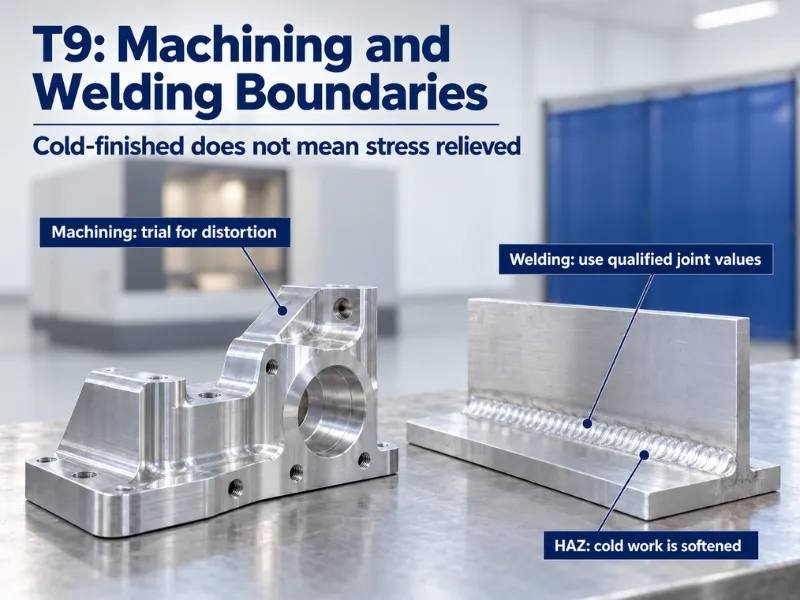
Yes, by TIG or MIG, but the joint will not hold T9 properties. The heat-affected zone reverts toward the annealed condition, and no post-weld aging treatment restores the T9 structure in this grade. If the finished assembly must carry T9 strength across a weld, change the design to a mechanical joint or pick a temper you can accept losing.
Which tempers do you supply, and what is the minimum order?
We supply bar, sheet, tube and custom profiles in T6, T8, T9, T6510 and T6511. Coil is quoted on enquiry. Round bar runs 6–400 mm and sheet 0.5–120 mm thick.
Non-standard sizes go to low-MOQ custom production, typically 10–60 days. Send the drawing, temper and size band for a route and a price.