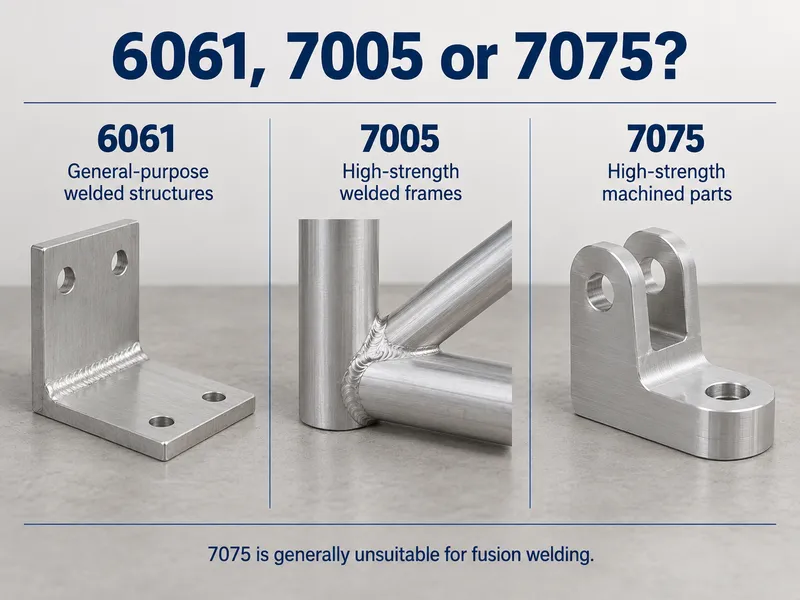
7005 is the more widely used of the two copper-free 7xxx welding alloys: an Al-Zn-Mg grade held to 0.10% copper with a deliberate zirconium addition, supplied mainly as extrusion for welded frames and transport structures.
The low copper is what makes the difference. It lets a welded joint age back toward parent strength instead of being written off in the heat-affected zone — the same reason 7075, at 1.2–2.0% copper, is fastened rather than welded. 7005 gives up peak strength against 7075 to keep that property.
What Is 7005 Aluminum Alloy?
7005 is a heat-treatable alloy in the 7000 series. Zinc is the main alloying element and magnesium forms the strengthening phase, with manganese and chromium supporting strength and corrosion behaviour.
Zirconium (0.08–0.20%) is what separates 7005 from a plain Al-Zn-Mg mix. It raises the recrystallisation temperature and keeps the grain structure fine, which is what suppresses hot cracking in the weld pool. That is the reason 7005 and its close cousins, 7003 and 7020, weld where 7075 will not.
| Element | Aralık (% ağırlıkça) | Rol |
| Çinko (Zn) | 4.0-5.0 | Birincil güçlendirici element |
| Magnezyum (Mg) | 1.0–1.8 | Forms the MgZn₂ strengthening phase |
| Manganez (Mn) | 0.20–0.70 | Strength, corrosion, grain structure control |
| Krom (Cr) | 0.06–0.20 | Grain-boundary stabilisation |
| Zirkonyum (Zr) | 0.08–0.20 | Grain refinement; resists weld hot cracking |
| Bakır (Cu) | ≤0,10 | Kept low for weldability and corrosion |
| Demir (Fe) | ≤0,40 | Safsızlık limiti |
| Silisyum (Si) | ≤0.35 | Safsızlık limiti |
| Titanyum (Ti) | 0.01–0.06 | Tane inceltici |
| Diğerleri (her biri / toplam) | ≤0,05 / ≤0,15 | Eser miktar limitleri |
| Alüminyum (Al) | Denge | Ana metal |
Density is about 2.78 g/cm³. Ranges follow EN 573-3 (designation EN AW-7005 / AlZn4.5Mg1.5Mn) and ASTM B221. 7005 is supplied mainly as extruded product, so the governing product standards are ASTM B221 and EN 755-2 rather than a flat-rolled sheet designation.
Temper Designations: O, T5, T53, and T6
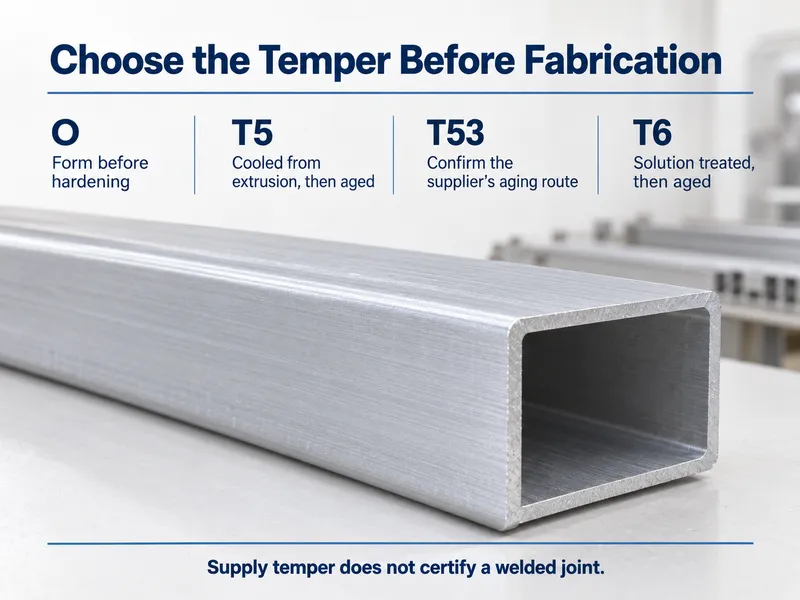
Temper is the heat-treatment and working condition the metal is supplied in, and it changes strength and formability far more than the alloy itself does. Four are common for 7005.
- O — annealed, the softest condition. Used when a part must be formed heavily before any heat treatment.
- T5 — cooled from the extrusion press and then artificially aged. The economical choice for profiles that do not need extra stress relief.
- T53 — press-quenched, naturally aged for about 72 hours at room temperature, then given a two-stage artificial age. This is the usual mill temper for 7005 extrusion, and the route welded fabrications follow.
- T6 / T63 — solution heat treated and artificially aged to the highest strength. One more process step, so it carries a premium over T5.
One clarification worth keeping straight: T53 is a supplied temper, not a description of a welded part. In practice the two line up, because a 7005 weldment is aged after welding and lands in the same property band.
Typical Mechanical Properties by Temper
| Temper | Çekme (MPa) | Yield, 0.2% (MPa) | Uzama (%) | Durum |
| O | ~190 | ~80 | ~20 | Annealed; heavy forming |
| T5 | ~345 | ~290 | ~12 | Press-cooled and aged |
| T53 | ~350–390 | ~300–345 | ~10–15 | Press-quenched, natural plus two-stage artificial age |
| T6 / T63 | ~370–390 | ~310–345 | ~10-12 | Çözeltiye alma ısıl işlemi uygulanmış ve yapay olarak yaşlandırılmış |
These are typical values for extruded product, taken from ASTM B221 and EN 755-2 property tables and producer data. Published 7005 figures vary by source and by product form, so treat the table as a planning reference rather than a specification. The guaranteed minimum for your order is set by the governing standard, ASTM B221 or EN 755-2, and shown on the MTC.
7005 vs 6061 vs 7075
| Alaşım / temper | Çekme (MPa) | Akma (MPa) | Kaynaklanabilirlik | Korozyon | En uygun kullanım |
| 6061-T6 | ~310 | ~276 | Mükemmel | İyi | Versatile structural work; easy forming and anodising |
| 7005-T5 | ~345 | ~290 | Mükemmel | Good for a 7xxx | Welded high-strength frames and profiles |
| 7075-T6 | ~572 | ~503 | Zayıf | Sınırlı | Aerospace and other peak-strength parts |
Read the table by asking one question first: will the part be welded? If yes, 7075 leaves the list because it is not fusion weldable, and 7005 is the stronger of the two options left — about 11% more tensile strength than 6061-T6 in the parent metal, and a much wider gap once a joint is made. If the part is machined and never welded, 6061’s lower cost, easier forming and wider stock usually outweigh 7005’s modest strength edge.
Working With 7005
Kaynak
7005 is the most weldable of the common 7xxx alloys, and the chemistry above is why: no copper to drive hot cracking, and zirconium keeping the grain structure fine. Weld it with 5356 filler (ER5356 / EN ISO 18273 S Al 5356). Where higher as-welded strength matters, 5183 is the alternative.
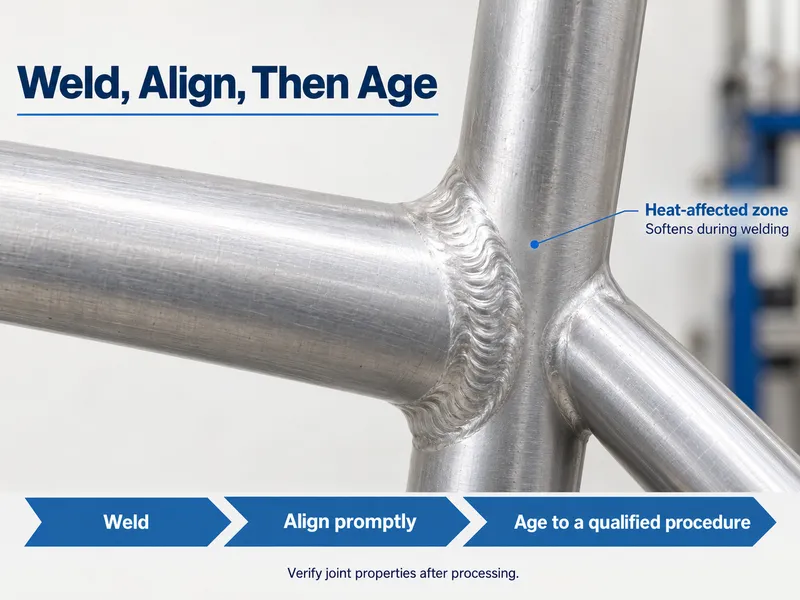
Welding still softens the heat-affected zone. What sets 7005 apart is how it recovers. An aging cycle after welding re-precipitates the strengthening phase and lifts the joint back toward parent strength, with no full re-solution and quench. That is why 7005 frames and rail structures are welded, aged, and shipped, rather than heat-treated again as a finished assembly.
Design on the aged, as-welded values, not the parent T6 column. Confirm the numbers against the MTC before releasing a drawing.
Talaşlı İmalat
7005 cuts harder than 6061, so expect more tool wear and a stronger need for sharp, high-rake tooling and a rigid setup. T53 and T6 take a cleaner finish than O. Because 7xxx tempers are notch-sensitive, avoid heavy cold forming after aging — form in O, then heat treat.
Korozyon Koruması
Copper is what makes 7075 corrosion-sensitive, and 7005 holds it to 0.10% maximum, so its corrosion resistance is good for a 7xxx grade. It still trails the 6xxx family. Anodise or paint it for marine, coastal, or humid service; bare chloride immersion is not its job. Where sustained stress meets warm, humid conditions, prefer T53 over peak-aged T6 — it trades a little strength for better stress-corrosion resistance.
Service Temperature
Treat 7005 as a room-temperature structural alloy. Like every precipitation-hardened grade, it over-ages and loses strength as service temperature rises, so check any hot application against temper-specific design data instead of assuming room-temperature values hold.
Uygulamalar
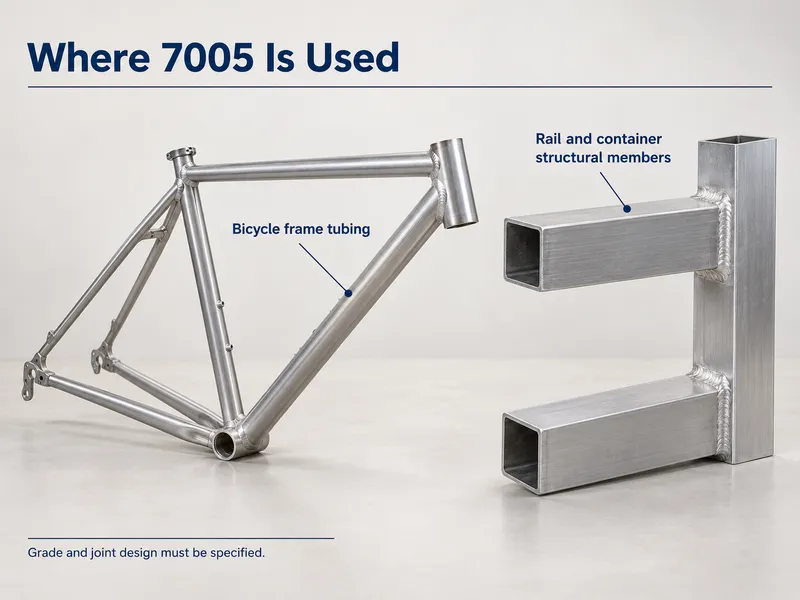
- Bicycle frames and welded sporting equipment such as racquets and bats
- Rail and metro car bodies and welded structural members
- Truck, trailer, and container frames — cross members, side posts, and stiffeners
- Köprüler ve mimari kaynaklı çerçeveler
- Heat exchangers and welded assemblies where post-weld re-solution is impractical
Uygun/Uygun Değil Sınırları
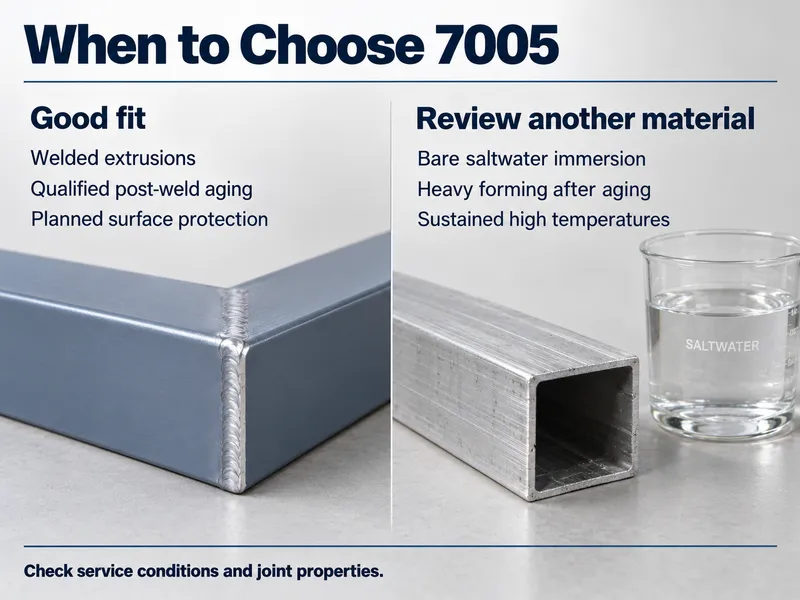
Go — specify 7005 when:
- A welded assembly needs more than about 290 MPa yield, and post-weld aging can restore the joint.
- Weldability matters more than peak strength, because 7005 welds and re-ages where 7075 cannot.
- The part is an extrusion and a moderate strength gain over 6061 is worth a small corrosion trade.
- Coating or anodising is planned for outdoor service.
Gitme — şu durumlarda başka yere bakın:
- Peak aerospace strength above roughly 500 MPa yield is required. That is 7075 or 7055 territory.
- The part is heavily machined and never welded. 6061 is cheaper, forms better, and stocks wider.
- Bare saltwater immersion is expected with no coating. Use 5083 or a 6xxx grade.
- Heavy cold forming after aging is planned. Form in O first, then heat treat.
Tedarik Notları: Sipariş Vermeden Önce Neyi Doğrulamalısınız
7005 is an extrusion alloy first. Bar, tube, and profiles to ASTM B221 or EN 755-2 are the standard range, and plate or sheet sits under a different specification — so name the form and its governing standard on the enquiry. Anything outside that range, from a non-standard section to a custom profile, is produced to drawing.
Four lines on the specification do most of the work: the governing standard, the temper (T5, T53, or T6), the governing wall thickness — minimum mechanical values are thickness-dependent — and the documentation level.
On documents, the MTC that ships with every order shows the actual chemistry and mechanical test results for the batch. If the project needs independent verification, ask for SGS reports. Note the difference between certificate levels: EN 10204 3.1 is signed by the manufacturer’s own authorised inspection representative, while 3.2 adds an independent third party, such as a customer representative or a body like TÜV, BV, SGS, or DNV.
Sonuç
7005 alüminyum is the weldable high-strength 7xxx grade — stronger than 6061 and far more weldable than 7075 — but it still gives up some corrosion resistance to the 6xxx family, and flat-rolled forms sit under a different specification from the extrusion range.
We supply 7005 as extruded profile, bar, and tube, and produce custom shapes, sizes, and tempers to your drawing through low-MOQ production with lead times of 10–60 days. Every order ships with an MTC.
Teknik inceleme ve fiyat teklifi için bize çizimi, with the temper and weld route for a form, temper, and availability check.
Sıkça Sorulan Sorular
What is the minimum order quantity and lead time for 7005?
Standard tempers and sizes ship from stock. Non-standard tempers and custom dimensions run as low-MOQ production, typically 10–60 days, driven by alloy, size and processing. Send the drawing and the quantity so both can be confirmed.
What documents come with a 7005 order?
An MTC ships with every order and carries the chemistry and mechanical results for that lot. Independent verification is available on request through SGS chemical, mechanical or ultrasonic reports, at extra cost. EN 10204 3.2 adds a third-party countersignature.
Do you supply 7005 in T53 and in non-standard sections?
Yes. Bar, tube and profile are supplied to ASTM B221 or EN 755-2, and sections, sizes or tempers outside that range are produced to your drawing on a low-MOQ basis, typically 10–60 days. Send the drawing with the governing standard named.