What Is 5056 Aluminum?
5056 is the high-magnesium end of the commercial 5xxx family, carrying roughly 5% Mg — more than 5052 (2.5%) or 5083 (4.5%). That magnesium content drives its identity: the highest as-wrought strength of any common commercial 5xxx grade, plus the marine-grade corrosion resistance the series is known for. It is best recognized as rivet wire and cold-headed fastener stock, where high shear strength and clean cold-forming behavior matter more than thickness.
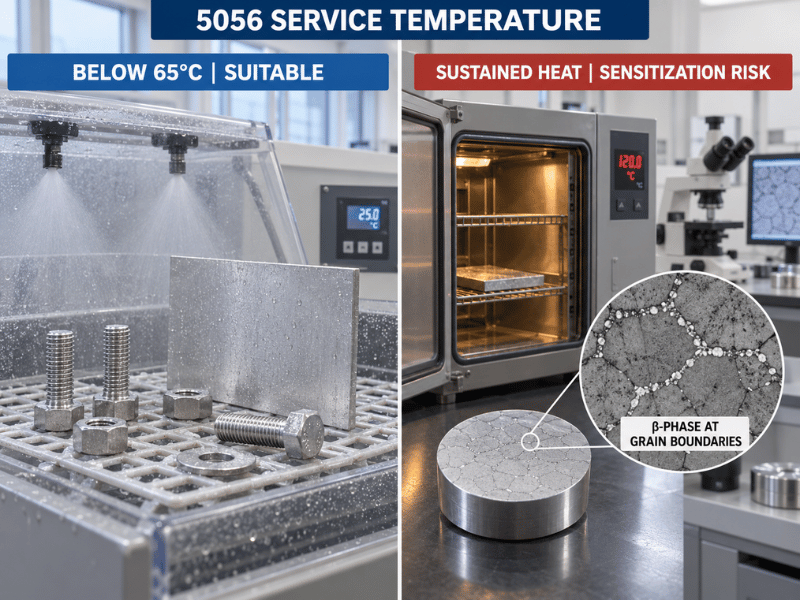
The alloy’s defining constraint is equally specific. 5056 is non-heat-treatable, and like every 5xxx grade above roughly 3% Mg, it has a sustained-service ceiling near 65°C before sensitization creates stress-corrosion-cracking risk. So the real selection question is not whether 5056 is strong enough — it rarely disappoints there — but whether the part stays cold enough, for long enough, to accept the trade-off.
5056 Chemical Composition
Composition limits per ASTM B209 / EN 573-3, in weight percent. Magnesium is the deliberate strengthening element; manganese and chromium are small controlled additions for grain structure and corrosion behavior.
| Element | Content (wt %) | Role |
|---|---|---|
| Magnesium (Mg) | 4.5–5.6 | Primary solid-solution strengthener |
| Manganese (Mn) | 0.05–0.20 | Grain refinement |
| Chromium (Cr) | 0.05–0.20 | Corrosion resistance, grain control |
| Silicon (Si) | 0.30 max | Impurity limit |
| Iron (Fe) | 0.40 max | Impurity limit |
| Copper (Cu) | 0.10 max | Impurity limit |
| Zinc (Zn) | 0.10 max | Impurity limit |
| Titanium (Ti) | 0.15 max | Grain refiner |
| Others (each / total) | 0.05 / 0.15 max | Trace limits |
| Aluminum (Al) | Balance | Base metal |
5056 Mechanical Properties by Temper
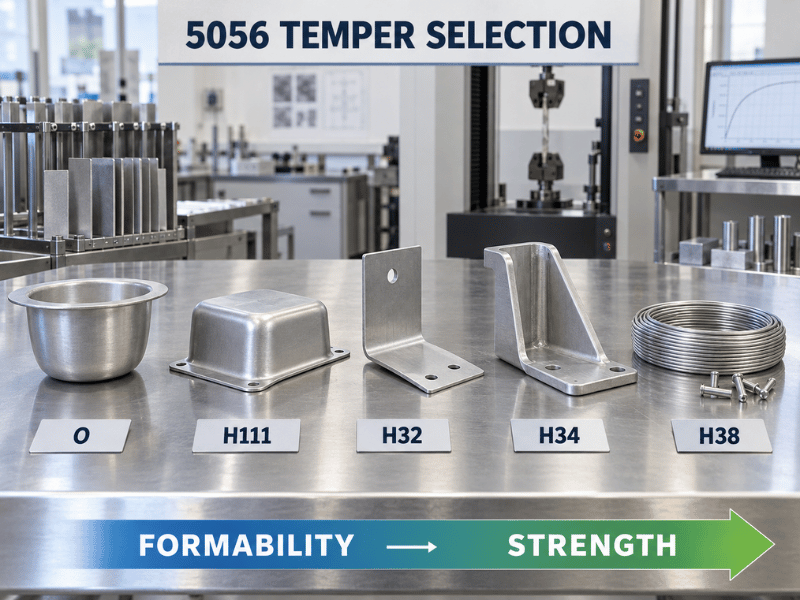
Because 5056 cannot be heat-treated, temper selection is the entire strength lever — it is the amount of cold work plus any stabilizing treatment. Values below are typical mid-range figures for sheet, plate, and wire; confirm against the mill test certificate for the specific form, gauge, and lot.
| Temper | Tensile Strength (MPa) | Yield Strength (MPa) | Elongation (%) | Hardness (HB) |
|---|---|---|---|---|
| O (annealed) | 290 | 152 | 35 | 65 |
| H32 (quarter-hard, stabilized) | 315 | 228 | 25 | 85 |
| H34 (half-hard, stabilized) | 345 | 283 | 15 | 95 |
| H38 (full-hard) | 414 | 345 | 7 | 105 |
| H111 (annealed, lightly strain-hardened) | 305 | 180 | 30 | 75 |
How these translate into practice:
- O maximizes formability. O fits when the part will be deep-drawn, spun, or severely bent before any service load is applied.
- H32 and H34 are the stabilized workhorses — “stabilized” meaning a low-temperature treatment that locks in properties so they do not drift during room-temperature storage. H32 is the common general sheet and plate spec; H34 adds strength at some cost to formability.
- H38 delivers the highest strength in the series, but elongation drops to about 7%, so it is limited to thin-gauge sheet and wire rather than structural plate.
- H111 sits between O and H32, useful when slightly better as-supplied strength is wanted while retaining most of the annealed formability.
Note that H38 and the H1x wire tempers are generally available only in thin-gauge sheet and wire forms, so quoting H38 on thick plate is usually a specification mistake.
5056 Physical Properties
| Property | Value | Test reference |
|---|---|---|
| Density | 2.64 g/cm³ | ASTM B193 |
| Melting range | 568–638°C | — |
| Thermal conductivity | ~117–130 W/m·K (at 25°C) | ASTM E1461 |
| Electrical conductivity | ~29% IACS | ASTM B193 |
| Modulus of elasticity | ~71 GPa | ASTM E111 |
| Coefficient of thermal expansion | 24.1 × 10⁻⁶/K (20–100°C) | ASTM E228 |
The low density is what makes 5056 attractive against steel in weight-sensitive assemblies. Thermally, it conducts far below the 1xxx and 6xxx grades, so it is not a heat-transfer material — but because the Al–Mg family has no ductile-to-brittle transition, it retains toughness at sub-zero temperatures, which suits cold-region and cryogenic service.
Corrosion Resistance and the 65°C Limit
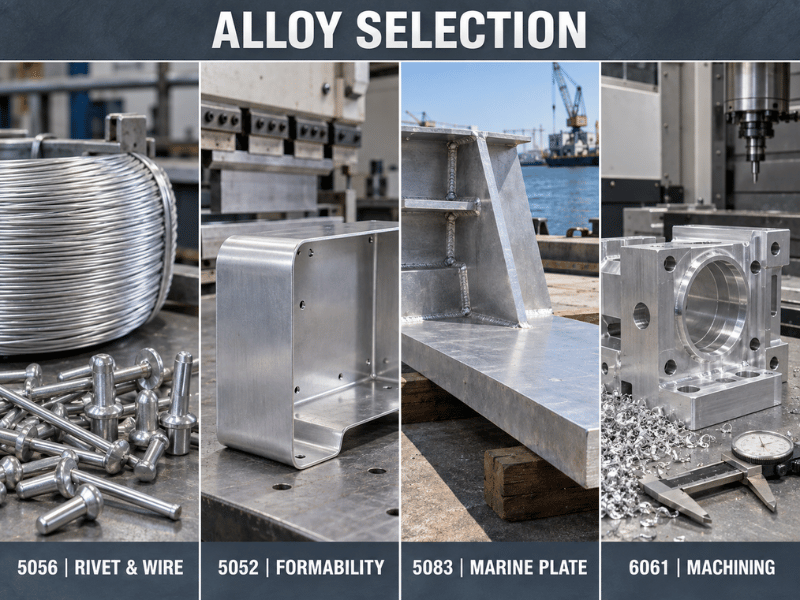
5056 performs well in marine atmospheres and saltwater spray, and its resistance to pitting generally exceeds 5052. In unprotected atmospheric and seawater exposure it behaves like the marine grade it is, which is why thin-gauge hull plating, deck hardware, and rigging fittings are standard applications.
The limit is thermal, not chemical. In 5xxx alloys containing more than about 3% Mg, long-term exposure above roughly 65°C drives magnesium to precipitate as β-phase (Al₃Mg₂) along grain boundaries. That process, called sensitization, leaves the boundaries depleted and vulnerable, so a part under sustained tensile stress in a corrosive environment can crack intergranularly well below its rated strength. It is a slow mechanism — infrequent brief excursions are not the concern; sustained elevated service is.
This matters even for welded assemblies, because the filler that matches 5056 is itself a high-Mg alloy. Where service runs above ambient, standard practice moves to 5454, which was designed for elevated-temperature service, or to stabilized marine tempers such as 5083-H116 or H321.
Working With 5056
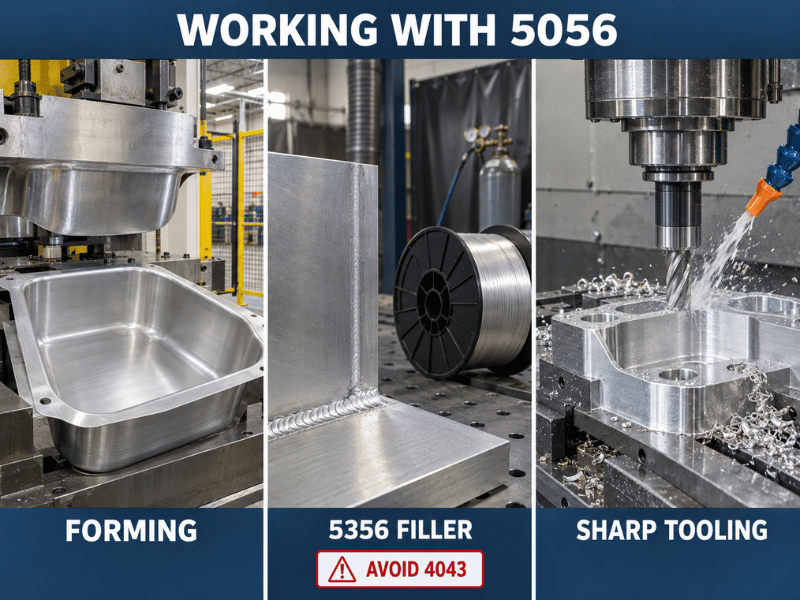
Welding. GTAW (TIG) and GMAW (MIG) both work well using 5356 filler, the standard Al–5%Mg wire whose chemistry closely matches the base metal. Resistance spot welding and mechanical fastening are also practical. Do not use silicon-bearing fillers such as 4043 on 5056: the silicon combines with the high magnesium to form excessive Mg₂Si, which produces brittle weld metal. As with any non-heat-treatable alloy, the heat-affected zone reverts toward annealed strength, so joint efficiency is set by the O-temper properties, not the cold-worked values.
Forming. The O temper bends and draws readily, taking tight radii. Harder tempers need progressively larger minimum bend radii — expect the requirement to climb sharply by H34 and H38 — so confirming the minimum radius against the actual temper and gauge is what keeps tooling and tolerances viable.
Machining. 5056 machines acceptably, but its high magnesium make it gummier than 6xxx grades, with a greater tendency to form built-up edge. Sharp positive-rake tooling, generous chip clearance, and consistent coolant or lubricant control the issue. When a part is machining-dominated and strength requirements allow, 6061-T6 remains the easier and more economical choice.
Finishing. 5056 takes a bright clear anodic coating and is used for decorative hardware and trim. For large architectural panels where coating uniformity across a wide surface is the acceptance criterion, 6xxx alloys are still the safer specification.
5056 vs 5052 vs 5083 vs 6061
| Factor | 5056 | 5052 | 5083 | 6061-T6 |
|---|---|---|---|---|
| Mg content | 4.5–5.6% | 2.2–2.8% | 4.0–4.9% | 0.8–1.2% |
| Typical UTS | 315 (H32) / 414 (H38) | 228 (H32) | 317 (H116/H321) | 310 |
| Typical yield | 228 (H32) | 193 (H32) | 228 (H116/H321) | 276 |
| Marine corrosion | Excellent | Excellent | Excellent + better warm SCC | Moderate — pits bare |
| Heat treatable | No | No | No | Yes |
| Signature role | Rivet wire, fasteners, screen wire | General sheet, widest availability | Shipbuilding plate | Machined structural parts |
| Main limitation | 65°C SCC limit | Lowest strength of the four | Not a wire/rivet alloy | Not intrinsically marine-grade |
5056 vs 5052. Roughly double the magnesium gives about 50–80 MPa more tensile strength across equivalent tempers, along with better pitting resistance. 5056 fits when a thin-gauge part needs additional strength margin without moving to a heat-treatable alloy, or when the form itself is wire or rivet stock. 5052 fits when broad availability and lowest cost decide the outcome.
5056 vs 5083. These overlap at room temperature, but 5083 holds up better against stress-corrosion cracking at moderate temperatures, which is why it is the standard shipbuilding grade for thick plate and warm-marine structures. 5056 wins where cold-service strength and wire or rivet forms matter.
5056 vs 6061. 6061-T6 offers a higher yield strength than most 5056 sheet tempers, heat-treatability, and notably better machinability — but bare 6061 pits in saltwater, so it is not intrinsically marine-grade. 5056 fits when corrosion resistance without coating is the requirement; 6061 fits when machining volume or heat-treatable strength dominates.
Go/No-Go: When to Specify 5056
5056 fits when:
- The part is a rivet, cold-headed fastener, or wire form where high shear strength and corrosion resistance both matter.
- Maximum 5xxx strength is needed at cold or ambient service temperature and the gauge is thin enough to reach a worked temper.
- The part is welded with a matched high-Mg filler and no post-weld heat treatment is planned.
- Uncoated marine corrosion resistance is required and the service environment stays below roughly 65°C.
5056 does not fit when:
- Sustained service temperature exceeds about 65°C — 5454, or 5083-H116/H321 for marine structures, is the substitute.
- Heat-treatable strength is the requirement; 5056 gains nothing from thermal treatment.
- The part is a thick structural section needing guaranteed high strength across the whole cross-section.
- CNC machining throughput is the dominant cost driver and corrosion exposure is mild — 6061-T6 machines more cleanly.
- Architectural anodizing uniformity across large panels is an acceptance criterion.
Where 5056 Is Used
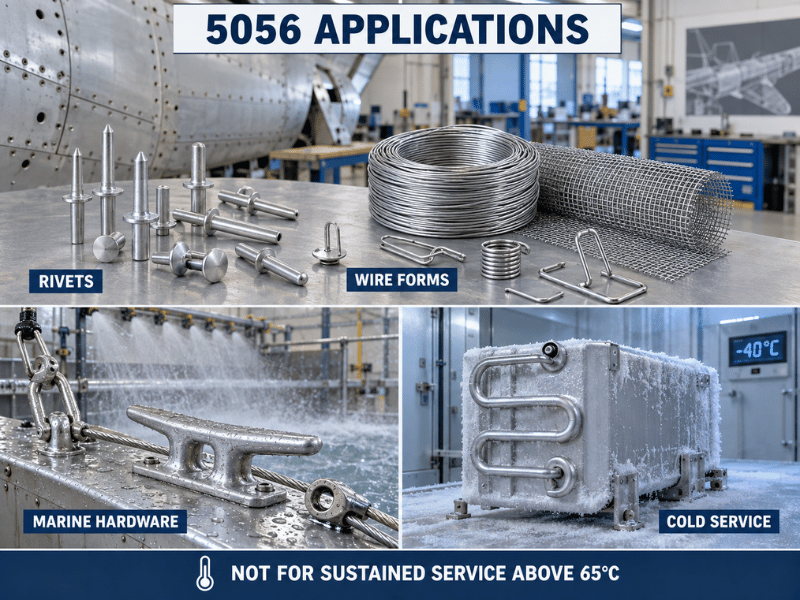
The selection logic above decides whether to use 5056; this is where the alloy actually shows up in practice.
- Rivets and fasteners. 5056 is one of the standard structural rivet alloys alongside 2024 and 2117, used for aluminum airframe assembly and notably for joining magnesium components. Cold-heading behavior and shear strength are the reasons it holds that position.
- Wire forms. Screen wire and insect screening, wire mesh and filters, cable sheathing and armor, nails, staples, zippers, hinge pins, and general cold-headed hardware.
- Welding consumables. Filler rod and wire stock chemically matched to the Al–5%Mg family, though 5356 has largely displaced 5056 in general-purpose filler applications.
- Marine hardware. Masts, deck fittings, rigging components, and thin-gauge hull plating where seawater exposure is constant.
- Cold-region and cryogenic service. Retained toughness at sub-zero temperatures suits cold-chain equipment, refrigerated transport, and cryogenic vessels.
Note that the strength figures quoted for wire products tend to sit higher than the equivalent H-temper sheet values, because drawing adds cold work. Specifying both form and temper avoids the mismatch.
Pros and Limitations at a Glance
| Dimension | Advantage | Limitation |
|---|---|---|
| Strength | Highest common commercial 5xxx | Only in thin gauges and worked tempers |
| Corrosion | Excellent marine, better pitting than 5052 | 65°C sensitization / SCC ceiling |
| Weldability | Excellent with 5356 filler | HAZ reverts to annealed strength |
| Formability | Excellent in O temper | Falls off sharply by H34/H38 |
| Machinability | Acceptable with good tooling | Gummier than 6xxx, built-up edge risk |
| Availability | Standard wire, sheet, plate, tube | Narrower than 5052; H38 is gauge-limited |
Conclusion
5056 is the strongest of the common 5xxx alloys and the go-to choice for rivet wire, cold-headed fasteners, and high-strength marine sheet. But it has clear limits: sustained service above ~65°C risks stress-corrosion cracking, it can’t be heat-treated, and it’s a poor fit for architectural anodizing or high-volume CNC machining. Most specification failures trace back to one of these three constraints — not the alloy’s strength — so confirming service temperature early turns 5056 from a risky pick into a safe one.
Linsy Aluminum supplies 5056 in wire, sheet, plate, tube, and custom-cut sizes in O, H32, H34, and H111 tempers. Non-stock specs are available at low MOQ, with typical lead times of 10–60 days depending on alloy, size, and processing. In-house CNC machining, TIG/MIG welding, laser cutting, and finishing (anodizing, polishing) cover downstream needs. Every order ships with an MTC; SGS chemical, mechanical, and dimensional test reports are available on request for an extra fee.
Frequently Asked Questions
What is 5056 aluminum most commonly used for?
Rivet wire is the single largest use, since 5056 has the shear strength and cold-heading behavior needed for structural aircraft and magnesium-assembly rivets. Beyond that it shows up across wire forms — screen wire, mesh and filters, cable sheathing, nails, staples, zippers — plus high-strength marine sheet and as filler-rod stock for welding Al–Mg alloys.
Why does 5056 have a 65°C service limit?
Alloys with more than about 3% magnesium can sensitize during long-term exposure above roughly 65°C: magnesium precipitates as β-phase (Al₃Mg₂) along grain boundaries, leaving them susceptible to intergranular corrosion. Under sustained tensile stress in a corrosive environment this becomes stress-corrosion cracking. Brief temperature excursions are not the issue — sustained elevated service is. 5454 is the standard upgrade for warmer duty.
Can 5056 be welded, and which filler should be used?
Yes. GTAW (TIG) and GMAW (MIG) both work with 5356 filler, whose ~5% Mg chemistry matches the base metal. Avoid silicon-bearing fillers such as 4043, because the silicon reacts with the high magnesium to form excessive Mg₂Si and produces brittle weld metal. Expect heat-affected-zone strength to revert toward annealed values, since 5056 is non-heat-treatable.
Which temper should I specify for 5056?
Use O when the part will be deeply drawn or severely formed. H32 is the general-purpose spec for sheet and plate, and H34 adds strength where some formability can be given up. H38 gives maximum strength but elongation falls to roughly 7% and availability is limited to thin-gauge sheet and wire. H111 suits cases needing slightly more strength than annealed with most of the O-temper formability retained.
Is 5056 better than 5083 for marine use?
It depends on temperature and form. At room temperature the two are close, and 5056 reaches higher strength in thin gauges and wire. Above ambient, 5083 — particularly in H116 or H321 tempers — resists stress-corrosion cracking far better, which is why it is the standard shipbuilding plate grade. For thick plate and warm-marine structures choose 5083; for cold-service wire, rivets, and thin sheet choose 5056.