6013 exists for one design problem: a part that needs 2024-T3-class strength but has to be welded. 6061 will weld, but it runs out of strength just above 310 MPa in T6. 2024-T3 has the strength, but it is not a fusion-welding alloy and needs cladding or paint to survive service.
6013 closes that problem from the 6xxx side. It is a heat-treatable Al-Mg-Si-Cu alloy with T6 yield strength, fracture toughness and fatigue behaviour close to 2024-T3 plate, joining like a 6xxx grade and needing no protective cladding.
Two limits then decide the specification. The copper that makes 6013 stronger than 6061 also raises its intergranular corrosion tendency, and peak strength arrives only after a heat treatment step that has to be written into the process route.
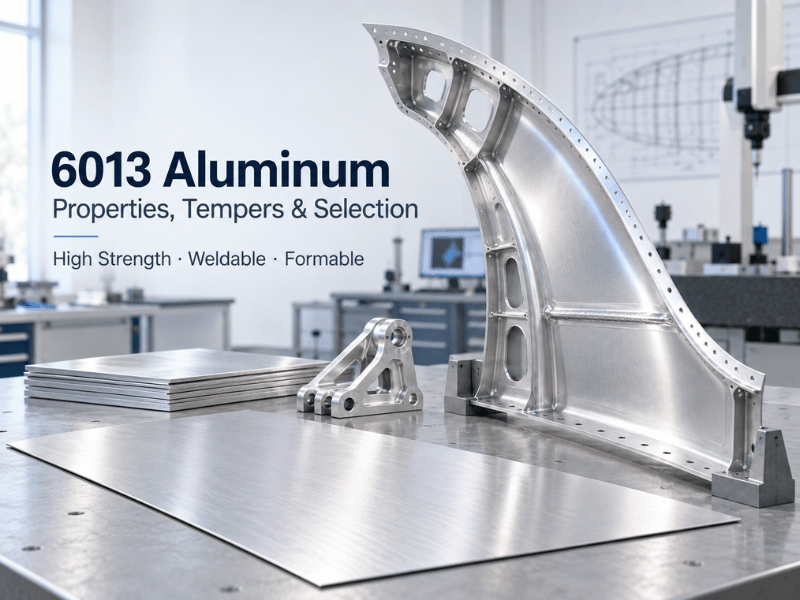
¿Qué es el aluminio 6013?
Strength in this alloy comes from precipitation ageing rather than cold work. Magnesium and silicon combine into Mg₂Si, and the copper addition drives additional Cu-bearing phases that raise both strength and fatigue resistance above what a plain Al-Mg-Si alloy reaches.
It is a relatively recent addition to the 6xxx family and remains a niche grade. You will not find it stocked as widely as 6061, and the premium over 6061 is real. Buyers specify it for two reasons: they need more strength than 6061 in a weldable alloy, or they need 2024-T3-class properties in a part that has to be welded or that cannot tolerate 2024’s corrosion behaviour.
Composición química
| Elemento | Rango (% en peso) |
| Silicio (Si) | 0.60 – 1.0 |
| Magnesio (Mg) | 0.80 – 1.2 |
| Cobre (Cu) | 0.60 – 1.1 |
| Manganeso (Mn) | 0.20 – 0.80 |
| Hierro (Fe) | ≤ 0,50 |
| Zinc (Zn) | ≤ 0.25 |
| Cromo (Cr) | ≤ 0,10 |
| Titanio (Ti) | ≤ 0,10 |
| Otros (cada uno / total) | ≤ 0,05 / ≤ 0,15 |
| Aluminio (Al) | Remainder (94.8 – 97.8) |
Two points matter more than the numbers themselves. Silicon and magnesium sit in a near-balanced ratio for Mg₂Si formation, which is what makes the alloy responsive to artificial ageing.
The copper level is the other point. At up to 1.1% it is roughly three to five times what 6061 permits, which explains both why 6013 is stronger than 6061 and why it is less corrosion-tolerant.
Especificaciones y designaciones equivalentes
| Sistema | Denominación |
| UNS | A96013 |
| ISO | AlMg1Si0.8CuMn |
| ASTM | B209 (sheet and plate), B221 (extruded bar, rod, tube, profiles) |
| AMS | 4216 (6013-T6 sheet), 4347 (6013-T4 sheet) |
| GB/T | 3190 |
When you write the purchase order, name the specification and the temper together. “6013” alone does not define a strength level — 6013-T4 and 6013-T6 differ by roughly 100 MPa in yield, which is the difference between a part that holds and one that does not.
Propiedades mecánicas según el estado de templado
| Temple | Resistencia a la tracción (MPa) | Límite elástico (MPa) | Alargamiento | Fatigue strength (MPa) | Shear strength (MPa) | Dureza (HB) |
| T4 | ~310 | ~170 | ~22% | ~98 | ~190 | — |
| T6 | 379 – 410 | ~350 | ~9% | ~140 | ~240 | ~130 |
| T651 | ≥ 379 | ≥ 359 | ≥ 5% | ~110 | 240 – 248 | 130 |
The T651 row is drawn from aluminium producer minimum values for plate; T6 sheet typically tests toward the upper end of its band. Treat the table as a screening tool and the mill test certificate as the governing document — guaranteed minimums shift with thickness and product form.
Worth noting: T6 has the highest fatigue strength of the three tempers, around 140 MPa, while T651 sits lower at roughly 110 MPa despite marginally higher static strength. If the part is fatigue-limited rather than statically limited, that difference should drive the temper call, not the yield number.
Propiedades físicas
| Propiedad | Valor |
| Densidad | 2.71 – 2.72 g/cm³ |
| Rango de fusión | ~579 – 650 °C |
| Conductividad térmica | ~150 – 164 W/m·K |
| Conductividad eléctrica | ~35 % IACS |
| Coeficiente de expansión térmica | 23.4 × 10⁻⁶ /°C (20 – 100 °C) |
| Módulo elástico | 69 – 71 GPa |
| Maximum service temperature | ~160 °C |
Electrical conductivity is the value most often quoted wrong. Because of the copper content, 6013 sits near 35% IACS — below 6061, not above it. Any application that leans on conductivity rather than strength should be looking at 6061, 6063 or 6101 instead.
Tempers: T4, T6, and T651
T4 is solution heat-treated and naturally aged. It is the softest of the three and the one you form in — formability in T4 is reported as broadly comparable to 2024-O. Elongation runs around 22%, which is what allows tight bends and deep draws.
T6 is solution heat-treated and artificially aged to peak strength. This is the delivered condition for most structural parts and for sheet.
T651 is T6 with an added stress-relief step — the material is stretched a controlled amount before artificial ageing. The stretching is what improves dimensional stability during and after machining, so T651 is the callout for plate that will be heavily milled. Sheet is normally supplied as T6 rather than T651, because the stretching step is a plate and bar operation.
The form-then-age route
This is the reason many shops specify 6013 at all, and it is the point most datasheets leave out. Natural ageing at T4 proceeds slowly, so a part can be formed in T4 and then aged directly to T6 peak strength without a second solution heat treatment.
For comparison, 2024-W has to be refrigerated to hold its formability, and most 6xxx parts that are formed and then aged need re-solution treatment first. Skipping that re-quench on 6013 means less distortion to correct, fewer process steps, and no re-controlling of grain structure. If your part is large, thin, or distortion-sensitive, this route alone can justify the alloy premium.
Working With 6013
Conformado
Do the forming in T4. In T6 the alloy has limited bend capability and cold forming is restricted by the strength level; complex shapes that form easily in T4 will crack in T6. Confirm minimum bend radii against the actual thickness and temper before committing tooling.
Soldadura
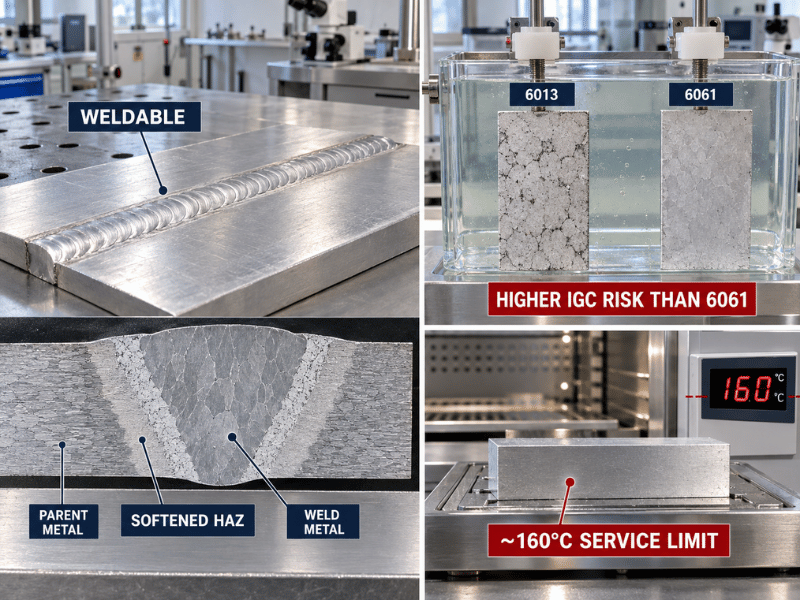
6013 welds well. Aluminium producer data rates its weldability at the top of the scale and describes it as readily joined by conventional welding and brazing methods — this is one of the alloy’s main advantages over 2024, which is not considered fusion weldable.
The usual caveat still applies: a 6xxx weld loses strength locally because the heat of welding over-agees or re-solutions the precipitate structure in and near the weld zone. Design to the as-welded condition and place welds away from peak-stress locations where possible. Filler selection should follow the joint requirements and any applicable procedure qualification — see our guide to aluminium welding wire selection for how filler choice interacts with base alloy and service environment.
Mecanizado
Machinability is good, rated around 70 on the standard 0–100 scale where free-cutting alloys sit near 90. T651 is generally preferred for heavily machined plate because of the stress relief.
Surface treatment
6013 takes anodizing and paint well. It is not a bright-anodizing decorative alloy — if appearance-critical bright trim is the requirement, 5005, 5657 or 6063 are the standard answers. For protective anodizing and paint pretreatment, 6013 performs without special handling.
Corrosion and Temperature Limits
The honest framing is this: 6013 has good corrosion resistance for a copper-bearing alloy, and less general corrosion resistance than 6061. Published comparisons note a higher tendency toward intergranular corrosion in 6013 than in 6061, particularly where processing is not properly controlled — with reported knock-on effects on fatigue resistance, ductility and strength if it is left unchecked.
Stress-corrosion cracking resistance is rated at the top of the producer scale, which is a genuine improvement over the 2xxx alloys 6013 competes with. But 6013 is not a marine alloy. For immersed or splash-zone saltwater service, the 5xxx grades remain the correct family — see our marine-grade aluminium selection guide.
On temperature, the practical ceiling is about 160 °C. Precipitation-hardened alloys lose strength as temperature rises, and 6013 is not an elevated-temperature material despite common assumptions about aerospace grades.
Where 6013 Is Used
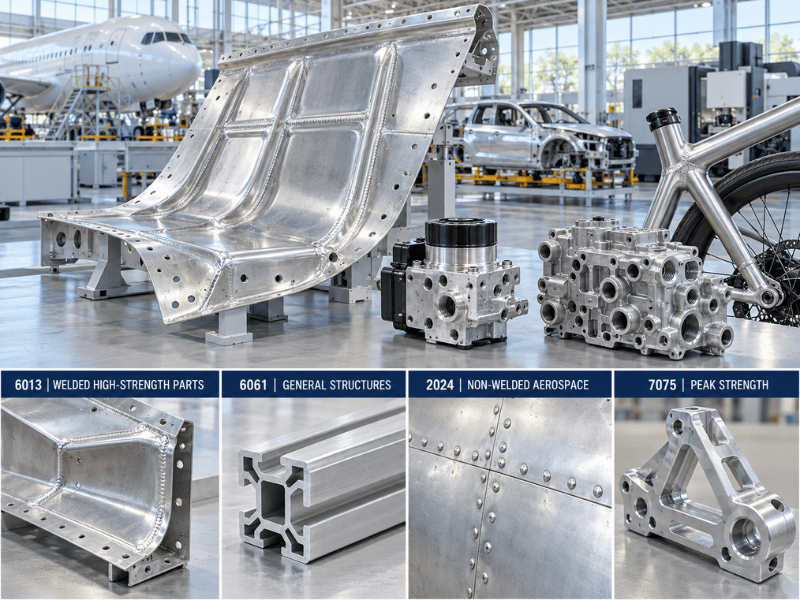
Producer application listings for 6013 include hydraulic components, valve bodies, machine parts, ABS braking system components, and munitions. Beyond those, the two volume applications are:
- Aeroespacial — aircraft skins and structural panels, where the alloy is evaluated as a candidate to replace 2024 sheet, particularly where welding or corrosion behaviour rules 2024 out.
- Automoción y transporte — structural and body panels, and bicycle frames, handlebars and wheel components, where higher-than-6061 strength is needed in a joinable alloy.
6013 vs. 6061 vs. 2024 vs. 7075
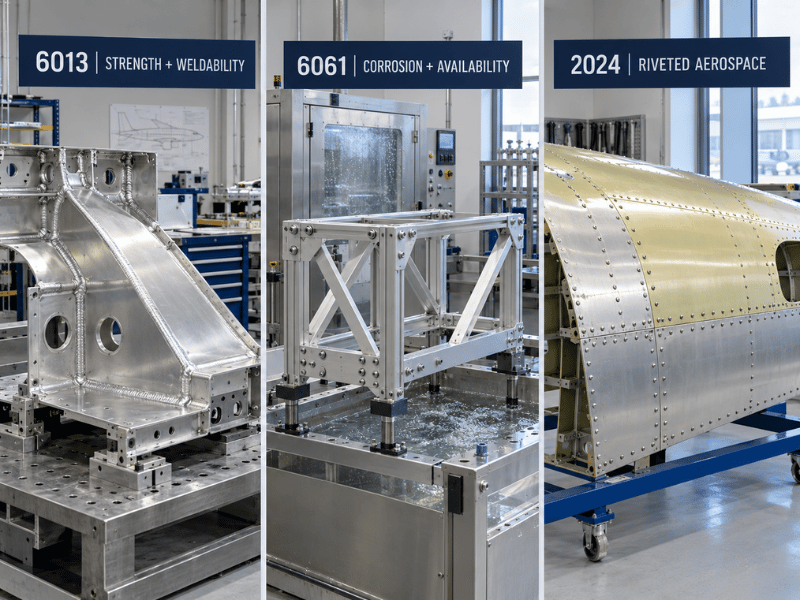
| Aleación | Key alloying | Resistencia a la tracción (MPa) | General corrosion | Soldabilidad | Fits when |
| 6013-T6 | Mg-Si-Cu | 379 – 410 | Good (higher IGC tendency than 6061) | Bien | 2024-class strength in a weldable part |
| 6061-T6 | Mg-Si | 240 – 310 | Muy buena | Excelente | General structural work, best all-round availability |
| 2024-T3 | Cu-Mg | 400 – 480 | Pobre | Not fusion weldable | Maximum 2xxx strength where welding is not required |
| 7075-T6 | Zn-Mg-Cu | 500 – 570 | Pobre | Pobre | Peak strength, corrosion and welding not driving |
The two comparisons that decide most jobs:
6013 vs 6061. 6013 is meaningfully stronger. 6061 is more corrosion-tolerant, cheaper, and available everywhere. Choose 6013 when the strength margin is what fails the design, not as a default upgrade. If corrosion resistance is the priority, 6061 is the better answer — see our complete guide to 6061 aluminium.
6013 vs 2024. Strength, fracture toughness and fatigue in 6013-T6 land close to 2024-T3 plate, with better corrosion resistance and lower density. The deciding factor is usually joining: if the assembly is welded, 6013 wins; if it is riveted and corrosion is managed by cladding or finishing, 2024 may still be specified.
Apto / No apto
Go — specify 6013 when:
- A welded joint is required in a part that needs strength beyond 6061. Typical parts: welded aerospace assemblies, hydraulic manifolds, structural brackets.
- The part can be formed in T4 and aged directly to T6, avoiding a re-solution treatment. Typical parts: large distortion-sensitive panels, drawn structural shapes.
- Fatigue resistance is a design driver and T6’s ~140 MPa fatigue strength clears the duty cycle. Typical parts: dynamically loaded brackets, transport structures.
- 2024-T3-class properties are needed but the service environment rules out a bare 2xxx alloy.
- Heavily machined plate where dimensional stability matters — specify T651.
No adecuado — busque otra opción cuando:
- Maximum corrosion resistance is the priority. 6061 or a 5xxx alloy will outperform 6013; the copper content works against you.
- The part sees continuous service above roughly 160 °C.
- Immersed or splash-zone saltwater is the primary exposure. Use 5083 or 5086 — start with our 5083 aluminium guide.
- 7075-class strength is genuinely required, and welding and corrosion are not binding constraints.
- Tight bend radii are needed in the delivered condition. Form in T4 and age, or pick a more formable alloy.
- Availability and cost dominate. 6061 is stocked far more widely and is the safer default.
Sourcing Checks
6013 is not a commodity grade, so the order needs more definition than a 6061 line item. Before releasing a purchase order, confirm:
- Specification and temper together — ASTM B209 or the applicable AMS sheet callout (4216 for T6, 4347 for T4), plus the temper. 6013-T6 and 6013-T651 are not interchangeable on a drawing.
- Thickness band — guaranteed mechanical minimums vary with thickness. State the range you will accept.
- Heat treatment route — if you intend to form in T4 and age to T6, say so at order stage so the material is supplied in a condition that supports it.
- MTC scope — request the certificate with chemistry and mechanical results, and confirm the temper and specification appear on it.
- Pruebas de terceros — where the application is aerospace or pressurised, agree the additional test scope up front rather than after production.
Linsy Aluminium supplies 6013 in sheet and plate, and supports CNC machining, TIG and MIG welding, laser cutting and surface finishing in-house, so material and first-stage processing can be handled on one order. See the 6013 aluminium alloy product page for available tempers and dimensions.
Conclusión
6013 earns its place when a welded, fatigue-loaded part needs more strength than 6061 carries, and when forming in T4 and ageing straight to T6 — no re-solution treatment, no extra quench — is worth the premium. The trade-off is availability: copper raises the intergranular corrosion tendency above 6061, the grade costs more, and most mills hold far less of it than 6061 or 2024.
We supply 6013 sheet and plate to the standard specifications and run low-MOQ custom production for tempers and dimensions outside them, with a 10–60 day lead time on custom lines. Every order ships with an MTC.
Envíenos el plano, temper and thickness requirement for a technical review and quotation.
Preguntas frecuentes
What forms does 6013 come in?
Sheet, plate and coil are the rolled forms. Tube, bar and non-standard sections are produced to your drawing, so the grade is not limited to flat product. Name the temper alongside the form, because not every temper runs in every product.
What filler should I use to weld 6013?
ER4043 (AlSi5) or ER5356 (AlMg5Cr) to AWS A5.10. ER4043 is the usual first choice on 6xxx base metal because its higher silicon content lowers hot-cracking sensitivity. Move to ER5356 where the joint needs a stronger as-welded deposit.
How does 6013 compare with 6061 on cost and availability?
It costs more and is stocked far less widely. 6061 is a commodity grade held by most service centres, while 6013 is a niche aerospace alloy, so lead time depends on whether your temper and thickness are held or produced. Budget for the premium and confirm stock before you commit to a delivery date.
Can 6013 be cut or machined to drawing before shipment?
Yes. Cutting to length, CNC machining, laser cutting and bending are handled in-house, so parts can arrive close to finished size. Send the drawing with your enquiry and the tolerance and surface callouts are quoted alongside the material.