1060 is a commercial-purity 1xxx aluminum — at least 99.6% aluminum, with no heat-treatable alloying elements to speak of. That purity is the whole point: it trades strength for the highest electrical and thermal conductivity of any common wrought grade, plus forming behavior that lets you deep-draw, spin, or bend it into shapes other alloys fight back against. The decision this guide handles is not “is 1060 strong enough” — it usually is not — but “where does its conductivity and formability win, and which temper (O, H12, H14, H16, H18, or the H2x variants) fits the part.”
If you need structural strength, stop here and look at 6061-T6; if you need maximum purity and conductivity on a budget, 1060 is the grade to specify. The rest of this guide walks through what 1060 is made of, how each temper changes its numbers, and where it earns its place in busbars, chemical tanks, and formed enclosures.
What Is 1060 Aluminum?
1060 belongs to the 1xxx series, the commercially pure aluminum family where aluminum content stays at or above 99.0%. At 99.6% minimum, 1060 sits near the top of that range — purer than 1100 (99.0%) and a hair purer than 1050 (99.5%), which is why the three are constantly compared.
Because there is almost no magnesium, silicon, copper, or zinc in the mix, 1060 cannot be strengthened by heat treatment. It gains what little strength it has through strain hardening — rolling or drawing the metal cold to lock in dislocations. That single fact shapes every property that follows: excellent conductivity, soft and formable in the O temper, and weak compared with any 6xxx or 7xxx grade.
1060 Aluminum Composition
1060 is defined almost entirely by how much aluminum it contains; the residual elements are capped low to protect conductivity and corrosion resistance.
| Element | Weight % |
|---|---|
| Aluminum (Al) | 99.60 min |
| Silicon (Si) | 0.25 max |
| Iron (Fe) | 0.35 max |
| Copper (Cu) | 0.05 max |
| Manganese (Mn) | 0.03 max |
| Magnesium (Mg) | 0.03 max |
| Zinc (Zn) | 0.05 max |
| Titanium (Ti) | 0.03 max |
| Other each | 0.03 max |
The low copper and iron ceilings matter: both are among the most damaging impurities for electrical conductivity, so keeping them down is what lets 1060 reach its ~61% IACS figure.
Physical and Mechanical Properties
Beyond chemistry, 1060’s physical profile is what makes engineers reach for it in electrical and thermal work.
| Property | Typical value |
|---|---|
| Density | 2.71 g/cm³ |
| Melting range | 645–657 °C |
| Thermal conductivity | ~234 W/m·K |
| Electrical conductivity | ≥ 61% IACS |
| Modulus of elasticity | ~69 GPa |
| Coefficient of thermal expansion | 23.6 µm/m·K |
| Reflectivity | High (visible and infrared) |
Mechanical strength depends heavily on temper (see the next section), but in the soft O condition 1060 lands around 90 MPa tensile and 70 MPa yield — roughly a quarter of what 6061-T6 delivers. Treat 1060 as a conductor and former, never as a load path.
1060 Tempers: Choosing the Right Strain-Hardened State
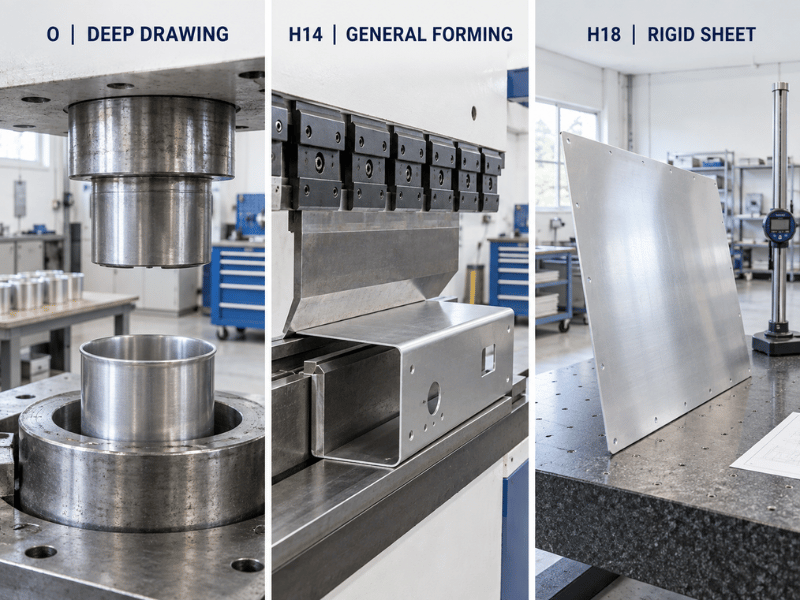
1060 is not heat-treatable, so “temper” here means how much cold work has been applied. The H1x tempers are strain-hardened only; the H2x tempers are strain-hardened and then partially annealed for better ductility at a given strength. Each step up the H-scale trades formability for stiffness.
| Temper | Tensile (MPa) | Yield (MPa) | Elongation % | Best use |
|---|---|---|---|---|
| O (annealed) | 90 | 70 | 43 | Deep drawing, spinning, maximum formability |
| H12 | 105 | 85 | 25 | Light structural, moderate forming |
| H14 | 125 | 103 | 20 | General sheet, gently formed parts |
| H16 | 145 | 124 | 17 | Stiff panels, limited bending |
| H18 | 165 | 145 | 15 | Rigid, fully hard, minimal forming |
| H22 | 105 | 62 | 25 | Same strength as H12, more ductile |
| H24 | 125 | 82 | 20 | Same strength as H14, more ductile |
For parts that must be bent or drawn after cutting, stay at O or H14 and keep the bend radius generous. For stiff enclosures or reflectors that will not be formed further, H18 gives the most rigid sheet 1060 can offer. The H2x variants let you hit the same strength with more leftover ductility, which helps when the part sees secondary forming.
1060 vs 1050 vs 1100 vs 6061
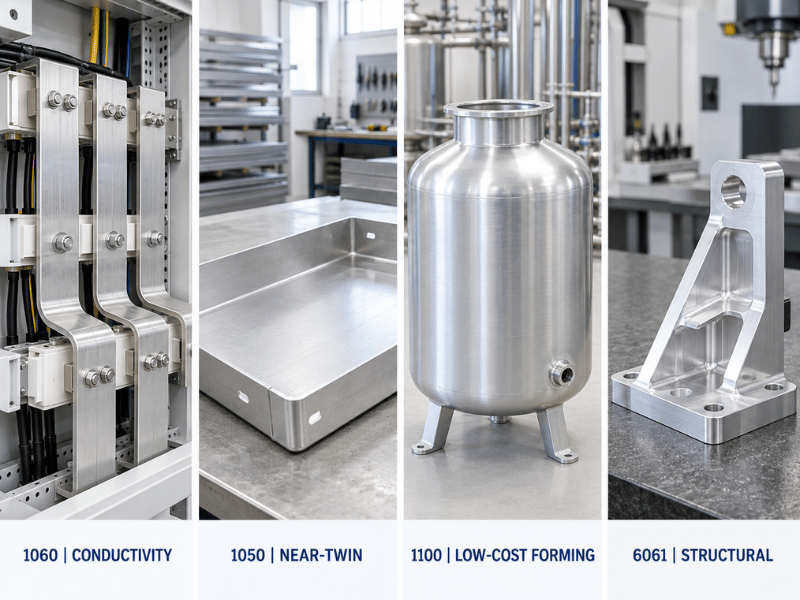
1060 is rarely specified in isolation — buyers weigh it against its near-pure siblings and, sometimes, against a structural alloy when the part has mixed roles.
| Grade | Al % | Conductivity | Tensile (O/H18) | Heat-treatable | Notes |
|---|---|---|---|---|---|
| 1060 | 99.6 | ~61% IACS | 90 / 165 MPa | No | Top conductivity of the three, slightly costlier than 1100 |
| 1050 | 99.5 | ~61% IACS | 90 / 160 MPa | No | Near-twin of 1060; often interchangeable on price |
| 1100 | 99.0 | ~59% IACS | 90 / 165 MPa | No | Cheapest, slightly less pure, excellent forming |
| 6061-T6 | 95–98 | ~40% IACS | 310 / — MPa | Yes | Structural strength; poor choice where conductivity rules |
Pick 1050 over 1060 only when a supplier quote or stock availability makes the 0.1% purity gap irrelevant — performance is effectively identical. Pick 1100 when budget and formability beat the last point of conductivity. Reach for 6061-T6 only when the part must carry load; it conducts roughly 35% less well and costs far more to process.
Where 1060 Aluminum Is Used
1060’s property set points it at a clear set of jobs:
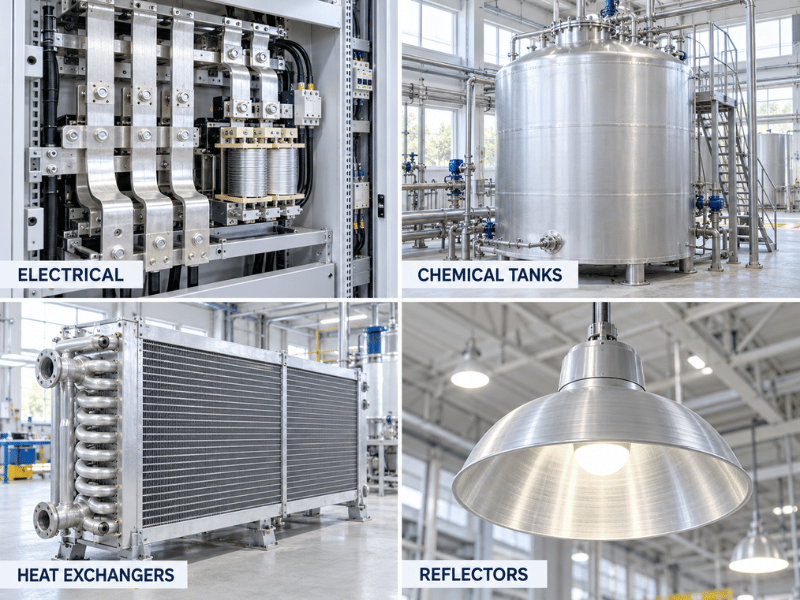
- Electrical busbars and conductors. The ~61% IACS conductivity makes 1060 a standard choice for busbar, transformer windings, and battery interconnects where cost per amp matters.
- Chemical and food tanks. High purity resists many acids and alkaline solutions better than alloyed grades, so 1060 lines tanks, piping, and vessel shells in process equipment.
- Heat exchangers and fins. High thermal conductivity plus formability suits it to radiator fins and condenser stock.
- Reflectors and lighting. Its high visible and IR reflectivity drives use in lamp reflectors and architectural reflective panels.
- Deep-drawn and spun parts. Cookware, decorative caps, and enclosures that need extreme formability without strength.
- Signage and nameplates. Soft, easily screen-printed or embossed, and weather-resistant.
Working With 1060 Aluminum
- Forming. 1060 is among the easiest metals to form. In O temper it deep-draws and spins with minimal springback; even H14 bends cleanly with a wide radius. Keep tools polished to avoid picking up the soft surface.
- Welding. 1060 welds readily with TIG or MIG using 1100 or 4043 filler. Because it is not heat-treatable, the weld zone does not soften the way a 6xxx joint does — but the base metal is so soft that distortion and warping are the real challenge, so clamp and fixture well.
- Machining. Machining is poor. The material is gummy, grabs the tool, and builds up edge; use sharp, polished high-rake cutters, high feed, and low depth to keep it controllable. Where possible, form instead of machine.
- Anodizing and finishing. 1060 anodizes to a thin, hard, translucent gray coating that protects well but looks flat — not the rich decorative color you get from 6063. For appearance work, paint or bright-finish it instead. It also takes adhesive and most wet coatings without pretreatment drama.
1060 Aluminum: Go or No-Go
| Choose 1060 when… | Avoid 1060 when… |
|---|---|
| The part conducts electricity or heat | The part carries structural load |
| You need deep drawing or spinning | You need hardness above ~165 MPa |
| Corrosion resistance in chemical service matters | You want a colored anodized finish |
| Budget and purity both count | The part sees high cyclic stress |
Pros and Limitations
Strengths. 1060 delivers the best electrical and thermal conductivity of the common wrought aluminums, forms better than almost any other metal, resists atmospheric and many chemical environments, welds without heat-treat complications, and stays cheap because it needs no alloying or aging.
Limits. It is weak — unusable as a load path — cannot be heat-treated to improve, machines poorly, and anodizes to a flat decorative look. Specify it for what it is best at, not as a general structural substitute.
Conclusion
1060 earns its place where conductivity and formability decide the build, not where strength does: busbars, chemical tanks, heat-exchanger fins, and deep-drawn parts all run on its 99.6% purity and ~61% IACS figure. Choose the temper by how much forming the part still needs — O or H14 for drawing, H18 for rigid panels — and reach for 1050 or 1100 when price or stock tips the balance, or 6061-T6 when the part must actually carry load.
Linsy Aluminum supplies 1060 in sheet, coil, and plate with mill test certificates and third-party inspection (SGS and others) available on request, backed by in-house cutting, CNC, welding, and surface finishing and lead times of roughly 10–60 days at low minimum order quantities. Send your drawing or specification and we will confirm stock and temper availability, then return a matched quote.
Frequently Asked Questions
Is 1060 aluminum the same as 1050?
They are near-twins: 1060 is 99.6% aluminum, 1050 is 99.5%, and both hit about 61% IACS conductivity with identical strength and formability. In most designs they are interchangeable, so the choice usually comes down to price and what a supplier has in stock.
Can 1060 aluminum be heat treated?
No. As a 1xxx commercial-purity alloy it has no heat-treatable elements, so solution heat treatment and aging do nothing for it. All strength comes from cold work — the H12 through H18 tempers — and any heating simply anneals it back toward the soft O condition.
Is 1060 good for electrical busbars?
Yes. At roughly 61% IACS it is one of the most conductive wrought aluminums available, and its low cost per amp makes it a standard busbar and conductor grade. Size the cross-section for its modest strength and you get a reliable, economical current path.
Which temper should I choose for 1060?
It depends on forming. For deep drawing or spinning, use O or H14 and keep bend radii wide; for stiff panels or reflectors that will not be formed further, H18 gives the most rigid sheet. The H2x tempers (H22, H24) offer the same strength as their H1x counterparts with more leftover ductility.
Can 1060 aluminum be anodized?
It can, and it builds a thin hard protective layer — but the result is a flat translucent gray, not the rich decorative color you get from 6063. For appearance-critical parts, paint or a bright mechanical finish is the better route; for corrosion protection, anodizing works fine.