O 1060 é um alumínio 1xxx de pureza comercial — pelo menos 99,6% de alumínio, sem elementos de liga endurecíveis por tratamento térmico dignos de nota. Essa pureza é o ponto central: troca resistência pela mais alta condutividade elétrica e térmica entre todas as ligas trabalhadas comuns, além de um comportamento de conformação que permite estampagem profunda, repuxamento ou dobra em formas que outras ligas resistem. A decisão que este guia aborda não é “o 1060 é resistente o suficiente” — geralmente não é — mas “onde sua condutividade e conformabilidade vencem, e qual tempera (O, H12, H14, H16, H18 ou as variantes H2x) se adequa à peça.”
Se você precisa de resistência estrutural, pare aqui e considere 6061-T6; se você precisa de pureza e condutividade máximas com orçamento limitado, o 1060 é a liga a especificar. O restante deste guia percorre do que o 1060 é feito, como cada tempera altera seus números e onde ele conquista seu lugar em barras coletoras, tanques químicos e invólucros conformados.
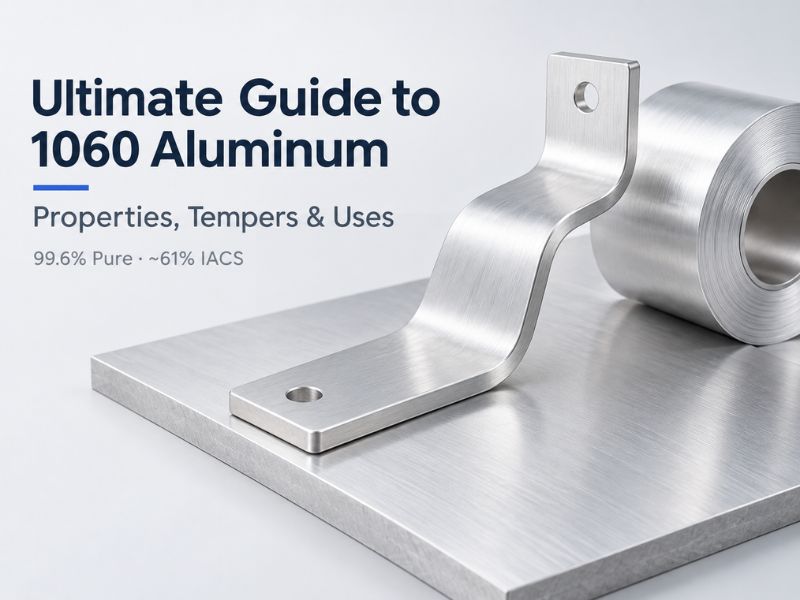
O Que É o Alumínio 1060?
O 1060 pertence à série 1xxx, a família de alumínio comercialmente puro onde o teor de alumínio permanece em ou acima de 99,0%. Com 99,6% mínimo, o 1060 situa-se próximo ao topo dessa faixa — mais puro que o 1100 (99,0%) e um pouco mais puro que o 1050 (99,5%), razão pela qual os três são constantemente comparados.
Como praticamente não há magnésio, silício, cobre ou zinco na mistura, o 1060 não pode ser endurecido por tratamento térmico. Ele obtém a pouca resistência que possui por meio de encruamento — laminando ou trefilando o metal a frio para fixar discordâncias. Esse único fato molda todas as propriedades que se seguem: condutividade excelente, macio e conformável na tempera O, e fraco em comparação com qualquer liga 6xxx ou 7xxx.
Composição do Alumínio 1060
O 1060 é definido quase inteiramente por quanto alumínio contém; os elementos residuais são limitados a teores baixos para proteger a condutividade e a resistência à corrosão.
| Elemento | Peso % |
|---|---|
| Alumínio (Al) | 99,60 mín |
| Silício (Si) | 0,25 máximo |
| Ferro (Fe) | 0,35 máx. |
| Cobre (Cu) | 0,05 máximo |
| Manganês (Mn) | 0,03 máx. |
| Magnésio (Mg) | 0,03 máx. |
| Zinco (Zn) | 0,05 máximo |
| Titânio (Ti) | 0,03 máx. |
| Outros cada | 0,03 máx. |
Os baixos limites de cobre e ferro importam: ambos estão entre as impurezas mais prejudiciais à condutividade elétrica, portanto mantê-los baixos é o que permite ao 1060 atingir seu valor de ~61% IACS.
Propriedades físicas e mecânicas
Além da química, o perfil físico do 1060 é o que faz os engenheiros recorrerem a ele em trabalhos elétricos e térmicos.
| Propriedade | Valor típico |
|---|---|
| Densidade | 2,71 g/cm³ |
| Faixa de fusão | 645–657 °C |
| Condutividade térmica | ~234 W/m·K |
| Condutividade elétrica | ≥ 61% IACS |
| Módulo de elasticidade | ~69 GPa |
| Coeficiente de expansão térmica | 23,6 µm/m·K |
| Refletividade | Alta (visível e infravermelho) |
A resistência mecânica depende fortemente da tempera (ver a próxima seção), mas na condição O macia o 1060 fica em torno de 90 MPa de tração e 70 MPa de escoamento — aproximadamente um quarto do que o 6061-T6 entrega. Trate o 1060 como condutor e conformador, nunca como caminho de carga.
Temperas do 1060: Escolhendo o Estado Encruado Correto
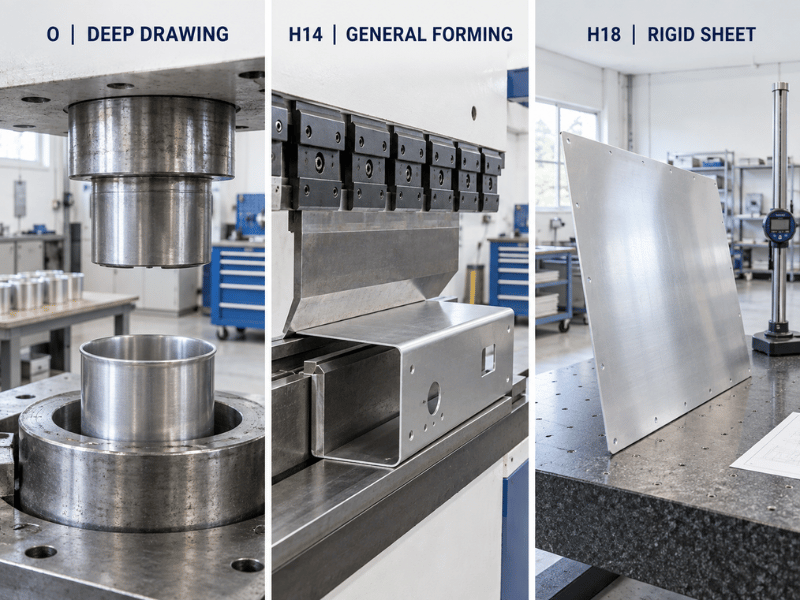
O 1060 não é endurecível por tratamento térmico, então “tempera” aqui significa quanto trabalho a frio foi aplicado. As temperas H1x são apenas encruadas; as temperas H2x são encruadas e depois parcialmente recozidas para melhor ductilidade em uma dada resistência. Cada passo na escala H troca conformabilidade por rigidez.
| Temperamento | Tração (MPa) | Limite de Escoamento (MPa) | Alongamento % | Melhor uso |
|---|---|---|---|---|
| O (recozido) | 90 | 70 | 43 | Estampagem profunda, repuxamento, máxima conformabilidade |
| H12 | 105 | 85 | 25 | Estrutural leve, conformação moderada |
| H14 | 125 | 103 | 20 | Chapa geral, peças levemente conformadas |
| H16 | 145 | 124 | 17 | Painéis rígidos, dobra limitada |
| H18 | 165 | 145 | 15 | Rígido, totalmente duro, conformação mínima |
| H22 | 105 | 62 | 25 | Mesma resistência que H12, mais dúctil |
| H24 | 125 | 82 | 20 | Mesma resistência que H14, mais dúctil |
Para peças que devem ser dobradas ou estampadas após o corte, permaneça em O ou H14 e mantenha o raio de dobra generoso. Para invólucros rígidos ou refletores que não serão mais conformados, o H18 oferece a chapa mais rígida que o 1060 pode proporcionar. As variantes H2x permitem atingir a mesma resistência com mais ductilidade remanescente, o que ajuda quando a peça passa por conformação secundária.
1060 vs 1050 vs 1100 vs 6061
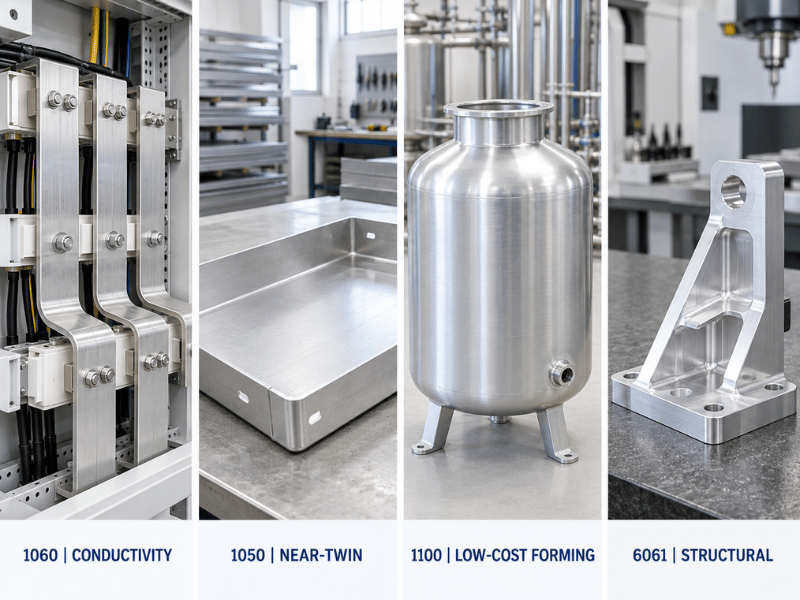
O 1060 raramente é especificado isoladamente — os compradores o avaliam em relação aos seus irmãos quase puros e, às vezes, em relação a uma liga estrutural quando a peça tem funções mistas.
| Grau | Al % | Condutividade | Tração (O/H18) | Tratável termicamente | Notas |
|---|---|---|---|---|---|
| 1060 | 99.6 | ~61% IACS | 90 / 165 MPa | Não | Maior condutividade dos três, ligeiramente mais caro que o 1100 |
| 1050 | 99.5 | ~61% IACS | 90 / 160 MPa | Não | Quase gêmeo do 1060; frequentemente intercambiável em preço |
| 1100 | 99.0 | ~59% IACS | 90 / 165 MPa | Não | Mais barato, ligeiramente menos puro, excelente conformação |
| 6061-T6 | 95–98 | ~40% IACS | 310 / — MPa | Sim | Resistência estrutural; má escolha onde a condutividade predomina |
Escolha 1050 sobre o 1060 apenas quando uma cotação de fornecedor ou disponibilidade de estoque torna a diferença de 0,1% de pureza irrelevante — o desempenho é efetivamente idêntico. Escolha 1100 quando orçamento e conformabilidade superam o último ponto de condutividade. Recorra a 6061-T6 apenas quando a peça deve suportar carga; ele conduz aproximadamente 35% menos bem e custa muito mais para processar.
Onde o Alumínio 1060 É Usado
O conjunto de propriedades do 1060 o direciona para um conjunto claro de aplicações:
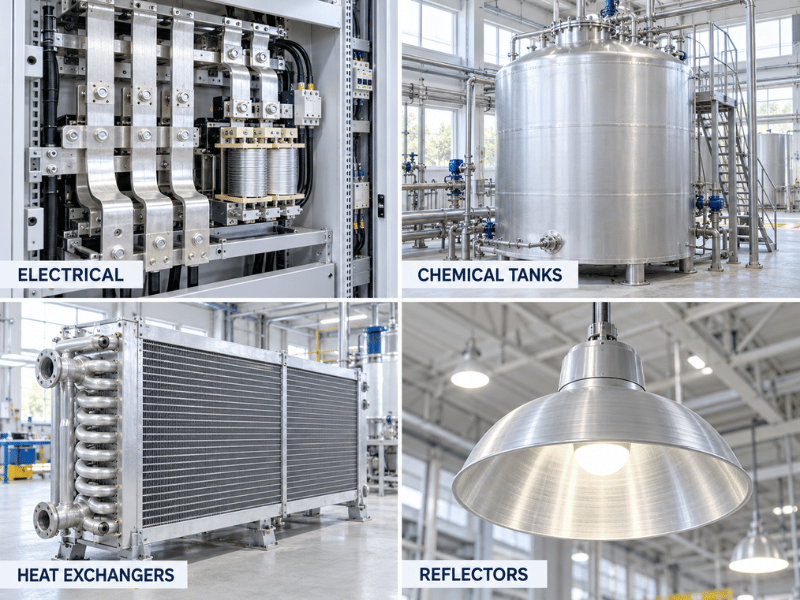
- Barras coletoras e condutores elétricos. A condutividade de ~61% IACS torna o 1060 uma escolha padrão para barras coletoras, enrolamentos de transformadores e interconexões de baterias onde o custo por ampère importa.
- Tanques químicos e alimentícios. A alta pureza resiste a muitos ácidos e soluções alcalinas melhor que ligas alloyadas, então o 1060 reveste tanques, tubulações e cascos de vasos em equipamentos de processo.
- Trocadores de calor e aletas. Alta condutividade térmica aliada à conformabilidade o torna adequado para aletas de radiadores e estoque para condensadores.
- Refletores e iluminação. Sua alta refletividade visível e no infravermelho impulsiona o uso em refletores de lâmpadas e painéis refletivos arquitetônicos.
- Peças estampadas profundamente e torneadas. Utensílios de cozinha, tampas decorativas e invólucros que exigem conformabilidade extrema sem resistência mecânica.
- Sinalização e placas de identificação. Macio, facilmente serigrafado ou estampado em relevo, e resistente às intempéries.
Trabalhando com Alumínio 1060
- Conformação. O 1060 está entre os metais mais fáceis de conformar. No temperamento O, ele é estampado profundamente e torneado com mínimo retorno elástico; até mesmo o H14 dobra-se de forma limpa com um raio amplo. Mantenha as ferramentas polidas para evitar marcar a superfície macia.
- Soldagem. O 1060 solda-se facilmente com TIG ou MIG usando filler 1100 ou 4043. Como não é tratável termicamente, a zona de solda não amolece como uma junta 6xxx — mas o metal base é tão macio que a distorção e o empenamento são o verdadeiro desafio, portanto fixe e prenda bem.
- Usinagem. A usinagem é ruim. O material é pegajoso, agarra a ferramenta e forma aresta postiça; use cortadores afiados, polidos e com alto ângulo de saída, avanço alto e baixa profundidade para mantê-lo controlável. Quando possível, conforme em vez de usinar.
- Anodização e acabamento. O 1060 anodiza-se formando um revestimento fino, duro e cinza translúcido que protege bem, mas parece opaco — não a cor decorativa rica que se obtém do 6063. Para trabalhos de aparência, pinte ou aplique acabamento brilhante. Também aceita adesivos e a maioria dos revestimentos úmidos sem complicações de pré-tratamento.
Alumínio 1060: Indicado ou Não Indicado
| Escolha o 1060 quando… | Evite o 1060 quando… |
|---|---|
| A peça conduz eletricidade ou calor | A peça suporta carga estrutural |
| Você precisa de estampagem profunda ou torneamento | Você precisa de dureza acima de ~165 MPa |
| A resistência à corrosão em serviço químico é importante | Você deseja um acabamento anodizado colorido |
| Orçamento e pureza são ambos importantes | A peça sofre alta tensão cíclica |
Vantagens e Limitações
Pontos fortes. O 1060 oferece a melhor condutividade elétrica e térmica entre os alumínios trabalháveis comuns, conforma-se melhor que quase qualquer outro metal, resiste a ambientes atmosféricos e a muitos ambientes químicos, solda-se sem complicações de tratamento térmico e permanece barato porque não requer elementos de liga nem envelhecimento.
Limitações. É fraco — inutilizável como caminho de carga — não pode ser tratado termicamente para melhorar, usina-se mal e anodiza-se com aparência decorativa opaca. Especifique-o para o que ele faz de melhor, não como substituto estrutural geral.
Conclusão
O 1060 conquista seu lugar onde a condutividade e a conformabilidade decidem a construção, não onde a resistência decide: barras coletoras, tanques químicos, aletas de trocadores de calor e peças estampadas profundamente dependem de sua pureza de 99,6% e índice de ~61% IACS. Escolha o temperamento conforme a quantidade de conformação que a peça ainda necessita — O ou H14 para estampagem, H18 para painéis rígidos — e recorra ao 1050 ou 1100 quando o preço ou o estoque inclinarem a balança, ou ao 6061-T6 quando a peça precisar realmente suportar carga.
A Linsy Aluminum fornece o 1060 em chapas, bobinas e placas com certificados de ensaio de fábrica e inspeção de terceiros (SGS e outros) disponíveis sob solicitação, com suporte de corte, CNC, soldagem e acabamento superficial internos e prazos de entrega de aproximadamente 10–60 dias com baixas quantidades mínimas de pedido. Envie seu desenho ou especificação e confirmaremos a disponibilidade de estoque e temperamento, retornando um orçamento compatível.
Perguntas frequentes
O alumínio 1060 é o mesmo que o 1050?
São quase gêmeos: o 1060 é 99,6% de alumínio, o 1050 é 99,5%, e ambos atingem cerca de 61% de condutividade IACS com resistência e conformabilidade idênticas. Na maioria dos projetos, são intercambiáveis, então a escolha geralmente se resume ao preço e ao que o fornecedor tem em estoque.
O alumínio 1060 pode ser tratado termicamente?
Não. Como liga de pureza comercial da série 1xxx, não possui elementos tratáveis termicamente, portanto o tratamento térmico de solubilização e o envelhecimento não produzem efeito. Toda a resistência vem do trabalho a frio — os temperamentos H12 a H18 — e qualquer aquecimento simplesmente o recozinha de volta à condição O macia.
O 1060 é bom para barras coletoras elétricas?
Sim. Com aproximadamente 61% IACS, é um dos alumínios trabalháveis mais condutivos disponíveis, e seu baixo custo por ampère o torna uma classe padrão para barras coletoras e condutores. Dimensione a seção transversal para sua resistência modesta e você obtém um caminho de corrente confiável e econômico.
Qual temperamento devo escolher para o 1060?
Depende da conformação. Para estampagem profunda ou torneamento, use O ou H14 e mantenha raios de dobra amplos; para painéis rígidos ou refletores que não serão mais conformados, o H18 proporciona a chapa mais rígida. Os temperamentos H2x (H22, H24) oferecem a mesma resistência que seus equivalentes H1x com mais ductilidade remanescente.
O alumínio 1060 pode ser anodizado?
Pode, e forma uma camada protetora fina e dura — mas o resultado é um cinza translúcido opaco, não a cor decorativa rica que se obtém do 6063. Para peças de aparência crítica, pintura ou acabamento mecânico brilhante é o melhor caminho; para proteção contra corrosão, a anodização funciona bem.