What Is 1050 Aluminum?
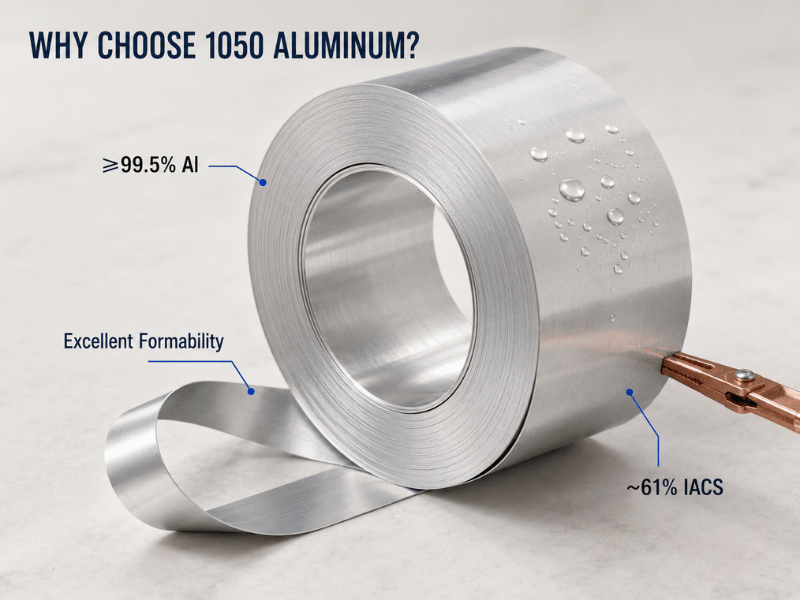
1050 aluminum is a commercially pure wrought alloy in the 1xxx series, with a minimum aluminum content of 99.5%. Because it is almost pure aluminum, it keeps the base metal’s best traits: high ductility, excellent corrosion resistance, and strong electrical and thermal conductivity. AA 1050/UNS A91050 and EN AW-1050A are closely related designations under different systems; the purchase order should state the governing standard because composition limits can differ slightly.
1050 is a non-heat-treatable alloy. It cannot be strengthened by solution heat treatment or aging like a 2xxx or 6xxx alloy; its strength is raised mainly through cold working (strain hardening), expressed through the H-temper family. Once you understand that single fact, the rest of the alloy’s behavior — soft O temper, progressively harder H12/H14/H16/H18 tempers, and the trade-off between strength and formability — falls into place.
Chemical Composition
| Element | Maximum Content (%) | Role |
| Aluminum (Al) | 99.5 (minimum) | Base metal; high purity drives conductivity, formability, corrosion resistance |
| Iron (Fe) | 0.40 | Most abundant impurity; affects strength and surface finish |
| Silicon (Si) | 0.25 | Controlled impurity; minor effect at this level |
| Copper (Cu) | 0.05 | Kept very low to preserve corrosion resistance |
| Manganese (Mn) | 0.05 | Minimal strengthening effect |
| Magnesium (Mg) | 0.05 | Almost no precipitation-hardening effect |
| Zinc (Zn) | 0.05 | Controlled trace element; excessive levels can affect properties |
| Titanium (Ti) | 0.03 | Trace element that may influence grain structure |
| Others (each) | 0.03 | Remaining trace elements |
The composition is deliberately simple. At least 99.5% aluminum keeps the alloy light, soft, formable, and conductive, while iron and silicon — the two impurities present in the largest amounts — influence strength, conductivity, workability, and surface response without turning 1050 into a precipitation-hardening alloy. This high purity is exactly why 1050 bends, draws, and conducts so well, and why it stays non-heat-treatable.
Mechanical and Physical Properties
Properties by Temper
Because 1050 is strain-hardened, strength depends strongly on temper. The table below gives representative ranges, not universal acceptance limits; exact minimums and maximums vary by product form, thickness, orientation, and governing standard. Common references include ASTM B209/B209M for sheet and plate, ASTM B211/B211M for rolled or cold-finished bar, rod, and wire, and, depending on tube form and service, ASTM B210/B210M, B221/B221M, B241/B241M, B483/B483M, or B491/B491M.
| Temper | Tensile Strength (MPa) | Yield Strength (MPa) | Elongation (%) |
| O (annealed) | 60–100 | 20–35 | 35–40 |
| H12 (quarter-hard) | 85–125 | 65–95 | 12–20 |
| H14 (half-hard) | 105–145 | 85–115 | 8–12 |
| H16 (three-quarter-hard) | 120–160 | 100–130 | 6–10 |
| H18 (full-hard) | ≥135 | ≥120 | 2–6 |
As cold work increases from O to H18, tensile and yield strength climb while elongation collapses — H18 reaches near-maximum commercial strength but loses most of its ductility. Hardness follows the same trend (roughly 20 HB in O up to ~70 HB in H18).
Physical Properties
| Property | Value |
| Density | 2.71 g/cm³ |
| Melting point | 646–660 °C |
| Thermal conductivity | 222–230 W/m·K |
| Electrical conductivity | ~61% IACS (annealed) |
| Coefficient of thermal expansion | 23.6 µm/m·K |
| Young’s modulus | 69 GPa |
These values are nearly constant across tempers: cold working changes strength and hardness, not the underlying physical constants. The ~61% IACS conductivity is what makes 1050 a candidate for busbars and light-duty conductors, sitting just below dedicated electrical grades such as 1350.
1050 Aluminum Tempers
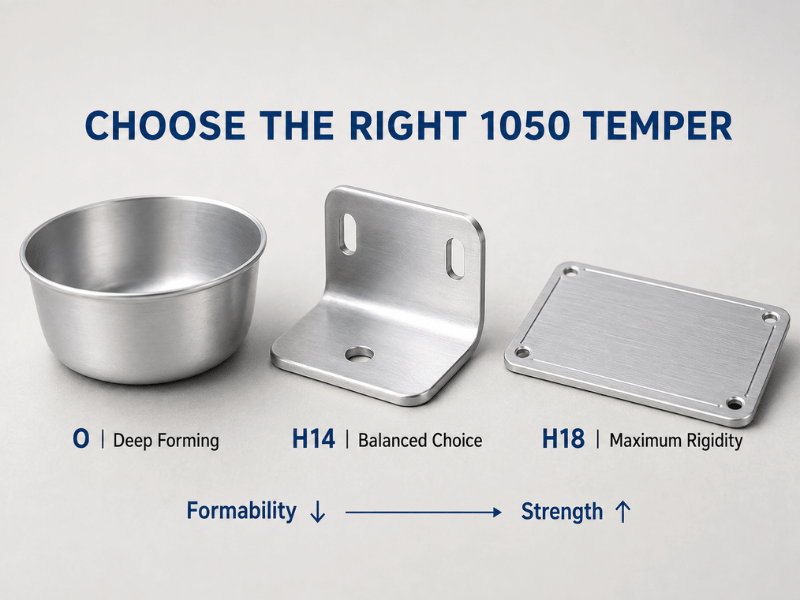
1050 is supplied across the strain-hardened H-temper range plus the fully annealed O condition. Each step trades formability for strength, so temper choice is really a strength-versus-formability decision.
1050-O Aluminum
O is the fully annealed, softest condition. It has the highest ductility and the best conductivity of the family, which is why it is the default choice for deep drawing, spinning, and any part that must be formed into a complex shape before use. Reflectors, lamp housings, and cookware bodies are typically O temper because they need to be formed, not loaded.
1050-H12, H14, H16, and H18 Aluminum
These are progressively strain-hardened tempers. 1050-H12 is quarter-hard and still forms easily; 1050-H14 is the half-hard workhorse used for moderately loaded brackets, nameplates, and bent panels; 1050-H16 is three-quarter-hard for stiffer components; 1050-H18 is full-hard and offers the highest commercial strength for rigid, lightly formed parts such as printing plates and decorative nameplates. Strength rises with each step and formability falls, so pick the hardest temper your forming process can still accept.
How to Choose the Right 1050 Temper
Start from the forming operation. If the part must be deep drawn, spun, or bent to a tight radius, choose 1050-O; harder tempers increase cracking risk and may require a larger bend radius or an intermediate anneal. If you need moderate strength with retained bendability, choose 1050-H14, the most common intermediate temper. Choose 1050-H18 only when the part is nearly flat or simply shaped and you want maximum rigidity. Remember that welding any H-temper part anneals the heat-affected zone back toward O, so design around the lower strength of the softened heat-affected zone.
Where 1050 Aluminum Is Used
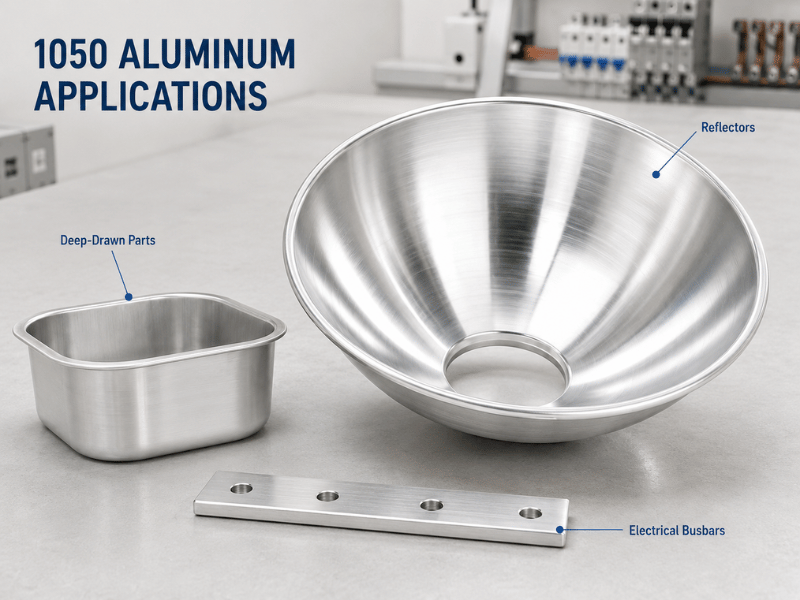
1050 fits applications where formability and corrosion resistance matter more than strength. Its corrosion resistance suits many food-industry containers and chemical-process components, although suitability depends on the media, temperature, surface condition, and applicable food-contact or process regulations. In general sheet-metal work it forms easily into architectural flashings, heat-exchanger fins, and reflective lighting panels. Its conductivity places it in busbars and light electrical conductors, while its bright, reflective surface makes it a standard for lamp reflectors and decorative nameplates.
1050 vs. 1060, 1100, and 3003
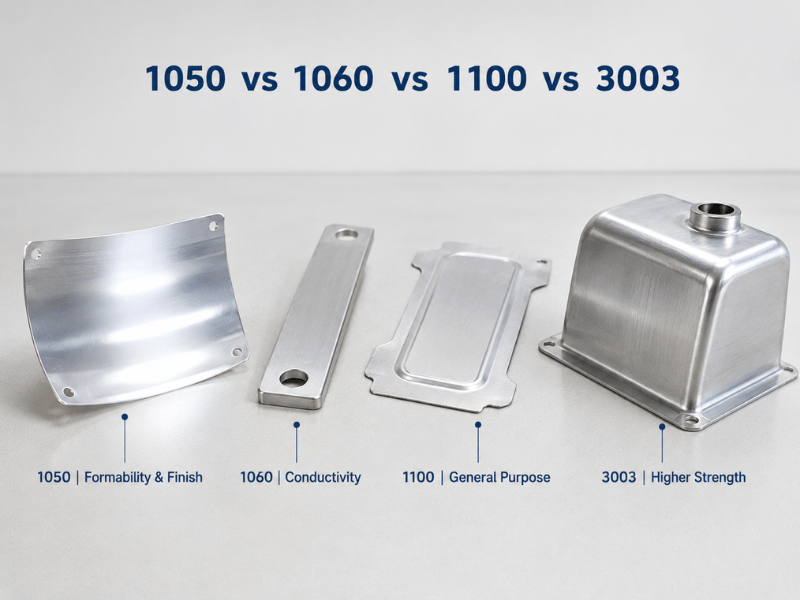
| Feature | 1050 | 1060 | 1100 | 3003 |
| Aluminum content | 99.5% min | 99.6% min | 99.0% min; controlled Cu | Al balance; typically 1.0–1.5% Mn |
| Strength (O, MPa) | ~75 | ~70 | ~90 | ~110 |
| Corrosion resistance | Excellent | Excellent | Excellent | Very good |
| Electrical conductivity | ~61% IACS | 61–62% IACS | 59–62% IACS | 40–50% IACS |
| Formability | Excellent | Excellent | Excellent | Good (a bit stiffer) |
| Typical use | Reflectors, pans, wire | Wires, light parts | Foil, wires | Cookware, tanks |
1050 and 1060 are nearly pure and both conduct well, so they suit soft electrical and forming jobs. 1100 contains controlled copper for slightly more strength while keeping good conductivity, favoring foil and wire. 3003 trades conductivity for manganese-driven strength, fitting sturdier cookware and tanks. The comparison values in the table are representative and vary with temper, product form, and standard. Choose 1050 when maximum formability, surface finish, and clear anodizing matter; step up to 3003 when the part needs greater strength.
Working With 1050 Aluminum
Formability
Formability is the headline trait. 1050 deep draws, spins, and bends to very tight radii without cracking, which is why it dominates reflectors, cookware, and architectural flashing. Softer tempers form best; harder tempers need wider bend radii.
Welding
1050 welds exceptionally well by MIG and TIG. ER1100 or another qualified filler may be selected according to joint design and service requirements, and heat input should be controlled to protect the surrounding material. The critical caveat: the heat-affected zone loses strength gained from cold working and anneals back toward the O condition. Design around the lower strength of the softened heat-affected zone.
Machining
Machinability is poor, especially in the soft O temper. The material is gummy and tends to build up on the cutting tool (built-up edge). Use very sharp tools with high positive rake, high cutting speeds with light feed, and good lubrication. Harder tempers such as H14 machine noticeably better than O.
Anodizing
1050 anodizes cleanly into a clear, transparent Type II oxide layer that can improve corrosion resistance without substantially changing appearance, making it useful for functional and architectural finishes. Colored appearance depends on surface condition, bath chemistry, dye system, and process control, so cosmetic requirements should be confirmed with a sample. It may not be the best choice when a uniform opaque appearance like some 6xxx finishes is required.
Pros and Limitations of 1050 Aluminum
Strengths
• Excellent formability for deep drawing, spinning, and tight-radius bending
• Outstanding corrosion resistance in outdoor and moist environments
• High thermal and electrical conductivity (~61% IACS)
• Superior clear-anodizing response
• Widely recyclable; food-contact use requires compliance with applicable regulations
Limitations
• Low strength — generally unsuitable for primary load-bearing structural parts
• Non-heat-treatable; strength is raised mainly through cold working
• Poor machinability, especially in O temper
• Colored anodizing appearance requires process control and sample approval
• Welded zones soften back toward O temper
Conclusion
1050 is the right call when a part must be formed, conduct, or resist corrosion more than it must carry load — but its low strength and poor machinability make it generally unsuitable for primary load-bearing structural duty. For a reliable commercially pure grade, Linsy supplies 1050 in wire, coil, and plate forms, with CNC machining, TIG/MIG welding, laser cutting, and surface finishing available, plus an MTC per order and ISO 9001/14001/45001 certification; SGS or other third-party testing can be arranged on request. Send your drawing or specification to Linsy Aluminum for a stock check and quote.
Frequently Asked Questions
Can 1050 aluminum be heat-treated to increase strength?
No. 1050 is non-heat-treatable — it cannot be solution heat treated or aged like 2xxx or 6xxx alloys. Strength is raised mainly through cold working, so pick a harder H-temper (H14, H16, H18) if you need more load capacity.
What is the difference between 1050-O and 1050-H14?
O is fully annealed: softest, most ductile, best for deep drawing and spinning. H14 is half-hard: roughly 105–145 MPa tensile versus 60–100 MPa for O, with much lower elongation. Choose O when you must form the part; choose H14 when you need moderate strength after forming.
Is 1050 aluminum easy to weld?
Yes. It welds well by MIG and TIG. ER1100 or another qualified filler may be selected according to joint design and service requirements. The heat-affected zone anneals back toward the soft O condition, so account for local softening in any welded assembly.
How does 1050 differ from 1350 aluminum?
1350 is tuned for electrical conductors with marginally higher conductivity, while 1050 favors formability and corrosion resistance with a clear anodizing finish. Use 1350 for conductors and 1050 where shaping and surface appearance matter.
Why choose 1050 over 1060 or 1100?
1050 and 1060 are both near-pure and conduct well; 1050’s slightly lower purity still gives excellent formability and a clear anodized finish. 1100 contains controlled copper for more strength but slightly less conductivity. Pick 1050 when formability, finish, and corrosion resistance lead the spec.