3105 is the grade a buyer reaches for when 3003 is not quite strong enough and 5052 costs more than the job can carry. It is a 3xxx alloy with magnesium added, and it earns its place almost entirely in painted and coated coil: roofing, wall cladding, gutters, ducting.
The decision is narrow, which is why it gets specified wrongly. This guide covers what the chemistry actually does, how the temper ladder works and where each step stops, how it behaves under a brake press and an arc, and which alloy to move to when 3105 runs out of road.
What 3105 Aluminum Is
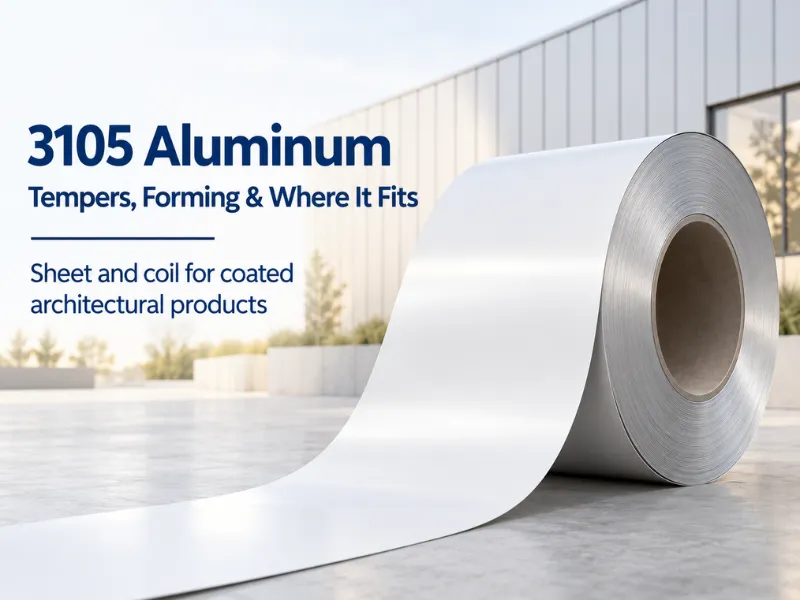
3105 is a non-heat-treatable aluminum-manganese-magnesium alloy, registered as AA 3105 / UNS A93105 and as EN AW-3105 (AlMn0.5Mg0.5). Sheet and plate are covered by ASTM B209; drawn tube by ASTM B210; bar, rod and wire by ASTM B211; extruded forms by ASTM B221.
Its commercial role is specific: it is the substrate behind color-coated architectural sheet. The magnesium addition lifts strength above 3003 while keeping the forming behavior and atmospheric corrosion resistance that make the 3xxx family the default for building products.
Strength comes from cold work, not from heat treatment. There is no solution-treat-and-age route for this alloy, and no T-temper exists. If a drawing calls 3105-T6, the drawing is wrong.
Chemical Composition of 3105
The limits below are the registered values under ASTM B209 and EN 573-3.
| Element | Weight % |
|---|---|
| Silicon (Si) | 0.60 max |
| Iron (Fe) | 0.70 max |
| Copper (Cu) | 0.30 max |
| Manganese (Mn) | 0.30 – 0.80 |
| Magnesium (Mg) | 0.20 – 0.80 |
| Chromium (Cr) | 0.20 max |
| Zinc (Zn) | 0.40 max |
| Titanium (Ti) | 0.10 max |
| Others, each / total | 0.05 / 0.15 |
| Aluminum (Al) | Remainder |
Three rows carry the whole grade. Magnesium at 0.20–0.80% is the addition 3003 does not have, and it is the reason 3105 sits above 3003 on strength.
Manganese is the row buyers get wrong. 3105 carries 0.30–0.80% Mn, well below the 1.0–1.5% in 3003 — so 3105 is not 3003 with magnesium stirred in. It is a lower-manganese base with magnesium added, and the net effect is a modest strength gain rather than a large one.
Chromium is capped at 0.20%, not added as a strengthening element; it refines the cast grain structure. Copper is a residual ceiling that protects corrosion performance, and it stays a trace element here.
Mechanical Properties by Temper
The H temper system tells you what was done to the metal. H1x is strain hardened only; H2x is strain hardened and then partially annealed; H3x is strain hardened and stabilized. 3105 sheet runs O, H12, H14, H16, H18, H22, H24, H26 and H28, with H112 for hot-worked plate.
| Temper | Condition | Basis | Tensile Rm (MPa) | Proof Rp0.2 min (MPa) | Elongation A50 min | Chosen for |
|---|---|---|---|---|---|---|
| O | Annealed | ASTM B209 minimum | 97 – 145 | 35 | 16 – 20% | Deep drawing, spinning, flashings |
| H12 | Quarter hard | ASTM B209 minimum | 131 – 179 | 103 | 1 – 3% | Light forming, general sheet |
| H14 | Half hard | ASTM B209 minimum | 152 – 200 | 124 | 1 – 2% | Panels, roll-formed profiles |
| H18 | Full hard | Typical mill value | 195 and above | ≈180 | 1% or less | Flat panels, cut lengths, stiffness |
The Basis column is the part to read: the first three rows are ASTM B209 minimums, while the H18 line is a typical mill figure and should not go into a purchase specification as a guaranteed minimum. ASTM B209 tabulates those minimums by gauge, so a 0.5 mm and a 3.0 mm sheet of the same temper do not carry the same line.
Two consequences matter at goods-in. First, the tensile bands overlap between neighboring tempers: O at 97–145 MPa and H12 at 131–179 MPa share a 14 MPa window, and H12 and H14 overlap as well, so temper is confirmed on proof strength rather than tensile. Second, H18 carries the highest proof minimum of the standard sheet tempers, with H28 at the same tensile level and more ductility; a quotation offering H19 sits outside the registered ladder, so ask which standard the figure came from.
H24 and H26 are the partially annealed versions. At the same tensile band, H24 carries a lower proof minimum than H14, which is exactly what a roll-former wants: enough stiffness to handle the coil and enough ductility to survive a tight profile without cracking. H26 pushes strength back up for long roof pans and high wind loads.
Forming 3105: Where the Bend Radius Runs Out
O temper takes the tightest radii and the deepest draws, and it is the condition for spun or hand-formed flashings. H12 and H22 form lightly without much springback correction.
H14 and H24 are the general production tempers. Typical mill practice for 0.5–1.5 mm sheet is an inside radius of about 2.5t for H14 and H24, and close to zero radius in O. That is a starting point, not a guarantee — tooling condition, edge quality and bend direction all move the limit.
H16 and H18 are minimum-forming tempers. Longitudinal seams, hems and tight ridges will crack in H18, and slitting burr becomes a crack starter on any hard temper, so specify edge condition when the part is formed after slitting.
Two rules avoid most forming failures. Bend across the rolling direction where the geometry allows, because ductility is higher across the grain than along it. And if the part needs both full strength and a tight bend, the answer is a softer temper plus thickness, not a harder temper — there is no heat treatment to relax the bend afterward.
Corrosion Resistance and Finishing
3105 resists general atmospheric corrosion well enough for unpainted exterior service, and it does so without cladding or coating. The low copper content is what keeps it that way: copper is the element that turns a 3xxx alloy into a corrosion problem, and here it is held at a residual level.
It is not rated for immersion, splash-zone or permanent-wet service, and a coating does not change what the alloy can do in those conditions.
Most 3105 never sees service bare. It is sold as coil for painting, and the coating system — PE, SMP or PVDF — plus the pretreatment line does more for service life than the alloy choice does. What the alloy contributes is a surface that takes conversion coating evenly and a temper that survives the forming the coated coil will go through.
Anodizing is where buyers get caught. 3105 will anodize, but the manganese produces a darker, greyer coating that is less uniform than on a 6xxx alloy. On a visible face that difference shows as color variation across a batch, which makes anodizing on 3105 a protective step rather than a decorative one.
Welding 3105
3105 welds with the standard aluminum processes: GTAW (TIG), GMAW (MIG) and resistance welding all work, and thin-gauge duct and gutter work is usually TIG or resistance seam rather than MIG.
Filler selection follows AWS A5.10. ER4043 is the common choice for 3xxx sheet; ER5356 is used where more weld strength or a closer color after anodizing is wanted. Whichever is used, qualify the procedure on the alloy and temper actually being welded.
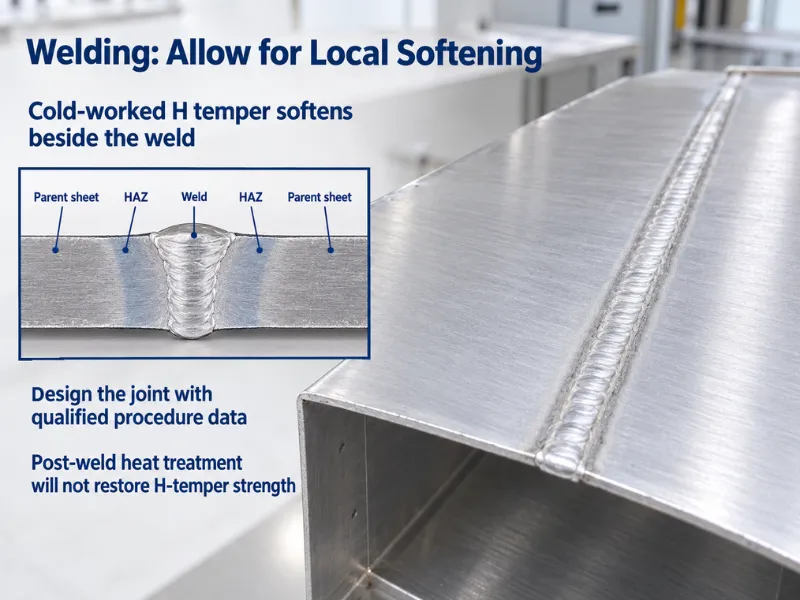
The heat-affected zone is the design issue. Fusion welding anneals the cold-worked metal beside the weld, so local properties fall back toward the O-temper band — 97–145 MPa tensile with a 35 MPa proof minimum, against 152–200 MPa and 124 MPa in the parent H14 sheet. Size the joint on the annealed values, not on the parent temper.
There is no recovery route. 3105 is non-heat-treatable, so post-weld heat treatment cannot restore the cold work that was lost; only re-rolling would, and that is not an option on a finished part.
3105 vs 3003, 5052, 1100 and 3005
| Alloy | Alloying axis | Reference temper | Tensile min (MPa) | Proof min (MPa) | Where it wins |
|---|---|---|---|---|---|
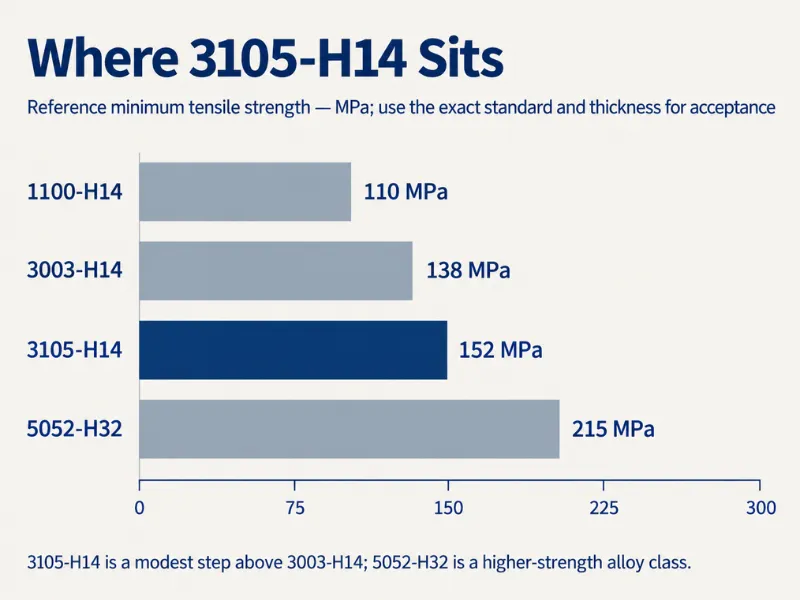
| 1100 | Commercially pure | H14 | 110 | 97 | Formability, conductivity, cost |
| 3003 | Mn 1.0–1.5, no Mg | H14 | 138 | 117 | Deep forming, availability, price |
| 3105 | Mn 0.30–0.80, Mg 0.20–0.80 | H14 | 152 | 124 | Coated architectural sheet |
| 3005 | Mn 1.0–1.5, Mg 0.20–0.60 | H14 | — | — | Siding stock with a higher Mn base |
| 5052 | Mg 2.2–2.8 | H32 | 215 | 160 | Marine service, higher loads |
Against 3003, the gain at H14 minimums is 14 MPa tensile and 7 MPa proof — about 10% and 6%. That is a real gain in thin gauge, where stiffness and dent resistance are bought with a fraction of a millimeter, and it is not enough to rescue a design that is short on strength by a wide margin.
Against 5052-H32, the gap runs the other way: 215 MPa tensile and 160 MPa proof, roughly 41% and 29% above 3105-H14 minimums. That is a different alloy class rather than a harder temper of the same one.
Against 1100, 3105-H14 is about 38% stronger at minimum, which is why 3105 is the substrate of choice for siding and signage backers.
3005 is the neighboring grade that catches buyers out. It keeps 3003’s high manganese and adds a little magnesium, which makes it a different alloy rather than a variant of 3105. If a specification names 3005, check the strength line the drawing calls for instead of assuming 3105 covers it at the same gauge.
Go / No-Go: Is 3105 Right for the Part?
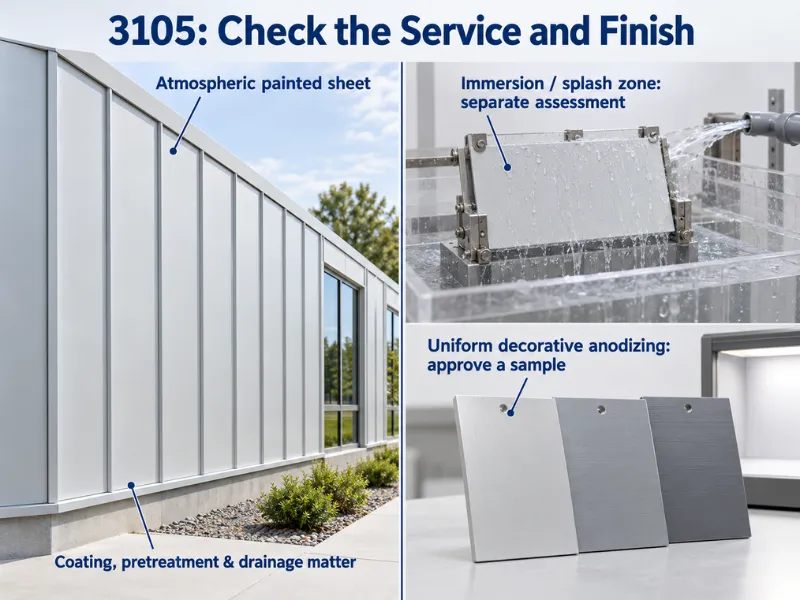
These are the conditions to check before the grade goes on the order.
Use 3105 when:
- The production route is coil-fed roll forming or stamping of roofing, cladding, gutter or duct components
- 3003 has failed a strength, dent-resistance or wind-load check, and 5052 is more alloy than the job needs
- Service is atmospheric, with no immersion, splash zone or chemical exposure
- The finish is paint or coil coating, and the substrate only has to take pretreatment evenly
- A welded assembly is involved and the joint can be sized on annealed values
Do not use 3105 when:
- Service includes permanent immersion, heavy chloride or chemical exposure — move to 5052 or 5083
- A visible anodized finish is specified — 5005 or 6063 gives the uniform coating 3105 cannot
- More than about 200 MPa tensile is required in the delivered condition — 5052-H32 or 6061-T6
- The design depends on parent-metal strength surviving a weld — no cold-worked 3xxx will do that
- Any heat treatment step is planned to raise strength — 3105 does not respond to it
Where 3105 Is Used
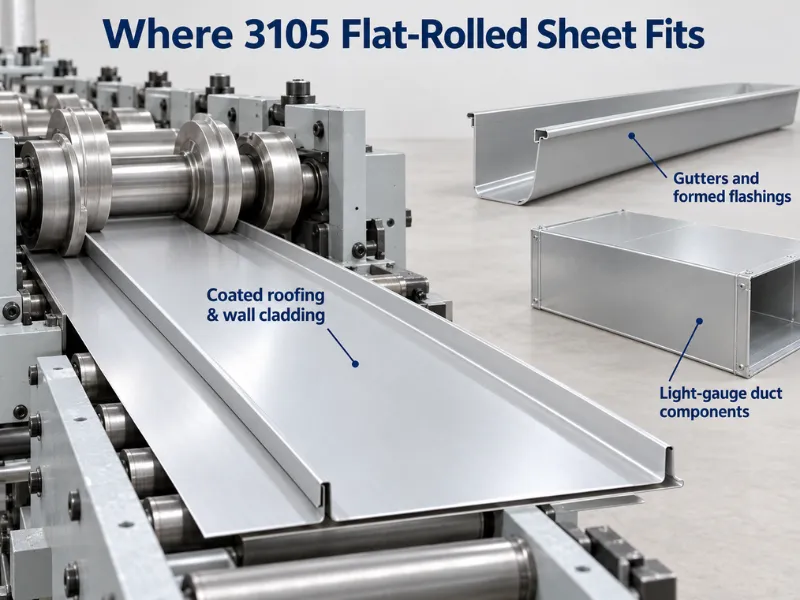
- Roofing and wall cladding — standing seam, corrugated and ribbed panels, coated or mill finish
- Rainware — gutters, downspouts, fascia and formed flashings
- Residential siding and transportable-building skins
- HVAC duct, plenum and fittings in light gauge
- Signage blanks and backing panels
- Appliance and lighting housings where a painted finish is the end use
Conclusion
3105 is a narrow, purpose-built grade: about 10% stronger than 3003, roughly 30% below 5052-H32 in tensile minimum, and useful precisely because it sits in that gap without giving up 3xxx forming behavior. Its limits are equally clear — no heat treatment, no marine service, and no uniform anodized finish.
We supply 3105 sheet and coil in O through H28, plate in O, H12–H18 and H112, sized to your drawing, and any temper the market produces we can roll to order, with an MTC on every order.
Send the gauge, temper and coil width, and we will confirm the temper against stock before you commit.
Frequently Asked Questions
Can 3105 replace 3003 without changing the drawing?
Usually yes, with three checks first:
- Temper — 3105 runs about 10% stronger at the same temper, so re-check any tight forming radius.
- Welding — requalify the procedure rather than extending the 3003 one.
- Gauge — if 3003 was sized on a strength minimum, 3105 may allow a lighter gauge, which changes the drawing.
Which temper should I order for roll-formed roofing?
Order H24 for most roll-formed roofing and cladding, or H26 where wind load and pan length demand more strength. H14 also roll-forms, but its higher proof strength leaves less ductility through a tight profile. Anything harder than H26 is a flat-panel temper, not a forming one.
Can 3105 be anodized to a clean architectural finish?
No. 3105 anodizes to a darker, less uniform grey than a 6xxx alloy because of its manganese content, so it is a poor choice for a visible anodized face. Specify 5005 or 6063 for anodized trim, or keep 3105 and paint it instead.
What is the minimum order for 3105 coil?
We run low-MOQ custom production on 3105 in non-stock gauges, widths and tempers, with typical lead times of 10–60 days. Stock sizes move faster. Send the temper, gauge, width and coil weight and we will confirm both the quantity and the lead time for that specification.