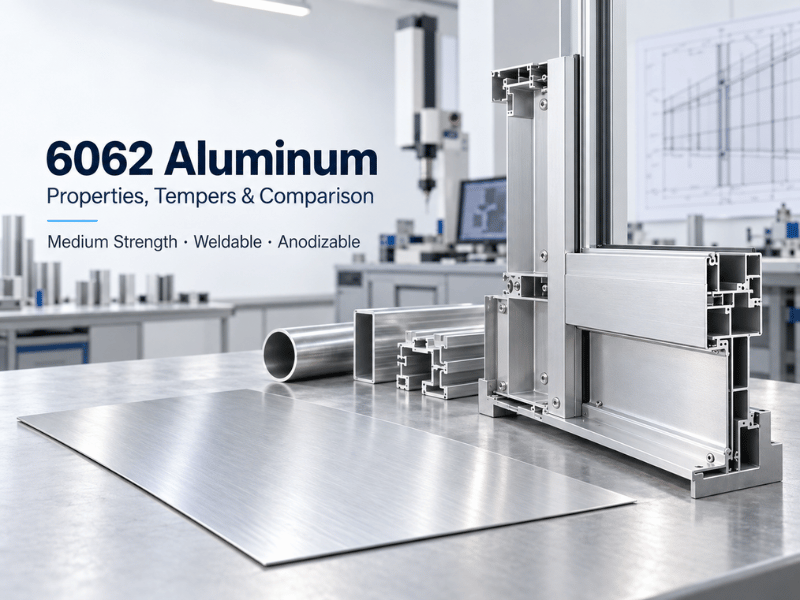
6062 is a 6xxx-series, heat-treatable aluminum built on the aluminum–magnesium–silicon system with a small intentional copper addition. Its chemistry sits almost on top of 6061’s, which is the single most useful thing a buyer can know about it: 6062 is best understood as a 6061-near grade, not a stronger or more exotic one. The decision this guide handles is whether to specify 6062 at all, or to use the far better documented 6061 (or the better-finishing 6063) instead.
That decision matters because the numbers are not where a buyer would expect them. 6062 is a registered designation — AA 6062, UNS A96062 — and its composition sits close enough to 6061’s that the two behave alike in service, so 6062 is normally quoted on a 6061 basis instead of from a table of its own. In practice, what separates the two grades is documentation rather than performance — and that is the part worth getting right before you order.
What Is 6062 Aluminum?
6062 is a wrought, heat-treatable alloy in the Al-Mg-Si-Cu family. Magnesium and silicon combine during artificial aging to form Mg₂Si precipitates, which is where the strength comes from — not from cold work — so the alloy stays weldable and formable in a way that strain-hardened 5xxx grades are not. The copper addition contributes additional precipitation hardening, and chromium is present to control grain structure through heat treatment.
The consequence of that chemistry is a middle-of-the-road property set. 6062 is a medium-strength alloy, not a high-strength one: it will not approach 7075, and there is no published basis for treating it as stronger than 6061. The Chinese national standard that covers it, GB/T 3618-1989, describes 6062 in exactly those terms — an Al-Mg-Si alloy with good corrosion resistance, good weldability, fair cold-workability and medium strength, used chiefly in building. Its practical appeal is not peak numbers but how it behaves through extrusion, machining, anodizing and welding, which is why it turns up in architectural and general structural work rather than in airframes.
6062 Aluminum Composition
The limits below are the AA/GB figures that the authoritative sources agree on. One element is genuinely contested, and it is flagged rather than smoothed over.
| Element | Weight % |
|---|---|
| Aluminum (Al) | Remainder |
| Silicon (Si) | 0.40–0.80 |
| Iron (Fe) | 0.70 max |
| Copper (Cu) | 0.15–0.40 |
| Manganese (Mn) | 0.15 max |
| Magnesium (Mg) | 0.80–1.20 |
| Chromium (Cr) | 0.04–0.14 per AA Teal Sheets (2025); 0.04–0.35 per GB/T 3618-1989 and most commercial datasheets |
| Zinc (Zn) | 0.25 max |
| Titanium (Ti) | 0.15 max |
| Others, each | 0.05 max |
| Others, total | 0.15 max |
Two things are worth pulling out. First, manganese is capped at 0.15 — it is not a 0.15–0.40 range, which is a common error in circulating datasheets. Second, the chromium ceiling differs between the current AA registration (0.14) and the older Chinese standard and much of the commercial literature (0.35). Chromium affects grain structure and recrystallization behaviour during heat treatment, so if your process depends on it, name the governing standard in the purchase order rather than leaving the alloy designation to carry it.
How 6062 Differs from 6061
This is the comparison that decides most 6062 purchases, and the honest answer is: barely, on paper.
| Element | 6062 | 6061 |
|---|---|---|
| Silicon (Si) | 0.40–0.80 | 0.40–0.80 |
| Iron (Fe) | 0.70 max | 0.70 max |
| Copper (Cu) | 0.15–0.40 | 0.15–0.40 |
| Manganese (Mn) | 0.15 max | 0.15 max |
| Magnesium (Mg) | 0.80–1.20 | 0.80–1.20 |
| Chromium (Cr) | 0.04–0.14 (AA) / 0.04–0.35 (GB) | 0.04–0.35 |
| Zinc (Zn) | 0.25 max | 0.25 max |
| Titanium (Ti) | 0.15 max | 0.15 max |
Every limit matches element for element; the only real difference is the chromium ceiling once you adopt the current AA registration. That is why 6062 behaves like 6061 in the workshop, why it heat-treats like 6061, and — as the next section explains — why so much published 6062 data is really 6061 data.
The practical implication is reassuring rather than disappointing. If you have a part that currently runs in 6061 and you are offered 6062, you are not stepping into unknown metallurgy. You are stepping into the same alloy system with a tighter chromium window and a much thinner paper trail, which is a documentation problem more than an engineering one.
6062 Tempers: O, T4, T6 and T651
6062 is supplied in the standard heat-treatable set. Temper does more to the finished part than the choice between 6062 and 6061 does, so specify both on the order line.
| Temper | Treatment | What it gives you | Typical use |
|---|---|---|---|
| O | Annealed | Softest condition, maximum ductility | Heavy forming, then heat treat |
| T4 | Solution heat treated and naturally aged | Moderate strength, high formability, stable before final aging | Form-first parts, bent or drawn sections |
| T6 | Solution heat treated and artificially aged | Peak practical strength | Structural parts, machined components |
| T651 | T6 plus stretching to relieve residual stress | T6 strength with better dimensional stability after machining | Precision machined parts, thick plate |
T6511 appears on extruded bar and profiles and carries the same idea as T651 — stress relief by stretching — applied to extrusion.
Two corrections are worth making explicitly, because both circulate in 6062 content online. T4 is naturally aged, not artificially aged; the artificial aging step is what separates T6 from T4. And there is no T73 temper for 6062. T73 is an overaging treatment applied to some 7xxx alloys to trade strength for stress-corrosion resistance; it has no meaning on a 6xxx grade.
6062 Mechanical and Physical Properties
The physical constants below come from the AA registration data. The mechanical line deliberately does not carry a number, and the next section explains why.
| Property | Value | Basis |
|---|---|---|
| Density | ≈2.70 g/cm³ | Typical for 6xxx Al-Mg-Si; not a specification value |
| Elastic modulus | ≈69 GPa | AA figure; average of tension and compression. Compression runs about 2% higher — not a temper-dependent range |
| Electrical resistivity | 0.0338–0.0383 Ω·mm²/m | AA Teal Sheets (2025) |
| Electrical conductivity | ≈45–51% IACS | Converted from the AA resistivity range |
| Thermal conductivity | 172–180 W/(m·K) | AA Teal Sheets (2025) |
| Solidus | ≈582 °C | Commonly cited for 6xxx Al-Mg-Si; verify against the MTC before heat treatment |
| Mechanical properties | No widely published minimum | See below |
Elastic modulus is the one number here you can treat as fixed for design purposes: like every aluminum alloy, 6062 sits near 69 GPa, so stiffness is a section-design problem rather than an alloy-selection problem.
Why 6062 Property Data Varies — and How to Verify What You Buy
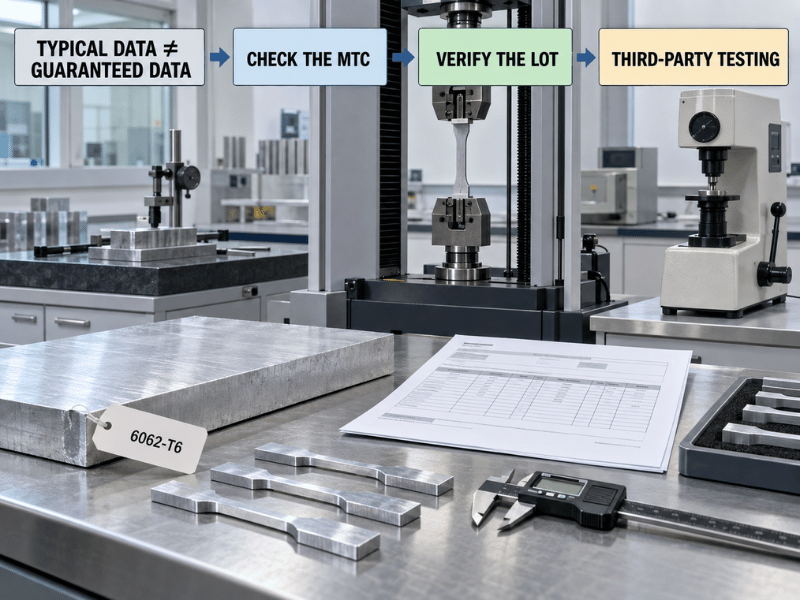
Search for 6062 mechanical properties and you will find tensile figures anywhere from 270 to 390 MPa. Those numbers are not independent measurements of 6062; most of them are 6061 values relabelled, and some supplier datasheets say so in writing. On our own 6062 product page, the property table states outright that the values listed are typical 6061 figures.
That is not deception so much as a consequence of how the designation is used. 6062 is registered, but it is not a grade buyers will find tabulated with minimum mechanical properties in the common ASTM product specifications the way 6061 and 6063 are, so there is no authoritative table to copy — and suppliers fill the gap with the nearest equivalent.
What this means in practice:
- Expect a 6061-based quotation. A 6062-T6 quote will usually cite roughly 310 MPa ultimate, 276 MPa yield and about 12% elongation, because those are the standard 6061-T6 figures. Treat that as the commercial basis of the quote, not as a standard-backed guarantee.
- Make the MTC the governing document. The mill test certificate for your actual lot is the only number you can design against or reject against. Require it with every order.
- Name the standard, not just the alloy. “6062-T6” alone does not tell the mill which composition or property regime applies. Specify the governing standard, product form, dimensions and temper together.
- Ask for independent testing where it matters. For structural or load-bearing work, request a third-party mechanical properties report rather than relying on typical values.
None of this makes 6062 a poor choice. It makes it a choice where the paperwork deserves more attention than usual — which is worth knowing before you commit, not after.
Where 6062 Aluminum Is Used
Building and architectural sections
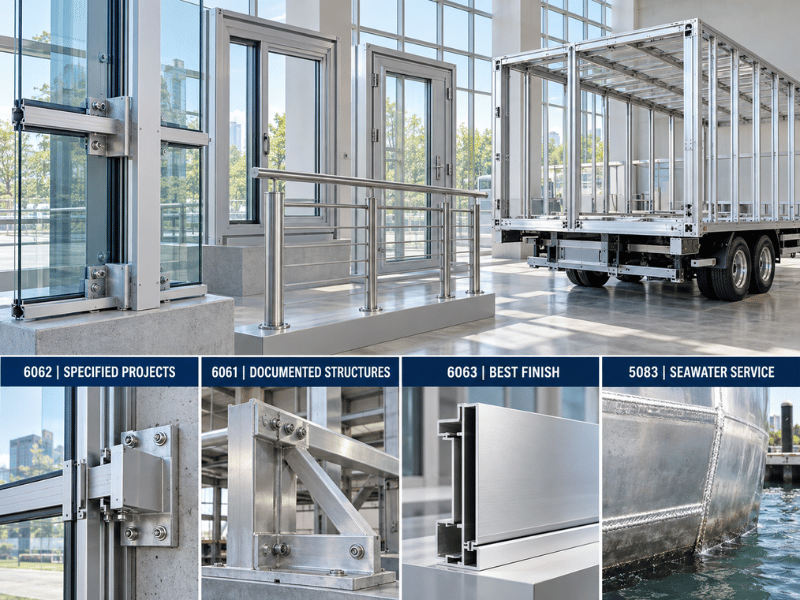
This is the application the Chinese national standard points to directly, and it is where 6062 earns its place. Medium strength is adequate for curtain wall supports, window and door frames, railings, trim and decorative structural sections, and the alloy’s response to anodizing is consistent enough for visible work. Where appearance is the primary requirement and load is low, 6063 is still the more forgiving choice — it extrudes more easily and finishes more cleanly.
General structural frames and transport bodies
6062 appears in structural frames, pipework, and truck and trailer bodies, where the load case is real but not extreme and where weldability matters more than peak strength. This is the same territory 6061 occupies, and the two are frequently interchangeable here. Where the section must carry a heavier load or is machined to tight tolerances, 6061-T6 is the safer specification simply because its properties are documented.
Light marine-adjacent fittings
6062 is used for boat fittings and other marine hardware, but the boundary is important: it is a 6xxx alloy with intentional copper, and copper reduces corrosion resistance in chloride service. Splash-zone and above-deck fittings are reasonable; permanently immersed hull structure is not. For continuous seawater contact, a 5xxx alloy such as 5083 is the correct call.
6062 vs 6061 vs 6063 — How to Choose
| Factor | 6062 | 6061 | 6063 |
|---|---|---|---|
| Chemistry | 6061-near; tighter Cr under AA | The 6xxx structural benchmark | Lower Mg and Si, Cu ≤0.10 |
| Strength | Medium; treat 6061 values as the quote basis | Documented and higher confidence | Lower; adequate for non-structural |
| Extrudability | Good | Good, but higher flow stress | Best of the three |
| Anodized finish | Good, consistent | Good, copper slightly dulls the finish | Best of the three |
| Corrosion resistance | Good in atmosphere | Good; copper slightly reduces it | Better than both, thanks to low copper |
| Documentation | Thin; verify on the MTC | Extensive | Extensive |
| Availability | Narrower; often a custom or project item | Broad stock across forms | Broad stock in profiles |
Choose 6062 when you are matching an existing specification that names it, or when a supplier is offering it on a project where the requirements are set by the drawing rather than by your own material selection.
Choose 6061 when you are designing from scratch and need properties you can defend — strength, fatigue or machined dimensional stability. The wider documentation alone is usually worth it, and 6061-T6 covers the same ground with better data behind it.
Choose 6063 when the part is a visible extrusion and appearance drives acceptance: window and door systems, curtain wall, railings and trim.
Consider 6082 or 6005 for European projects or structural extrusions respectively — 6082 is the common European structural grade, and 6005 sits between 6063 and 6061 for extruded structural sections.
When to Specify 6062 — and When Not To
| Go with 6062 | Stop and reconsider |
|---|---|
| A drawing or contract names 6062 | You are selecting the alloy yourself and need documented properties |
| Medium strength is genuinely sufficient | The part is load-critical and allowable stress must be justified |
| The part is architectural, visible or anodized | The part is a permanently immersed marine structure |
| You can require an MTC with the order | You cannot get mechanical test data for the lot |
| Supply is confirmed for the form and temper you need | Lead time or availability is tight — 6061 is easier to source |
The pattern here is simple: 6062 is a fine material to fulfill a specification, and a weak one to originate one. If you are writing the spec, 6061 will usually serve you better.
Working With 6062
Machining. 6062 machines like the 6061-near alloy it is, cutting cleanly and holding tolerance in T6 and T651. For parts that are heavily machined or must stay flat after material removal, order T651 rather than T6 — the stretching step relieves the residual stress that otherwise shows up as movement once you start cutting.
Welding. TIG and MIG both work. Use 4043 filler where crack resistance and a clean bead matter most, or 5356 where higher as-welded strength and a better colour match after anodizing are priorities. The heat-affected zone is the constraint: welding pulls the aged temper back down toward the T4 range locally, so a welded assembly cannot be designed on the T6 base-metal allowables. Either design to post-weld values or plan a full re-heat treatment after welding.
Corrosion protection. Atmospheric and mild industrial service are fine, and anodizing or powder coating raises the margin further. Two limits apply: the copper content makes 6062 less resistant than the copper-free 6xxx and 5xxx grades in chloride environments, and it should not be specified for continuous immersion in seawater. Where the part sits near 5xxx material or dissimilar metals, isolate the joint.
Forming. O and T4 are the tempers to form in. T6 will bend, but with a noticeably larger minimum radius and a higher risk of edge cracking. Where the geometry is tight, form in T4 or O and artificially age to T6 afterwards — that is the standard route and it is what T4 exists for.
Pros and Limitations at a Glance
| Dimension | Advantage | Limitation |
|---|---|---|
| Strength | Medium strength covers most structural and architectural work | No published minimum; cannot be justified from typical values alone |
| Chemistry | 6061-near, so shop behaviour is predictable | Tighter chromium window under the current AA registration is often overlooked |
| Weldability | Welds readily with standard 4xxx or 5xxx filler | HAZ softens toward T4; do not design on T6 allowables |
| Corrosion | Good in atmosphere; anodizes consistently | Copper content rules out continuous seawater immersion |
| Finish | Clean, uniform anodized appearance | Not as forgiving as 6063 on appearance-critical extrusions |
| Availability | Obtainable across sheet, plate, bar, tube, profile and wire | Narrower stock than 6061; often a project or custom item |
| Documentation | MTC available per order | No authoritative mechanical property table to reference |
Conclusion
6062 is a 6061-near alloy whose real value is predictable behaviour through extrusion, machining, welding and anodizing — not a strength advantage, and not an aerospace pedigree. Its defining trade-off is that it behaves like the industry-standard 6061 while carrying far less documentation behind it, which makes the MTC and the governing standard on your purchase order more important here than for almost any other 6xxx grade.
We supply 6062 in sheet, plate, bar, tube, profile and wire in O, T4, T6 and T651, with cut-to-length, CNC machining, welding, laser cutting and anodizing handled in-house. Every order ships with an MTC, SGS mechanical and composition testing is available on request, with lead time typically 10–60 days.
Send us the drawing, the standard and the temper you need, and we will confirm availability and the test documentation before you commit.
Frequently Asked Questions
Is 6062 an aerospace alloy?
Not in any meaningful sense. Airframe structure is dominated by 2024, 7075, 7050 and 6061, all of which carry documented minimum properties and aerospace material specifications. 6062 is a general-purpose medium-strength alloy used mainly in building, structural frames and transport bodies.
How does 6062 pricing compare with 6061?
Pricing tracks availability more than the alloy itself. 6061 is a high-volume grade with broad mill stock; 6062 is a narrow designation often produced to the project. Form, temper and quantity move the number more than the grade choice does, so send us the specification and we will quote the actual lot.
What is the minimum order quantity for 6062?
Stock forms ship from standard pack quantities; anything outside the stocked range is a low-MOQ custom run. Because 6062 is a narrow grade, the practical minimum depends on the form, temper and whether a heat is available. Tell us the specification and quantity and we will confirm what ships from stock and what has to be produced.