Alumínio 2017 is the original duralumin — an Al-Cu-Mg alloy carrying roughly 4% copper, registered by the Aluminum Association as 2017 and standardized in Europe as EN AW-2017A. It is still bought for the reason it was invented: high strength in a part that will be machined or riveted rather than welded.
Two things decide whether an order goes smoothly. The designation pair is not interchangeable — 2017A allows up to 1.0% magnesium against 2017’s 0.8%, so a 2017A heat can fail a 2017 drawing — and the temper list is shorter than the market implies, because T4 and T451 are what the product standards actually tabulate.
What 2017 Aluminum Is
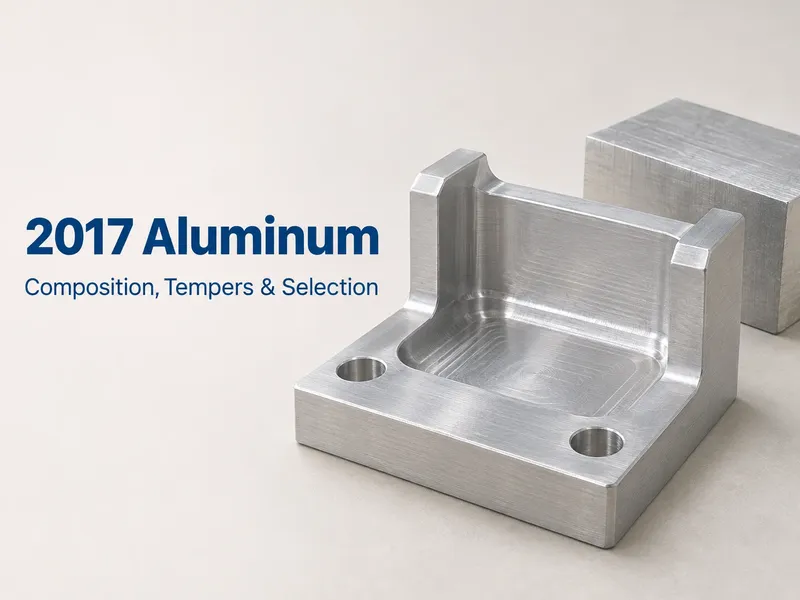
Copper is the alloy’s engine and its liability. At 3.5–4.5% it drives the precipitation-hardening response, with θ-Al₂Cu and S-Al₂CuMg forming during natural aging; manganese at 0.4–1.0% controls grain structure and adds toughness. The result reaches structural strength in the naturally aged condition, with no artificial aging step.
Because the grade predates the 2xxx generation that followed it, drawings from the 1940s onward still name it, and so do spares specifications for equipment built then. Cross-references to verify rather than substitute: UNS A92017, EN AW-2017 and EN AW-2017A (AlCu4MgSi and AlCu4MgSi(A)), DIN 3.1325, GB/T 3190 2A11. Of these, 2A11 is the designation routinely quoted as “the same alloy” — verify it rather than substitute it, since Chinese impurity control and mechanical requirements are set separately from the AA and EN systems.
2017 or 2017A: The First Decision on Any Drawing
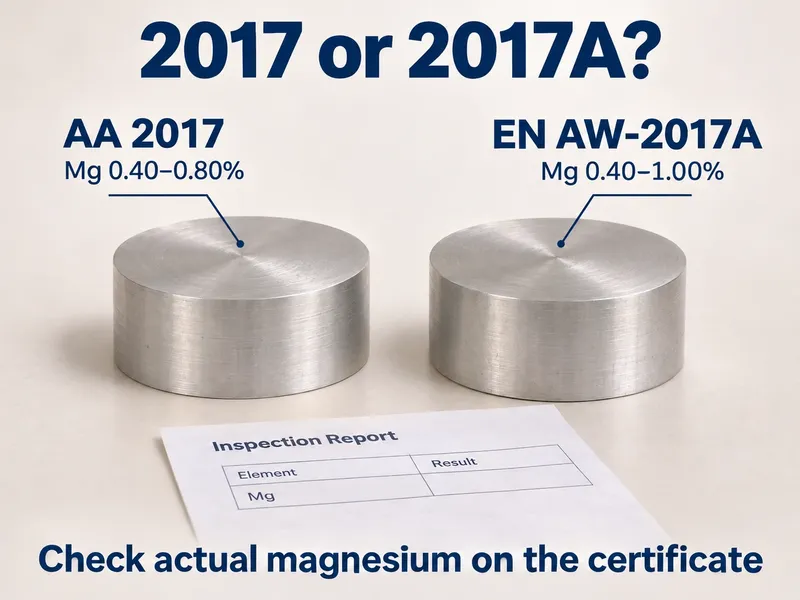
The two designations share every limit except magnesium and the titanium/zirconium entry. Side by side, the difference is small enough to miss on a certificate and large enough to reject a heat.
| Element (wt%) | AA 2017 | EN AW-2017A |
|---|---|---|
| Silício | 0.20 – 0.80 | 0.20 – 0.80 |
| Ferro | 0,70 máx. | 0,70 máx. |
| Cobre | 3.50 – 4.50 | 3.50 – 4.50 |
| Manganês | 0.40 – 1.00 | 0.40 – 1.00 |
| Magnésio | 0.40 – 0.80 | 0.40 – 1.00 |
| Cromo | 0,10 máximo | 0,10 máximo |
| Zinco | 0,25 máximo | 0,25 máximo |
| Titânio | 0,15 máximo | — |
| Zirconium + titanium | — | 0,25 máximo |
| Outros, cada / total | 0.05 / 0.15 | 0.05 / 0.15 |
The relationship runs one way. Every limit in AA 2017 falls inside EN AW-2017A, so material certified as 2017 also satisfies 2017A. The reverse does not hold: a 2017A heat with 0.95% magnesium meets the European specification and breaches the American one.
So the rule is not “these are equivalent”. If the drawing names 2017, read the magnesium figure on the certificate rather than the grade label — the label cannot tell you which specification the heat meets.
Tempers: T4, T451, and the “2017-T6” Request
T4 is solution heat treatment followed by natural aging, and it is the condition most of this alloy ships in. T451 adds stress relief by stretching after quenching — what you want when a lot of metal comes out of thick plate and flatness has to survive the machining. O is used when the part will be formed and heat treated afterwards; T42 covers material the purchaser solution treats from O.
Those four are what the sheet and plate standards tabulate for this grade. T6 is not among them: EN AW-2017A is not artificially aged to T6 in European practice, and no product standard carries a T6 minimum for 2017 that you can hold a supplier to. An inquiry for “2017-T6” is a special-order contract item, not an off-the-shelf temper — so ask what property the designer was buying. If the answer is a higher guaranteed yield, the fix is a grade change: 2024-T351 or 2014-T6, both of which exist in the standards with published minimums.
Mechanical Properties by Thickness
2017 strength is not one number but a set of thickness bands, and the floor falls by about a quarter between thin sheet and heavy plate. This is the EN 485-2:2008 minimum for 2017A sheet, strip and plate in T4 and T451.
| Espessura (mm) | Tensile Rm min (MPa) | Yield Rp0.2 min (MPa) | Elongation A50 min (%) |
|---|---|---|---|
| 0.4 – 1.5 | 390 | 245 | 14 |
| 1.5 – 6.0 | 390 | 245 | 15 |
| 6.0 – 12.5 | 390 | 260 | 13 |
| 12.5 – 40 | 390 | 250 | 12 |
| 40 – 60 | 385 | 245 | 12 |
| 60 – 80 | 370 | 240 | 7 |
| 80 – 120 | 360 | 240 | 6 |
| 120 – 150 | 350 | 240 | 4 |
| 150 – 180 | 330 | 220 | 2 |
| 180 – 200 | 300 | 200 | 2 |
Read by thickness first and alloy second. A 2 mm sheet and a 150 mm plate are both legitimately “2017A-T4”, and their guaranteed tensile floors differ by 60 MPa. Designing to the thin-gauge figure and buying heavy plate is the most common way this alloy underperforms a calculation.
Bar, rod and tube are governed separately — EN 755-2 for extruded product, EN 754-2 for drawn. Take the figure for the diameter you are buying from the standard cited on the order. ASTM B209 and B211 also band their minimums differently from the EN documents, so quote the ASTM figure from the edition on the purchase order rather than converting an EN number onto an ASTM drawing.
What the Copper Does to Corrosion
Copper in solid solution makes this alloy strong; copper-rich particles at grain boundaries make it vulnerable. In wet or chloride-bearing service the potential difference between those particles and the matrix drives galvanic attack, and it concentrates at grain boundaries instead of spreading evenly. Unprotected 2017 is a poor choice outdoors, in marine atmospheres, or anywhere the part sits wet.
Three ways to keep it in service: aluminum cladding (alclad sheet, where a pure-aluminum layer is rolled onto the surface), a protective coating system, and design that keeps the part dry and isolates it from steel. Anodizing works, with a caveat — copper disrupts oxide growth, so decorative anodizing gives uneven color and a brownish cast, while hard anodizing for wear resistance behaves better than anodizing for appearance. Where color consistency is a specification line, 2017 will not match a 6xxx part in the same tank.
Machining: Where 2017 Actually Sits
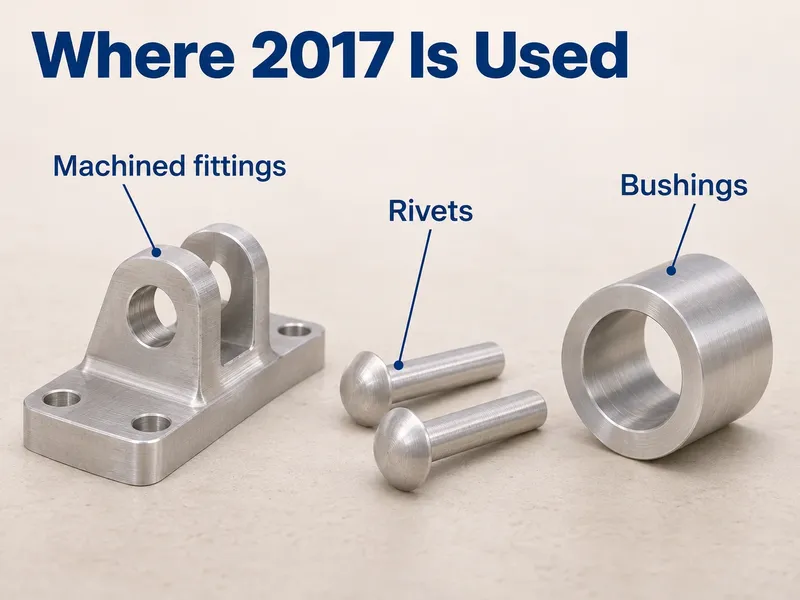
2017 has a free-machining reputation, and it is deserved — but the ranking is often stated in the wrong direction. On the common index where 2011 is the 280 reference, 2017 rates 200 and 2024 rates 210: the same band. 7075 sits lower at 170, and 2011 is the dedicated free-machining grade at 280.
The honest version: 2017 machines well, cuts short broken chips and holds good finish, but it is not faster than 2024. The reason to pick it over 2024 is cost and forming tolerance, not cycle time. Deep drilling is a genuine strength of the grade. What matters more than the index is stock condition — thick sections need T451, because residual stress in T4 plate moves the workpiece during machining and again afterwards.
Forming, Joining and Finishing
Form 2017 in the annealed or freshly quenched condition. T4 bends less than the temper name suggests, and a part designed around 6061-T6 bend radii will crack here.
Fusion welding is not a route this alloy supports: the copper-bearing 2xxx family is crack-sensitive in the weld metal, and the heat-affected zone loses strength that post-weld aging cannot recover. Resistance and spot welding behave better. Riveting, bolting and adhesive bonding are the established methods, which is why the alloy’s historic applications are rivets, fittings and screw-machine parts. If the design needs a welded joint, change grade rather than process — 6061 welds readily with 4043 or 5356 filler, and 2219 exists for welded 2xxx work.
2017 vs 2024, 6061 and 7075
The table uses typical values for each grade, because that is what the positioning question needs. The guaranteed floor for your form and thickness is in the standards table above, or on your certificate.
| Liga e têmpera | UTS típico (MPa) | Typical yield (MPa) | Corrosão | Fusion welding |
|---|---|---|---|---|
| 2017-T4 | 427 | 276 | Poor unprotected | Não recomendado |
| 2024-T3 / T351 | 470 | 325 | Poor unprotected | Não recomendado |
| 6061-T6 | 310 | 276 | Bom | Readily |
| 7075-T6 | 572 | 503 | Ruim | Não recomendado |
Contra Alumínio 2024 the gap is smaller than the grade numbers suggest — about 10% on typical tensile, closer to 18% on yield, which is the figure that governs a loaded machined part. 2024 is stronger with a far wider aerospace supply base; 2017 stays in the frame where the drawing already names it, where forming tolerance outweighs the last 18% of yield, or where the part is a rivet.
Against 6061 the two are level on typical yield, and 6061 is the easier material to live with: it welds, it resists corrosion, it is universally stocked. Pick 2017 when the part needs more than 6061’s guaranteed floor without paying 2024 prices, in an environment where coating or indoors service contains the corrosion penalty. Against 7075-T6 it is a different strength class — roughly a third higher, more expensive, slower to machine.
Go/No-Go
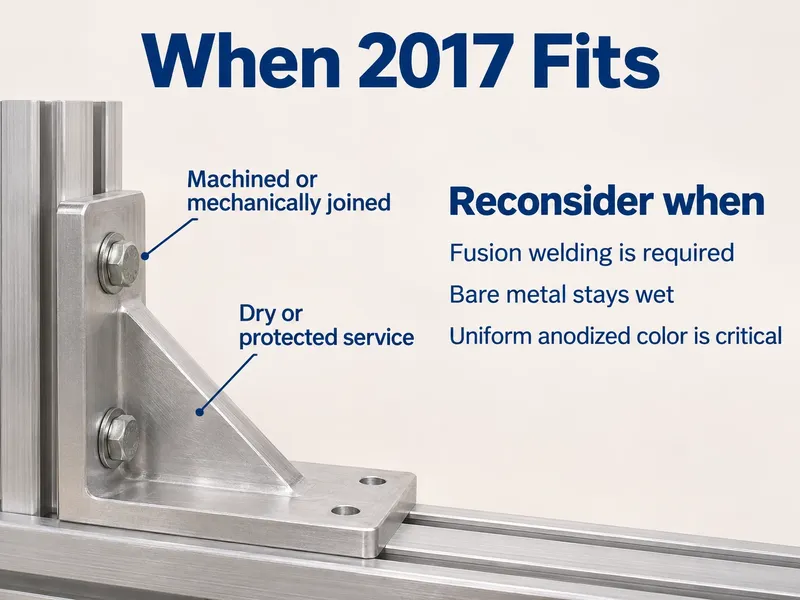
Go — 2017 fits when all of these hold:
- The part is machined, turned, drilled or riveted, and joining is mechanical rather than welded.
- Service is indoors, or the part will be coated, clad or otherwise protected.
- The drawing already names 2017, or the design genuinely needs more than a 6061 guaranteed floor.
- Working stress sits inside the yield minimum for the thickness band you are buying.
No-go — choose something else when any of these hold:
- The assembly is fusion welded — 6061 for general work, 2219 if a 2xxx is required.
- The part sees marine, de-icing salt or permanent moisture without cladding or coating — 5083 or 6061.
- The design needs a guaranteed yield above 260 MPa, the highest band in the table — 2024-T351.
- The drawing calls for 2017-T6 — 2024-T351 or 2014-T6, because the temper has no standard minimum here.
- Color-critical anodized finish is a specification line — 6061, or plan on paint.
In practice it lands on rivets and fasteners, machined fittings, bushings, brake pistons, hinge pins, pulleys, camera and optical components, jigs and tooling plate, and legacy aerospace secondary structure where the drawing is already fixed.
What to Put on the Purchase Order
Four lines decide whether the material you receive is the material you designed around.
- Designation and standard. Write “2017 per ASTM B209” or “EN AW-2017A per EN 573-3”, not just “2017”. The designations carry different magnesium limits, and the standard decides which minimums apply.
- Temper and stress condition. T4 or T451, stated explicitly. If the part is heavily machined from plate, T451 is the stress-relieved choice and the certificate should say so.
- Thickness or diameter band. Give the actual dimension, because the minimum mechanical property follows the band, not the alloy name.
- Certificate content. Require a mill test certificate reporting actual chemical analysis and actual mechanical results for the heat or lot, with magnesium as a number rather than a pass mark.
Conclusão
2017 aluminum earns its place on a narrow set of arguments: a machined or riveted part, a drawing that already names the grade, and a service environment where the copper penalty is controlled by coating or by staying indoors. Everything it offers comes from copper, and so does everything it costs — corrosion resistance, weldability and color-consistent anodizing all fall away in exchange for naturally aged strength at a lower price than 2024.
We supply 2017 and 2017A plate, sheet, bar and tube in T4, T451 and O, cut to size or to drawing, with an MTC reporting actual chemistry and mechanical results so the magnesium figure is visible before you release the part.
Send us the drawing, the designation on it and the thickness you need, and we will confirm which specification and temper band the part falls into.
Perguntas frequentes
Which designation belongs on the purchase order — 2017 or 2017A?
Use the designation on the drawing, then require the certificate to show actual magnesium. If the drawing is silent, 2017A is the wider specification and accepts both.
Is 2017 worth it over 6061 for a machined bracket?
Only if you need more than 6061-T6’s guaranteed tensile floor — 290 MPa minimum for sheet and plate. On typical values the two are level at about 276 MPa yield, and 6061 is cheaper to finish and easier to weld. Under that floor, 6061 wins; over it, 2017 is cheaper than 2024.
What is your MOQ and lead time for 2017 plate?
Plate in T4 and T451 quotes at low minimums, with MOQ set against the thickness and size you need rather than a mill tonnage. Stock covers common thicknesses; non-standard sizes are produced to order on the same low-MOQ basis. Custom production runs 10–60 days depending on thickness, size and whether stress-relieved T451 is required.
Can you cut 2017 plate to size and supply the certificate with it?
Yes — cutting plate and bar to length or to drawing is part of normal order processing, not a separate service. Every order leaves with a mill certificate we issue after production, listing actual chemical analysis and mechanical results for the lot. Where the drawing calls for third-party verification, SGS reports are available on request at additional cost.