5456 Alüminyum Nedir?
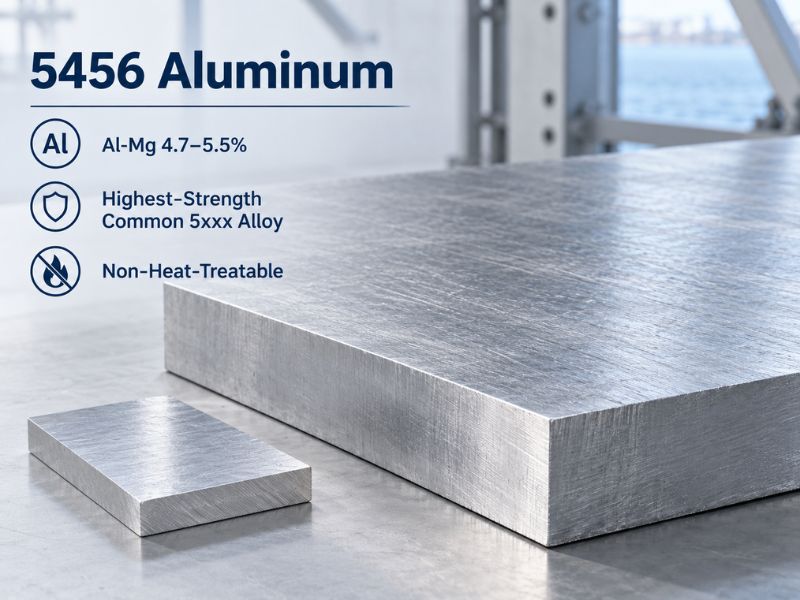
5456, 5xxx serisinde bir dövme alüminyum-magnezyum alaşımıdır ve %4,7–5,5 magnezyum içeriğiyle, aksi takdirde ısıl işlemle sağlanacak olan katı çözelti mukavemetlendirmesinin yerini alır. Isıl işlemle sertleştirilemez, bu nedenle her ek megapaskal, su verme ve yaşlandırma çevriminden değil, deformasyon sertleşmesinden ve alaşım içeriğinden gelir. Manganez tokluk katar ve krom tane yapısını kontrol eder; bunlar birlikte 5456'ya, yaygın olarak stoklanan 5xxx alaşımları arasında en yüksek imalat sonrası mukavemeti kazandırır.
Bu magnezyum seviyesi aynı zamanda alaşımın tek ciddi kısıtlamasının da kaynağıdır. Yaklaşık %3 magnezyumun üzerinde, yaklaşık 65 °C'nin üzerinde uzun süre tutulan bir Al-Mg alaşımı, tane sınırları boyunca bir beta fazı çökelttirir ve bu ağ, çevresindeki matrise göre anodiktir. Korozyon daha sonra yüzey boyunca değil, tane sınırları boyunca ilerler; bu nedenle yüksek magnezyumlu kalitelerin deniz hizmeti için kabul edilebilir sayılması için yalnızca belirli bir alaşım değil, belirli bir temper durumu da gerekir.
5456 Kimyasal Bileşimi
Aşağıdaki sınırlar, sac ve plaka için ASTM B209'a göredir. Titanyum değeri komşu kaliteler arasında farklılık gösterir: 5456 maksimum 0,20'ye izin verirken, 5056 yalnızca maksimum 0,15'e izin verir; bu nedenle bu iki değer birbirinden kopyalanmamalıdır.
| Element | Bileşim (ağırlıkça %) |
|---|---|
| Silisyum (Si) | 0,25 maks. |
| Demir (Fe) | 0,40 maks |
| Bakır (Cu) | 0,10 maks. |
| Manganez (Mn) | 0.50–1.00 |
| Magnezyum (Mg) | 4.7–5.5 |
| Krom (Cr) | 0.05–0.20 |
| Çinko (Zn) | 0,25 maks. |
| Titanyum (Ti) | 0,20 maks. |
| Diğerleri, her biri | 0,05 maks. |
| Diğerleri, toplam | 0,15 maks. |
| Alüminyum (Al) | Denge |
Satın alma siparişinde iki kalem dikkat gerektirir. Bu seviyedeki magnezyum, 5456'yı 5083'ün üzerine taşıyan mukavemeti sağlayan unsurdur; bu nedenle magnezyumun aralığın alt sınırına yakın olduğunu gösteren bir sertifika, mukavemet avantajının ne kadarının korunduğu sorusunu gündeme getirmelidir. Bakır %0,10 ile sınırlandırılmıştır çünkü bakır doğrudan deniz suyu korozyon performansına karşı çalışır.
Temper Durumuna Göre 5456 Mekanik Özellikleri
Aşağıdaki tipik değerler, haddelenmiş ürünler için ASM ve Aluminum Association verilerinden alınmıştır. Karşılaştırma ve erken tasarım çalışmaları için faydalıdırlar; ancak garanti edilen değerler ilgili spesifikasyona ve kalınlığa göre belirlenir ve fiilen teslim edilen malzemeyi fabrika test sertifikası belirler.
| Temper | Çekme Dayanımı (MPa) | Akma Dayanımı (MPa) | Uzama (%) | Tipik Sertlik (HB) |
|---|---|---|---|---|
| O (tavlanmış) | 310 | 159 | 24 | — |
| H111 | 310 | 180 | 14 | — |
| H112 | 310 | 166 | 22 | — |
| H116 / H321 | 350 | 255 | 12 | 90 |
ASTM B928 kapsamındaki her şey için bağlayıcı sayı, tipik değer değil, kod minimumudur:
| Temper | Kalınlık Aralığı | Çekme Mukavemeti, min (MPa) | Akma Mukavemeti, min (MPa) | Uzama, min (%) |
|---|---|---|---|---|
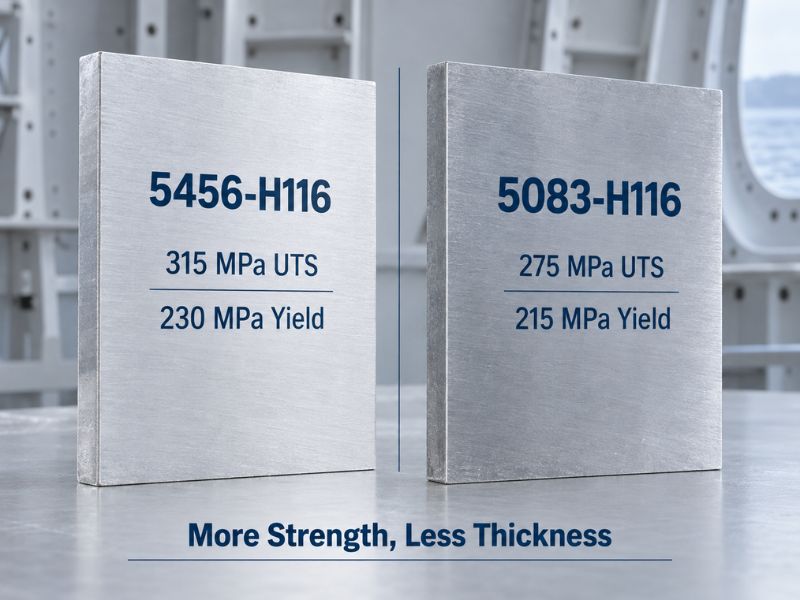
| 5456-H116 / H321 | 3–40 mm | 315 | 230 | 10 |
| 5083-H116 / H321 | 3–50 mm | 275 | 215 | 10 |
| 5086-H116 / H321 | 3–50 mm | 240 | 195 | 10 |
Burada en önemli satır ilkidir. 5083-H116 ile karşılaştırıldığında, 5456-H116 aynı kod minimumunda yaklaşık 40 MPa daha fazla çekme mukavemeti ve yaklaşık 15 MPa daha fazla akma mukavemeti sağlar; çok daha yaygın olarak stoklanan 5083 yerine bunun seçilmesinin tüm ticari gerekçesi budur.
H116 ve H321 Neden Vardır: 65°C Sensitizasyon Sınırı
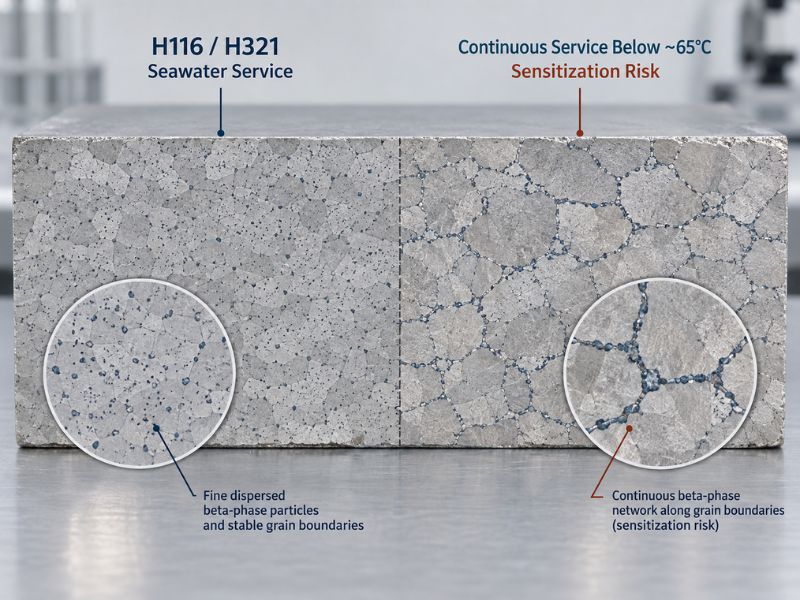
Sensitizasyon, 5456'nın nasıl spesifiye edilebileceğini belirleyen arıza modudur. Yaklaşık %3 magnezyumun üzerinde, 65 °C ve üzeri aralıkta uzun süreli maruz kalma, çözünmüş magnezyumu katı çözeltiden dışarı sürerek tane sınırları boyunca beta-fazı parçacıklarına dönüştürür. Bu parçacıklar bir kez bağlantılı bir ağ oluşturduğunda, alaşım taneler arası korozyona, eksfoliasyon korozyonuna ve gerilme korozyonlu çatlamaya karşı savunmasız hale gelir — bunların tümü içeride ilerler ve görsel muayeneyle kolayca gözden kaçar.
5456, ısıl işlemle bundan muaf tutulamaz. Isıl işlemle sertleştirilemeyen bir alaşımdır ve yerleşmiş bir tane sınırı ağını çözen bir yaşlandırma çevrimi yoktur. Sensitizasyon bir kez oluştuğunda, durum kalıcıdır.
H116 ve H321 özellikle bu mekanizmayı geciktirmek için vardır. Her ikisi de, beta-fazı parçacıklarını taneler arasında sürekli bir film yerine tanelerin içinde ince, dağılmış bir dağılıma süren stabilize edici bir ısıl işlem gören deformasyonla sertleştirilmiş koşullardır. ASTM B928 daha sonra sonucu doğrular: H116 ve H321 plaka, PB'den daha kötü olmayan bir derecelendirmede eksfoliasyon korozyon testini ve 15 mg/cm²'lik bir taneler arası korozyon kütle kaybı sınırını geçmelidir.
| Durum | Pratikte Anlamı | Tipik Teklif İfadesi |
|---|---|---|
| H116 | Deformasyonla sertleştirilmiş, B928 eksfoliasyon ve taneler arası sınırlarını karşılayacak şekilde stabilize edilmiş | Klas kuruluşu onayının gerekli olduğu yerlerde belirtilir |
| H321 | Kontrollü bir soğuk işlem adımıyla deformasyonla sertleştirilmiş ve stabilize edilmiş | Tanımlanmış mekanik minimumlara sahip kaynaklı yapılar için belirtilir |
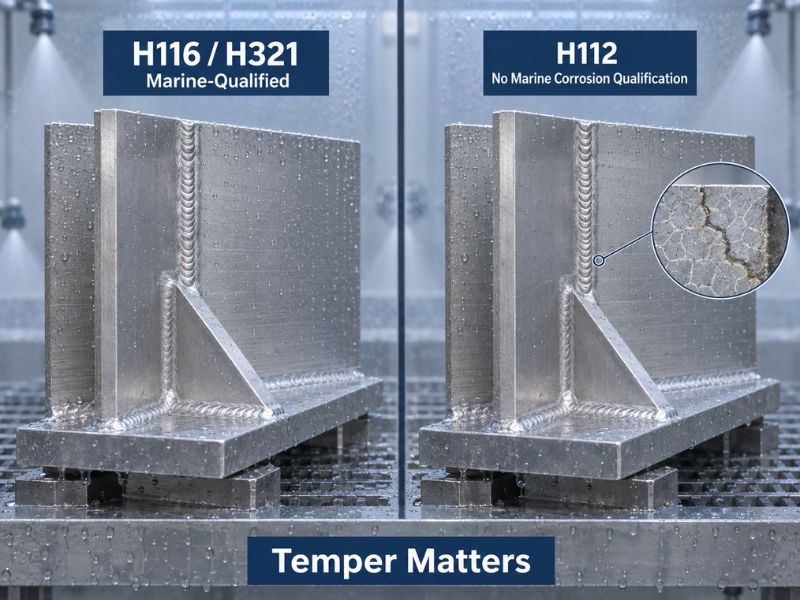
| H112 | Fabrika işleminden hafifçe deformasyonla sertleştirilmiş, korozyon kalifikasyonu yok | Genel yapı için kabul edilebilir, tek başına deniz suyu teması için uygun değil |
| O | Tamamen tavlanmış, maksimum şekillendirilebilirlik | Zorlu şekillendirme için kullanılır, genellikle ardından kaynak yapılır |
Pratik kural basittir: parça deniz suyuyla temas ediyorsa ve yıllarca yerinde kalıyorsa, temper satırı H116 veya H321 okumalıdır. Aynı parça için H112 teklif eden bir fiyat teklifi daha ucuzdur çünkü korozyon kalifikasyonu taşımaz, metalin farklı olmasından değil.
5456 Fiziksel Özellikleri
| Mülkiyet | Tipik Değer |
|---|---|
| Yoğunluk | 2,66 g/cm³ |
| Erime Aralığı | 570–638 °C |
| Termal İletkenlik | 117–127 W/m·K |
| Elektriksel İletkenlik | ,5–29,5 IACS |
| Elastik Modül | 69–74 GPa |
| Termal Genleşme Katsayısı | 23.9 × 10-⁶ /°C |
| Manyetik Tepki | Manyetik değil |
Bu iki iletkenlik değeri çoğu tasarımcının beklediğinden düşüktür ve doğrudan magnezyum içeriğinden kaynaklanır. Katı çözeltideki her magnezyum yüzdesi elektronları ve fononları saçtığından, yaklaşık IACS ve 120 W/m·K değerlerindeki 5456, IACS ve 138 W/m·K civarındaki 5052'nin oldukça altında kalır. Parçayı iletken veya ısı yayıcı olarak kullanan her uygulama, kimyanın aleyhine çalışır.
Korozyon Direnci ve Deniz Hizmeti
Deniz suyunda ve deniz atmosferlerinde 5456 iyi performans gösterir — yeter ki temper durumu korozyon kalifikasyonunu taşısın. Kendiliğinden oluşan oksit filmi, magnezyum ve krom içeriğiyle stabilize edilir; bu, klorür saldırısını yavaşlatır ve çukurlaşmayı sığ tutar. Pratikte bu, boyalı çeliğe kıyasla daha düşük tersane bakımı ve gövde kaplamasında uzun bir hizmet geçmişi anlamına gelir.
Üç koşul bu tabloyu değiştirir:
- Yaklaşık 65 °C'nin üzerinde sürekli sıcaklık. Makine dairesi yapıları, ısıtılan tanklar ve egzoz yakınındaki bağlantı parçaları klasik arıza noktalarıdır. Ya parçayı ısı kaynağından uzaklaştırın ya da daha düşük magnezyum içeriğiyle onu sensitizasyon aralığının dışında tutan 5454'e geçin.
- Sürekli çekme gerilmesi altındaki kalın kesitler. Kalın plaka, kaynak sonrasında daha fazla kısıtlama gerilmesi tutar ve SCC hem hassas bir yol hem de gerilme gerektirir. 5456 üzerindeki daha kalın kesitler açık bir mühendislik incelemesini hak eder.
- Farklı metallerle temas. Alüminyum, bakır, pirinç ve paslanmaz çeliğe göre anodiktir. İzolasyon ve drenaj hizmette keşfedilmek yerine tasarıma dahil edilmelidir.
5456 ile Çalışma: Şekillendirme, Kaynak ve İşleme
Kaynak. 5456 welds well by MIG and TIG, but joint design cannot use parent-metal properties. Because the alloy is non-heat-treatable, the heat-affected zone is annealed back toward the O condition and stays there — no post-weld treatment restores it. Weld-metal properties from an ER5556 deposit on 5083 or 5456 base plate run about 280–310 MPa tensile and 130–165 MPa yield, against 255 MPa yield for H116 parent metal. That is roughly a 35–45% drop in yield near the joint, and AWS D1.2 allowable stresses already assume this, so design to the annealed HAZ value rather than the temper purchased.
| Dolgu | Magnezyum İçeriği | When It Fits | Watch Out For |
|---|---|---|---|
| ER5556 | ~5.0% | Default for 5456 — matches the base alloy and carries corrosion performance best | Limited availability outside marine supply chains |
| ER5183 | ~4.8% | Where maximum as-welded strength on the joint matters | Confirm against the approved procedure |
| ER5356 | ~4.5% | General 5xxx fabrication, widely stocked | Not preferred for sustained service above about 65 °C |
| ER4043 | Silicon-bearing | Avoid on 5456 | Silicon combines with magnesium into brittle Mg₂Si and the weld anodizes black |
Şekillendirme. Formability follows the temper. O and H111 handle heavy bending and drawing; H116 and H321 will take moderate forming but bend radii must be opened up relative to what a shop accustomed to 5052 would expect. Cold-forming H321 plate hard and then putting it into service invites both cracking and higher residual stress, which feeds directly into the SCC mechanism above.
İşleme. 5456 machines acceptably but is gummier than the heat-treatable alloys, so chip evacuation and sharp tooling matter more than spindle power. Chip control improves with higher rake angles and positive cutting geometry.
Yüzey işleme. Like all 5xxx alloys, 5456 anodizes to a muted grey rather than a bright finish, and it will not colour-match a 6063 extrusion. If appearance is a criterion, specify that requirement before the order is placed rather than discovering it at assembly.
5456 vs 5083 vs 5086 vs 5052: How to Choose
| Alloy and Temper | Tensile, min (MPa) | Yield, min (MPa) | Magnezyum (%) | Where It Wins |
|---|---|---|---|---|
| 5456-H116 | 315 | 230 | 4.7–5.5 | Highest strength of the group in seawater contact |
| 5083-H116 | 275 | 215 | 4.0–4.9 | Broadest availability, best-documented marine record |
| 5086-H116 | 240 | 195 | 3.5–4.5 | Good marine performance at lower cost and better formability |
| 5052-H32 | 215 | 160 | 2.2–2.8 | Forming-heavy sheet work, no sensitization limit |
Reading down the magnesium column explains almost everything about how these four behave. Higher magnesium buys strength and costs temperature capability: the two high-magnesium grades carry the 65 °C restriction, while 5052 at 2.2–2.8% does not. Availability runs the other way — 5083 is stocked almost everywhere, and 5456 is a special order at many service centres, which is reflected in both price and lead time.
Go/No-Go: When to Specify 5456
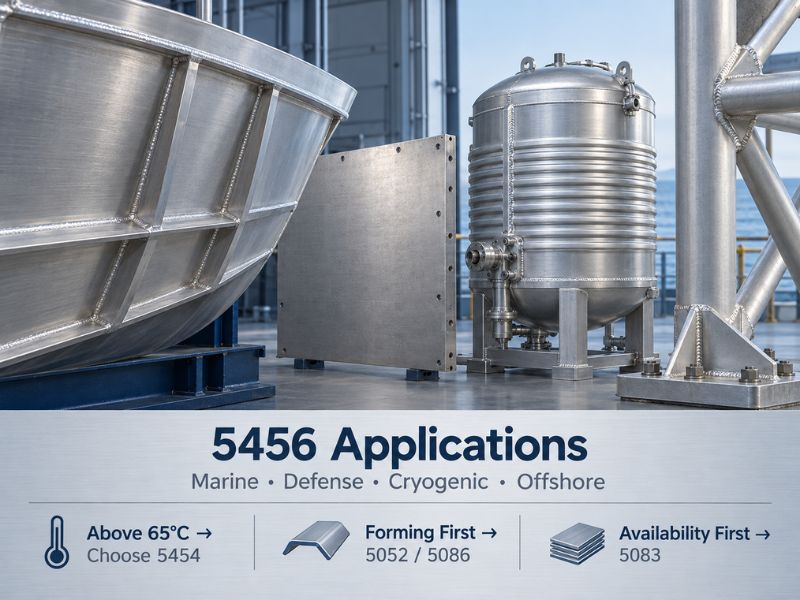
The entries below answer whether to use the alloy. Applications are covered separately in the next section — this section covers the decision, that one covers the destinations.
Go — 5456 fits when:
- The design needs more strength than 5083-H116 provides and thickness cannot increase to compensate
- The structure is welded, stays in seawater contact, and the specification can require H116 or H321 with B928 test results
- Impact resistance and toughness at low temperature matter, including cryogenic and offshore service
- Thermal growth must stay predictable against a documented expansion coefficient under dynamic load
No-Go — choose something else when:
- Continuous metal temperature may exceed roughly 65 °C — move to 5454 instead
- Lead time and stock availability dominate the decision — 5083 is the safer supply chain
- The part needs a bright or colour-matched anodized finish — use 6xxx
- Forming dominates over strength — 5052 or 5086 will cost less and form easier
- The project requires strength that only heat treatment delivers — move to a heat-treatable series
Where 5456 Is Used
Denizcilik ve gemi inşaatı. Hull plating, decks, bulkheads, and superstructures on patrol boats, workboats, and high-speed craft are the core application set. 5456 earns its place where weight reduction is worth paying for, since the strength margin over 5083 lets a hull designer remove thickness rather than add it.
Defence and protective structures. Armor plate for military vehicles, military bridging components, and blast-resistant assemblies use 5456 for energy absorption combined with ballistic performance. MIL-DTL-46027 is one specification covering this territory, and it carries its own temper and testing requirements beyond the commercial standards.
Pressure vessels and heavy welded fabrications. 5456 appears in storage tanks, pressure vessels, and large transportation frames where welded joint integrity governs the design. Joint efficiency must always be calculated from the annealed HAZ properties, not from H116 parent-metal figures.
Cryogenic and offshore service. Unlike carbon steel, 5xxx alloys do not suffer a ductile-to-brittle transition as temperature falls, and both strength and elongation improve. That makes 5456 usable for cryogenic tanks and for offshore structures exposed to cold climates.
Artılar ve Sınırlamalar Bir Bakışta
| Boyut | Avantaj | Sınırlama |
|---|---|---|
| Güç | Highest as-fabricated strength of the common 5xxx alloys | No heat-treat route exists to raise it further |
| Korozyon | Excellent seawater performance with H116/H321 qualification | Requires that temper; H112 carries no corrosion qualification |
| Sıcaklık | Stable in cold service, including cryogenic | Unusable above roughly 65 °C because of sensitization |
| Kaynaklanabilirlik | Welds cleanly by MIG and TIG with matching filler | HAZ anneals to O condition with ~35–45% yield loss, permanent |
| Stok Durumu | Supplied by marine-focused mills and stockists | Thinner supply chain and longer lead times than 5083 |
| Maliyet | Justifies itself where strength removes thickness | Higher per-kilo price and often a customs temper requirement |
| Şekillendirilebilirlik | Workable in O and H111 | H116/H321 need wide bend radii and careful cold work |
| Görünüş | Acceptable with paint or coating | Anodizes grey, will not bright-match 6063 |
Sourcing 5456: What to Specify
A 5456 enquiry that carries the following items will come back priced correctly the first time. One that does not will return a cheaper quote for material that will not pass inspection:
| Specification Item | What to State | Why It Changes the Quote |
|---|---|---|
| Temper | H116 or H321 for anything touching seawater | Corrosion-tested plate costs more than H112 |
| Standart | ASTM B928 for marine, B209 for general product form | Each carries different test requirements |
| Thickness range | Relevant ranges change mechanical minimums | Minimums drop as thickness increases |
| Exfoliation / IGC test | Required if the part is contact seawater | B928 requires ≤PB and ≤15 mg/cm² |
| certificates | MTC required; SGS testing if specified by the project | Traceability is part of the deliverable |
| Form and size | Plate, sheet, bar, tube, or profile with dimensions | Determines mill routing and lead time |
Linsy supplies 5456 in plate, sheet, bar, tube, and extruded profiles, most commonly in O, H111, H112, H116, and H321 temper. Typical plate-range supply runs from 6 mm up to 120 mm thick, with sheet and coil down to about 0.5 mm; other sizes can be discussed against the order specification. Every shipment leaves with a mill test certificate documenting composition and mechanical properties, and third-party SGS reports — including chemical, mechanical, ultrasonic, and dimensional — can be arranged on request. Production runs under ISO 9001, ISO 14001, and ISO 45001 systems.
Custom sizes for non-stock items typically run 10–60 days depending on alloy, dimensions, processing, and order complexity, and low-MOQ custom production is available. In-house support covers CNC machining, MIG and TIG welding, laser cutting, and surface finishing including anodizing and polishing.
Sonuç
5456 buys roughly 40 MPa of additional strength over 5083-H116 at the same code minimum, and it charges for that with two hard conditions: the temper must be H116 or H321 for anything touching seawater, and the structure must stay below about 65 °C or move to 5454. Those two rules are where 5456 projects go wrong, and neither appears in a datasheet handed over at quotation stage.
Linsy Aluminum works with exactly that boundary. We supply 5456 across plate, sheet, bar, tube, and profiles in O, H111, H112, H116, and H321, with the mill test certificate issued for every order and optional SGS reports where a project requires third-party verification. If there is any doubt about whether the service temperature or the temper is right for a design, send the drawing and the operating conditions — we will confirm which specification actually needs to appear on the purchase order before it is placed.
Sıkça Sorulan Sorular
Is 5456 stronger than 5083?
Yes, by a useful margin at the code minimum. ASTM B928 sets 5456-H116 at 315 MPa tensile and 230 MPa yield against 275 MPa and 215 MPa for 5083-H116, so the difference is about 40 MPa tensile and 15 MPa yield in the same thickness range. The trade-off is supply: 5083 is stocked far more widely, and its marine service record is documented across more vessels.
Why is 65 °C the stated limit for 5456?
Above about 3% magnesium, extended exposure around 65 °C and above pulls dissolved magnesium out of solution and precipitates beta phase along grain boundaries. That creates an anodic path between grains, opening the door to intergranular corrosion, exfoliation, and stress corrosion cracking. Because 5456 cannot be heat treated, the condition cannot be reversed once it develops. Parts near engines, heated tanks, or exhaust runs are the usual offenders, and 5454 is the standard substitute in those zones.
Which temper should be specified for a seawater-facing hull plate?
H116 or H321, stated with ASTM B928. Both receive a stabilising treatment that disperses beta-phase particles inside the grains rather than letting them form a continuous film at the boundaries, and B928 verifies the outcome with an exfoliation test at PB or better and an intergranular mass-loss limit of 15 mg/cm². H112 sits outside that qualification and is not a substitute in saltwater contact.
What happens to strength after welding 5456?
The heat-affected zone anneals back toward the O condition and stays there, since no post-weld heat treatment restores strain hardening. An ER5556 deposit on 5456 base plate typically gives 280–310 MPa tensile and 130–165 MPa yield, against about 255 MPa yield for H116 parent metal — a 35–45% reduction near the weld. AWS D1.2 allowable stresses already assume this, so joints must be designed to annealed HAZ values rather than the specified temper.
Can 5456 be anodized?
Yes, but it does not produce the finish most people expect. Like all 5xxx alloys it anodizes to a muted grey rather than a bright surface, and it will not colour-match a 6063 extrusion. Where appearance matters, that needs to be agreed before ordering, or captured through paint and coating instead.