什么是1050铝合金?
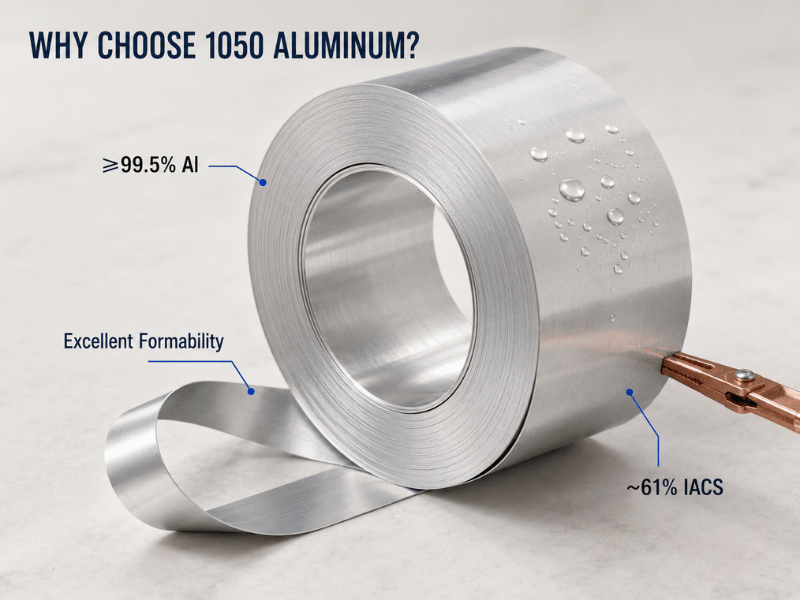
1050铝合金是1xxx系列中的商业纯变形铝合金,铝含量最低为99.5%。由于其几乎为纯铝,因此保留了基体金属的最佳特性:高延展性、优异的耐腐蚀性以及良好的导电和导热性能。AA 1050/UNS A91050和EN AW-1050A是不同标准体系下的相近牌号;由于成分限值可能略有差异,采购订单中应注明适用的标准。.
1050是一种不可热处理强化合金。它不能像2xxx或6xxx系列合金那样通过固溶热处理或时效来强化;其强度主要通过冷加工(应变硬化)来提高,以H状态系列表示。一旦理解了这一点,该合金的其他行为——软的O状态、逐渐变硬的H12/H14/H16/H18状态,以及强度与成形性之间的权衡——就都迎刃而解了。.
化学成分
| 要素 | 最大含量(%) | 角色 |
| 铝 (Al) | 99.5(最低) | 基体金属;高纯度带来高导电性、良好的成形性和耐腐蚀性 |
| 铁(Fe) | 0.40 | 含量最多的杂质;影响强度和表面光洁度 |
| 硅 (Si) | 0.25 | 受控杂质;在该含量水平下影响较小 |
| 铜 (Cu) | 0.05 | 保持极低含量以维持耐腐蚀性 |
| 锰 (Mn) | 0.05 | 强化效果极小 |
| 镁(Mg) | 0.05 | 几乎没有沉淀硬化效果 |
| 锌 (Zn) | 0.05 | 受控微量元素;过量会影响性能 |
| 钛 (Ti) | 0.03 | 可能影响晶粒组织的微量元素 |
| 其他(每项) | 0.03 | 其余微量元素 |
该合金成分刻意保持简单。至少99.5%的铝含量使合金保持轻质、柔软、易成形和导电的特性,而铁和硅——含量最多的两种杂质——则影响强度、导电性、加工性能和表面响应,同时不会使1050变成沉淀硬化型合金。正是这种高纯度,使得1050具有优异的弯曲、拉深和导电性能,也使其保持不可热处理强化的特性。.
机械和物理特性
不同状态下的性能
由于1050是应变硬化合金,其强度在很大程度上取决于状态。下表给出的是代表性范围,而非通用验收限值;确切的最小值和最大值因产品形态、厚度、取向和适用标准而异。常见参考标准包括:板材和带材的ASTM B209/B209M,轧制或冷精整棒材、条材和线材的ASTM B211/B211M,以及根据管材形式和用途选用的ASTM B210/B210M、B221/B221M、B241/B241M、B483/B483M或B491/B491M。.
| 脾气 | 拉伸强度(兆帕) | 屈服强度(兆帕) | 伸长率 (%) |
| O(退火) | 60–100 | 20–35 | 35–40 |
| H12(1/4硬) | 85–125 | 65–95 | 12–20 |
| H14(半硬) | 105–145 | 85–115 | 8–12 |
| H16(3/4硬) | 120–160 | 100–130 | 6–10 |
| H18(全硬) | ≥135 | ≥120 | 2–6 |
随着冷加工量从O状态增加到H18状态,抗拉强度和屈服强度不断升高,而伸长率则急剧下降——H18状态达到接近商业最大强度,但失去了大部分延展性。硬度也遵循相同趋势(O状态约20 HB,H18状态约70 HB)。.
物理特性
| 财产 | 价值 |
| 密度 | 2.71 克/立方厘米 |
| 熔点 | 646–660 °C |
| 导热性 | 222–230 W/m·K |
| 导电性 | 约61% IACS(退火态) |
| 热膨胀系数 | 23.6 µm/m·K |
| 弹性模量 | 69 GPa |
这些数值在各状态下几乎恒定:冷加工改变的是强度和硬度,而非基本的物理常数。约61% IACS的导电率使1050成为母线排和轻载导体的候选材料,仅略低于1350等专用电工级合金。.
1050铝合金的状态
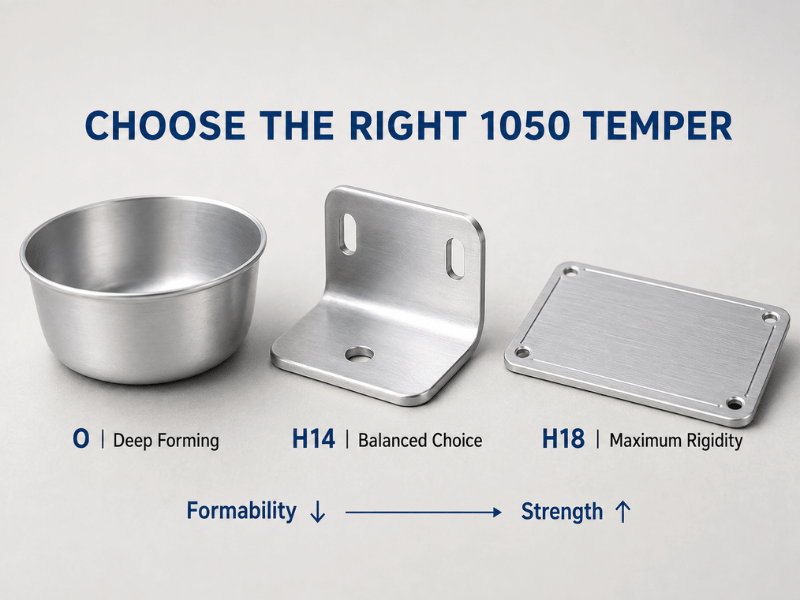
1050以应变硬化H状态系列以及完全退火的O状态供应。每一步都在以成形性换取强度,因此状态的选择实质上是在强度与成形性之间做权衡。.
1050-O铝合金
O状态是完全退火、最软的状态。它具有该系列中最高的延展性和最佳的导电性,因此是深拉深、旋压以及任何在使用前必须成形为复杂形状的零件的默认选择。反射器、灯罩和炊具本体通常采用O状态,因为它们需要成形而非承受载荷。.
1050-H12、H14、H16和H18铝合金
这些是逐步应变硬化的状态。1050-H12为1/4硬,仍易于成形;1050-H14为半硬,是用于中等载荷支架、铭牌和弯曲面板的主力状态;1050-H16为3/4硬,适用于要求更高刚度的部件;1050-H18为全硬,为刚性、轻度成形的零件(如印刷版和装饰铭牌)提供最高的商业强度。每一步强度递增而成形性递减,因此应选择成形工艺仍能承受的最硬状态。.
如何选择合适的1050状态
从成形工艺入手。如果零件必须深拉深、旋压或小半径弯曲,请选择1050-O;较硬的状态会增加开裂风险,可能需要更大的弯曲半径或中间退火。如果需要中等强度且保持可弯曲性,请选择1050-H14,这是最常见的中等状态。只有当零件接近平面或形状简单且需要最大刚度时,才选择1050-H18。请记住,焊接任何H状态零件都会使热影响区退火回到接近O状态,因此设计时需考虑软化热影响区的较低强度。.
1050铝合金的应用领域
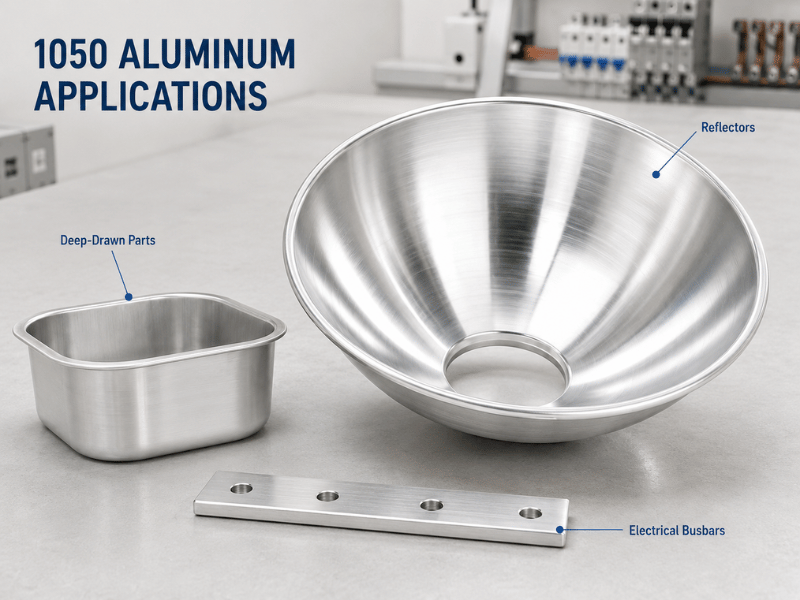
1050适用于成形性和耐腐蚀性比强度更重要的应用。其耐腐蚀性适用于许多食品工业容器和化工工艺部件,但适用性取决于介质、温度、表面状态以及适用的食品接触或工艺法规。在一般钣金加工中,它易于成形为建筑泛水板、换热器翅片和反射照明面板。其导电性使其用于母线排和轻型电导体,而其光亮反射表面使其成为灯具反射器和装饰铭牌的标准材料。.
1050与1060、1100和3003的对比
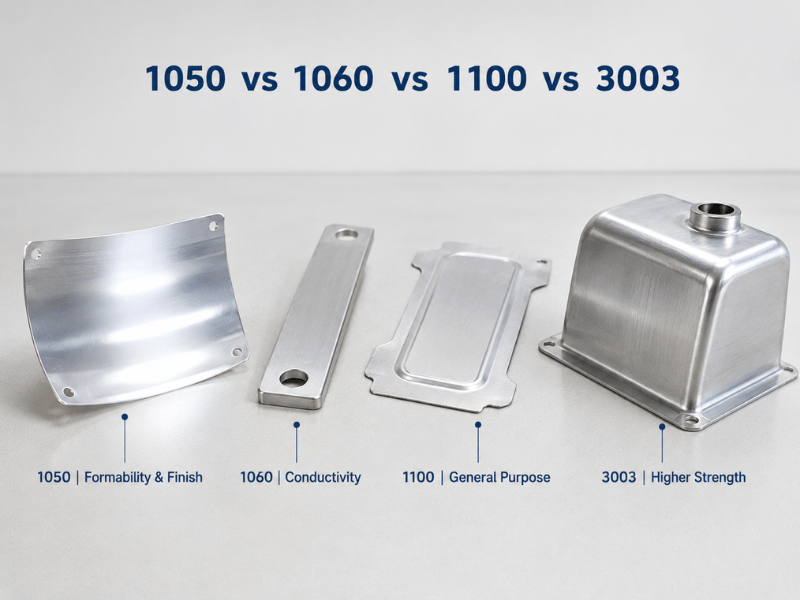
| 特点 | 1050 | 1060 | 1100 | 3003 |
| 铝含量 | 99.5%最小值 | 99.6%最小值 | 99.0%最小值;含受控Cu | Al余量;通常含1.0–1.5% Mn |
| 强度(O状态,MPa) | ~75 | ~70 | ~90 | ~110 |
| 耐腐蚀性 | 优秀 | 优秀 | 优秀 | 非常好 |
| 导电性 | 约61% IACS | 61-621TTP3T IACS | 59-621TTP3T IACS | 40-501TTP3T IACS |
| 成型性 | 优秀 | 优秀 | 优秀 | 良好(略硬) |
| 典型用途 | 反射器、锅具、线材 | 电线、灯具部件 | 箔、电线 | 炊具、水箱 |
1050和1060几乎为纯铝且导电性良好,因此适用于软态电气和成形应用。1100含有受控铜,强度略高,同时保持良好的导电性,适用于箔材和线材。3003以导电性换取锰强化的强度,适用于更坚固的炊具和储罐。表中的对比值为代表性数据,随状态、产品形态和标准而变化。当最大成形性、表面光洁度和清晰阳极氧化效果至关重要时,选择1050;当零件需要更高强度时,升级到3003。.
1050铝合金的加工
成型性
成形性是其突出特性。1050可深拉深、旋压和极小半径弯曲而不开裂,这就是它主导反射器、炊具和建筑泛水板市场的原因。较软的状态成形性最佳;较硬的状态需要更大的弯曲半径。.
焊接
1050通过MIG和TIG焊接效果极佳。可根据接头设计和使用要求选择ER1100或其他合格填充金属,并应控制热输入以保护周围材料。关键注意事项:热影响区会失去冷加工获得的强度,退火回到接近O状态。设计时需考虑软化热影响区的较低强度。.
机械加工
机加工性较差,尤其是在软的O状态。材料发黏,容易在切削刀具上产生积屑瘤。应使用具有大正前角的锋利刀具、高切削速度和轻进给量,并配合良好的润滑。H14等较硬状态的机加工性明显优于O状态。.
阳极氧化
1050可阳极氧化形成清洁、透明的II型氧化层,在不显著改变外观的情况下提高耐腐蚀性,使其适用于功能性及建筑装饰性表面处理。着色外观取决于表面状态、槽液化学、染料体系和工艺控制,因此外观要求应通过样品确认。当需要某些6xxx系列那样的均匀不透明外观时,1050可能不是最佳选择。.
1050铝合金的优点与局限性
优点
• 优异的成形性,适用于深拉深、旋压和小半径弯曲
• 在户外和潮湿环境中具有出色的耐腐蚀性
• 高热导率和电导率(约61% IACS)
• 优异的清晰阳极氧化响应
• 可广泛回收利用;食品接触用途需符合适用法规
局限性
• 强度低——通常不适用于主要承重结构件
• 不可热处理强化;强度主要通过冷加工提高
• 机加工性差,尤其是O状态
• 彩色阳极氧化外观需要工艺控制及样品确认
• 焊接区域会软化回退至O态
结论
当零件需要成形、导电或耐腐蚀的需求高于承载需求时,1050是正确的选择——但其强度低、机加工性差,通常不适用于主要承重结构用途。作为可靠的工业纯铝牌号,Linsy供应线材、卷材和板材形式的1050铝材,并提供CNC加工、TIG/MIG焊接、激光切割及表面处理服务,每单附带材质证书,且通过ISO 9001/14001/45001认证;可根据要求安排SGS或其他第三方检测。请将您的图纸或规格发送至Linsy Aluminum,以获取库存查询和报价。.
常见问题
1050铝能否通过热处理提高强度?
不能。1050属于不可热处理强化合金——不能像2xxx或6xxx系合金那样进行固溶热处理或时效处理。强度主要通过冷加工提高,因此如果您需要更高的承载能力,请选择更硬的H态(H14、H16、H18)。.
1050-O和1050-H14有什么区别?
O态为完全退火状态:最软、延展性最好,最适合深冲和旋压成形。H14为半硬状态:抗拉强度约为105–145 MPa,而O态为60–100 MPa,伸长率则低得多。当零件需要成形时选择O态;当成形后需要中等强度时选择H14。.
1050铝容易焊接吗?
是的。它通过MIG和TIG焊接效果良好。可根据接头设计和使用要求选择ER1100或其他合格填充材料。热影响区会退火软化至接近O态,因此在焊接组件设计中需考虑局部软化问题。.
1050与1350铝有何不同?
1350专为电导体应用优化,导电率略高;而1050更侧重于成形性和耐腐蚀性,并具有清晰的阳极氧化表面。导体应用选用1350,而形状成形和表面外观要求较高时选用1050。.
为什么选择1050而不是1060或1100?
1050和1060均为近纯铝且导电性良好;1050的纯度略低,但仍具有优异的成形性和清晰的阳极氧化表面。1100含有受控的铜元素,强度更高但导电率略低。当成形性、表面质量和耐腐蚀性为规格主导因素时,选择1050。.