O que é o Alumínio 1050?
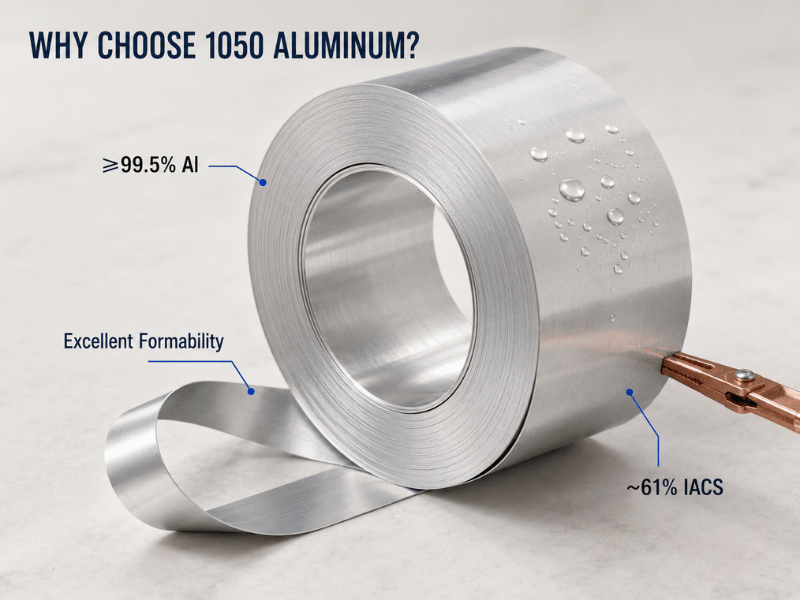
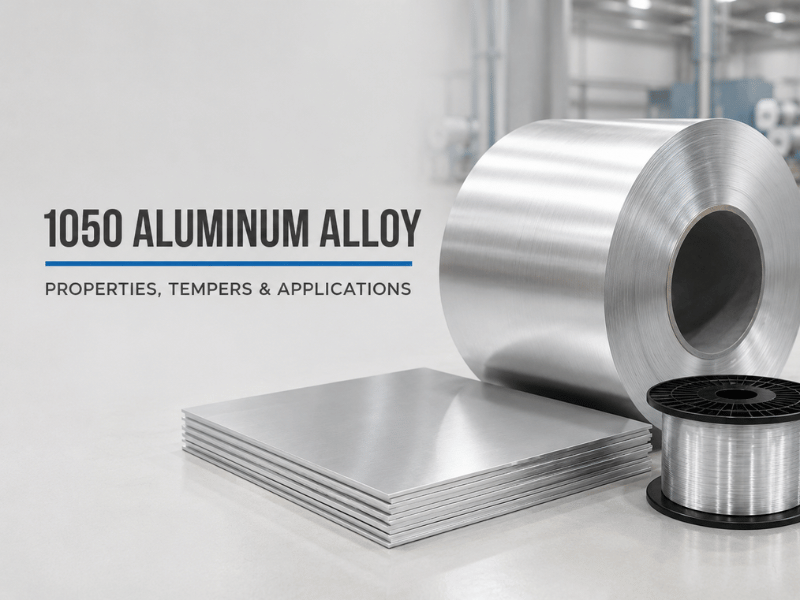
O alumínio 1050 é uma liga comercialmente pura forjada da série 1xxx, com um teor mínimo de alumínio de 99,5%. Por ser quase alumínio puro, mantém as melhores características do metal base: alta ductilidade, excelente resistência à corrosão e forte condutividade elétrica e térmica. AA 1050/UNS A91050 e EN AW-1050A são designações intimamente relacionadas sob diferentes sistemas; a ordem de compra deve especificar a norma aplicável, pois os limites de composição podem diferir ligeiramente.
O 1050 é uma liga não tratável termicamente. Não pode ser endurecida por tratamento térmico de solução ou envelhecimento como uma liga da série 2xxx ou 6xxx; sua resistência é elevada principalmente através de trabalho a frio (encruamento), expresso pela família de têmperas H. Uma vez compreendido esse fato, o restante do comportamento da liga — têmpera O mole, têmperas H12/H14/H16/H18 progressivamente mais duras e a relação entre resistência e conformabilidade — se encaixa naturalmente.
Composição química
| Elemento | Teor Máximo (%) | Função |
| Alumínio (Al) | 99,5 (mínimo) | Metal base; a alta pureza impulsiona a condutividade, conformabilidade e resistência à corrosão |
| Ferro (Fe) | 0.40 | Impureza mais abundante; afeta a resistência e o acabamento superficial |
| Silício (Si) | 0.25 | Impureza controlada; efeito menor neste nível |
| Cobre (Cu) | 0.05 | Mantido muito baixo para preservar a resistência à corrosão |
| Manganês (Mn) | 0.05 | Efeito de fortalecimento mínimo |
| Magnésio (Mg) | 0.05 | Quase nenhum efeito de endurecimento por precipitação |
| Zinco (Zn) | 0.05 | Elemento traço controlado; níveis excessivos podem afetar as propriedades |
| Titânio (Ti) | 0.03 | Elemento traço que pode influenciar a estrutura de grão |
| Outros (cada) | 0.03 | Elementos traço restantes |
A composição é deliberadamente simples. Pelo menos 99,5% de alumínio mantém a liga leve, macia, conformável e condutora, enquanto ferro e silício — as duas impurezas presentes em maiores quantidades — influenciam a resistência, condutividade, usinabilidade e resposta superficial sem transformar o 1050 em uma liga endurecível por precipitação. Essa alta pureza é exatamente a razão pela qual o 1050 dobra, estampa e conduz tão bem, e por que permanece não tratável termicamente.
Propriedades mecânicas e físicas
Propriedades por Têmpera
Como o 1050 é endurecido por encruamento, a resistência depende fortemente da têmpera. A tabela abaixo fornece faixas representativas, não limites universais de aceitação; mínimos e máximos exatos variam conforme a forma do produto, espessura, orientação e norma aplicável. Referências comuns incluem ASTM B209/B209M para chapas e placas, ASTM B211/B211M para barras, varões e fios laminados ou acabados a frio e, dependendo da forma do tubo e do serviço, ASTM B210/B210M, B221/B221M, B241/B241M, B483/B483M ou B491/B491M.
| Temperamento | Resistência à tração (MPa) | Resistência ao escoamento (MPa) | Alongamento (%) |
| O (recozido) | 60–100 | 20–35 | 35–40 |
| H12 (quarto duro) | 85–125 | 65–95 | 12–20 |
| H14 (meio duro) | 105–145 | 85–115 | 8–12 |
| H16 (três quartos duro) | 120–160 | 100–130 | 6–10 |
| H18 (duro total) | ≥135 | ≥120 | 2–6 |
À medida que o trabalho a frio aumenta de O para H18, a resistência à tração e ao escoamento aumentam enquanto o alongamento colapsa — H18 atinge resistência comercial quase máxima, mas perde a maior parte de sua ductilidade. A dureza segue a mesma tendência (aproximadamente 20 HB em O até ~70 HB em H18).
Propriedades físicas
| Propriedade | Valor |
| Densidade | 2,71 g/cm³ |
| Ponto de fusão | 646–660 °C |
| Condutividade térmica | 222–230 W/m·K |
| Condutividade elétrica | ~61% IACS (recozido) |
| Coeficiente de expansão térmica | 23,6 µm/m·K |
| Módulo de Young | 69 GPa |
Esses valores são quase constantes entre as têmperas: o trabalho a frio altera a resistência e a dureza, não as constantes físicas subjacentes. A condutividade de ~61% IACS é o que torna o 1050 um candidato para barramentos e condutores elétricos de serviço leve, situando-se logo abaixo de graus elétricos dedicados, como o 1350.
Têmperas do Alumínio 1050
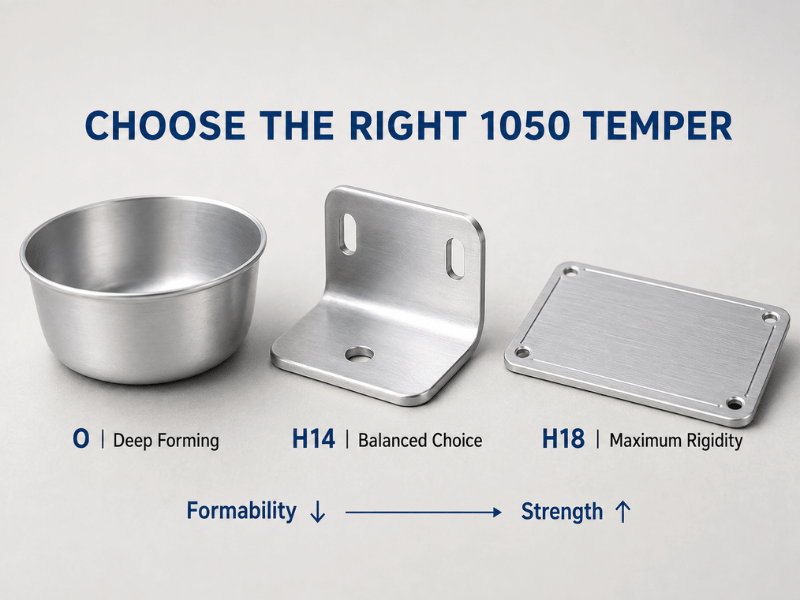
O 1050 é fornecido em toda a faixa de têmperas H endurecidas por encruamento, além da condição totalmente recozida O. Cada etapa troca conformabilidade por resistência, portanto a escolha da têmpera é realmente uma decisão entre resistência versus conformabilidade.
Alumínio 1050-O
O é a condição totalmente recozida, a mais macia. Possui a maior ductilidade e a melhor condutividade da família, razão pela qual é a escolha padrão para estampagem profunda, repuxo e qualquer peça que deva ser formada em formato complexo antes do uso. Refletores, carcaças de luminárias e corpos de utensílios de cozinha são tipicamente de têmpera O porque precisam ser conformados, não carregados.
Alumínio 1050-H12, H14, H16 e H18
Estas são têmperas progressivamente endurecidas por encruamento. O 1050-H12 é quarto duro e ainda se conforma facilmente; o 1050-H14 é o meio duro versátil usado para suportes moderadamente carregados, placas de identificação e painéis dobrados; o 1050-H16 é três quartos duro para componentes mais rígidos; o 1050-H18 é duro total e oferece a maior resistência comercial para peças rígidas e levemente conformadas, como chapas de impressão e placas de identificação decorativas. A resistência aumenta a cada etapa e a conformabilidade diminui, portanto escolha a têmpera mais dura que seu processo de conformação ainda possa aceitar.
Como Escolher a Têmpera Certa do 1050
Comece pela operação de conformação. Se a peça deve ser estampada profundamente, repuxada ou dobrada em raio apertado, escolha 1050-O; têmperas mais duras aumentam o risco de trincas e podem exigir um raio de dobra maior ou um recozimento intermediário. Se você precisa de resistência moderada com conformabilidade mantida, escolha 1050-H14, a têmpera intermediária mais comum. Escolha 1050-H18 somente quando a peça for quase plana ou de formato simples e você desejar rigidez máxima. Lembre-se de que soldar qualquer peça de têmpera H recozee a zona afetada pelo calor de volta à condição O, portanto projete considerando a menor resistência da zona afetada pelo calor amolecida.
Onde o Alumínio 1050 É Utilizado
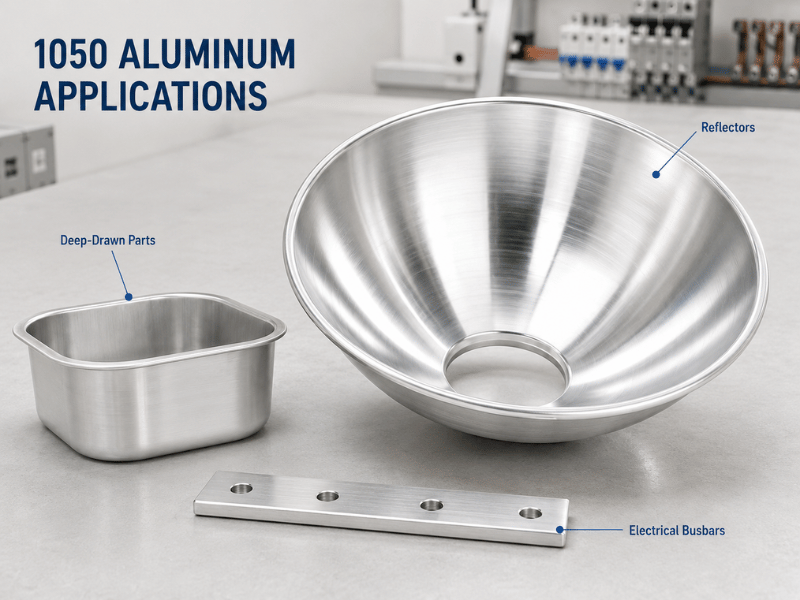
O 1050 se adequa a aplicações onde conformabilidade e resistência à corrosão importam mais que resistência mecânica. Sua resistência à corrosão atende muitos recipientes da indústria alimentícia e componentes de processos químicos, embora a adequação dependa do meio, temperatura, condição superficial e regulamentações aplicáveis de contato com alimentos ou de processo. Em chaparia em geral, conforma-se facilmente em rufos arquitetônicos, aletas de trocadores de calor e painéis de iluminação reflexivos. Sua condutividade o posiciona em barramentos e condutores elétricos leves, enquanto sua superfície brilhante e reflexiva o torna padrão para refletores de lâmpadas e placas de identificação decorativas.
1050 vs. 1060, 1100 e 3003
| Recurso | 1050 | 1060 | 1100 | 3003 |
| Teor de alumínio | 99,5% mín. | 99,6% mín. | 99,0% mín.; Cu controlado | Al balance; tipicamente 1,0–1,5% Mn |
| Resistência (O, MPa) | ~75 | ~70 | ~90 | ~110 |
| Resistência à corrosão | Excelente | Excelente | Excelente | Muito boa |
| Condutividade elétrica | ~61% IACS | 61-62% IACS | 59-62% IACS | 40-50% IACS |
| Formabilidade | Excelente | Excelente | Excelente | Boa (um pouco mais rígida) |
| Uso típico | Refletores, panelas, fios | Fios, peças de iluminação | Folha de alumínio, fios | Utensílios de cozinha, tanques |
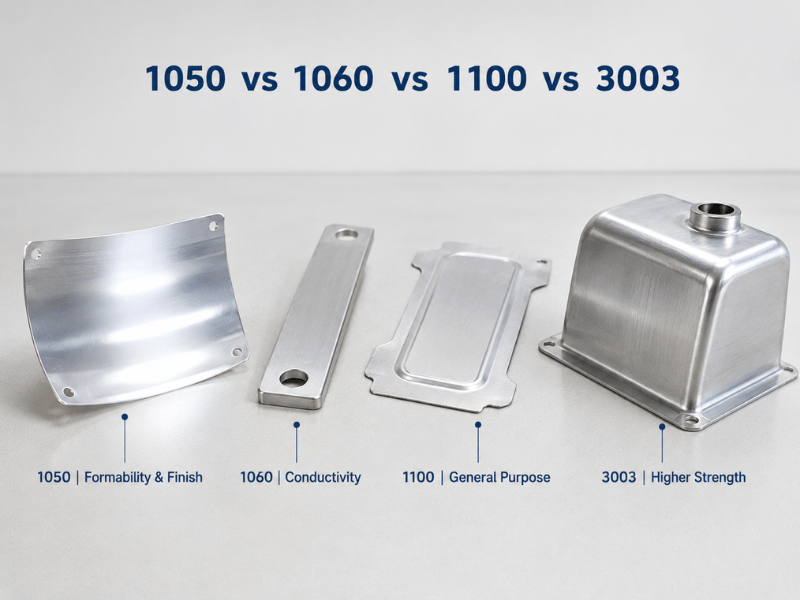
O 1050 e o 1060 são quase puros e ambos conduzem bem, portanto adequam-se a trabalhos elétricos e de conformação suaves. O 1100 contém cobre controlado para resistência ligeiramente maior, mantendo boa condutividade, favorecendo folhas e fios. O 3003 troca condutividade por resistência impulsionada pelo manganês, adequando-se a utensílios de cozinha e tanques mais robustos. Os valores de comparação na tabela são representativos e variam com têmpera, forma do produto e norma. Escolha 1050 quando conformabilidade máxima, acabamento superficial e anodização clara forem importantes; avance para 3003 quando a peça precisar de maior resistência.
Trabalhando com o Alumínio 1050
Formabilidade
A conformabilidade é a característica principal. O 1050 estampa profundamente, repuxa e dobra em raios muito apertados sem trincar, razão pela qual domina refletores, utensílios de cozinha e rufos arquitetônicos. Têmperas mais moles conformam melhor; têmperas mais duras exigem raios de dobra maiores.
Soldagem
O 1050 solda excepcionalmente bem por MIG e TIG. ER1100 ou outro metal de adição qualificado pode ser selecionado conforme o projeto da junta e os requisitos de serviço, e o aporte térmico deve ser controlado para proteger o material circundante. A ressalva crítica: a zona afetada pelo calor perde a resistência obtida pelo trabalho a frio e recozee de volta à condição O. Projete considerando a menor resistência da zona afetada pelo calor amolecida.
Usinagem
A usinabilidade é ruim, especialmente na têmpera O mole. O material é pegajoso e tende a se acumular na ferramenta de corte (aresta postiça). Use ferramentas muito afiadas com alto ângulo de saída positivo, altas velocidades de corte com avanço leve e boa lubrificação. Têmperas mais duras, como H14, usinam notavelmente melhor que O.
Anodização
O 1050 anodiza limpo em uma camada de óxido Tipo II clara e transparente que pode melhorar a resistência à corrosão sem alterar substancialmente a aparência, tornando-o útil para acabamentos funcionais e arquitetônicos. A aparência colorida depende da condição superficial, química do banho, sistema de corante e controle do processo, portanto requisitos cosméticos devem ser confirmados com uma amostra. Pode não ser a melhor escolha quando um acabamento opaco uniforme, como alguns acabamentos da série 6xxx, for necessário.
Vantagens e Limitações do Alumínio 1050
Pontos fortes
• Excelente conformabilidade para estampagem profunda, repuxo e dobra em raio apertado
• Resistência à corrosão excepcional em ambientes externos e úmidos
• Alta condutividade térmica e elétrica (~61% IACS)
• Resposta superior à anodização clara
• Amplamente reciclável; uso em contato com alimentos requer conformidade com regulamentações aplicáveis
Limitações
• Baixa resistência mecânica — geralmente inadequado para peças estruturais primárias de suporte de carga
• Não tratável termicamente; a resistência é elevada principalmente por trabalho a frio
• Usinabilidade ruim, especialmente na têmpera O
• A aparência do anodizado colorido requer controle de processo e aprovação de amostra
• As zonas soldadas amolecem de volta em direção ao temperamento O
Conclusão
A liga 1050 é a escolha certa quando uma peça precisa ser conformada, conduzir eletricidade ou resistir à corrosão mais do que suportar carga — mas sua baixa resistência e má usinabilidade a tornam geralmente inadequada para serviço estrutural primário de suporte de carga. Para um grau comercialmente puro confiável, a Linsy fornece a liga 1050 em fio, bobina e chapa, com usinagem CNC, soldagem TIG/MIG, corte a laser e acabamento de superfície disponíveis, além de certificado de material (MTC) por pedido e certificação ISO 9001/14001/45001; ensaios por SGS ou outros terceiros podem ser agendados mediante solicitação. Envie seu desenho ou especificação para a Linsy Aluminum para verificação de estoque e cotação.
Perguntas frequentes
A liga de alumínio 1050 pode ser tratada termicamente para aumentar sua resistência?
Não. A liga 1050 não é tratável termicamente — ela não pode ser submetida a tratamento térmico de solução ou envelhecimento como as ligas das séries 2xxx ou 6xxx. A resistência é aumentada principalmente por trabalho a frio, portanto escolha um temperamento H mais duro (H14, H16, H18) se precisar de maior capacidade de carga.
Qual é a diferença entre 1050-O e 1050-H14?
O temperamento O é totalmente recozido: mais macio, mais dúctil, ideal para estampagem profunda e repuxo. O H14 é meio-duro: aproximadamente 105–145 MPa de resistência à tração versus 60–100 MPa para o O, com alongamento muito menor. Escolha O quando a peça precisar ser conformada; escolha H14 quando precisar de resistência moderada após a conformação.
A liga de alumínio 1050 é fácil de soldar?
Sim. Ela solda bem por MIG e TIG. O ER1100 ou outro metal de adição qualificado pode ser selecionado de acordo com o projeto da junta e os requisitos de serviço. A zona afetada pelo calor recozee de volta em direção à condição macia O, portanto considere o amolecimento local em qualquer montagem soldada.
Como a liga 1050 difere do alumínio 1350?
A liga 1350 é otimizada para condutores elétricos com condutividade marginalmente maior, enquanto a 1050 favorece conformabilidade e resistência à corrosão com acabamento anodizado claro. Use 1350 para condutores e 1050 onde a conformação e a aparência superficial importam.
Por que escolher a liga 1050 em vez da 1060 ou 1100?
As ligas 1050 e 1060 são ambas quase puras e conduzem bem eletricidade; a pureza ligeiramente menor da 1050 ainda oferece excelente conformabilidade e acabamento anodizado claro. A 1100 contém cobre controlado para maior resistência, mas condutividade ligeiramente menor. Escolha 1050 quando conformabilidade, acabamento e resistência à corrosão liderarem a especificação.