Was ist Aluminium 1050?
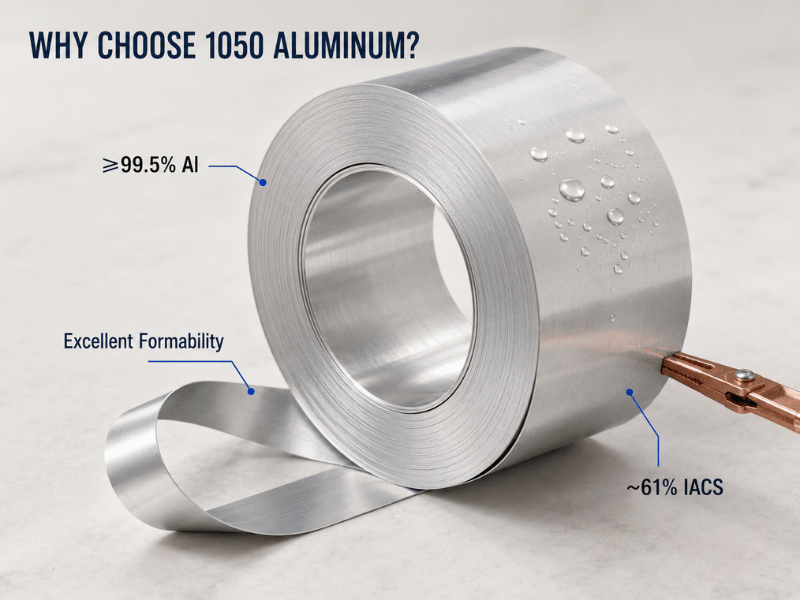
Aluminium 1050 ist eine handelsübliche, reine Knetlegierung der 1xxx-Serie mit einem Mindestaluminiumgehalt von 99,51 TP3T. Da es sich um nahezu reines Aluminium handelt, behält es die besten Eigenschaften des Grundmetalls: hohe Duktilität, ausgezeichnete Korrosionsbeständigkeit sowie hohe elektrische und thermische Leitfähigkeit. AA 1050/UNS A91050 und EN AW-1050A sind eng verwandte Bezeichnungen in verschiedenen Normungssystemen; die Bestellung sollte die maßgebende Norm angeben, da sich die Zusammensetzungsgrenzen geringfügig unterscheiden können.
1050 ist eine nicht aushärtbare Legierung. Sie kann nicht wie eine 2xxx- oder 6xxx-Legierung durch Lösungsglühen oder Altern gehärtet werden; ihre Festigkeit wird hauptsächlich durch Kaltverformung (Verfestigung) erhöht, ausgedrückt durch die H-Zustandsfamilie. Sobald man diese Tatsache versteht, fügen sich die übrigen Eigenschaften der Legierung – der weiche O-Zustand, die zunehmend härteren Zustände H12/H14/H16/H18 sowie der Kompromiss zwischen Festigkeit und Umformbarkeit – nahtlos ein.
Chemische Zusammensetzung
| Element | Maximaler Gehalt (%) | Rolle |
| Aluminium (Al) | 99,5 (Minimum) | Basismetall; hohe Reinheit bestimmt Leitfähigkeit, Umformbarkeit und Korrosionsbeständigkeit |
| Eisen (Fe) | 0.40 | Häufigste Verunreinigung; beeinflusst Festigkeit und Oberflächenbeschaffenheit |
| Silizium (Si) | 0.25 | Kontrollierte Verunreinigung; geringer Einfluss auf diesem Niveau |
| Kupfer (Cu) | 0.05 | Sehr niedrig gehalten, um die Korrosionsbeständigkeit zu erhalten |
| Mangan (Mn) | 0.05 | Geringer Verfestigungseffekt |
| Magnesium (Mg) | 0.05 | Nahezu kein Ausscheidungshärtungseffekt |
| Zink (Zn) | 0.05 | Kontrolliertes Spurenelement; übermäßige Gehalte können die Eigenschaften beeinflussen |
| Titan (Ti) | 0.03 | Spurenelement, das die Kornstruktur beeinflussen kann |
| Sonstige (jeweils) | 0.03 | Übrige Spurenelemente |
Die Zusammensetzung ist bewusst einfach gehalten. Mindestens 99,51 TP3T Aluminium halten die Legierung leicht, weich, umformbar und leitfähig, während Eisen und Silizium – die beiden in größten Mengen vorhandenen Verunreinigungen – Festigkeit, Leitfähigkeit, Verarbeitbarkeit und Oberflächenverhalten beeinflussen, ohne 1050 in eine ausscheidungshärtbare Legierung zu verwandeln. Diese hohe Reinheit ist genau der Grund, warum sich 1050 so gut biegen, tiefziehen und leiten lässt und warum es nicht wärmebehandelbar bleibt.
Mechanische und physikalische Eigenschaften
Eigenschaften nach Zustand
Da 1050 kaltverfestigt wird, hängt die Festigkeit stark vom Zustand ab. Die folgende Tabelle zeigt repräsentative Bereiche, keine allgemeingültigen Abnahmegrenzen; exakte Mindest- und Höchstwerte variieren je nach Produktform, Dicke, Orientierung und maßgebender Norm. Übliche Referenzen sind ASTM B209/B209M für Blech und Platte, ASTM B211/B211M für gewalzte oder kaltfertig bearbeitete Stangen, Stäbe und Drähte sowie – je nach Rohrform und Anwendung – ASTM B210/B210M, B221/B221M, B241/B241M, B483/B483M oder B491/B491M.
| Temperament | Zugfestigkeit (MPa) | Streckgrenze (MPa) | Dehnung (%) |
| O (geglüht) | 60–100 | 20–35 | 35–40 |
| H12 (viertelhart) | 85–125 | 65–95 | 12–20 |
| H14 (halbhart) | 105–145 | 85–115 | 8–12 |
| H16 (dreiviertelhart) | 120–160 | 100–130 | 6–10 |
| H18 (vollhart) | ≥135 | ≥120 | 2–6 |
Mit zunehmender Kaltverformung von O bis H18 steigen Zugfestigkeit und Streckgrenze, während die Dehnung stark abnimmt – H18 erreicht nahezu die maximale handelsübliche Festigkeit, verliert jedoch den Großteil seiner Duktilität. Die Härte folgt demselben Trend (etwa 20 HB im O-Zustand bis zu ca. 70 HB im H18-Zustand).
Physikalische Eigenschaften
| Eigentum | Wert |
| Dichte | 2,71 g/cm³ |
| Schmelzpunkt | 646–660 °C |
| Wärmeleitfähigkeit | 222–230 W/m·K |
| Elektrische Leitfähigkeit | ~611 TP3T IACS (weichgeglüht) |
| Wärmeausdehnungskoeffizient | 23,6 µm/m·K |
| Elastizitätsmodul | 69 GPa |
Diese Werte sind über alle Zustände nahezu konstant: Kaltverformung verändert Festigkeit und Härte, nicht die zugrunde liegenden physikalischen Konstanten. Die Leitfähigkeit von ~611 TP3T IACS macht 1050 zu einem Kandidaten für Stromschienen und leichte elektrische Leiter, knapp unter speziellen Elektroleitgüten wie 1350.
Zustände von Aluminium 1050
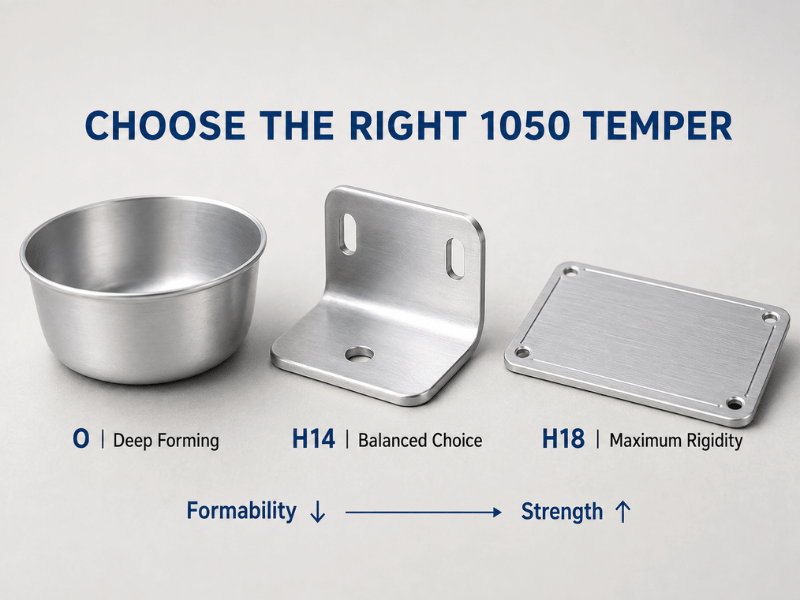
1050 wird über den gesamten Bereich der kaltverfestigten H-Zustände sowie im vollständig weichgeglühten O-Zustand geliefert. Jede Stufe tauscht Umformbarkeit gegen Festigkeit, sodass die Wahl des Zustands im Wesentlichen eine Entscheidung zwischen Festigkeit und Umformbarkeit ist.
Aluminium 1050-O
O ist der vollständig weichgeglühte, weichste Zustand. Er weist die höchste Duktilität und die beste Leitfähigkeit der Familie auf, weshalb er die Standardwahl für Tiefziehen, Drücken und alle Teile ist, die vor der Verwendung in eine komplexe Form gebracht werden müssen. Reflektoren, Lampengehäuse und Kochgeschirrkörper werden typischerweise im O-Zustand gefertigt, da sie geformt und nicht belastet werden müssen.
Aluminium 1050-H12, H14, H16 und H18
Dies sind zunehmend kaltverfestigte Zustände. 1050-H12 ist viertelhart und lässt sich noch leicht umformen; 1050-H14 ist der halbharte Allrounder für mäßig belastete Halterungen, Typenschilder und gebogene Paneele; 1050-H16 ist dreiviertelhart für steifere Bauteile; 1050-H18 ist vollhart und bietet die höchste handelsübliche Festigkeit für starre, leicht geformte Teile wie Druckplatten und dekorative Typenschilder. Die Festigkeit steigt mit jeder Stufe, die Umformbarkeit nimmt ab – wählen Sie daher den härtesten Zustand, den Ihr Umformprozess noch verarbeiten kann.
So wählen Sie den richtigen 1050-Zustand
Beginnen Sie mit dem Umformverfahren. Muss das Teil tiefgezogen, gedrückt oder mit engem Biegeradius gebogen werden, wählen Sie 1050-O; härtere Zustände erhöhen das Rissrisiko und erfordern möglicherweise einen größeren Biegeradius oder eine Zwischenglühung. Benötigen Sie mittlere Festigkeit bei erhaltener Biegefähigkeit, wählen Sie 1050-H14, den gebräuchlichsten Zwischenzustand. Wählen Sie 1050-H18 nur, wenn das Teil nahezu flach oder einfach geformt ist und maximale Steifigkeit gewünscht wird. Beachten Sie, dass das Schweißen jedes H-Zustands die Wärmeeinflusszone zurück in Richtung O-Zustand glüht – konstruieren Sie daher um die geringere Festigkeit der aufgeweichten Wärmeeinflusszone herum.
Wo Aluminium 1050 verwendet wird
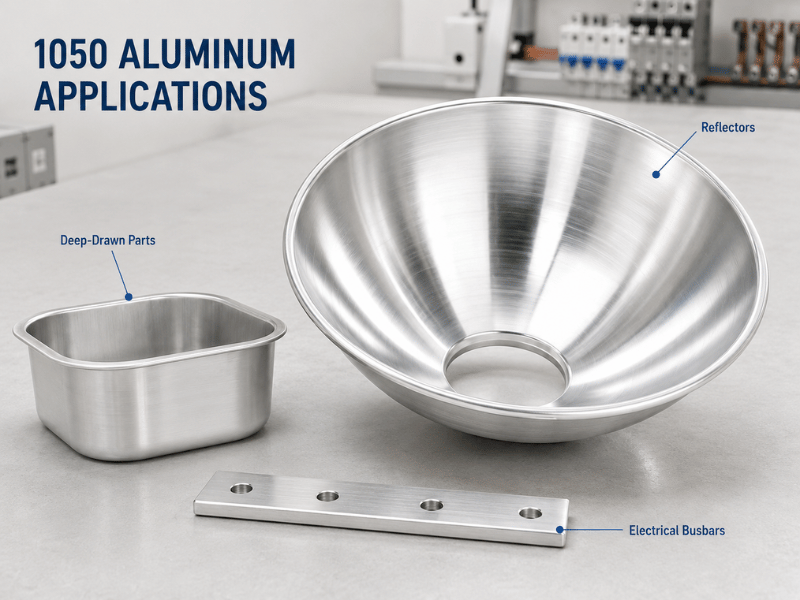
1050 eignet sich für Anwendungen, bei denen Umformbarkeit und Korrosionsbeständigkeit wichtiger sind als Festigkeit. Seine Korrosionsbeständigkeit macht es für viele Behälter der Lebensmittelindustrie und Komponenten chemischer Prozesse geeignet, wobei die Eignung vom Medium, der Temperatur, dem Oberflächenzustand und den geltenden Lebensmittelkontakt- oder Prozessvorschriften abhängt. In der allgemeinen Blechbearbeitung lässt es sich leicht zu architektonischen Abschlussblechen, Wärmetauscherlamellen und reflektierenden Beleuchtungspaneelen formen. Seine Leitfähigkeit bringt es in Stromschienen und leichte elektrische Leiter, während seine helle, reflektierende Oberfläche es zum Standard für Lampenreflektoren und dekorative Typenschilder macht.
1050 im Vergleich zu 1060, 1100 und 3003
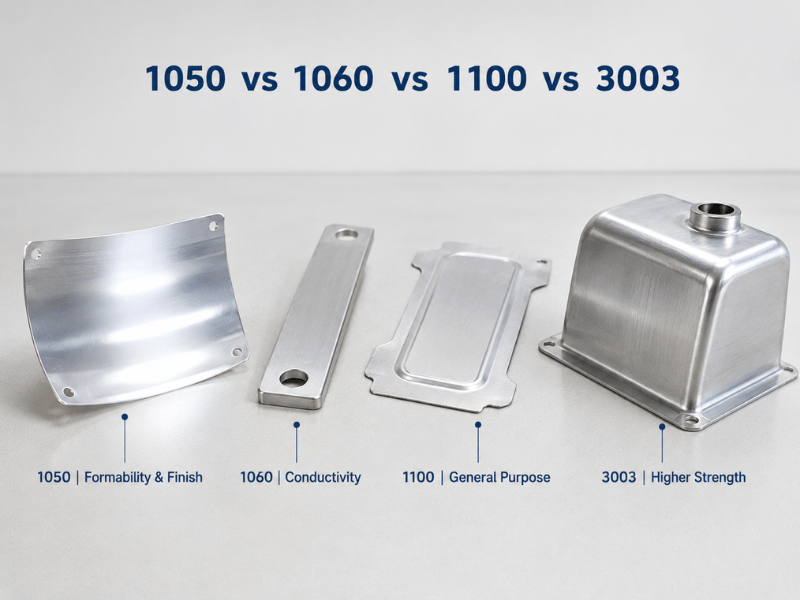
| Merkmal | 1050 | 1060 | 1100 | 3003 |
| Aluminiumgehalt | 99,51 TP3T min | 99,61 TP3T min | 99,01 TP3T min; kontrolliertes Cu | Al Rest; typischerweise 1,0–1,51 TP3T Mn |
| Festigkeit (O, MPa) | ~75 | ~70 | ~90 | ~110 |
| Korrosionsbeständigkeit | Ausgezeichnet | Ausgezeichnet | Ausgezeichnet | Very good |
| Elektrische Leitfähigkeit | ~611 TP3T IACS | 61-62% IACS | 59-62% IACS | 40-50% IACS |
| Verformbarkeit | Ausgezeichnet | Ausgezeichnet | Ausgezeichnet | Gut (etwas steifer) |
| Typische Verwendung | Reflektoren, Pfannen, Draht | Drähte, leichte Teile | Folie, Drähte | Kochgeschirr, Tanks |
1050 und 1060 sind nahezu rein und beide gut leitfähig, daher eignen sie sich für weiche elektrische und umformende Anwendungen. 1100 enthält kontrolliertes Kupfer für etwas mehr Festigkeit bei guter Leitfähigkeit und wird bevorzugt für Folie und Draht verwendet. 3003 tauscht Leitfähigkeit gegen manganbedingte Festigkeit und eignet sich für robustere Kochgeschirre und Tanks. Die Vergleichswerte in der Tabelle sind repräsentativ und variieren je nach Zustand, Produktform und Norm. Wählen Sie 1050, wenn maximale Umformbarkeit, Oberflächengüte und klares Eloxieren entscheidend sind; steigen Sie auf 3003 um, wenn das Teil höhere Festigkeit benötigt.
Verarbeitung von Aluminium 1050
Verformbarkeit
Umformbarkeit ist die herausragende Eigenschaft. 1050 lässt sich tiefziehen, drücken und mit sehr engen Radien biegen, ohne zu reißen – deshalb dominiert es Reflektoren, Kochgeschirr und architektonische Abschlussbleche. Weichere Zustände formen sich am besten; härtere Zustände erfordern größere Biegeradien.
Schweißen
1050 lässt sich hervorragend mit MIG und WIG schweißen. ER1100 oder ein anderes qualifiziertes Zusatzmaterial kann je nach Schweißnahtkonstruktion und Betriebsanforderungen gewählt werden; die Wärmezufuhr sollte kontrolliert werden, um das umgebende Material zu schützen. Der entscheidende Vorbehalt: Die Wärmeeinflusszone verliert die durch Kaltverformung gewonnene Festigkeit und glüht zurück in Richtung O-Zustand. Konstruieren Sie um die geringere Festigkeit der aufgeweichten Wärmeeinflusszone herum.
Bearbeitung
Die Zerspanbarkeit ist schlecht, insbesondere im weichen O-Zustand. Das Material ist zäh und neigt zum Aufbau an der Schneide (Aufbauschneide). Verwenden Sie sehr scharfe Werkzeuge mit hohem positivem Spanwinkel, hohe Schnittgeschwindigkeiten mit geringem Vorschub und gute Schmierung. Härtere Zustände wie H14 lassen sich deutlich besser zerspanen als O.
Eloxieren
1050 lässt sich sauber zu einer klaren, transparenten Typ-II-Oxidschicht eloxieren, die die Korrosionsbeständigkeit verbessern kann, ohne das Erscheinungsbild wesentlich zu verändern, was es für funktionale und architektonische Oberflächen nützlich macht. Das farbige Erscheinungsbild hängt von Oberflächenzustand, Badchemie, Farbsystem und Prozesskontrolle ab, daher sollten kosmetische Anforderungen mit einem Muster bestätigt werden. Es ist möglicherweise nicht die beste Wahl, wenn ein gleichmäßiges, deckendes Erscheinungsbild wie bei einigen 6xxx-Oberflächen gefordert ist.
Vorteile und Grenzen von Aluminium 1050
Stärken
• Ausgezeichnete Umformbarkeit für Tiefziehen, Drücken und Biegen mit engem Radius
• Hervorragende Korrosionsbeständigkeit in Außen- und Feuchtumgebungen
• Hohe thermische und elektrische Leitfähigkeit (~611 TP3T IACS)
• Überlegenes Verhalten beim Klareloxieren
• Weitgehend recycelbar; Lebensmittelkontakt erfordert die Einhaltung geltender Vorschriften
Beschränkungen
• Geringe Festigkeit – allgemein ungeeignet für primär lasttragende Strukturbauteile
• Nicht wärmebehandelbar; Festigkeit wird hauptsächlich durch Kaltverformung erhöht
• Schlechte Zerspanbarkeit, insbesondere im O-Zustand
• Farbige Eloxaloberflächen erfordern Prozesskontrolle und Musterfreigabe
• Schweißzonen erweichen zurück in Richtung des O-Zustands
Schlussfolgerung
1050 ist die richtige Wahl, wenn ein Bauteil eher umgeformt werden, Strom leiten oder Korrosion widerstehen muss, als dass es Last tragen muss – jedoch machen die geringe Festigkeit und die schlechte Zerspanbarkeit es für primär lasttragende Strukturanwendungen grundsätzlich ungeeignet. Als zuverlässige handelsübliche Reinheitsstufe liefert Linsy 1050 in Draht-, Coil- und Plattenform, mit CNC-Bearbeitung, TIG/MIG-Schweißen, Laserschneiden und Oberflächenveredelung, zusätzlich mit Werkszeugnis pro Bestellung und ISO-9001/14001/45001-Zertifizierung; SGS- oder andere Drittprüfungen können auf Anfrage arrangiert werden. Senden Sie Ihre Zeichnung oder Spezifikation an Linsy Aluminum für eine Lagerprüfung und ein Angebot.
Häufig gestellte Fragen
Kann Aluminium 1050 durch Wärmebehandlung festigkeitstechnisch verbessert werden?
Nein. 1050 ist nicht aushärtbar – es kann nicht wie die Legierungen der Serien 2xxx oder 6xxx lösungsgeglüht oder ausgelagert werden. Die Festigkeit wird hauptsächlich durch Kaltverfestigung erhöht; wählen Sie daher einen härteren H-Zustand (H14, H16, H18), wenn Sie eine höhere Tragfähigkeit benötigen.
Was ist der Unterschied zwischen 1050-O und 1050-H14?
O ist vollständig weichgeglüht: am weichsten, am duktlisten, am besten geeignet für Tiefziehen und Drücken. H14 ist halbhart: etwa 105–145 MPa Zugfestigkeit gegenüber 60–100 MPa bei O, mit deutlich geringerer Dehnung. Wählen Sie O, wenn das Bauteil umgeformt werden muss; wählen Sie H14, wenn Sie nach der Umformung eine mittlere Festigkeit benötigen.
Ist Aluminium 1050 leicht zu schweißen?
Ja. Es lässt sich gut mit MIG und TIG schweißen. ER1100 oder ein anderes qualifiziertes Zusatzmaterial kann je nach Schweißnahtkonstruktion und Betriebsanforderungen ausgewählt werden. Die Wärmeeinflusszone glüht zurück in den weichen O-Zustand, daher muss bei jeder geschweißten Baugruppe eine lokale Entfestigung berücksichtigt werden.
Wie unterscheidet sich 1050 von Aluminium 1350?
1350 ist für elektrische Leiter optimiert und weist eine geringfügig höhere Leitfähigkeit auf, während 1050 Umformbarkeit und Korrosionsbeständigkeit mit einer klaren Eloxaloberfläche bevorzugt. Verwenden Sie 1350 für Leiter und 1050, wenn Formgebung und Oberflächenbild entscheidend sind.
Warum 1050 anstelle von 1060 oder 1100 wählen?
1050 und 1060 sind beide nahezu rein und leitfähig; die geringfügig niedrigere Reinheit von 1050 bietet dennoch hervorragende Umformbarkeit und eine klare eloxierte Oberfläche. 1100 enthält kontrolliertes Kupfer für höhere Festigkeit, jedoch mit geringfügig niedrigerer Leitfähigkeit. Wählen Sie 1050, wenn Umformbarkeit, Oberfläche und Korrosionsbeständigkeit die Spezifikation bestimmen.