¿Qué es el aluminio 1050?
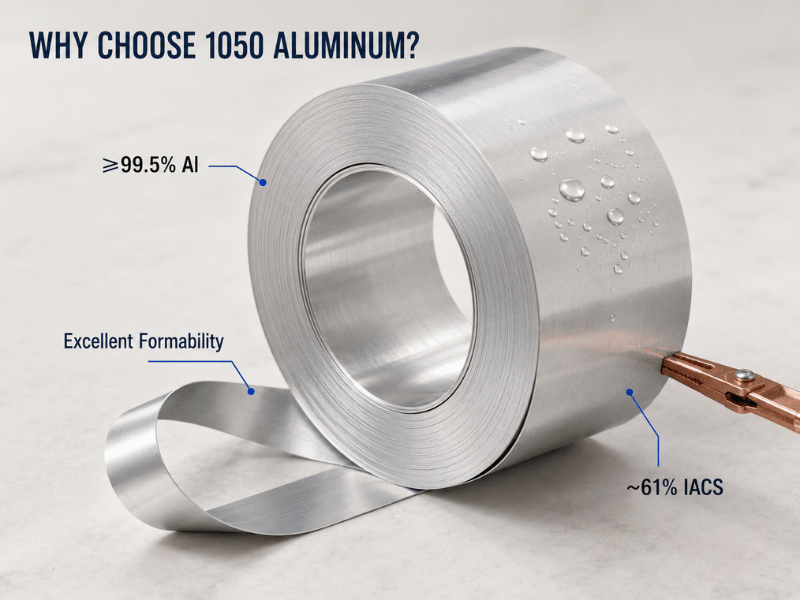
El aluminio 1050 es una aleación comercialmente pura forjada de la serie 1xxx, con un contenido mínimo de aluminio del 99,5%. Debido a que es casi aluminio puro, conserva las mejores características del metal base: alta ductilidad, excelente resistencia a la corrosión y una fuerte conductividad eléctrica y térmica. AA 1050/UNS A91050 y EN AW-1050A son designaciones estrechamente relacionadas bajo diferentes sistemas; la orden de compra debe indicar la norma aplicable, ya que los límites de composición pueden diferir ligeramente.
El 1050 es una aleación no tratable térmicamente. No puede endurecerse mediante tratamiento térmico de solución o envejecimiento como una aleación 2xxx o 6xxx; su resistencia se incrementa principalmente mediante trabajo en frío (endurecimiento por deformación), expresado a través de la familia de temple H. Una vez que se comprende ese único hecho, el resto del comportamiento de la aleación — temple blando O, temples progresivamente más duros H12/H14/H16/H18, y la compensación entre resistencia y formabilidad — encaja en su lugar.
Composición química
| Elemento | Contenido máximo (%) | Papel |
| Aluminio (Al) | 99,5 (mínimo) | Metal base; la alta pureza impulsa la conductividad, la formabilidad y la resistencia a la corrosión |
| Hierro (Fe) | 0.40 | Impureza más abundante; afecta la resistencia y el acabado superficial |
| Silicio (Si) | 0.25 | Impureza controlada; efecto menor en este nivel |
| Cobre (Cu) | 0.05 | Se mantiene muy baja para preservar la resistencia a la corrosión |
| Manganeso (Mn) | 0.05 | Efecto de endurecimiento mínimo |
| Magnesio (Mg) | 0.05 | Casi ningún efecto de endurecimiento por precipitación |
| Zinc (Zn) | 0.05 | Elemento traza controlado; niveles excesivos pueden afectar las propiedades |
| Titanio (Ti) | 0.03 | Elemento traza que puede influir en la estructura del grano |
| Otros (cada uno) | 0.03 | Elementos traza restantes |
La composición es deliberadamente simple. Al menos 99,5% de aluminio mantiene la aleación ligera, blanda, formable y conductora, mientras que el hierro y el silicio — las dos impurezas presentes en mayores cantidades — influyen en la resistencia, la conductividad, la trabajabilidad y la respuesta superficial sin convertir al 1050 en una aleación endurecible por precipitación. Esta alta pureza es exactamente la razón por la que el 1050 se dobla, embute y conduce tan bien, y por la que permanece sin tratamiento térmico.
Propiedades mecánicas y físicas
Propiedades según el temple
Debido a que el 1050 se endurece por deformación, la resistencia depende en gran medida del temple. La tabla siguiente ofrece rangos representativos, no límites de aceptación universales; los mínimos y máximos exactos varían según la forma del producto, el espesor, la orientación y la norma aplicable. Las referencias comunes incluyen ASTM B209/B209M para chapa y placa, ASTM B211/B211M para barra, varilla y alambre laminados o acabados en frío, y, según la forma del tubo y el servicio, ASTM B210/B210M, B221/B221M, B241/B241M, B483/B483M o B491/B491M.
| Temple | Resistencia a la tracción (MPa) | Límite elástico (MPa) | Alargamiento (%) |
| O (recocido) | 60–100 | 20–35 | 35–40 |
| H12 (cuarto duro) | 85–125 | 65–95 | 12–20 |
| H14 (medio duro) | 105–145 | 85–115 | 8–12 |
| H16 (tres cuartos duro) | 120–160 | 100–130 | 6–10 |
| H18 (totalmente duro) | ≥135 | ≥120 | 2–6 |
A medida que el trabajo en frío aumenta de O a H18, la resistencia a la tracción y el límite elástico aumentan mientras que el alargamiento colapsa — H18 alcanza una resistencia comercial casi máxima pero pierde la mayor parte de su ductilidad. La dureza sigue la misma tendencia (aproximadamente 20 HB en O hasta ~70 HB en H18).
Propiedades físicas
| Propiedad | Valor |
| Densidad | 2,71 g/cm³ |
| Punto de fusión | 646–660 °C |
| Conductividad térmica | 222–230 W/m·K |
| Conductividad eléctrica | ~61% IACS (recocido) |
| Coeficiente de expansión térmica | 23,6 µm/m·K |
| Módulo de Young | 69 GPa |
Estos valores son casi constantes en todos los temples: el trabajo en frío cambia la resistencia y la dureza, no las constantes físicas subyacentes. La conductividad de ~61% IACS es lo que convierte al 1050 en un candidato para barras colectoras y conductores eléctricos de servicio ligero, situándose justo por debajo de los grados eléctricos dedicados como el 1350.
Temples del aluminio 1050
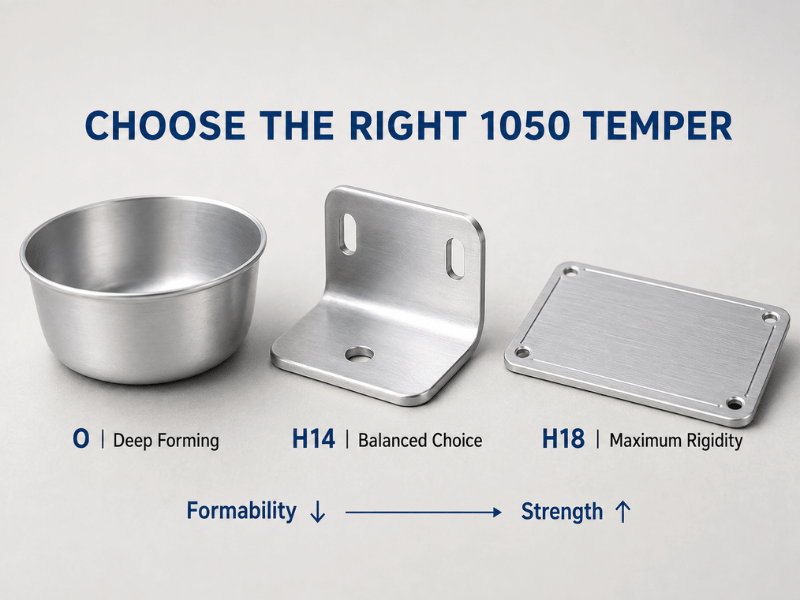
El 1050 se suministra en toda la gama de temples H endurecidos por deformación, más la condición completamente recocida O. Cada paso intercambia formabilidad por resistencia, por lo que la elección del temple es realmente una decisión entre resistencia y formabilidad.
Aluminio 1050-O
O es la condición completamente recocida, la más blanda. Tiene la mayor ductilidad y la mejor conductividad de la familia, razón por la cual es la opción predeterminada para embutición profunda, hilado y cualquier pieza que deba formarse en una forma compleja antes de su uso. Los reflectores, las carcasas de lámparas y los cuerpos de utensilios de cocina son típicamente de temple O porque necesitan ser formados, no cargados.
Aluminio 1050-H12, H14, H16 y H18
Estos son temples progresivamente endurecidos por deformación. El 1050-H12 es cuarto duro y aún se forma fácilmente; el 1050-H14 es el temple medio duro de uso general para soportes con carga moderada, placas de identificación y paneles doblados; el 1050-H16 es tres cuartos duro para componentes más rígidos; el 1050-H18 es totalmente duro y ofrece la mayor resistencia comercial para piezas rígidas con formación ligera, como planchas de impresión y placas de identificación decorativas. La resistencia aumenta con cada paso y la formabilidad disminuye, así que seleccione el temple más duro que su proceso de formación aún pueda aceptar.
Cómo elegir el temple correcto de 1050
Comience por la operación de formación. Si la pieza debe embutirse profundamente, hilarse o doblarse con un radio cerrado, elija 1050-O; los temples más duros aumentan el riesgo de agrietamiento y pueden requerir un radio de curvatura mayor o un recocido intermedio. Si necesita resistencia moderada con flexibilidad de doblado conservada, elija 1050-H14, el temple intermedio más común. Elija 1050-H18 solo cuando la pieza sea casi plana o de forma simple y desee máxima rigidez. Recuerde que soldar cualquier pieza en temple H recuece la zona afectada por el calor de vuelta hacia O, así que diseñe en torno a la menor resistencia de la zona afectada por el calor ablandada.
Dónde se utiliza el aluminio 1050
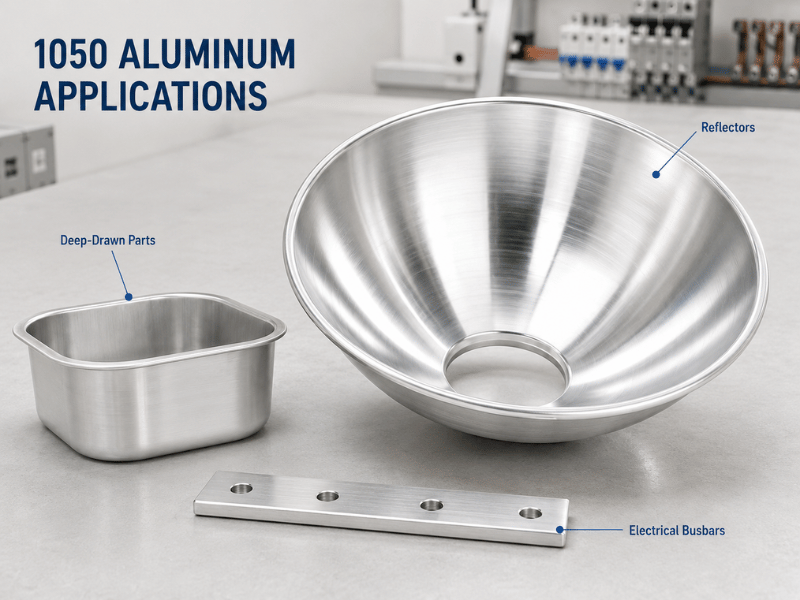
El 1050 se adapta a aplicaciones donde la formabilidad y la resistencia a la corrosión importan más que la resistencia. Su resistencia a la corrosión es adecuada para muchos contenedores de la industria alimentaria y componentes de procesos químicos, aunque la idoneidad depende del medio, la temperatura, la condición superficial y las regulaciones aplicables de contacto con alimentos o de proceso. En trabajos generales de chapa metálica, se forma fácilmente en vierteaguas arquitectónicos, aletas de intercambiadores de calor y paneles de iluminación reflectantes. Su conductividad lo sitúa en barras colectoras y conductores eléctricos ligeros, mientras que su superficie brillante y reflectante lo convierte en un estándar para reflectores de lámparas y placas de identificación decorativas.
1050 vs. 1060, 1100 y 3003
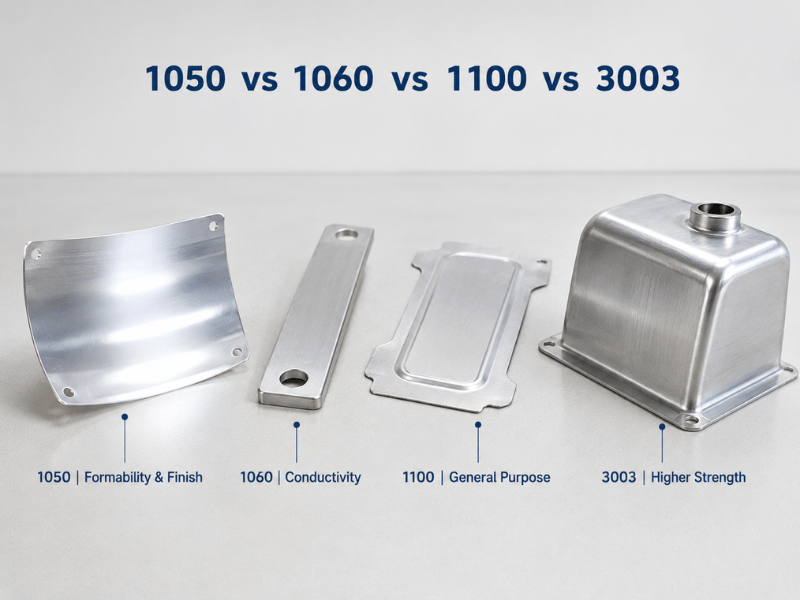
| Característica | 1050 | 1060 | 1100 | 3003 |
| Contenido de aluminio | 99,5% mín. | 99,6% mín. | 99,0% mín.; Cu controlado | Balance de Al; típicamente 1,0–1,5% Mn |
| Resistencia (O, MPa) | ~75 | ~70 | ~90 | ~110 |
| Resistencia a la corrosión | Excelente | Excelente | Excelente | Muy buena |
| Conductividad eléctrica | ~61% IACS | 61-62% IACS | 59-62% IACS | 40-50% IACS |
| Formabilidad | Excelente | Excelente | Excelente | Buena (ligeramente más rígido) |
| Uso típico | Reflectores, cacerolas, alambre | Cables, piezas ligeras | Láminas, alambres | Utensilios de cocina, tanques |
El 1050 y el 1060 son casi puros y ambos conducen bien, por lo que son adecuados para trabajos eléctricos y de formación suaves. El 1100 contiene cobre controlado para una resistencia ligeramente mayor mientras mantiene buena conductividad, favoreciendo láminas y alambre. El 3003 intercambia conductividad por resistencia impulsada por manganeso, adaptándose a utensilios de cocina y tanques más robustos. Los valores de comparación en la tabla son representativos y varían con el temple, la forma del producto y la norma. Elija 1050 cuando la formabilidad máxima, el acabado superficial y el anodizado claro importen; suba a 3003 cuando la pieza necesite mayor resistencia.
Trabajo con aluminio 1050
Formabilidad
La formabilidad es la característica principal. El 1050 se embute profundamente, se hila y se dobla con radios muy cerrados sin agrietarse, razón por la cual domina en reflectores, utensilios de cocina y vierteaguas arquitectónicos. Los temples más blandos forman mejor; los temples más duros requieren radios de curvatura más amplios.
Soldadura
El 1050 suelda excepcionalmente bien por MIG y TIG. Se puede seleccionar ER1100 u otro material de aporte calificado según el diseño de la unión y los requisitos de servicio, y el aporte de calor debe controlarse para proteger el material circundante. La advertencia crítica: la zona afectada por el calor pierde la resistencia obtenida por trabajo en frío y se recuece de vuelta hacia la condición O. Diseñe en torno a la menor resistencia de la zona afectada por el calor ablandada.
Mecanizado
La maquinabilidad es pobre, especialmente en el temple blando O. El material es gomoso y tiende a acumularse en la herramienta de corte (filo recrecido). Utilice herramientas muy afiladas con ángulo de desprendimiento altamente positivo, altas velocidades de corte con avance ligero y buena lubricación. Los temples más duros como H14 se mecanizan notablemente mejor que O.
Anodizado
El 1050 se anodiza limpiamente en una capa de óxido Tipo II clara y transparente que puede mejorar la resistencia a la corrosión sin cambiar sustancialmente la apariencia, lo que lo hace útil para acabados funcionales y arquitectónicos. La apariencia de color depende de la condición superficial, la química del baño, el sistema de tinte y el control del proceso, por lo que los requisitos cosméticos deben confirmarse con una muestra. Puede no ser la mejor opción cuando se requiere una apariencia opaca uniforme como algunos acabados de la serie 6xxx.
Ventajas y limitaciones del aluminio 1050
Fortalezas
• Excelente formabilidad para embutición profunda, hilado y doblado con radio cerrado
• Resistencia a la corrosión sobresaliente en entornos exteriores y húmedos
• Alta conductividad térmica y eléctrica (~61% IACS)
• Respuesta superior al anodizado claro
• Ampliamente reciclable; el uso en contacto con alimentos requiere cumplimiento de las regulaciones aplicables
Limitaciones
• Baja resistencia — generalmente inadecuado para piezas estructurales primarias que soportan carga
• No tratable térmicamente; la resistencia se incrementa principalmente mediante trabajo en frío
• Maquinabilidad deficiente, especialmente en temple O
• La apariencia de anodizado de color requiere control de proceso y aprobación de muestras
• Las zonas soldadas se ablandan volviendo al temple O
Conclusión
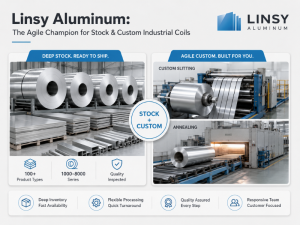
1050 es la elección correcta cuando una pieza debe conformarse, conducir o resistir la corrosión más de lo que debe soportar carga — pero su baja resistencia y deficiente maquinabilidad la hacen generalmente inadecuada para aplicaciones estructurales primarias de soporte de carga. Para un grado comercialmente puro confiable, Linsy suministra 1050 en alambre, bobina y placa, con mecanizado CNC, soldadura TIG/MIG, corte por láser y acabado superficial disponibles, además de un certificado de materiales (MTC) por pedido y certificación ISO 9001/14001/45001; se puede coordinar inspección por SGS u otros terceros bajo solicitud. Envíe su plano o especificación a Linsy Aluminum para verificación de existencias y cotización.
Preguntas frecuentes
¿Puede el aluminio 1050 tratarse térmicamente para aumentar su resistencia?
No. El 1050 no es tratable térmicamente — no puede someterse a tratamiento térmico de solución ni envejecimiento como las aleaciones 2xxx o 6xxx. La resistencia se incrementa principalmente mediante trabajo en frío, por lo que se debe elegir un temple H más duro (H14, H16, H18) si se necesita mayor capacidad de carga.
¿Cuál es la diferencia entre 1050-O y 1050-H14?
El temple O es completamente recocido: el más blando, con mayor ductilidad, ideal para embutición profunda y repujado. El H14 es semiduro: aproximadamente 105–145 MPa de resistencia a la tracción frente a 60–100 MPa del O, con una elongación mucho menor. Elija O cuando deba conformar la pieza; elija H14 cuando necesite resistencia moderada después del conformado.
¿Es fácil soldar el aluminio 1050?
Sí. Se suelda bien mediante MIG y TIG. Se puede seleccionar ER1100 u otro material de aporte calificado según el diseño de la unión y los requisitos de servicio. La zona afectada por el calor se recuece volviendo a la condición blanda O, por lo que se debe considerar el ablandamiento local en cualquier ensamblaje soldado.
¿En qué se diferencia el 1050 del aluminio 1350?
El 1350 está optimizado para conductores eléctricos con una conductividad ligeramente superior, mientras que el 1050 favorece la conformabilidad y la resistencia a la corrosión con un acabado anodizado claro. Use 1350 para conductores y 1050 donde importen el conformado y la apariencia superficial.
¿Por qué elegir 1050 en lugar de 1060 o 1100?
El 1050 y el 1060 son ambos casi puros y conducen bien; la pureza ligeramente inferior del 1050 aún ofrece excelente conformabilidad y un acabado anodizado claro. El 1100 contiene cobre controlado para mayor resistencia pero conductividad ligeramente menor. Elija 1050 cuando la conformabilidad, el acabado y la resistencia a la corrosión lideren la especificación.