¿Qué es el aluminio 1350?
El 1350 es una aleación de la serie 1xxx con un contenido mínimo de aluminio del 99,50%, y es la aleación que la Aluminum Association designa como grado EC (Electrical Conductor). No es tratable térmicamente — obtiene la poca resistencia que tiene mediante endurecimiento por deformación en frío, no mediante tratamiento de solución y envejecimiento como las aleaciones 6xxx o 2xxx.
Esa pureza es el punto central: el hierro y el silicio se mantienen en límites bajos específicamente para proteger la conductividad eléctrica, lo que convierte al 1350 en la elección estándar para alambre, barra colectora y devanados de transformadores en lugar de para piezas estructurales. El compromiso definitorio es la máxima conductividad a costa de baja resistencia — y ese compromiso es exactamente la razón por la que el temple que se elija (O para conformado, H19 para resistencia) importa más que cualquier otra especificación.
Composición química del aluminio 1350
El 1350 se controla casi enteramente por los límites máximos de impurezas, porque el metal base ya es 99,5% aluminio. El hierro y el silicio son los dos elementos más perjudiciales para la conductividad, por lo que sus límites son estrictos.
| Elemento | Contenido (máx. salvo indicación) |
|---|---|
| Aluminio (Al) | 99,50% mínimo (balance) |
| Silicio (Si) | 0.10% |
| Hierro (Fe) | 0.40% |
| Cobre (Cu) | 0.05% |
| Manganeso (Mn) | 0.01% |
| Magnesio (Mg) | 0.01% |
| Cromo (Cr) | 0.01% |
| Zinc (Zn) | 0.05% |
| Titanio (Ti) | 0.02% |
| Otros (cada uno / total) | 0.03% / 0.10% |
La relación hierro-silicio también importa en la práctica: el alambre conductor de grado EC normalmente se especifica con Fe + Si controlados de modo que la suma se mantenga lo suficientemente baja para proteger la conductividad. Para uso eléctrico, la tabla de composición anterior es la base de aceptación (ASTM B230 / B233, EN AW-1350, GB 1A35).
Propiedades físicas y mecánicas del aluminio 1350
El número único que define al 1350 es su conductividad eléctrica — un mínimo garantizado de 61,2% IACS (International Annealed Copper Standard), comúnmente especificado en 61,8% IACS. Es la conductividad más alta de cualquier aleación de aluminio forjado convencional y la razón por la que el cobre se reemplaza por 1350 en conductores sensibles al peso.
| Propiedad | Valor |
|---|---|
| Densidad | 2,70 g/cm³ |
| Rango de fusión | 646–657 °C |
| Conductividad eléctrica | ≥ 61,2% IACS (comúnmente 61,8% IACS) |
| Conductividad térmica | ~234 W/(m·K) |
| Módulo de elasticidad | ~68,9 GPa |
| Resistencia a la tracción, temple O | 60–100 MPa |
| Resistencia a la tracción, temple H19 | 150–200 MPa |
| Límite elástico, temple O | 20–50 MPa |
| Límite elástico, temple H19 | 145–185 MPa |
| Alargamiento, O / H19 | ≥ 20% / ≥ 1,5% |
La conductividad permanece esencialmente constante entre temples — aproximadamente 61,8% IACS tanto en O como en H19 — por lo que seleccionar H19 por resistencia no cuesta capacidad de conducción de corriente. Los valores mecánicos anteriores son para alambre según ASTM B230; la chapa y otras formas escalan con la misma lógica de trabajo en frío pero utilizan valores específicos de la forma.
Temperaturas comunes del aluminio 1350
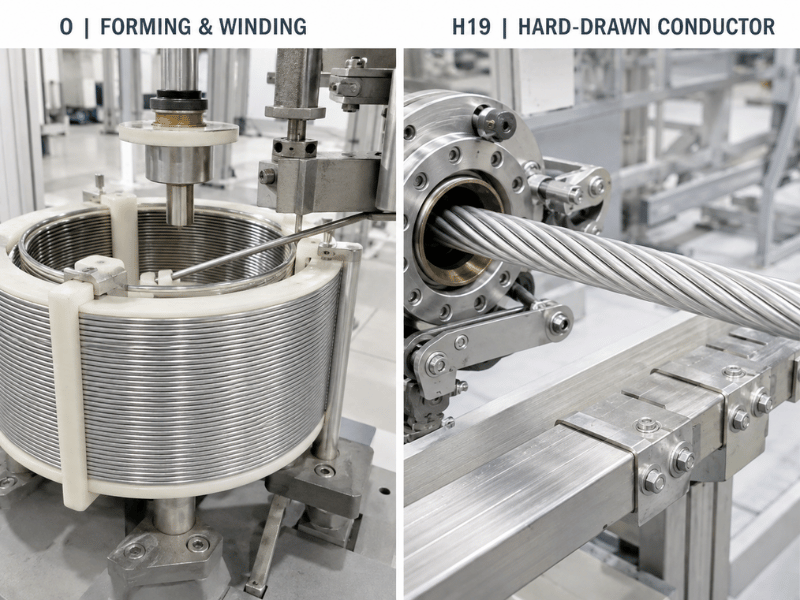
El 1350 se refuerza únicamente mediante trabajo en frío (endurecimiento por deformación), nunca mediante tratamiento térmico. Partiendo de la condición O totalmente blanda, cada paso H1x aplica más reducción y recocido parcial para aumentar la resistencia a expensas del alargamiento.
| Temple | Nivel de endurecimiento por deformación | UTS típico (MPa) | Lo mejor para |
|---|---|---|---|
| O | Totalmente recocido, blando | 60–100 | Trefilado, bobinado, dobleces cerrados |
| H12–H18 | Trabajo en frío progresivo entre O y H19 | Aumenta de ~90 hacia ~170 a lo largo de la escala | Conductores conformados que necesitan más rigidez que O |
| H19 | Duro total (alambre EC estándar) | 150–200 | Conductores aéreos, barra colectora, núcleos de cable |
H19 es el caballo de batalla comercial: es el temple especificado para alambre EC trefilado en duro en ASTM B230 y para conductores cableados en capas concéntricas (AAC/ACSR) en ASTM B231. Si la aplicación es alambre trefilado, cable cableado o barra colectora, H19 es casi siempre la elección. O se reserva para alambre magneto, trefilado fino y conductores flexibles donde la conformabilidad domina.
Límites de idoneidad (Go/No-Go)
Use esta lista para decidir si el 1350 encaja antes de especificarlo.
Apto — use 1350 cuando:
- La máxima conductividad eléctrica con el mínimo peso sea la prioridad — líneas aéreas, barra colectora y devanados de transformadores o motores donde el 61,2% IACS importa más que la resistencia.
- La pieza no sea estructural y se conforme o trefile hasta su forma — alambre magneto, bobinado de bobinas y conductores flexibles aprovechan la conformabilidad del temple O.
- La resistencia a la corrosión en servicio atmosférico ordinario o ligeramente químico sea suficiente — la película de óxido de aluminio puro protege los conductores exteriores expuestos sin recubrimiento.
- Se desee un reemplazo del cobre por peso o costo, y el diseño pueda aceptar la menor relación de conductividad del aluminio frente al cobre (~61% vs 100% IACS).
No apto — no use 1350 cuando:
- El componente soporte carga mecánica — el 1350-H19 alcanza solo unos 150–200 MPa de tracción, muy por debajo de grados estructurales como el 6061-T6 (310 MPa) o el 6082-T6.
- Se requiera dureza o resistencia al desgaste — la aleación es blanda incluso en H19 y se agarrotará o rayará bajo contacto deslizante.
- La temperatura de servicio sea alta y la resistencia deba mantenerse — como todo aluminio, el 1350 pierde resistencia notable por encima de aproximadamente 150 °C, por lo que no es un material estructural para altas temperaturas.
- La pieza necesite roscado, flexión repetida bajo carga o trayectorias de carga mecanizadas — su bajo límite elástico y dureza lo convierten en una mala elección estructural.
Dónde se utiliza el aluminio 1350
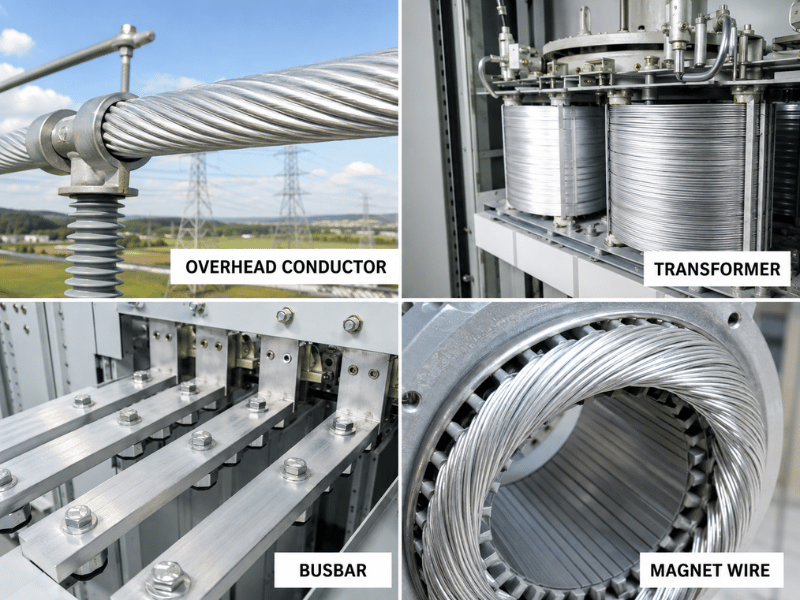
Los criterios de Apto/No apto anteriores separan “¿debería?” de “¿dónde?”. La lista siguiente mapea los sistemas donde el 1350 es práctica estándar.
Transmisión y distribución de energía
Los conductores aéreos son el mayor uso: las líneas de aluminio puro (AAC) y de aluminio con refuerzo de acero (ACSR) se fabrican con alambres 1350-H19 trefilados en frío porque transportan más corriente por kilogramo que cualquier familia común de conductores aéreos. Los núcleos de cables subterráneos, el cableado de barras de subestaciones y los devanados de transformadores utilizan la misma conductividad de grado EC, con alambre en temple O donde la flexibilidad durante la instalación es importante.
Alambre magneto, bobinado de bobinas y barra colectora
Los motores, generadores y transformadores utilizan 1350-O para alambre magneto y bobinado fino de bobinas, donde la extrema conformabilidad y la más alta conductividad son decisivas. La barra colectora —tanto sólida como trenzada— utiliza H19 para distribución rígida de alta corriente en tableros de maniobra y electrónica de potencia. Para formas de alambre de grado EC, consulte la alambre de aluminio 1350-O/H19.
1350 vs 6061 vs 8000 — Cómo elegir
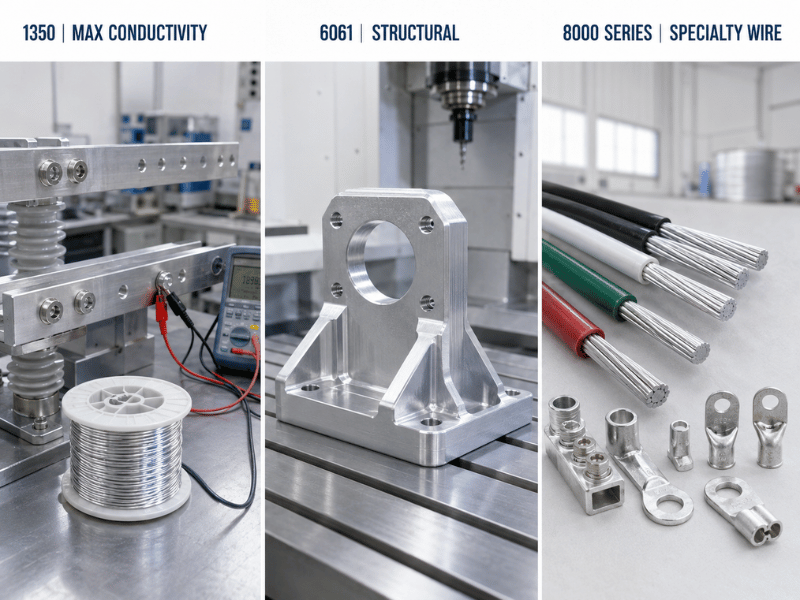
Estos tres no son competidores; responden a preguntas diferentes. El 1350 es el grado de conductividad, el 6061 es el grado estructural y la serie 8000 cubre roles de conductor de nicho.
| Propiedad | 1350 (grado EC) | 6061-T6 | Grados conductores de la serie 8000 |
|---|---|---|---|
| Rol principal | Conductividad eléctrica | Resistencia estructural | Conductores especiales (algunos cables de construcción) |
| Conductividad eléctrica | 61.2% IACS (mín.) | ~40% IACS | Típicamente por debajo de 61.2% IACS |
| Resistencia a la tracción | 60–200 MPa (según temple) | 310 MPa | ~100–200 MPa |
| Tratamiento térmico | No (solo trabajo en frío) | Sí (T6) | Varía según el grado |
| Resistencia a la corrosión | Alta (pureza) | Alta (menor que 1350) | Buena, dependiente de la aleación |
| Uso típico | Alambre, barra colectora, devanados | Marcos, piezas mecanizadas | Especificaciones específicas de conductores 8000 |
Elija 1350 cuando la conductividad por peso sea la restricción. Elija 6061-T6 cuando la pieza deba soportar carga y esté involucrada la soldadura o el mecanizado. Considere un grado de la serie 8000 (por ejemplo, 8176 o 8130 para cable de construcción) solo cuando una norma específica o un beneficio de aleación —no una mayor conductividad— impulse la especificación; el 1350 sigue liderando en rendimiento de IACS puro. Para la alternativa estructural, consulte la página de aleación de aluminio 6061.
Trabajar con aluminio 1350
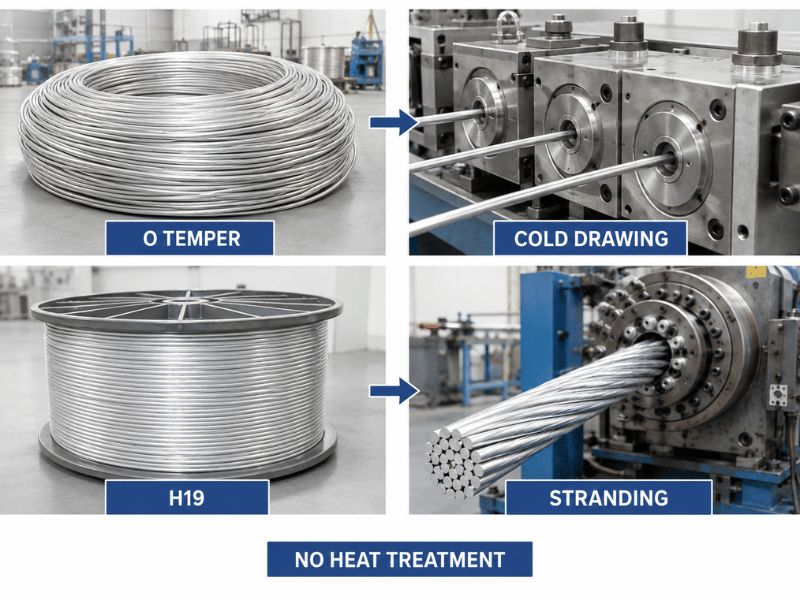
Conformado y trefilado: En temple O, el 1350 es extremadamente conformable —se trefila, se dobla y se bobina sin dificultad, por lo que es el estándar para alambre magneto y conductores finos. El H19 pierde la mayor parte de esa ductilidad (la elongación cae a aproximadamente 1.5%), así que confórmelo antes del endurecimiento final o úselo tal como se trefila.
Soldadura y unión: El 1350 se suelda bien por métodos de resistencia (usado para empalmes de conductores) y puede unirse por MIG/TIG con material de aporte adecuado, aunque la soldadura es poco común en la fabricación estándar de conductores. Tenga en cuenta que la soldadura no trata térmicamente la aleación —no hay temple T que restaurar.
Protección contra la corrosión: La alta pureza le da al 1350 una excelente resistencia a la corrosión atmosférica a través de su película natural de óxido, por lo que la mayoría de los usos de conductores en exteriores no necesitan recubrimiento. En ambientes con cloruros o industriales, se aplican el mismo anodizado, pintura o encamisado utilizados en otros grados de aluminio.
Sin tratamiento térmico: Debido a que el 1350 no es tratable térmicamente, la resistencia proviene únicamente del trabajo en frío. Cualquier paso de recocido lo devuelve hacia el temple O; restaurar el H19 requiere retrefilado, no tratamiento en horno. Planifique la ruta de fabricación en torno al temple final.
Ventajas y limitaciones de un vistazo
| Dimensión | Fuerza | Limitación |
|---|---|---|
| Conductividad eléctrica | La más alta de cualquier aleación de aluminio común (≥61.2% IACS) | Aún ~61% del cobre —no es un reemplazo del cobre donde el espacio es fijo |
| Peso | ~1/3 del peso del cobre para igual corriente | La baja resistencia limita el uso estructural |
| Conformabilidad (O) | Excelente para trefilado y bobinado | El H19 es frágil en curvaturas cerradas |
| Resistencia a la corrosión | Alta por pureza, no necesita recubrimiento en exteriores | La superficie blanda se agarrota bajo desgaste por deslizamiento |
| Coste | Más barato y ligero que los conductores de cobre | Las bajas propiedades mecánicas restringen las aplicaciones |
| Disponibilidad | Grado EC estándar, amplia disponibilidad de molino | No es un grado de sección estructural de stock |
Conclusión
El aluminio 1350 ofrece la conductividad más alta de cualquier aleación de aluminio forjado convencional —un mínimo garantizado de 61.2% IACS— pero su contrapartida es la baja resistencia y dureza que lo descartan para piezas portantes. Eso lo convierte en la elección correcta para conductores, barra colectora y devanados, y en la elección incorrecta para cualquier aplicación estructural.
Linsy Aluminum, una fábrica con sede en Shenzhen con más de 20 años de experiencia, suministra 1350 en alambre, barra colectora, chapa y bobina en toda la serie 1000–8000, incluyendo alambre EC 1350-O y 1350-H19, con documentación MTC completa por pedido e informes de ensayo SGS disponibles a solicitud; el plazo de entrega personalizado típico es de 10–60 días con soporte de MOQ bajo para tamaños no estándar. Cuando la especificación requiera 1350 de grado EC, envíe el plano o la especificación del conductor para una revisión de grado y temple.
Preguntas frecuentes
¿Cuál es la diferencia entre 1350-O y 1350-H19?
El 1350-O está totalmente recocido y es blando, con elongación de 20% o más —ideal para trefilado, bobinado y curvaturas cerradas. El 1350-H19 está endurecido por deformación a fondo duro hasta 150–200 MPa de resistencia a la tracción, el temple estándar para conductores aéreos y barra colectora donde la resistencia importa más que la conformabilidad. La conductividad es la misma (~61.8% IACS) en ambos.
¿Es adecuado el aluminio 1350 para aplicaciones estructurales?
No. Incluso en H19, el 1350 alcanza solo aproximadamente 150–200 MPa de resistencia a la tracción, muy por debajo de grados estructurales como el 6061-T6 (310 MPa). Es un grado para conductores, no un grado estructural, y debe limitarse a usos eléctricos no portantes.
¿Cuál es la diferencia entre el aluminio 1350 y el 1370?
Ambos son aleaciones puras de grado EC, pero el 1370 tiene una pureza mínima superior de 99,70% de aluminio frente al 99,50% del 1350, lo que proporciona una conductividad ligeramente mejor. Ambos se utilizan como conductores eléctricos; el 1370 se especifica cuando la aplicación exige el grado de mayor pureza.
¿Se puede tratar térmicamente el aluminio 1350 para aumentar su resistencia?
No. El 1350 no es una aleación tratable térmicamente — solo gana resistencia mediante endurecimiento por deformación en frío (los temples H1x). El recocido lo devuelve hacia el estado O, y restaurar el H19 requiere trefilado nuevamente, no un ciclo de horno.
¿Cuál es la diferencia entre el aluminio 1350 y el 1050?
Ambos son aleaciones puras con un mínimo de 99,50%, pero el 1350 está ajustado para uso eléctrico con hierro y silicio mantenidos bajos para proteger la conductividad, mientras que el 1050 es un grado puro de propósito general. Elija 1350 cuando el rendimiento eléctrico sea la prioridad y 1050 para conformado y fabricación generales.