Introducción
Aleación de aluminio 2618 Es una aleación de aluminio forjado de la serie 2xxx tratable térmicamente, diseñada para aplicaciones de alta temperatura. Con cobre, magnesio y níquel como principales elementos de aleación, el 2618 conserva una excelente resistencia a temperaturas elevadas de hasta aproximadamente 200 °C. También ofrece una fuerte resistencia a la fatiga y una buena resistencia a la fluencia bajo cargas térmicas sostenidas.
Estas propiedades hacen del 2618 un material preferido para componentes de motores aeroespaciales, pistones de alto rendimiento, ruedas de compresor y piezas de turbinas donde la estabilidad térmica es crítica. Este artículo cubre la composición química de la aleación, sus propiedades mecánicas, aplicaciones prácticas y su comparación con otros grados de aluminio como 2024, 4032, 6061 y 7075.
Qué es la aleación de aluminio 2618
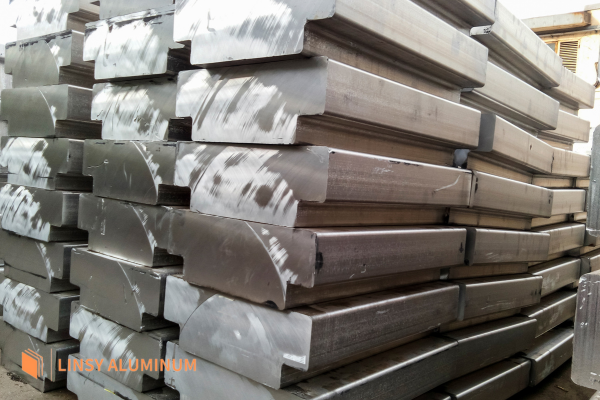
La aleación de aluminio 2618 pertenece a la familia de aleaciones de aluminio forjado tratables térmicamente, distinguida por su retención de resistencia a temperaturas elevadas. Su combinación de resistencia a alta temperatura, resistencia a la fatiga y maquinabilidad la hace adecuada para aplicaciones exigentes en los sectores aeroespacial y de automovilismo deportivo.
La composición de la aleación —principalmente aluminio con cobre, magnesio y níquel— contribuye directamente a su estabilidad térmica. Esto convierte al 2618 en una opción fiable cuando los componentes deben mantener su integridad estructural bajo ciclos térmicos repetidos y esfuerzos mecánicos.
Composición química del aluminio 2618
Las características distintivas de la aleación de aluminio 2618 están definidas por su composición química. A continuación se presenta un desglose de los elementos de aleación clave:
| Elemento | Composición Porcentaje | Papel |
|---|---|---|
| Aluminio | ~90% | Material de base |
| Cobre | 2-3% | Aumenta la resistencia, especialmente tras el tratamiento térmico |
| Magnesio | 1.2-1.8% | Actúa junto con el cobre para fortalecer aún más la aleación |
| Níquel | 1.2-1.8% | Mejora el rendimiento a alta temperatura y la estabilidad térmica |
Estos elementos de aleación, cuidadosamente controlados durante la producción, permiten que el 2618 cumpla con los rigurosos estándares exigidos por las industrias aeroespacial y de alto rendimiento, donde la estabilidad térmica es esencial.
Propiedades físicas y mecánicas clave
| Propiedad | Valor | Qué significa |
|---|---|---|
| Densidad | 2,75 g/cm³ | Ligero para aplicaciones de alta resistencia |
| Punto de fusión | ~550-640°C (1.022-1.184°F) | Amplio intervalo de solidificación, adecuado para trabajo en caliente |
| Resistencia a la tracción | ~420-450 MPa (T6) | Alta resistencia para aplicaciones estructurales exigentes |
| Límite elástico | ~350-380 MPa (T6) | Buena resistencia a la deformación permanente |
| Alargamiento | ~5-10% | Ductilidad moderada |
| Dureza | ~120-130 HB (Brinell, T6) | Buena dureza superficial para resistencia al desgaste |
| Conductividad térmica | ~140-155 W/m-K | Capacidad de transferencia de calor aceptable |
| Resistencia a la fatiga | ~150-180 MPa | Fuerte resistencia a cargas cíclicas |
La aleación de aluminio 2618 ofrece una combinación equilibrada de peso moderado, alta resistencia y estabilidad térmica. Su baja densidad reduce el peso de los componentes, mientras que su amplio intervalo de fusión le permite funcionar de manera fiable en entornos calientes como los compartimentos de motor. La resistencia a la tracción de 420–450 MPa en temple T6 y la resistencia a la fatiga de 150–180 MPa la convierten en una opción fiable para piezas sometidas a esfuerzos repetidos, como pistones y ruedas de compresor.
Ventajas y limitaciones de la aleación de aluminio 2618
| Beneficios | Limitaciones |
|---|---|
| Alta resistencia a temperaturas elevadas | Menor resistencia a la corrosión en comparación con las aleaciones de las series 6xxx y 5xxx |
| Buena resistencia a la fatiga | Coste más elevado que las aleaciones de uso general |
| Tratable térmicamente para mejorar sus propiedades | Susceptible a la corrosión bajo tensión (agrietamiento por corrosión bajo tensión) |
| Buena maquinabilidad en condición tratada térmicamente | Conformabilidad en frío limitada |
| Soldable con técnicas específicas | Requiere recubrimientos protectores en entornos corrosivos |
Aplicaciones prácticas de la aleación de aluminio 2618

La aleación de aluminio 2618 es muy valorada en los sectores aeroespacial y de automovilismo deportivo por su alta relación resistencia-peso y su rendimiento a alta temperatura. La capacidad de carga y la resistencia a la fatiga de la aleación la hacen ideal para pistones, forjas y componentes estructurales de motor donde la fiabilidad en condiciones extremas es innegociable.
Aeroespacial y automovilismo
En el sector aeroespacial, el aluminio 2618 se utiliza para fabricar piezas de motores de aeronaves, componentes de fuselaje y estructuras alares. Su capacidad para mantener la resistencia a altas temperaturas es crítica en entornos de motores a reacción, donde los componentes enfrentan esfuerzos térmicos y mecánicos sostenidos.
Los pistones y las ruedas de compresor fabricados con 2618 mantienen su forma y resistencia durante la operación a alta temperatura, lo que ayuda a que los motores funcionen de manera fiable durante intervalos de servicio prolongados.
La industria del automovilismo deportivo también depende del 2618 para pistones y componentes de motores de competición. La resistencia a alta temperatura y la resistencia a la fatiga de la aleación permiten que las piezas soporten las condiciones exigentes de los entornos de carreras a altas RPM.
Comparación: 2618 frente a otras aleaciones de aluminio
Si bien la aleación de aluminio 2618 sobresale en aplicaciones de alta temperatura, la selección del material adecuado depende de los requisitos específicos de resistencia, conformabilidad, resistencia a la corrosión y costo. Comparar el 2618 con otras aleaciones comunes ayuda a los ingenieros a tomar decisiones informadas sobre materiales.
Aluminio 2618 vs 4032 vs 6061 vs 7075
Cada una de estas aleaciones ofrece ventajas distintivas según sus propiedades mecánicas y aplicaciones previstas:
| Característica | 2618 Aluminio | 4032 Aluminio | Aluminio 6061 | Aluminio 7075 |
|---|---|---|---|---|
| Elementos de aleación primarios | Cu, Mg, Ni | Cu, Mg, Si | Mg, Si | Zn, Cu, Mg |
| Densidad (g/cm³) | ~2.77 | ~2.69 | ~2.70 | ~2.81 |
| Resistencia a la tracción (MPa) | ~440 (temple T6) | ~380 (temple T6) | ~310 (temple T6) | ~570 (temple T6) |
| Límite elástico (MPa) | ~370 (temple T6) | ~315 (temple T6) | ~275 (temple T6) | ~505 (temple T6) |
| Resistencia al calor | Excelente (hasta ~200°C) | Buena (hasta ~150°C) | Moderado (hasta ~150°C) | Moderado (hasta ~120°C) |
| Resistencia a la corrosión | Moderado (requiere revestimientos) | Bueno (mejor que 2618) | Muy buena | Regular (susceptible debido al contenido de Cu) |
| Maquinabilidad | Bien | Excelente | Muy buena | Feria |
| Soldabilidad | Regular (se necesitan técnicas especiales) | Pobre | Excelente | Pobre |
| Resistencia a la fatiga | Excelente | Bien | Bien | Excelente |
| Coste | Alta | Moderado | Bajo | Alta |
| Aplicaciones típicas | Piezas de motores aeroespaciales, pistones | Pistones de automoción, componentes de motor | Piezas estructurales, uso general | Estructuras aeroespaciales, piezas de alta tensión |
| Ventaja principal | Alta resistencia a temperaturas elevadas | Resistencia al desgaste, baja dilatación térmica | Versatilidad, resistencia a la corrosión | Resistencia excepcional a temperatura ambiente |
| Limitación clave | Menor resistencia a la corrosión, mayor costo | Soldabilidad deficiente, resistencia moderada | Menor resistencia máxima | Mala soldabilidad, problemas de corrosión |
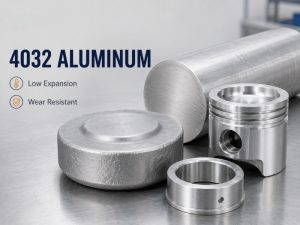
2618 aluminio El 2618 destaca por su resistencia a alta temperatura y su buena maquinabilidad, lo que lo hace ideal para componentes de motores de aeronaves y pistones de alto rendimiento. El 4032 es favorecido para componentes de motor debido a su baja expansión térmica y buena resistencia al desgaste. El 6061, conocido por su versatilidad, se utiliza ampliamente en aplicaciones estructurales. El 7075, con su excepcional resistencia a temperatura ambiente, maneja escenarios estructurales de alta tensión.
Qué aleación elegir
Elegir la aleación adecuada—2618, 4032, 6061o 7075—depende de su aplicación específica, condiciones de operación y prioridades.
Factores clave a tener en cuenta
- Requisitos de resistencia: Para máxima resistencia a temperatura ambiente, elija Aluminio 7075 (resistencia a la tracción de 570 MPa). Para resistencia a alta temperatura, elija 2618 aluminio (conserva resistencia hasta ~200 °C).
- Exposición a la temperatura: Para piezas de motor y pistones que operan por encima de 150 °C, el 2618 es la mejor opción. El 4032 y el 6061 manejan calor moderado hasta ~150 °C, mientras que el 7075 se debilita por encima de ~120 °C.
- Resistencia a la corrosión: Si la pieza enfrenta humedad o exposición exterior, Aluminio 6061 ofrece la mejor resistencia a la corrosión. El 2618 y el 7075 requieren recubrimientos protectores en entornos corrosivos.
- Resistencia al desgaste: Para piezas móviles como pistones donde el desgaste superficial es una preocupación, 4032 aluminio proporciona la mejor resistencia al desgaste debido a su mayor contenido de silicio.
- Soldabilidad y conformabilidad: El 6061 es el más fácil de soldar y conformar. El 2618 requiere técnicas de soldadura especializadas, mientras que el 4032 y el 7075 generalmente no se recomiendan para soldadura.
- Coste: El 6061 es el más rentable y ampliamente disponible. El 2618 y el 7075 tienen un precio más alto debido a sus propiedades especializadas, situándose el 4032 en un punto intermedio.
Conclusión
La aleación de aluminio 2618 es un material especializado de alta temperatura para los sectores aeroespacial y de automovilismo deportivo, no una aleación de uso general. Su composición fortificada con níquel ofrece una excelente retención de resistencia hasta aproximadamente 200 °C, junto con una fuerte resistencia a la fatiga y buena maquinabilidad, lo que la hace ideal para pistones, ruedas de compresor y componentes de turbinas. Sin embargo, su mayor costo, menor resistencia a la corrosión y disponibilidad limitada en comparación con aleaciones comerciales comunes implican que solo debe especificarse cuando el rendimiento a alta temperatura sea el requisito principal.
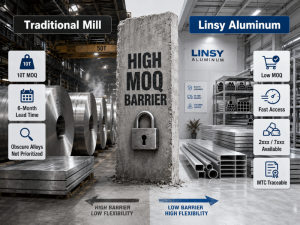
Linsy Aluminio Linsy cubre toda la gama de las series 1000 a 8000, incluida la familia 2xxx, y puede obtener o suministrar aluminio 2618 para aplicaciones especializadas. Con más de 20 años de experiencia, certificaciones ISO 9001/14001/45001 y capacidades internas de mecanizado CNC, soldadura TIG/GTAW, corte por láser y acabados superficiales, Linsy respalda proyectos que requieren soluciones de aluminio de alto rendimiento, desde el abastecimiento personalizado hasta la fabricación. Los plazos de entrega suelen ser de 10 a 60 días, con certificados completos de materiales (MTC) proporcionados por pedido e informes de pruebas SGS disponibles bajo solicitud.
Contacte hoy con Linsy Aluminum para analizar sus requisitos de aluminio 2618 y solicitar una cotización.
Preguntas frecuentes
¿Para qué se utiliza la aleación de aluminio 2618?
El aluminio 2618 se utiliza principalmente para componentes aeroespaciales y de automovilismo deportivo de alta temperatura, incluidos pistones de motor, ruedas de compresor, piezas de turbinas, componentes estructurales de aeronaves y revestimientos de aeronaves supersónicas. Cualquier aplicación que requiera retención de resistencia por encima de 150 °C es candidata para el 2618.
¿Qué temperatura puede soportar el aluminio 2618?
El aluminio 2618 conserva una excelente resistencia a temperaturas de hasta aproximadamente 200 °C (392 °F). Por encima de este umbral, las propiedades mecánicas comienzan a disminuir, aunque la aleación mantiene cierta resistencia útil hasta aproximadamente 250 °C (482 °F). Esto es significativamente mejor que aleaciones como 6061 y 7075, que se debilitan a temperaturas más bajas.
¿En qué se diferencia el 2618 del aluminio 2024 y 7075?
2618 aluminio El 2618 sacrifica la resistencia máxima a temperatura ambiente por un rendimiento superior a alta temperatura. El aluminio 2024 ofrece mayor resistencia a temperatura ambiente pero pierde resistencia más rápidamente por encima de 150 °C. El aluminio 7075 es el más resistente a temperatura ambiente (~570 MPa) pero se debilita significativamente por encima de 120 °C. El 2618 es la opción preferida cuando la exposición sostenida al calor es la condición de diseño principal.
¿Es soldable la aleación de aluminio 2618?
El aluminio 2618 puede soldarse utilizando técnicas especializadas como TIG (GTAW) con metales de aporte apropiados, pero se considera de dificultad media a difícil de soldar. El alto contenido de cobre aumenta el riesgo de agrietamiento en caliente y porosidad durante la soldadura. En la mayoría de las aplicaciones, los componentes de 2618 se mecanizan a partir de forjas o barras en lugar de ensamblajes soldados.
¿Por qué el aluminio 2618 contiene níquel?
El níquel (1.2-1.8%) se añade al aluminio 2618 específicamente para mejorar la estabilidad a alta temperatura y la resistencia a la fluencia. El níquel forma compuestos intermetálicos finos y térmicamente estables que resisten el engrosamiento a temperaturas elevadas, ayudando a la aleación a conservar su resistencia durante la exposición prolongada al calor. Esta es una ventaja crítica para aplicaciones en motores y turbinas.