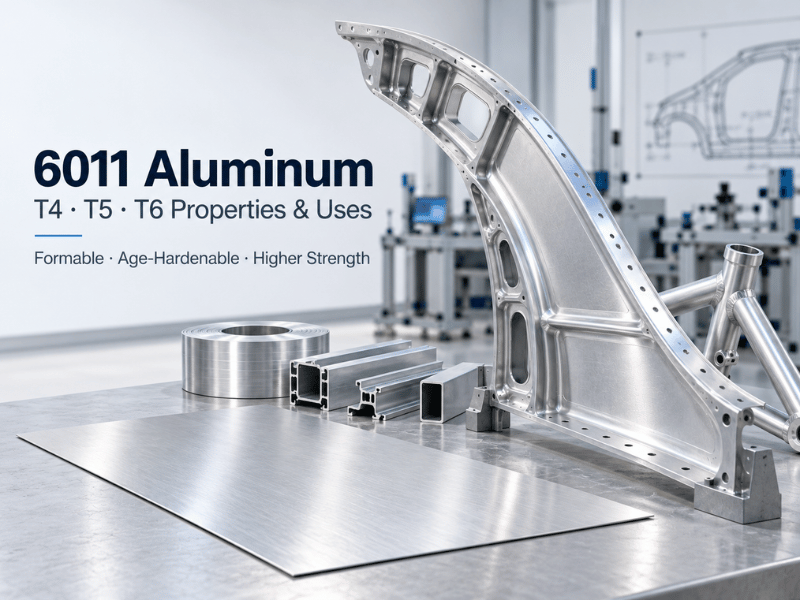
6011 usually arrives on a drawing rather than a shortlist — an automotive structural profile, a bicycle frame tube, a formed part that needs a step more aged strength than 6061 delivers. Copper is what buys that step and what bounds it. The temper you order, T4, T5 or T6, then decides how much of the strength you get and how hard the part is to form.
6011 알루미늄이란?
6011 is a heat-treatable aluminium-magnesium-silicon alloy of the 6xxx family. It strengthens through magnesium silicide (Mg₂Si) precipitation during age hardening, the same mechanism that hardens 6061 and 6082.
What separates 6011 from the common structural 6xxx grades is 구리. It carries roughly twice the copper of 6061, and that single difference drives everything worth knowing about it: higher age-hardening response and strength, at the cost of corrosion resistance and conductivity.
Chemical Composition of 6011
The composition below is the registered limits, which agree across the Aluminum Association registration, EN 573-3 and GB/T 3190-2020.
| 요소 | 무게 % |
| 실리콘(Si) | 0.6 – 1.2 |
| 철(Fe) | 1.0 이하 |
| 구리(Cu) | 0.4 – 0.9 |
| 망간(Mn) | 0.8 최대 |
| 마그네슘(Mg) | 0.6 – 1.2 |
| 크롬(Cr) | 0.30 최대 |
| 니켈(Ni) | 0.20 최대 |
| 아연(Zn) | 1.5 max |
| 티타늄(Ti) | 0.20 최대 |
| 기타, 각각 / 합계 | 0.05 / 0.15 |
| 알루미늄(Al) | 잔액 |
Quote the registered limits. Composition data for 6011 does not always match them, so check the chemistry on the mill certificate against this table before you commit. A certificate showing copper at 0.15%, zinc capped at 0.25%, no nickel row, or lead and bismuth at 0.2–0.6% was drawn from another alloy or another standard — ask which one before you accept it.
Lead and bismuth at 0.2–0.6% each would make 6011 a free-machining alloy, which it is not. Those additions belong to a different family, and a 6011 datasheet carrying Pb and Bi is describing something else.
Why the Copper Content Matters
Copper is the defining element here, and its effects run in different directions.
강도 — 긍정적. Copper participates in the age-hardening response alongside Mg₂Si, so 6011 reaches higher strength than 6061 in comparable tempers. Reported 6011-T6 tensile strength runs typically 310–360 MPa against 6061-T6 at around 310 MPa.
내식성 — 부정적. Copper in aluminium forms cathodic intermetallic particles and increases susceptibility to pitting and intergranular attack. With roughly twice the copper of 6061, 6011 should not be assumed to be the more corrosion-resistant of the two. For marine exposure, road-salt exposure, or any application where the alloy will be unpainted and wet, 6061 is the safer starting point.
Conductivity — negative. Alloying elements in solution scatter heat- and charge-carrying electrons. Silicon in solid solution is a strong offender and copper compounds the effect. Given 6011 sits at the top of the silicon range and carries substantial copper, expect conductivity at or below 6061-T6 rather than above it.
Weldability — needs qualification. Standard Al-Mg-Si practice does not automatically transfer. The higher copper content can affect hot-cracking behaviour, so a procedure qualified on 6061 should be re-qualified rather than assumed valid.
This is why the generic online claim that 6011 is “better for corrosion resistance and cools better than 6061” should not be repeated. On both counts the chemistry points the other way.
열처리 상태에 따른 기계적 특성
6011 does not enjoy the broad, consistently tabulated property data that 6061 does. Published figures vary by product form — sheet, extrusion, and tube sources disagree — so the table below gives indicative commercial values, not specification minimums.
| 성질 | 인장 강도(MPa) | 항복 강도(MPa) | 연신율 (%) |
| O(어닐링) | 85 – 130 | 40 – 80 | 25 – 30 |
| T4 | ~290 | ~140 | ~22 |
| T5 | mid-range between T4 and T6 | mid-range between T4 and T6 | — |
| T6 | 310 – 360 | 240 – 320 | 8 – 12 |
Two caveats worth reading before you use any of these numbers.
First, the spread on T4 is genuinely large. One extruder publishes 6011-T4 at 150 MPa minimum tensile; others publish 230–290 MPa for the same designation. That gap is too wide to design from.
Second, T5 data is scarce. Where 6011-T5 is produced it behaves as expected — between naturally aged T4 and fully aged T6 — but reliable published values are hard to find, and it should be specified against a mill declaration rather than a generic chart.
For any structural part, require the mechanical figures on the mill test certificate for the ordered form and thickness. For 6xxx wrought products, properties are normally verified against the applicable product standard — ASTM B209 for sheet and plate, EN 485-2 in Europe — but 6011 is not universally listed in every edition, so confirm the governing standard up front.
물리적 속성
| 속성 | 가치 |
| 밀도 | ~2.70g/cm³ |
| 용융 범위 | ~580 – 650 °C |
| 열팽창 계수 | ~23.6 × 10⁻⁶ /°C (20–100 °C) |
| 탄성 계수 | ~69 GPa |
| 열 전도성 | Not reliably published — expect at or below 6061-T6 |
| 전기 전도성 | Not reliably published — expect at or below 6061-T6 |
The two conductivity rows deserve an explanation rather than a number.
6061-T6 is well established at roughly 167 W/m·K for thermal conductivity and around 40% IACS electrically. Because 6011 carries more silicon and substantially more copper, its conductivity should fall at or below those figures. Reported values circulating for 6011 — commonly 155–175 W/m·K — sit inside or below the 6061 band, which is consistent with that reasoning.
The practical consequence: do not specify 6011 expecting better heat transfer than 6061. If you are designing a radiator, heat sink, or any thermal component and need a measured conductivity figure, ask for it on the mill datasheet. For heat-transfer-driven designs where 6011 is not already mandated, 6063 is the more sensible 6xxx choice at around 201 W/m·K.
6011 vs 6061 vs 6063 vs 6082 vs 7075
Comparisons below are aligned by temper and generally against T6 or the closest commercial condition.
| 합금 | 주요 합금 원소 | 인장 강도 (T6) | 내식성 | 용접성 | 일반 용도 |
| 6011 | Mg 0.6–1.2, Si 0.6–1.2, Cu 0.4–0.9 | 310 – 360 MPa | Good, but below 6061 | Weldable; qualify procedure | Automotive profiles, bicycle frames, formed structural parts |
| 6061 | Mg 0.8–1.2, Si 0.4–0.8, Cu 0.15–0.40 | ~310 MPa | 매우 우수 | 우수 | General structural work, marine frames, machine parts |
| 6063 | Mg 0.45–0.9, Si 0.2–0.6 | ~240 MPa | 매우 우수 | 우수 | Architectural extrusions, heat sinks, window systems |
| 6082 | Mg 0.6–1.2, Si 0.7–1.3, Mn 0.4–1.0 | ~310 – 340 MPa | 매우 우수 | 매우 우수 | European structural extrusions, transport |
| 7075 | Zn 5.1–6.1, Mg 2.1–2.9, Cu 1.2–2.0 | 500 – 570 MPa | Poor | Poor — not fusion welded in practice | Aerospace structure, high-load parts |
Where each one fits:
- 6011 — when the strength-to-formability balance of the 6xxx family is right but you need a step above 6061 in aged strength, and the part lives in a controlled environment rather than in salt spray.
- 6061 — the default. Better availability, better corrosion behaviour, better-documented properties, easier welding. Choose it unless 6011 is genuinely on the drawing.
- 6063 — best surface finish, highest conductivity of these, lowest strength. Choose it for visible extrusions and thermal parts.
- 6082 — the European structural equivalent to 6061 with manganese strengthening. It covers much of what people reach for 6011 to get.
- 7075 — a different tier of strength entirely, with lower corrosion resistance and no practical fusion welding. Not a substitute for 6011; a different class of part.
Understanding T4, T5, and T6
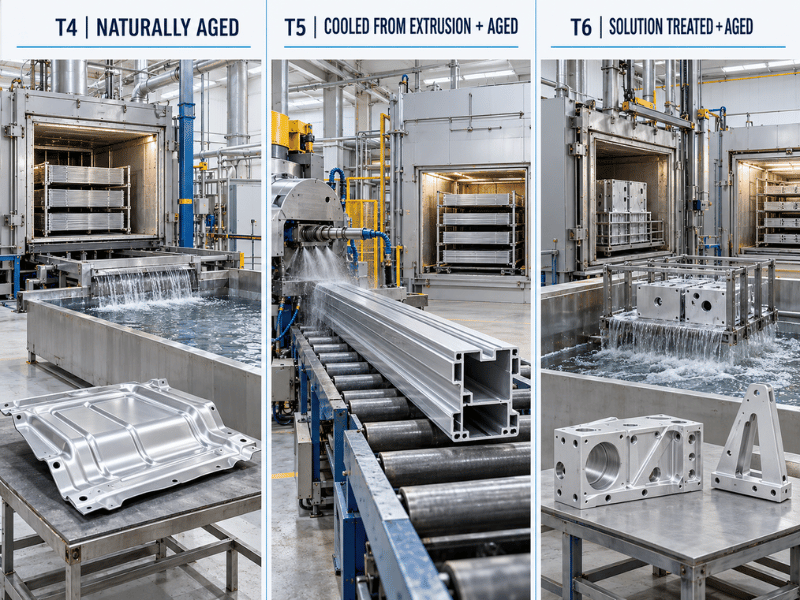
These three tempers appear constantly in 6011 enquiries, and they are frequently described incorrectly. The definitions below follow standard temper nomenclature.
| 성질 | What actually happens | Result |
| T4 | Solution heat treated, quenched, then naturally aged at room temperature | Good formability with moderate strength; continues to gain strength over time |
| T5 | Cooled directly from an elevated-temperature shaping process such as extrusion, then artificially aged | Mid-level strength without a separate solution treatment |
| T6 | Solution heat treated, quenched, then artificially aged at elevated temperature | Maximum strength for the alloy; lowest formability of the three |
Three clarifications that matter:
- “Naturally aged” refers to aging, not cooling. Every solution-treated temper is quenched rapidly. In T4 it is the aging that is natural — it happens at room temperature. Describing T4 as “natural cooling” misrepresents the process.
- T5 does not involve casting. It follows hot working — typically an extrusion press. 6011 is a wrought alloy; there is no casting step in any of these three tempers.
- T6 strength comes from artificial aging, not quench rate. The quench is necessary but it is the subsequent aging that develops the properties. Attributing T6 strength to “rapid cooling” is a common and misleading shortcut.
Note that these are heat-treatment tempers. Strain-hardening designations such as O or H18 describe a different mechanism and are not how 6011 is specified in service, even though O is sometimes used as forming stock.
Choosing Between T4, T5, and T6
| If the requirement is… | 지정 사양 |
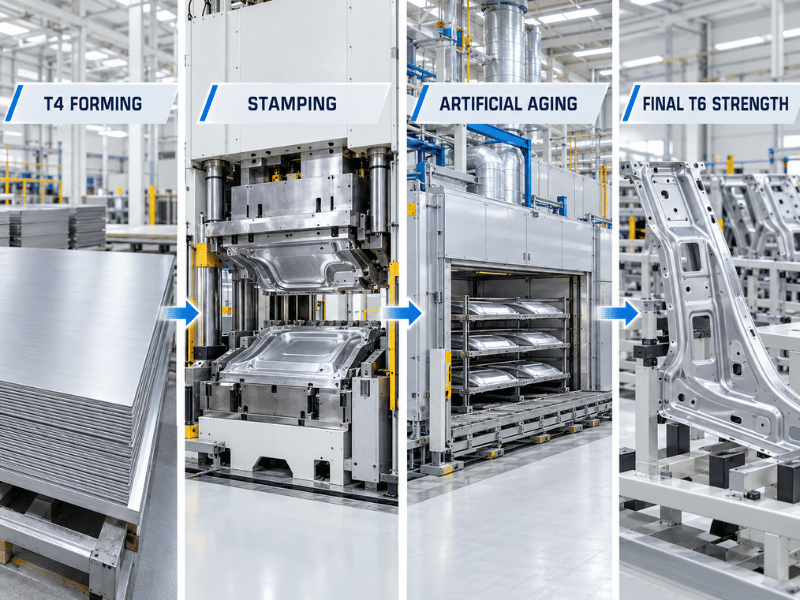
| Forming complex shapes before aging | T4 — form it, then age to T6 if strength is needed afterwards |
| A formed part already made from stock, with moderate strength | T5 — avoids a separate solution treatment |
| Maximum structural strength | T6 |
| Maximum ductility for deep drawing | O as forming stock, then heat treat |
| Anything critical, with no drawing requirement | Ask; do not guess on a specialist grade like this |
The T4-then-age route is common in automotive work: sheet arrives in T4, gets stamped or formed while formable, then receives artificial aging to reach final properties. If your part follows that path, specify both conditions on the enquiry so the mill supplies the correct incoming state.
Working With 6011
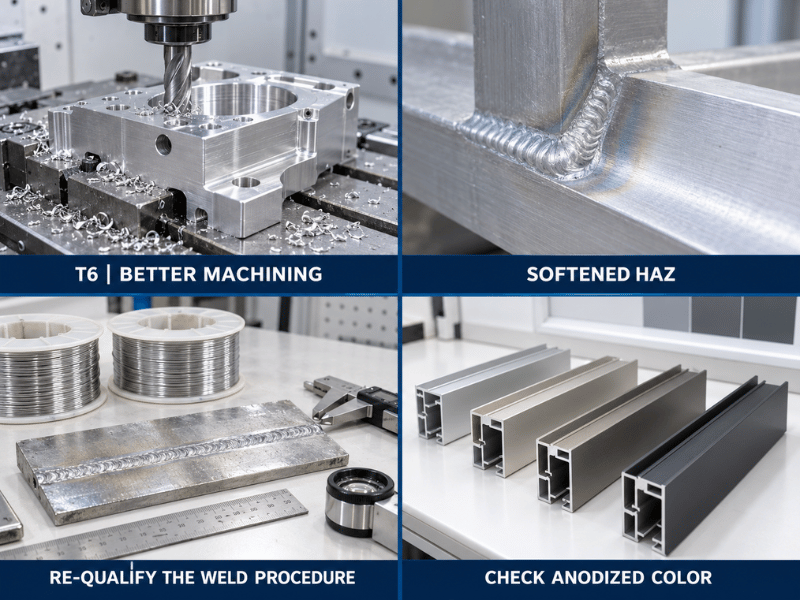
성형. T4 is the forming condition. Expect good cold formability there, dropping sharply in T6. Bend radii and forming limits are not as widely documented for 6011 as they are for 6061 — request them for your specific thickness.
절삭 가공. The age-hardened tempers machine well. T6 produces shorter chips than T4, which tends to be gummier. Standard aluminium tooling and cutting fluids apply.
용접. MIG and TIG welding both work, and the standard Al-Mg-Si filler logic applies: ER4043 where crack resistance and puddle control dominate, ER5356 where higher weld strength or a better anodizing colour match matters. Because of the copper content, do not assume a procedure qualified on 6061 transfers without testing. Remember the heat-affected zone of any heat-treatable alloy softens through overaging, and that loss cannot be recovered by post-weld heat treatment of the joint alone — design accordingly.
표면 처리. 6011 anodizes acceptably, though copper-bearing alloys can show a slightly warmer or less uniform tone than low-copper grades. Where colour consistency is a specification line, run a sample through the actual finishing line before production.
Availability and Sourcing Realities
6011 is a more specialised grade than the alloys it is usually compared to, so confirm form and temper up front:
- Sheet, plate and coil in T4, T5 and T6 are the forms most likely to be available from stock or short-lead production.
- Tube and bar are generally made to order, so allow lead time and expect minimum quantities.
- Extrusions are available but usually tied to specific profiles rather than a general catalogue.
For most enquiries, the honest comparison is against 6061 or 6082. If 6011 is not already named on your drawing, ask whether the marginal strength gain justifies the made-to-order route and patchier property data. Often it does not.
Documentation requirements are the same as for any certified alloy: a mill test certificate with actual chemical analysis and mechanical results per heat or lot, and third-party inspection arranged on request when the project calls for it.
Go/No-Go: When to Specify 6011
Go — specify 6011 when:
- A customer drawing or existing assembly already names 6011, and substitution is not an option.
- You need a step above 6061 in aged strength in a formed part, and the service environment is not aggressive.
- The part is painted, coated, or otherwise protected, so the corrosion penalty from copper is contained.
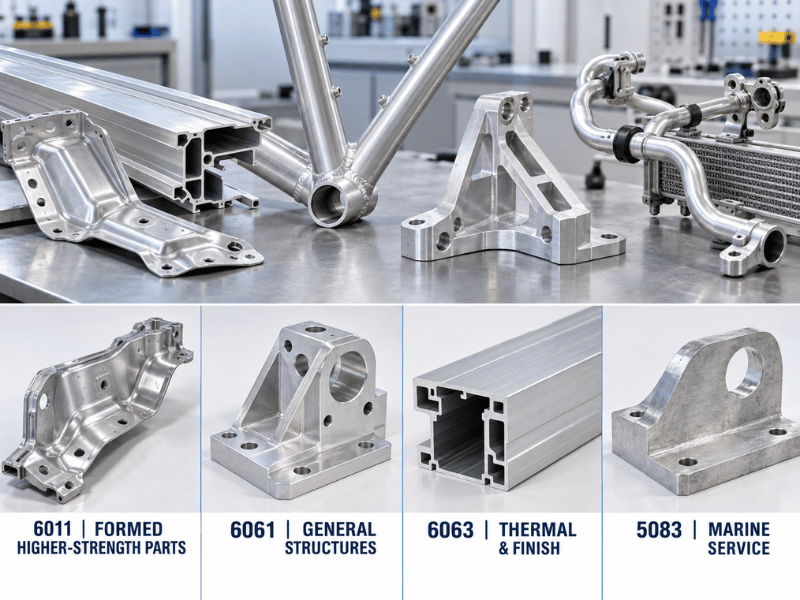
- You are producing bicycle frame tubes, automotive body or structural profiles, or similar formed transport components where the grade is already established.
- You can verify properties against a mill certificate rather than relying on generic tables.
No-go — 다음의 경우 다른 것을 선택하십시오:
- The part sees marine or de-icing salt exposure — 6061 or 5083 instead.
- You are designing for heat transfer, or want maximum conductivity — 6063 is far better at around 201 W/m·K.
- You need broad availability, consistent published property data, and easy qualification — 6061.
- The application is aerospace primary structure — this is not what 6011 is used for; look at 2024, 7075 or the appropriate AMS-qualified grade.
- The part will be welded in safety-critical service and you want a deep base of qualified procedure data — 6061.
Where 6011 Is Used
| 분야 | 용도 |
| 자동차 | Body and structural profiles, reinforcement members, trim sections |
| Bicycle manufacture | Frame tubes for mid- to high-tier aluminium frames, where the higher copper variant is used to reach greater strength than 6061 |
| Transport and general engineering | Formed structural parts, brackets, machine guards |
| Cooling circuits | Automotive coolant and oil lines where formability and strength are both needed — specified for mechanical reasons, not superior conductivity |
The characterisation to avoid is “aerospace.” 6011 is not an aerospace structural grade, and claims placing it alongside 7075 for aircraft structure are not supported by how the alloy is actually used.
장점 및 한계 요약
| 优点 | 제한 사항 |
| Higher aged strength than 6061 in comparable tempers | Higher copper means reduced corrosion resistance versus 6061 |
| Good formability in T4, allowing form-then-age processing | Conductivity below 6061, well below 6063 — not a thermal alloy |
| Makes available a step above 6061 without moving to 7xxx | Thin grade: narrower availability, tube and bar usually made to order |
| Established in bicycle frames and automotive profiles | Poorly documented properties with wide disagreement between published sources |
| Standard Al-Mg-Si filler and finishing practice applies | Procedures qualified on 6061 should be re-qualified rather than assumed |
결론
6011 is a copper-bearing variant within the heat-treatable 6xxx family, and its value is narrow but real: a formed part that needs more aged strength than 6061 delivers, in an environment that is not corrosive. The copper that makes that possible is also what limits it — corrosion resistance and conductivity both fall below 6061, and the published property record is thinner than anything a designer would accept for 6061. So the decision usually comes down to one question: is 6011 already named on your drawing, or are you choosing it?
We supply 6011 sheet, plate, and coil in T4, T5, and T6, with tube and bar sourced to order, and every order ships with an MTC reporting actual chemical analysis and mechanical results. Tell us the forming sequence at enquiry stage and we will confirm the correct incoming temper.
도면을 보내주십시오, temper, thickness range, and service environment for a grade-fit check.
자주 묻는 질문
Can we substitute 6061 for 6011 without re-qualifying the part?
Treat a 6061-for-6011 swap as a design change, not a drop-in. 6061 is the lower-strength, more corrosion-resistant grade, so the swap has to be justified on the part rather than on what we hold in stock. Where 6011 is named on a customer drawing, we normally ask for written approval before quoting 6061 against it.
What testing does 6011 welding procedure qualification need?
Plan on qualifying the procedure, not inheriting a 6061 one. AWS D1.2 has no prequalified route for aluminium, so the WPS needs a welded test coupon tested in tension, in bend and by macro-examination. Change the base alloy group, filler, process, position or thickness range and you requalify.
What is your MOQ and lead time for 6011 sheet?
Standard 6011 sheet, plate and coil quote at low minimums. We set MOQ against the size and temper you need rather than a mill-scale tonnage, and custom sizes run on the same basis. Custom production takes 10–60 days depending on alloy, dimensions and processing; standard stock ships sooner.
Can you cut 6011 to length, and what paperwork comes with the order?
Yes — cutting sheet and plate to length is part of normal order processing, not a separate service. Every order leaves with an MTC we issue after production, listing the chemistry and mechanicals for the lot shipped. That lets you verify copper and tensile strength against the registered limits rather than a generic table.