6011 zwykle trafia na rysunek, a nie na listę krótką — profil konstrukcyjny dla motoryzacji, rura ramy rowerowej, część formowana, która wymaga o stopień wyższej wytrzymałości po starzeniu niż zapewnia 6061. Miedź jest tym, co daje ten stopień, i tym, co go ogranicza. Zamawiany stan utwardzania — T4, T5 lub T6 — decyduje następnie o tym, ile tej wytrzymałości uzyskasz i jak trudna w formowaniu będzie część.
Co to jest aluminium 6011?
6011 to poddawany obróbce cieplnej stop aluminium-magnez-krzem z rodziny 6xxx. Umacnia się poprzez wydzielanie krzemku magnezu (Mg₂Si) podczas utwardzania przez starzenie — ten sam mechanizm, który utwardza 6061 i 6082.
To, co odróżnia 6011 od powszechnych konstrukcyjnych gatunków 6xxx, to miedź. Zawiera około dwukrotnie więcej miedzi niż 6061, a ta pojedyncza różnica determinuje wszystko, co warto o nim wiedzieć: wyższą odpowiedź na utwardzanie przez starzenie i wyższą wytrzymałość, kosztem odporności na korozję i przewodności.
Skład chemiczny 6011
Poniższy skład odpowiada zarejestrowanym wartościom granicznym, które są zgodne w rejestracji Aluminum Association, EN 573-3 i GB/T 3190-2020.
| Element | Waga % |
| Krzem (Si) | 0.6 – 1.2 |
| Żelazo (Fe) | 1,0 maks. |
| Miedź (Cu) | 0.4 – 0.9 |
| Mangan (Mn) | maks. 0,8 |
| Magnez (Mg) | 0.6 – 1.2 |
| Chrom (Cr) | maks. 0,30 |
| Nikiel (Ni) | 0,20 maks. |
| Cynk (Zn) | 1,5 maks. |
| Tytan (Ti) | 0,20 maks. |
| Inne, każde / łącznie | 0.05 / 0.15 |
| Aluminium (Al) | Równowaga |
Podawaj zarejestrowane wartości graniczne. Dane dotyczące składu 6011 nie zawsze są z nimi zgodne, więc przed zatwierdzeniem sprawdź chemię na świadectwie hutniczym względem tej tabeli. Świadectwo wykazujące miedź na poziomie 0,15%, cynk ograniczony do 0,25%, brak wiersza dla niklu lub ołów i bizmut na poziomie 0,2–0,6% zostało zaczerpnięte z innego stopu lub innej normy — zapytaj, z której, zanim je zaakceptujesz.
Ołów i bizmut na poziomie 0,2–0,6% każdy uczyniłyby 6011 stopem łatwo skrawalnym, którym on nie jest. Te dodatki należą do innej rodziny, a karta danych 6011 zawierająca Pb i Bi opisuje coś innego.
Dlaczego zawartość miedzi ma znaczenie
Miedź jest tutaj pierwiastkiem definiującym, a jej efekty działają w różnych kierunkach.
Wytrzymałość — pozytywnie. Miedź uczestniczy w odpowiedzi na utwardzanie przez starzenie obok Mg₂Si, dzięki czemu 6011 osiąga wyższą wytrzymałość niż 6061 w porównywalnych stanach utwardzania. Podawana wytrzymałość na rozciąganie 6011-T6 wynosi typowo 310–360 MPa wobec około 310 MPa dla 6061-T6.
Odporność na korozję — negatywnie. Miedź w aluminium tworzy katodowe cząstki międzymetaliczne i zwiększa podatność na wżery i atak międzykrystaliczny. Przy około dwukrotnie większej zawartości miedzi niż 6061 nie należy zakładać, że 6011 jest bardziej odporny na korozję z tych dwóch. W przypadku ekspozycji morskiej, ekspozycji na sól drogową lub każdego zastosowania, w którym stop będzie niepomalowany i mokry, 6061 jest bezpieczniejszym punktem wyjścia.
Przewodność — negatywnie. Pierwiastki stopowe w roztworze rozpraszają elektrony przenoszące ciepło i ładunek. Krzem w roztworze stałym jest silnym czynnikiem pogarszającym, a miedź potęguje ten efekt. Biorąc pod uwagę, że 6011 znajduje się na górze zakresu krzemu i zawiera znaczną ilość miedzi, należy oczekiwać przewodności na poziomie lub poniżej 6061-T6, a nie powyżej.
Spawalność — wymaga kwalifikacji. Standardowa praktyka dla Al-Mg-Si nie przenosi się automatycznie. Wyższa zawartość miedzi może wpływać na skłonność do pęknięć na gorąco, więc procedura zakwalifikowana dla 6061 powinna zostać ponownie zakwalifikowana, a nie uznana za ważną.
Dlatego ogólne twierdzenie internetowe, że 6011 jest “lepszy pod względem odporności na korozję i lepiej chłodzi niż 6061”, nie powinno być powtarzane. W obu przypadkach chemia wskazuje przeciwnie.
Właściwości mechaniczne w zależności od stanu utwardzenia
6011 nie cieszy się tak szerokimi, konsekwentnie tabelarycznymi danymi właściwości, jak 6061. Publikowane wartości różnią się w zależności od formy wyrobu — źródła dotyczące blachy, wyciskania i rury są niezgodne — więc poniższa tabela podaje orientacyjne wartości handlowe, a nie minima specyfikacyjne.
| Temperament | Wytrzymałość na rozciąganie (MPa) | Granica plastyczności (MPa) | Wydłużenie (%) |
| O (wyżarzony) | 85 – 130 | 40 – 80 | 25 – 30 |
| T4 | ~290 | ~140 | ~22 |
| T5 | zakres pośredni między T4 a T6 | zakres pośredni między T4 a T6 | — |
| T6 | 310 – 360 | 240 – 320 | 8 – 12 |
Dwa zastrzeżenia warte przeczytania przed użyciem któregokolwiek z tych liczb.
Po pierwsze, rozrzut dla T4 jest naprawdę duży. Jeden wytwórca wyrobów wyciskanych publikuje 6011-T4 przy minimalnej wytrzymałości na rozciąganie 150 MPa; inni podają 230–290 MPa dla tego samego oznaczenia. Ta różnica jest zbyt duża, aby projektować na jej podstawie.
Po drugie, dane dla T5 są skąpe. Tam, gdzie 6011-T5 jest produkowany, zachowuje się zgodnie z oczekiwaniami — między naturalnie starzonym T4 a w pełni starzonym T6 — ale wiarygodne publikowane wartości są trudne do znalezienia i należy go specyfikować na podstawie deklaracji hutniczej, a nie ogólnego wykresu.
Dla każdej części konstrukcyjnej wymagaj danych mechanicznych na świadectwie badań hutniczych dla zamówionej formy i grubości. Dla wyrobów kutych 6xxx właściwości są normalnie weryfikowane względem odpowiedniej normy wyrobu — ASTM B209 dla blachy i płyt, EN 485-2 w Europie — ale 6011 nie jest powszechnie wymieniany w każdym wydaniu, więc potwierdź obowiązującą normę z góry.
Właściwości fizyczne
| Nieruchomość | Wartość |
| Gęstość | ~2,70 g/cm³ |
| Zakres topnienia | ~580 – 650 °C |
| Współczynnik rozszerzalności cieplnej | ~23,6 × 10⁻⁶ /°C (20–100 °C) |
| Moduł sprężystości | ~69 GPa |
| Przewodność cieplna | Brak wiarygodnie publikowanych danych — oczekuje się na poziomie lub poniżej 6061-T6 |
| Przewodność elektryczna | Brak wiarygodnie publikowanych danych — oczekuje się na poziomie lub poniżej 6061-T6 |
Dwa wiersze dotyczące przewodności zasługują na wyjaśnienie, a nie na liczbę.
6061-T6 jest dobrze ustalony na poziomie około 167 W/m·K przewodności cieplnej i około 40% IACS przewodności elektrycznej. Ponieważ 6011 zawiera więcej krzemu i znacznie więcej miedzi, jego przewodność powinna spaść na poziomie lub poniżej tych wartości. Podawane wartości krążące dla 6011 — powszechnie 155–175 W/m·K — mieszczą się w przedziale 6061 lub poniżej, co jest zgodne z tym rozumowaniem.
Praktyczna konsekwencja: nie specyfikuj 6011, oczekując lepszego transferu ciepła niż 6061. Jeśli projektujesz chłodnicę, radiator lub dowolny element termiczny i potrzebujesz zmierzonej wartości przewodności, poproś o nią na karcie danych hutniczych. W przypadku konstrukcji opartych na transferze ciepła, gdzie 6011 nie jest już wymagany, 6063 jest rozsądniejszym wyborem z rodziny 6xxx przy około 201 W/m·K.
6011 vs 6061 vs 6063 vs 6082 vs 7075
Poniższe porównania są wyrównane według stanu utwardzania i generalnie dotyczą T6 lub najbliższego stanu handlowego.
| Stop | Główny składnik stopowy | Wytrzymałość na rozciąganie (T6) | Odporność na korozję | Spawalność | Typowe zastosowanie |
| 6011 | Mg 0,6–1,2, Si 0,6–1,2, Cu 0,4–0,9 | 310 – 360 MPa | Dobra, ale poniżej 6061 | Spawalny; wymaga kwalifikacji procedury | Profile motoryzacyjne, ramy rowerowe, formowane części konstrukcyjne |
| 6061 | Mg 0,8–1,2, Si 0,4–0,8, Cu 0,15–0,40 | ~310 MPa | Bardzo dobra | Doskonały | Ogólne prace konstrukcyjne, ramy morskie, części maszyn |
| 6063 | Mg 0,45–0,9, Si 0,2–0,6 | ~240 MPa | Bardzo dobra | Doskonały | Wyciskania architektoniczne, radiatory, systemy okienne |
| 6082 | Mg 0,6–1,2, Si 0,7–1,3, Mn 0,4–1,0 | ~310 – 340 MPa | Bardzo dobra | Bardzo dobra | Europejskie wyciskania konstrukcyjne, transport |
| 7075 | Zn 5.1–6.1, Mg 2.1–2.9, Cu 1.2–2.0 | 500 – 570 MPa | Słaby | Poor — not fusion welded in practice | Aerospace structure, high-load parts |
Where each one fits:
- 6011 — when the strength-to-formability balance of the 6xxx family is right but you need a step above 6061 in aged strength, and the part lives in a controlled environment rather than in salt spray.
- 6061 — the default. Better availability, better corrosion behaviour, better-documented properties, easier welding. Choose it unless 6011 is genuinely on the drawing.
- 6063 — best surface finish, highest conductivity of these, lowest strength. Choose it for visible extrusions and thermal parts.
- 6082 — the European structural equivalent to 6061 with manganese strengthening. It covers much of what people reach for 6011 to get.
- 7075 — a different tier of strength entirely, with lower corrosion resistance and no practical fusion welding. Not a substitute for 6011; a different class of part.
Understanding T4, T5, and T6
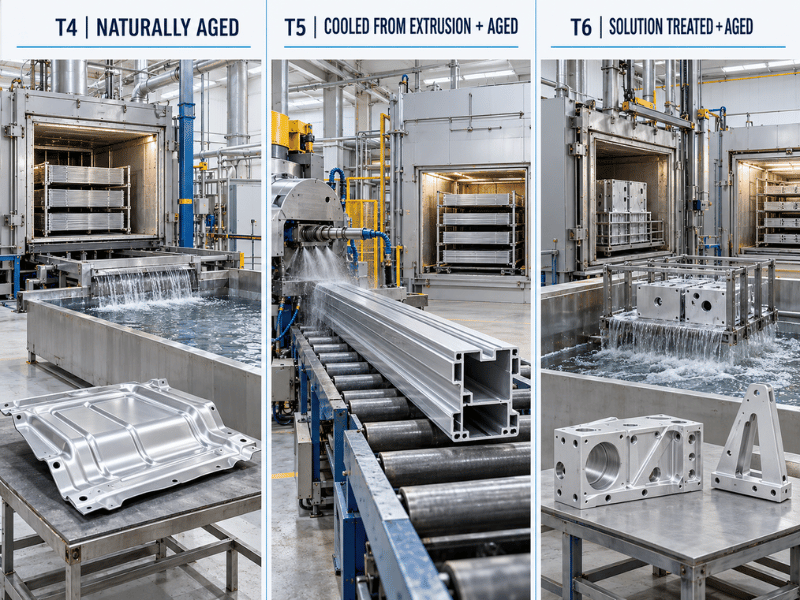
These three tempers appear constantly in 6011 enquiries, and they are frequently described incorrectly. The definitions below follow standard temper nomenclature.
| Temperament | What actually happens | Result |
| T4 | Solution heat treated, quenched, then naturally aged at room temperature | Good formability with moderate strength; continues to gain strength over time |
| T5 | Cooled directly from an elevated-temperature shaping process such as extrusion, then artificially aged | Mid-level strength without a separate solution treatment |
| T6 | Solution heat treated, quenched, then artificially aged at elevated temperature | Maximum strength for the alloy; lowest formability of the three |
Three clarifications that matter:
- “Naturally aged” refers to aging, not cooling. Every solution-treated temper is quenched rapidly. In T4 it is the aging that is natural — it happens at room temperature. Describing T4 as “natural cooling” misrepresents the process.
- T5 does not involve casting. It follows hot working — typically an extrusion press. 6011 is a wrought alloy; there is no casting step in any of these three tempers.
- T6 strength comes from artificial aging, not quench rate. The quench is necessary but it is the subsequent aging that develops the properties. Attributing T6 strength to “rapid cooling” is a common and misleading shortcut.
Note that these are heat-treatment tempers. Strain-hardening designations such as O or H18 describe a different mechanism and are not how 6011 is specified in service, even though O is sometimes used as forming stock.
Choosing Between T4, T5, and T6
| If the requirement is… | Specyfikacja |
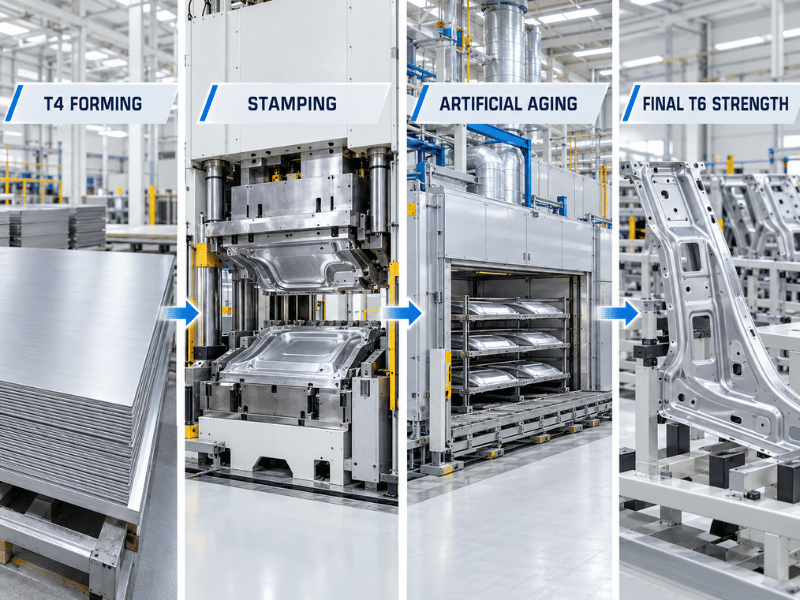
| Forming complex shapes before aging | T4 — form it, then age to T6 if strength is needed afterwards |
| A formed part already made from stock, with moderate strength | T5 — avoids a separate solution treatment |
| Maximum structural strength | T6 |
| Maximum ductility for deep drawing | O as forming stock, then heat treat |
| Anything critical, with no drawing requirement | Ask; do not guess on a specialist grade like this |
The T4-then-age route is common in automotive work: sheet arrives in T4, gets stamped or formed while formable, then receives artificial aging to reach final properties. If your part follows that path, specify both conditions on the enquiry so the mill supplies the correct incoming state.
Working With 6011
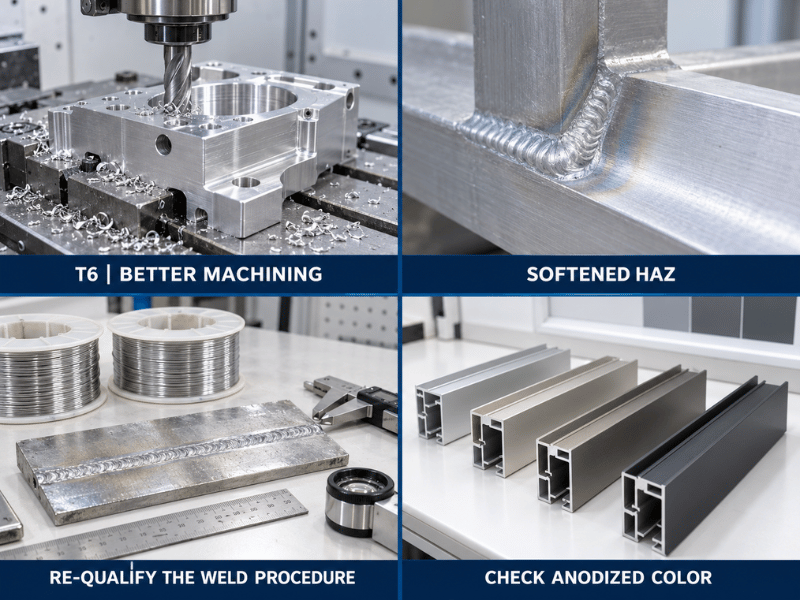
Formowanie. T4 is the forming condition. Expect good cold formability there, dropping sharply in T6. Bend radii and forming limits are not as widely documented for 6011 as they are for 6061 — request them for your specific thickness.
Obróbka skrawaniem. The age-hardened tempers machine well. T6 produces shorter chips than T4, which tends to be gummier. Standard aluminium tooling and cutting fluids apply.
Spawanie. MIG and TIG welding both work, and the standard Al-Mg-Si filler logic applies: ER4043 where crack resistance and puddle control dominate, ER5356 where higher weld strength or a better anodizing colour match matters. Because of the copper content, do not assume a procedure qualified on 6061 transfers without testing. Remember the heat-affected zone of any heat-treatable alloy softens through overaging, and that loss cannot be recovered by post-weld heat treatment of the joint alone — design accordingly.
Wykończenie powierzchni. 6011 anodizes acceptably, though copper-bearing alloys can show a slightly warmer or less uniform tone than low-copper grades. Where colour consistency is a specification line, run a sample through the actual finishing line before production.
Availability and Sourcing Realities
6011 is a more specialised grade than the alloys it is usually compared to, so confirm form and temper up front:
- Sheet, plate and coil in T4, T5 and T6 are the forms most likely to be available from stock or short-lead production.
- Tube and bar are generally made to order, so allow lead time and expect minimum quantities.
- Extrusions are available but usually tied to specific profiles rather than a general catalogue.
For most enquiries, the honest comparison is against 6061 or 6082. If 6011 is not already named on your drawing, ask whether the marginal strength gain justifies the made-to-order route and patchier property data. Often it does not.
Documentation requirements are the same as for any certified alloy: a mill test certificate with actual chemical analysis and mechanical results per heat or lot, and third-party inspection arranged on request when the project calls for it.
Go/No-Go: When to Specify 6011
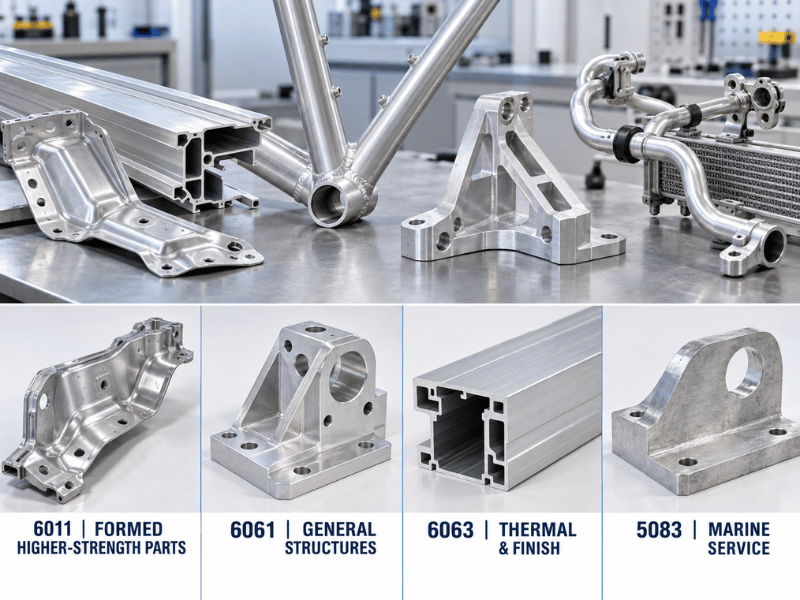
Go — specify 6011 when:
- A customer drawing or existing assembly already names 6011, and substitution is not an option.
- You need a step above 6061 in aged strength in a formed part, and the service environment is not aggressive.
- The part is painted, coated, or otherwise protected, so the corrosion penalty from copper is contained.
- You are producing bicycle frame tubes, automotive body or structural profiles, or similar formed transport components where the grade is already established.
- You can verify properties against a mill certificate rather than relying on generic tables.
No-go — choose something else when:
- The part sees marine or de-icing salt exposure — 6061 or 5083 instead.
- You are designing for heat transfer, or want maximum conductivity — 6063 is far better at around 201 W/m·K.
- You need broad availability, consistent published property data, and easy qualification — 6061.
- The application is aerospace primary structure — this is not what 6011 is used for; look at 2024, 7075 or the appropriate AMS-qualified grade.
- The part will be welded in safety-critical service and you want a deep base of qualified procedure data — 6061.
Where 6011 Is Used
| Sektor | Zastosowanie |
| Motoryzacja | Body and structural profiles, reinforcement members, trim sections |
| Bicycle manufacture | Frame tubes for mid- to high-tier aluminium frames, where the higher copper variant is used to reach greater strength than 6061 |
| Transport and general engineering | Formed structural parts, brackets, machine guards |
| Cooling circuits | Automotive coolant and oil lines where formability and strength are both needed — specified for mechanical reasons, not superior conductivity |
The characterisation to avoid is “aerospace.” 6011 is not an aerospace structural grade, and claims placing it alongside 7075 for aircraft structure are not supported by how the alloy is actually used.
Zalety i Ograniczenia w Skrócie
| Zalety | Ograniczenia |
| Higher aged strength than 6061 in comparable tempers | Higher copper means reduced corrosion resistance versus 6061 |
| Good formability in T4, allowing form-then-age processing | Conductivity below 6061, well below 6063 — not a thermal alloy |
| Makes available a step above 6061 without moving to 7xxx | Thin grade: narrower availability, tube and bar usually made to order |
| Established in bicycle frames and automotive profiles | Poorly documented properties with wide disagreement between published sources |
| Standard Al-Mg-Si filler and finishing practice applies | Procedures qualified on 6061 should be re-qualified rather than assumed |
Wnioski
6011 is a copper-bearing variant within the heat-treatable 6xxx family, and its value is narrow but real: a formed part that needs more aged strength than 6061 delivers, in an environment that is not corrosive. The copper that makes that possible is also what limits it — corrosion resistance and conductivity both fall below 6061, and the published property record is thinner than anything a designer would accept for 6061. So the decision usually comes down to one question: is 6011 already named on your drawing, or are you choosing it?
We supply 6011 sheet, plate, and coil in T4, T5, and T6, with tube and bar sourced to order, and every order ships with an MTC reporting actual chemical analysis and mechanical results. Tell us the forming sequence at enquiry stage and we will confirm the correct incoming temper.
Send us the drawing, temper, thickness range, and service environment for a grade-fit check.
Często zadawane pytania
Can we substitute 6061 for 6011 without re-qualifying the part?
Treat a 6061-for-6011 swap as a design change, not a drop-in. 6061 is the lower-strength, more corrosion-resistant grade, so the swap has to be justified on the part rather than on what we hold in stock. Where 6011 is named on a customer drawing, we normally ask for written approval before quoting 6061 against it.
What testing does 6011 welding procedure qualification need?
Plan on qualifying the procedure, not inheriting a 6061 one. AWS D1.2 has no prequalified route for aluminium, so the WPS needs a welded test coupon tested in tension, in bend and by macro-examination. Change the base alloy group, filler, process, position or thickness range and you requalify.
What is your MOQ and lead time for 6011 sheet?
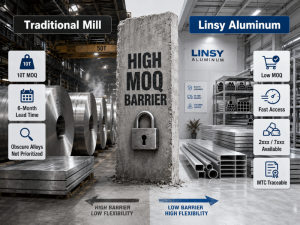
Standard 6011 sheet, plate and coil quote at low minimums. We set MOQ against the size and temper you need rather than a mill-scale tonnage, and custom sizes run on the same basis. Custom production takes 10–60 days depending on alloy, dimensions and processing; standard stock ships sooner.
Can you cut 6011 to length, and what paperwork comes with the order?
Yes — cutting sheet and plate to length is part of normal order processing, not a separate service. Every order leaves with an MTC we issue after production, listing the chemistry and mechanicals for the lot shipped. That lets you verify copper and tensile strength against the registered limits rather than a generic table.