5005 알루미늄이란 무엇인가?
5005는 5xxx 계열 중 저마그네슘 끝단에 위치하며, 마그네슘 함량이 약 0.8%로 5052(약 2.5%)나 5083(약 4.5%)보다 훨씬 낮습니다. 이 단일 수치가 5005에 관한 거의 모든 것을 설명합니다. 마그네슘이 적기 때문에 5005는 5xxx 계열 형제들의 고강도를 포기하는 대신, 구매자들이 실제로 이를 지정하는 두 가지 특성을 얻습니다: 우수한 양극산화 반응 그리고 합금 원소 함량이 더 낮은 무게로 3003에 근접한 내식성. 이는 양극산화 건축용 시트의 표준 선택이며, 기계적 물성은 구조용 영역이 아닌 3003과 동일한 범위에 위치합니다.
이는 비열처리 합금입니다. 모든 강도 증가는 냉간 가공에서 비롯되며 H-템퍼로 표현되고, 6061이나 7075처럼 석출 경화될 수 없습니다. 실질적인 결과는 경도와 강도가 구매하는 템퍼에 의해 결정되지, 이후 부품에 가하는 어떤 처리에 의해서도 결정되지 않는다는 것입니다 — 어닐링으로 다시 연화시키는 경우는 예외입니다.
간과되는 진정한 장점도 하나 있습니다: 5005는 약 3% 마그네슘 임계값보다 훨씬 아래에 위치하기 때문에, 리튬계 5083이나 5056 같은 고마그네슘 등급을 연속 사용 시 약 65 °C로 제한하는 β상(Al₃Mg₂) 입계 석출에 취약하지 않습니다. 고온의 약한 부식 환경에서 5005는 그러한 제약을 받지 않습니다.
5005 화학 조성
ASTM B209 / EN 573-3에 따른 조성 한도, 중량 퍼센트 기준. 마그네슘은 유일한 의도적 합금 원소이며, 나머지는 모두 소량의 제어된 첨가물이거나 불순물 상한입니다.
| 요소 | 콘텐츠(%) | 역할 |
|---|---|---|
| 마그네슘(Mg) | 0.50 – 1.10 | 주요 합금 원소; 강도 및 부식 거동 |
| 실리콘(Si) | 0.30 최대 | 불순물, 양극산화 투명도를 위해 낮게 유지 |
| 철(Fe) | 0.70 max | 불순물; 표면 조도에 영향 |
| 구리(Cu) | 0.20 최대 | 내식성 및 양극산화 색상을 보호하기 위해 낮게 유지 |
| 망간(Mn) | 0.20 최대 | 소량 첨가, 결정립 구조 |
| 크롬(Cr) | 최대 0.10 | 소량 내식성 첨가 |
| 아연(Zn) | 최대 0.25 | 미량 |
| 티타늄(Ti) | 0.05 – 0.15 | 晶粒细化剂 |
| 기타(각) | 최대 0.05 | 미량 불순물 |
| 기타(합계) | 최대 0.15 | 미량 불순물의 합계 |
| 알루미늄(Al) | 나머지 | 기지 |
구리와 규소에 대한 엄격한 상한은 보기보다 중요합니다. 두 원소 모두 양극산화 피막을 변색시킵니다 — 구리는 황색으로, 규소는 회색으로 — 이것이 저Cu, 저Si 화학 조성이 5005를 단순한 또 다른 5xxx 등급이 아닌 양극산화 합금으로 만드는 이유입니다.
템퍼별 5005 경도
경도는 5005의 냉간 가공 조직이 가장 직접적으로 나타나는 지표입니다. 아래 값은 500 kg 하중과 10 mm 볼로 측정한 전형적인 브리넬 수치(ASTM E10)이며, 전신용 알루미늄에 사용되는 관례입니다.
| 성질 | 상태 | 브리넬 경도 (HB) | 대략적 전단 강도 (MPa) |
|---|---|---|---|
| O | Annealed | 28 | 76 |
| H32 | 변형 경화, 안정화 (¼ 경질) | 36 | 96 |
| H34 | 변형 경화, 안정화 (½ 경질) | 41 | 96 |
| H36 | 변형 경화, 안정화 (¾ 경질) | 46 | 103 |
| H38 | 변형 경화, 안정화 (완전 경질) | 51 | 110 |
이 표에서 세 가지 결론이 도출됩니다.
범위가 좁습니다. 전체 템퍼 범위에 걸쳐 5005는 28에서 51 HB로 변화합니다 — 어닐링에서 완전 경질까지 두 배 미만입니다. O에서 T6까지 약 세 배로 증가하는 6061과 비교해 보십시오. 설계에 냉간 가공으로 제공할 수 없는 경도가 필요하다면, 5005는 잘못된 출발점이며 어떤 템퍼 선택으로도 해결되지 않습니다.
경도는 수입 검사 도구이지 설계 입력값이 아닙니다. HB는 납품품을 MTC와 대조 확인하기에 충분히 빠르고 비파괴적이며, 인장 강도와 잘 상관됩니다. 그러나 어떤 엔지니어도 브리넬로 브래킷을 설계하지 않습니다. HB는 주문한 템퍼를 받았는지 확인하는 데 사용하고, 실제 계산에는 인장 강도와 항복 강도를 사용하십시오.
양극산화는 표면 경도를 변화시키며, 체적 경도는 변화시키지 않습니다. 이것이 경도 문의에서 가장 흔한 오해입니다. 양극산화 피막층은 기재보다 훨씬 단단합니다 — 산화알루미늄은 경도 척도에서 어떤 알루미늄 합금보다 훨씬 위에 위치합니다 — 따라서 긁힘 및 마모 저항이 상당히 향상됩니다. 기저 금속은 변하지 않으며, 5005-H34 패널은 코팅 아래에 여전히 41 HB를 가집니다. 도면에 “더 단단하게”라고 표기되어 있다면, 표면 내마모성(양극산화)을 의미하는지 하중 지지 능력(합금 변경)을 의미하는지 확인하십시오.
템퍼별 5005 기계적 물성
시트 및 플레이트의 전형적인 값. ASTM B209 최소 값은 이 수치보다 낮으며 두께에 따라 변한다는 점에 유의하십시오 — 특정 로트에 대한 보증 수치는 이 표가 아닌 MTC에서 나옵니다.
| 성질 | 인장 강도(MPa) | 항복 강도(MPa) | 연신율 (50 mm에서 1%) | 경도(HB) |
|---|---|---|---|---|
| O | 124 | 41 | 25 | 28 |
| H32 | 138 | 117 | 11 | 36 |
| H34 | 159 | 138 | 8 | 41 |
| H36 | 179 | 165 | 6 | 46 |
| H38 | 200 | 186 | 6 | 51 |
연신율 열은 대부분의 실제 사양을 결정하는 항목입니다. H32에서 H38로 낮추면 인장 강도가 약 45% 증가하고 사용 가능한 연신율의 거의 절반을 잃습니다 — 11%에서 6%로. 평판 장식 패널에는 이 trade-off가 무료입니다. 성형 반경, 헴, 또는 롤링 엣지가 있는 모든 것에는 H32 또는 H34가 상한이며, 성형이 심한 경우 O가 답입니다.
H1x와 H3x 명칭은 상호 교환할 수 없습니다. H1x 템퍼는 변형 경화만 된 것이고; H3x 템퍼는 변형 경화 후 저온 열처리로 안정화된 것으로, 강도를 약간 줄이고 의미 있는 연성을 회복시킵니다. 이러한 안정화가 H32/H34가 건축 작업을 지배하는 이유입니다 — 추가 연성이 성형성을 제공하고, 안정화된 상태는 선반에서 시효 연화되는 대신 물성을 유지합니다.
5005 물리적 물성
| 속성 | 가치 |
|---|---|
| 밀도 | 2.70g/cm³ |
| 용융 범위 | 632 – 655 °C |
| 열 전도성 | ~201 W/m·K (O 템퍼) |
| 전기 전도성 | ~52% IACS (경질 템퍼에서 감소) |
| 열팽창 계수 | 23.7 × 10⁻⁶ /°C (20–100 °C) |
| 비열 | ~900 J/kg-K |
| 탄성 계수 | ~69 GPa |
| 푸아송 비 | 0.33 |
이 중 두 가지가 구매 시 중요합니다. ~201 W/m·K 및 ~52% IACS의 열전도율과 전기전도율은 5xxx 합금으로서 높은 편이며 — 마그네슘 함량이 낮기 때문입니다 — 둘 다 템퍼 경도가 높아질수록 감소하므로, 전도율 기반 사양은 전체 범위에 걸쳐 가정하지 말고 O 또는 H32 상태에 대해 설정해야 합니다. 용융 범위는 주로 용접 및 고온 사용 논의에 중요합니다.
내식성 및 양극산화
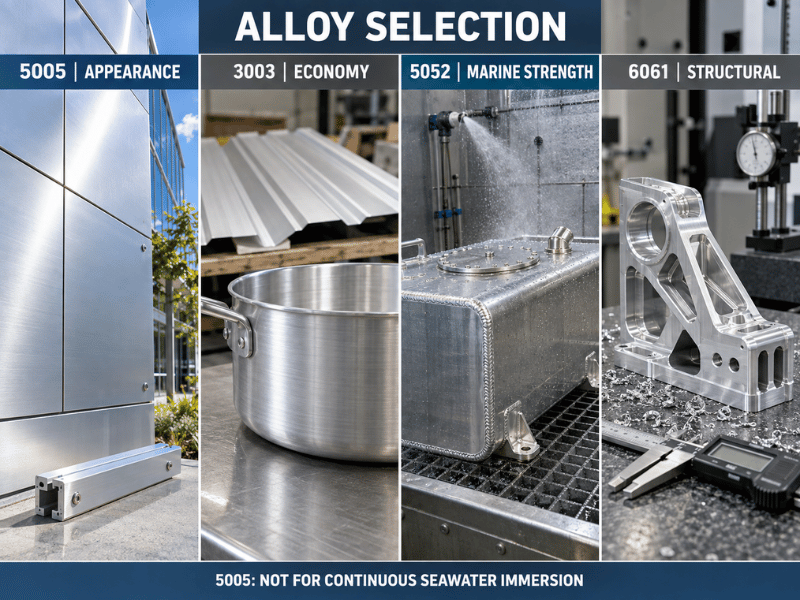
대기 및 약알칼리 환경. 5005은 3003과 비교할 만한 수준으로 일반 대기 부식에 저항하며, 산업 대기 및 해안 대기를 포함하고, 약알칼리 환경에서 더 우수한 성능을 발휘하는 5xxx 계열의 이점을 추가로 갖는다. 연속 해수 침수용으로는 선택되지 않는다 — 5083과 5086이 그 영역을 담당한다 — 그러나 해양 대기, 해안 건축, 그리고 선박 내부 하드웨어에는 충분히 적합하다.
65 °C 문제. 고마그네슘 5xxx 계열은 약 65 °C 부근의 연속 사용 상한을 가지며, 이를 초과하면 입계를 따라 β상이 석출되어 응력부식균열 경로가 열린다. 약 0.8% Mg에서 5005는 해당 메커니즘이 실질적 우려가 되는 임계값 아래에 있다. 이는 고온 사용에서 5083 및 5056에 대한 실질적인 차별점이며, 이를 선택해야 하는 가장 덜 인식된 이유 중 하나이다.
고온에서는 여전히 연화된다. 냉간 가공된 조질은 사용 온도가 상승함에 따라 강도를 점진적으로 잃으며, 약 345 °C에서 완전 어닐링된다. 부품이 지속적인 열에 노출된다면, 주문서의 H 조질 값이 아니라 어닐링(O 조질) 값을 기준으로 설계해야 한다 — 비용을 들여 얻은 냉간 가공은 열을 견디지 못한다.
아노다이징 — 그리고 숨은 문제. 아노다이징 시 5005는 3003보다 더 투명한 균질한 피막을 생성하며, 6063 건축용 압출재와 우수한 색상 일치를 제공한다. 이러한 조합이 5005가 아노다이징 외장재 및 장식용 트림의 기본 소재인 이유이다.
숨은 문제: 5005는 눈에 띄는 줄무늬, 때때로 “바코딩”이라 불리는 현상과 함께 아노다이징될 수 있다. 표면 마감이 중요한 경우 — 완전히 노출된 외장 패널, 대형 무결점 표면 — 주문 시 5005-AQ (아노다이징 품질, 때때로 특수 아노다이징 품질로 판매됨)를 지정해야 한다. 비용이 더 들지만, 설치 후 줄무늬를 발견하는 것보다는 훨씬 저렴하다. 갈바닉 부식은 또 다른 상존하는 주의사항이다: 여느 알루미늄과 마찬가지로 5005는 습한 환경에서 더 귀한 금속과 전기적으로 결합되면 빠르게 부식되므로, 강철 및 구리 합금과 절연해야 한다.
5005의 가공
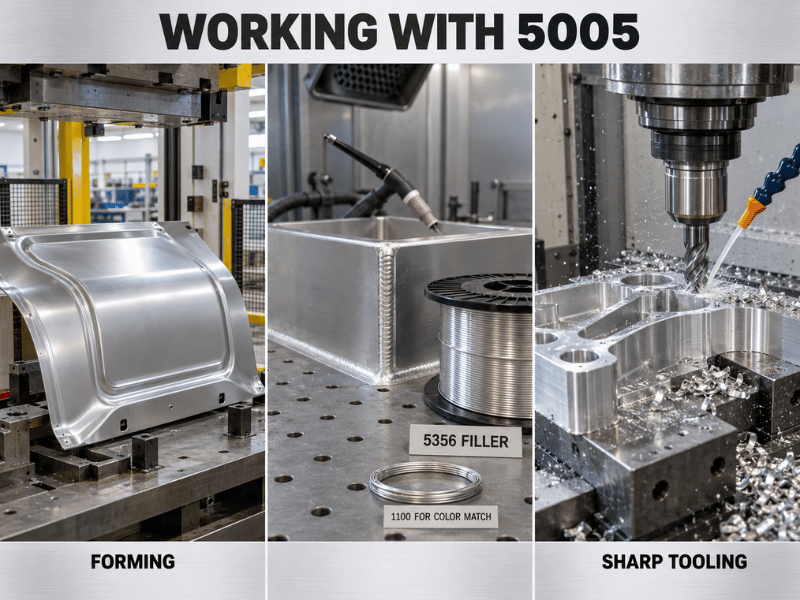
성형. 5005는 특히 어닐링 상태에서 쉽게 성형된다. 얇은 H32 판재는 파단 없이 매우 좁은 반경 — 대략 0 내지 ½ × 두께 — 으로 절곡할 수 있으며, H34는 일반적으로 1 내지 2 × 두께를 견딘다. 딥 드로잉, 스피닝, 롤 포밍은 O 조질에서 표준적이다. 성형 하중과 공구 마모는 유사한 형상에서 탄소강보다 낮다.
용접. GTAW(TIG)와 GMAW(MIG) 모두 깨끗하게 용접되며, 저항 점용접과 마찰 교반 용접도 마찬가지이다. 용가재 선택은 우선순위에 따라 나뉜다: 4043 (Al-Si)는 열간 균열 저항성과 용접 비드 유동성 때문에 종종 선호되며, 5356 (Al-Mg)는 기계적으로 더 강한 용접 금속을 생성한다. 어느 쪽도 용접 전후 열처리가 필요하지 않으며, 낮은 마그네슘 함량은 용접 후 민감화 위험이 의미 있게 존재하지 않음을 뜻한다. 열영향부는 어닐링 강도 쪽으로 되돌아갈 것으로 예상해야 한다 — 모든 비열처리 합금과 마찬가지로, 그 강도는 회복되지 않는다.
절삭 가공. 보통이다. 5005는 1100이나 3003 같은 매우 연한 계열보다 절삭성이 좋고, 2017이나 6082 같은 쾌삭 합금보다는 나쁘다. 연질이므로 끈적한 칩과 구성 날끝(built-up edge)이 발생하므로, 날카로운 공구, 더 높은 절삭 속도, 충분한 윤활을 사용해야 한다. 부품이 표면 마감보다 절삭 가공 중심이라면 6061이 더 나은 선택이다.
어닐링. 표준 처리는 약 345 °C에서 유지한 후 서냉하는 것이다. 일반적으로 열간 가공되지 않는다 — 단조는 5xxx 합금에 거의 적용되지 않으며 5005의 일반적인 공정 경로가 아니다.
5005 vs 3003 vs 5052 vs 6061
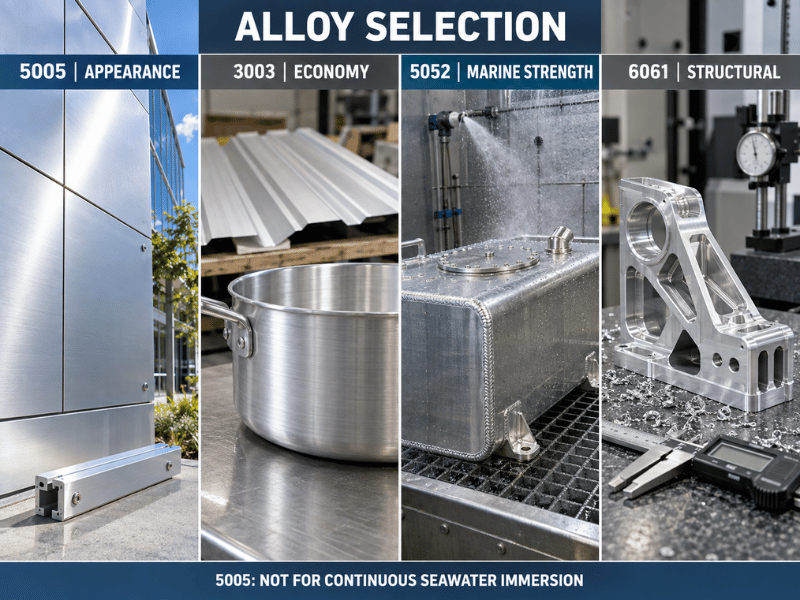
| 합금 및 템퍼 | 인장 강도 (MPa) | 항복 강도 (MPa) | 연신율 (%) | 경도(HB) | 아노다이징 | 최상의 대상 |
|---|---|---|---|---|---|---|
| 5005-H34 | 159 | 138 | 8 | 41 | 우수 — 투명 피막, 6063과 일치 | 아노다이징 건축 패널, 사인 |
| 3003-H14 | 152 | 145 | 8–16 | 40 | 양호 — 약간 변색될 수 있음 | 조리기구, 지붕, 일반 판금 |
| 5052-H32 | 228 | 193 | 12 | 60 | 보통 — 덜 균일 | 해양 부품, 연료 탱크, 성형 인클로저 |
| 6061-T6 | 310 | 276 | 12 | 95 | 양호 — 약간 덜 균일 | 구조 프레임, 압출재, 기계 가공 부품 |
5005 vs 3003. 유사한 조질에서 이 둘은 강도가 비슷하다 — 몇 퍼센트 이내 — 따라서 강도를 기준으로 둘 중 하나를 고르는 사람은 잘못된 변수를 최적화하고 있는 것이다. 5005는 아노다이징 투명도, 6063과의 색상 일치, 전도도(약 52% IACS 대 약 40%)에서 우수하다. 3003은 가격과 약간 더 나은 딥 드로잉에서 우수하다. 표면이 보이는 경우 5005를 선택하고, 보이지 않는 경우 3003을 선택하라.
5005 vs 5052. 5052는 상당히 더 강하다 — 대부분의 사람들이 실제로 구매하는 조질에서 228 MPa 대 159 MPa — 그리고 진정한 해양 침수에서 더 잘 견딘다. 그 대가로 덜 균일한 양극 산화 피막과 더 높은 비용을 지불한다. 구조와 염수에는 5052; 외관에는 5005.
5005 vs 6061. 다른 범주이다. 6061-T6는 5005의 항복강도를 대략 두 배로 높이고 절삭성도 훨씬 우수하지만, 열처리 가능하고, T6에서 성형성을 잃으며, 구리 함량 때문에 내식성과 양극 산화 균일성이 일부 희생된다. 5005는 장식용 판재 합금이고, 6061은 구조용 합금이다.
Go/No-Go: 5005를 지정해야 하는 경우
다음과 같은 경우 5005를 지정하라:
- 부품이 아노다이징될 예정이고 외관이 합격 기준인 경우 — 특히 6063 압출재와 색상을 일치시켜야 하는 경우
- 환경이 연속 침수가 아니라 대기, 해안, 또는 약알칼리성인 경우
- 부품이 성형, 절곡, 또는 드로잉되고 적당한 강도로 충분한 경우
- 사용 온도가 상온이거나 완만하게 상승한 수준이며, 고Mg 계열을 제약하는 65 °C 민감화 한계를 피하고자 하는 경우
- 5052/5083보다更高的 열전도도 또는 전기전도도가 유용한 경우
다음과 같은 경우에는 다른 소재를 찾아라:
- 하중 지지 능력이 설계를 좌우하는 경우 — 성형 판재에는 5052, 구조에는 6061-T6로 가라
- 부품이 수중 또는 비말대 해양 사용 환경인 경우 — 5083 또는 5086
- 절삭 가공량이 많고 사이클 타임이 중요한 경우 — 6061
- 내마모성이 대량 요구사항인 경우 — 아노다이징은 표면만 개선하며, 4xxx 또는 하드 코팅 솔루션이 필요할 수 있다
- 사양이 대략 51 HB 이상의 경도를 요구하는 경우, 그것이 5005가 멈추는 지점이다
5005가 사용되는 곳
| 분야 | 대표적 부품 | Why 5005 |
|---|---|---|
| Architecture and construction | Facades, roofing, wall panels, decorative trim, anodized profiles | Anodizing clarity, corrosion resistance, colour match to 6063 |
| Signage and display | Anodized signs, nameplates, retail displays, decorative panels | Bright uniform finish, formability, light weight |
| Marine and coastal | 선박 내부 피팅, 해양 하드웨어, 연안 건축 부품 | Atmospheric marine corrosion resistance without immersion-grade cost |
| 전기 | Busbars, conductor rail, enclosures | ~52% IACS conductivity with formability |
| Appliance and consumer | Appliance trim, utensils, furniture, packaging | Formed-and-anodized economics |
| Automotive and transport | Interior trim, non-structural panels | Formability and finish quality |
| Chemical and process | Tank panels, equipment housings | Alkaline resistance and weldability |
장점 및 한계 요약
| 치수 | 이점 | 주의 사항 |
|---|---|---|
| 아노다이징 | Clear, uniform film; best-in-class 6063 colour match | Streaking possible — specify 5005-AQ for critical finishes |
| 내식성 | Excellent atmospheric and coastal | Not for continuous seawater immersion |
| Temperature safety | Below the 3% Mg threshold — no 65 °C SCC ceiling | Cold-worked tempers still soften with sustained heat |
| 성형성 | Excellent in O; tight bend radii in H32/H34 | Ductility falls fast by H36/H38 |
| 용접성 | Clean TIG/MIG, no pre- or post-heat, no sensitization risk | HAZ reverts toward annealed strength |
| 가공 | Better than 1100/3003 | Gummy chips; well behind 6061 |
| 전도도 | ~201 W/m·K, ~52% IACS — high for 5xxx | Both drop in harder tempers |
| 힘 | Adequate for decorative and light-duty work | Ceiling around 200 MPa / 51 HB |
결론
5005 earns its place on a drawing for one reason: it anodizes better than the alternatives at a price that makes decorative architectural work economical — while matching 3003 on corrosion resistance and dodging the elevated-temperature sensitization limit that bites higher-magnesium 5xxx grades. Its hardness window is narrow by design (28 HB annealed to 51 HB full hard), and the temper choice is where specs live or die: H32/H34 for formed parts, H38 only when nothing forms, and 5052 or 6061 the moment load-bearing, immersion service, or machining volume becomes the driver. If the surface is visible and exposed, spend the small premium on 5005-AQ.
At Linsy Aluminum, we supply 5005 across sheet, coil, plate, bar, tube, and wire in the common tempers, with in-house machining, welding, laser cutting, anodizing, and polishing. Send your drawing and spec — temper and anodizing requirement included — and we’ll confirm hardness and finish before you commit.
자주 묻는 질문
How hard is 5005 aluminum?
It depends entirely on temper, because 5005 is non-heat-treatable and gains hardness only from cold work. Typical Brinell values run 28 HB in the annealed O condition, 36 HB in H32, 41 HB in H34, 46 HB in H36, and 51 HB in H38. Published figures vary somewhat by source and thickness, so treat these as typical and confirm guaranteed values on the MTC.
5005 알루미늄은 열처리가 가능한가요?
No. 5005 cannot be precipitation-hardened; all strength comes from strain hardening, expressed in the H-tempers. It can be annealed — around 345 °C followed by slow cooling — but that softens it rather than strengthening it. If you need heat-treatable strength, 6061 is the usual move.
Which 5005 temper should I specify?
Use O when the part is deeply drawn or severely formed. H32 is the general-purpose choice and the safest default for architectural sheet, with H34 adding strength where some formability can be given up. H36 and H38 deliver maximum strength but elongation drops to around 6%, which rules out most forming. H32 and H34 are preferred for anodized architectural work because the stabilised H3x condition holds its properties.
Does anodizing make 5005 harder?
It hardens the surface, not the metal. The anodic oxide layer is considerably harder than the aluminium substrate, so scratch and wear resistance improve substantially — but the bulk hardness underneath is unchanged, and a 5005-H34 part still has 41 HB below its coating. Anodizing is the right answer for surface durability and the wrong answer for load-bearing capacity.
Is 5005 suitable for marine environments?
For marine atmosphere, yes — it performs well in coastal and salt-spray exposure and is widely used for interior boat fittings and coastal architectural parts. For continuous seawater immersion or heavily loaded marine structure, higher-magnesium grades such as 5083 or 5086 are the correct specification. 5005 also has an advantage here: at ~0.8% Mg it sits below the threshold where the 65 °C sensitization and stress-corrosion-cracking limit applies to grades like 5083 and 5056.