Wat is 5005-aluminium?
5005 is het magnesiumarme uiteinde van de 5xxx-familie, met ongeveer 0,8% magnesium — ruim onder 5052 (~2,5%) of 5083 (~4,5%). Dat ene getal verklaart bijna alles eraan. Met minder magnesium ruilt 5005 de hoge sterkte van zijn 5xxx-neven in voor twee dingen waarvoor kopers het daadwerkelijk specificeren: een uitstekende anodiseerrespons en corrosieweerstand dicht bij die van 3003 bij een lager gewicht aan legeringselementen. Het is de standaardkeuze voor geanodiseerd architecturaal plaatmateriaal, en de mechanische eigenschappen liggen in dezelfde band als 3003 in plaats van in structureel gebied.
Het is een niet-warmtebehandelbare legering. Elke toename van sterkte komt van koudvervorming, tot uitdrukking gebracht in de H-tempers, en het kan niet precipitatief worden gehard zoals 6061 of 7075. De praktische consequentie is dat hardheid en sterkte worden bepaald door de temper die u koopt, niet door wat u daarna met het onderdeel doet — behalve het teruggloeien.
Er is ook een echt voordeel dat over het hoofd wordt gezien: omdat 5005 ruim onder de drempel van ~3% magnesium ligt, is het niet gevoelig voor β-fase (Al₃Mg₂) korrelgrensprecipitatie die hogere-magnesiumgraden zoals 5083 en 5056 beperkt tot ruwweg 65 °C bij langdurige dienst. Voor warme, mild corrosieve toepassingen draagt 5005 die beperking niet.
Chemische samenstelling van 5005
Samenstellingsgrenzen volgens ASTM B209 / EN 573-3, in gewichtsprocent. Magnesium is het enige bewuste legeringselement van betekenis; al het andere is ofwel een kleine gecontroleerde toevoeging of een onzuiverheidsplafond.
| Element | Inhoud (%) | Rol |
|---|---|---|
| Magnesium (Mg) | 0.50 – 1.10 | Primair legeringselement; sterkte en corrosiegedrag |
| Silicium (Si) | 0,30 max | Onzuiverheid, laag gehouden voor anodiseerhelderheid |
| IJzer (Fe) | 0,70 max | Onzuiverheid; beïnvloedt oppervlakteafwerking |
| Koper (Cu) | maximaal 0,20 | Laag gehouden om corrosieweerstand en anodische kleur te beschermen |
| Mangaan (Mn) | maximaal 0,20 | Kleine toevoeging, korrelstructuur |
| Chroom (Cr) | 0,10 max | Kleine toevoeging voor corrosieweerstand |
| Zink (Zn) | 0,25 max | Sporen |
| Titanium (Ti) | 0.05 – 0.15 | Korrelverfijner |
| Overige (per stuk) | 0,05 max | Sporen van onzuiverheden |
| Overige (totaal) | 0,15 max | Som van spore-onzuiverheden |
| Aluminium (Al) | Rest | Basismetaal |
De strakke plafonds voor koper en silicium zijn belangrijker dan ze lijken. Beide elementen verkleuren een anodische film — koper duwt deze naar geel, silicium naar grijs — daarom maakt een low-Cu, low-Si chemie van 5005 een anodiseerlegering in plaats van zomaar een andere 5xxx-graad.
Hardheid van 5005 per temper
Hardheid is waar de koudvervormde structuur van 5005 het meest direct tot uiting komt. Onderstaande waarden zijn typische Brinell-cijfers gemeten met een belasting van 500 kg en een kogel van 10 mm (ASTM E10), de conventie die voor gewalst aluminium wordt gebruikt.
| Temper | Toestand | Brinell-hardheid (HB) | Geschatte schuifsterkte (MPa) |
|---|---|---|---|
| O | Uitgegloeid | 28 | 76 |
| H32 | Vervormingsgehard, gestabiliseerd (¼ hard) | 36 | 96 |
| H34 | Vervormingsgehard, gestabiliseerd (½ hard) | 41 | 96 |
| H36 | Vervormingsgehard, gestabiliseerd (¾ hard) | 46 | 103 |
| H38 | Vervormingsgehard, gestabiliseerd (volhard) | 51 | 110 |
Drie dingen volgen uit die tabel.
Het bereik is smal. Over het gehele temperbereik beweegt 5005 zich van 28 naar 51 HB — minder dan een verdubbeling van gegloeid tot volhard. Vergelijk dat met 6061, dat ruwweg verdrievoudigt van O naar T6. Als uw ontwerp hardheid vereist die koudvervorming niet kan leveren, is 5005 het verkeerde uitgangspunt en geen enkele temperselectie lost dat op.
Hardheid is een ontvangstinspectiegereedschap, geen ontwerpinvoer. HB is snel en niet-destructief genoeg om een levering tegen zijn MTC te controleren, en het correleert goed met treksterkte. Maar geen enkele ingenieur dimensioneert een beugel op basis van Brinell. Gebruik HB om te bevestigen dat u de bestelde temper hebt ontvangen; gebruik trek- en vloeigrens voor de daadwerkelijke berekening.
Anodiseren verandert de oppervlaktehardheid, niet de bulkhardheid. Dit is het meest voorkomende misverstand bij een hardheidsvraag. De anodische oxidelaag is veel harder dan het substraat — aluminiumoxide staat ver boven elke aluminiumlegering op de hardheidsschaal — dus kras- en slijtvastheid verbeteren aanzienlijk. Het onderliggende metaal is onveranderd, en een 5005-H34 plaat heeft nog steeds 41 HB onder zijn coating. Als een tekening “harder” zegt, stel dan vast of het oppervlakteslijtvastheid betekent (anodiseer het) of draagvermogen (verander de legering).
Mechanische eigenschappen van 5005 per temper
Typische waarden voor plaat en dikplaat. Let op dat ASTM B209 minimum waarden onder deze cijfers liggen en variëren met dikte — gegarandeerde getallen voor uw specifieke partij komen uit de MTC, niet uit deze tabel.
| Temper | Treksterkte (MPa) | Rekgrens (MPa) | Rek (1% in 50 mm) | Hardheid (HB) |
|---|---|---|---|---|
| O | 124 | 41 | 25 | 28 |
| H32 | 138 | 117 | 11 | 36 |
| H34 | 159 | 138 | 8 | 41 |
| H36 | 179 | 165 | 6 | 46 |
| H38 | 200 | 186 | 6 | 51 |
De rek-kolom is degene die de meeste echte specificaties bepaalt. Van H32 naar H38 gaan levert ruwweg 45% meer treksterkte op en kost u bijna de helft van de beschikbare rek — 11% naar 6%. Voor een vlak decoratief paneel is die ruil gratis. Voor alles met een vormradius, een zoom of een gerolde rand is H32 of H34 het plafond, en O is het antwoord wanneer het vormen ernstig is.
De aanduidingen H1x en H3x zijn niet uitwisselbaar. H1x-tempers zijn alleen vervormingsgehard; H3x-tempers zijn vervormingsgehard en vervolgens gestabiliseerd met een lage-temperatuur warmtebehandeling, die een beetje sterkte afhaalt en betekenisvolle ductiliteit teruggeeft. Die stabilisatie is waarom H32/H34 het architecturale werk domineren — de extra ductiliteit koopt vormbaarheid, en de gestabiliseerde toestand houdt zijn eigenschappen vast in plaats van age-softening op de plank.
Fysische eigenschappen van 5005
| Eigendom | Waarde |
|---|---|
| Dichtheid | 2,70 g/cm³ |
| Smelttraject | 632 – 655 °C |
| Thermische geleidbaarheid | ~201 W/m·K (O-temper) |
| Elektrische geleidbaarheid | ~52% IACS (neemt af in hardere tempers) |
| Thermische uitzettingscoëfficiënt | 23,7 × 10⁻⁶ /°C (20–100 °C) |
| Specifieke warmtecapaciteit | ~900 J/kg-K |
| Elasticiteitsmodulus | ~69 GPa |
| Poissonratio | 0.33 |
Twee hiervan hebben inkoopgewicht. Thermische en elektrische geleidbaarheid bij ~201 W/m·K en ~52% IACS zijn hoog voor een 5xxx-legering — het lage magnesiumgehalte is de reden — en beide nemen af naarmate de temperhardheid stijgt, dus een geleidbaarheidsgestuurde specificatie moet tegen de O- of H32-toestand worden geplaatst in plaats van over het hele bereik te worden aangenomen. Het smeltbereik is vooral van belang voor lassen en elke discussie over dienst bij verhoogde temperatuur.
Corrosieweerstand en anodiseren
Atmosferische en mild alkalische dienst. 5005 weerstaat algemene atmosferische corrosie vergelijkbaar met 3003, inclusief industriële en kustatmosferen, met het extra 5xxx-voordeel van betere prestaties in licht alkalische omstandigheden. Het is niet de keuze voor continu onderdompeling in zeewater — 5083 en 5086 houden die positie — maar voor mariene atmosfeer, kustarchitectuur en interieur bootbeslag is het ruimschoots toereikend.
De 65 °C-kwestie. Hogere-magnesium 5xxx-kwaliteiten hebben een continu-bedrijfstemperatuurplafond nabij 65 °C, waarboven β-fase-precipitatie langs korrelgrenzen een spanningscorrosie-scheurpad opent. Bij ~0,8% Mg ligt 5005 onder de drempel waar dat mechanisme een praktische zorg is. Dit is een echte differentiator ten opzichte van 5083 en 5056 in warme toepassing, en het is een van de minst gewaardeerde redenen om het te kiezen.
Verhoogde temperatuur verzacht het nog steeds. Koudvervormde tempers verliezen geleidelijk sterkte naarmate de bedrijfstemperatuur stijgt, met volledige uitgloeiing rond 345 °C. Als een onderdeel aanhoudende hitte zal ondervinden, ontwerp dan op basis van de uitgegloeide (O-temper) waarden in plaats van de H-temper waarden op de bestelling — de koude vervorming waarvoor u betaald hebt, overleeft de hitte niet.
Anodiseren — en de addertje onder het gras. Bij anodiseren produceert 5005 een heldere, homogene film die transparanter is dan die van 3003 en een uitstekende kleurmatch geeft met 6063 architecturale extrusies. Die combinatie is waarom het de standaardkeuze is voor geanodiseerde gevels en decoratief trimwerk.
De addertje onder het gras: 5005 kan anodiseren met zichtbare strepen, soms “barcoding” genoemd. Als de afwerking kritisch is — een gevelpaneel in vol zicht, een groot ononderbroken oppervlak — specificeer dan 5005-AQ (anodiseerkwaliteit, soms verkocht als speciale anodiseerkwaliteit) op het moment van bestelling. Het kost meer en het is veel goedkoper dan het ontdekken van de strepen na installatie. Galvanische corrosie is het andere blijvende voorbehoud: zoals elk aluminium corrodeert 5005 snel wanneer het elektrisch gekoppeld is aan een edeler metaal in een natte omgeving, dus isoleer het van staal en koperlegeringen.
Werken met 5005
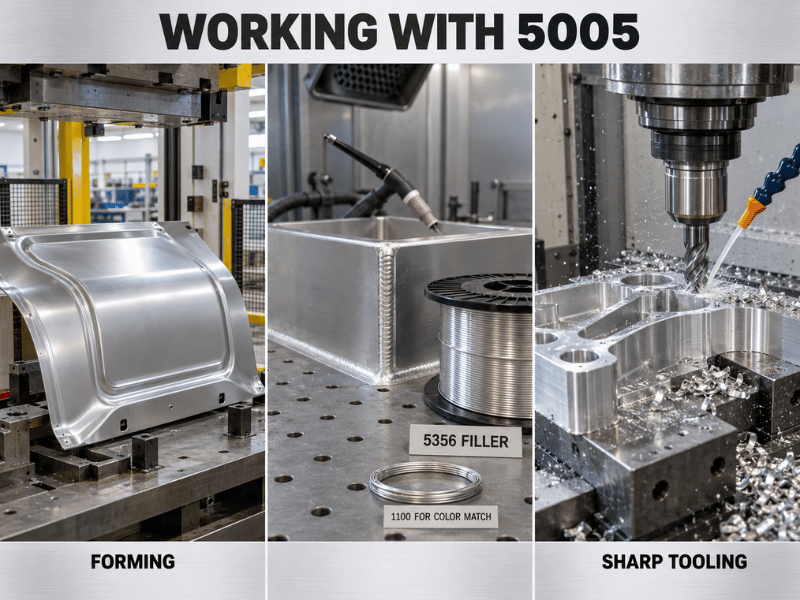
Vormen. 5005 laat zich gemakkelijk vormen, vooral uitgegloeid. Dunne H32-plaat kan worden gebogen tot zeer krappe radii — ruwweg 0 tot ½ × dikte — zonder falen, en H34 haalt over het algemeen 1 tot 2 × dikte. Dieptrekken, spinvormen en rolvormen zijn standaard in de O-conditie. Vormkrachten en gereedschapsslijtage zijn lager dan bij koolstofstaal bij vergelijkbare geometrie.
Lassen. GTAW (TIG) en GMAW (MIG) lassen beide schoon, evenals weerstandspuntlassen en friction stir welding. Vulmetaalkeuze splitst zich naar prioriteit: 4043 (Al-Si) heeft vaak de voorkeur vanwege zijn tolerantie voor warmtescheuren en lasrupsvloeibaarheid, terwijl 5356 (Al-Mg) mechanisch sterker lasmetaal produceert. Geen van beide vereist voor- of nawarmtebehandeling, en het lage magnesiumgehalte betekent dat er geen betekenisvol risico op nawarmte-sensibilisatie is. Verwacht dat de warmte-beïnvloede zone terugkeert naar uitgegloeide sterkte — zoals bij elke niet-warmtebehandelbare legering komt die sterkte niet terug.
Bewerking. Redelijk. 5005 bewerkt beter dan zeer zachte kwaliteiten zoals 1100 of 3003 en minder goed dan vrijsnijdende legeringen zoals 2017 of 6082. De zachtheid produceert kleverige spanen en opgebouwde snijkanten, dus gebruik scherp gereedschap, hogere snijsnelheden en royale smering. Waar een onderdeel bewerkingsgedomineerd is in plaats van afwerkingsgedomineerd, is 6061 de betere keuze.
Uitgloeien. Standaardbehandeling is rond 345 °C gevolgd door langzame afkoeling. Het wordt over het algemeen niet warm vervormd — smeden wordt zelden toegepast op 5xxx-legeringen en is geen normale route voor 5005.
5005 vs 3003 vs 5052 vs 6061
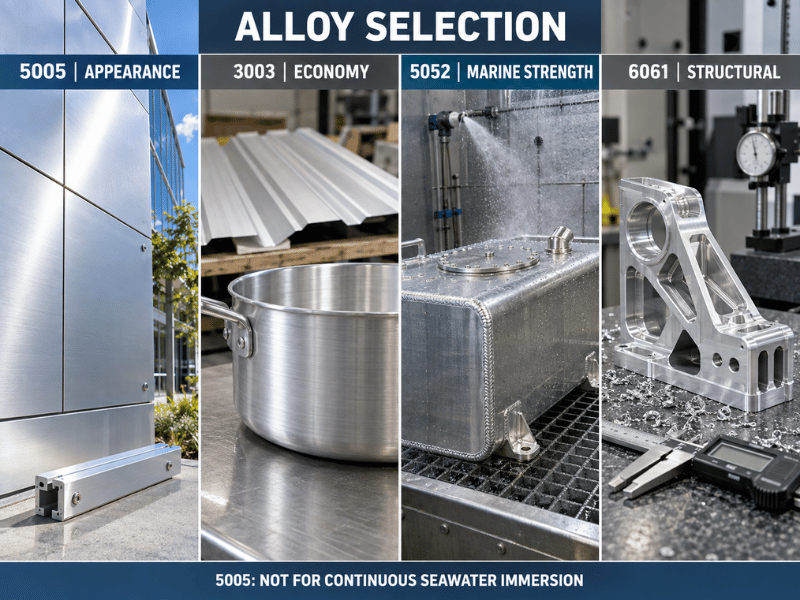
| Legering en tempering | Treksterkte (MPa) | Rekgrens (MPa) | Rek (%) | Hardheid (HB) | Anodiseren | Geschikt voor |
|---|---|---|---|---|---|---|
| 5005-H34 | 159 | 138 | 8 | 41 | Uitstekend — heldere film, matcht 6063 | Geanodiseerde architecturale panelen, bewegwijzering |
| 3003-H14 | 152 | 145 | 8–16 | 40 | Goed — kan licht verkleuren | Kookgerei, dakbedekking, algemeen plaatwerk |
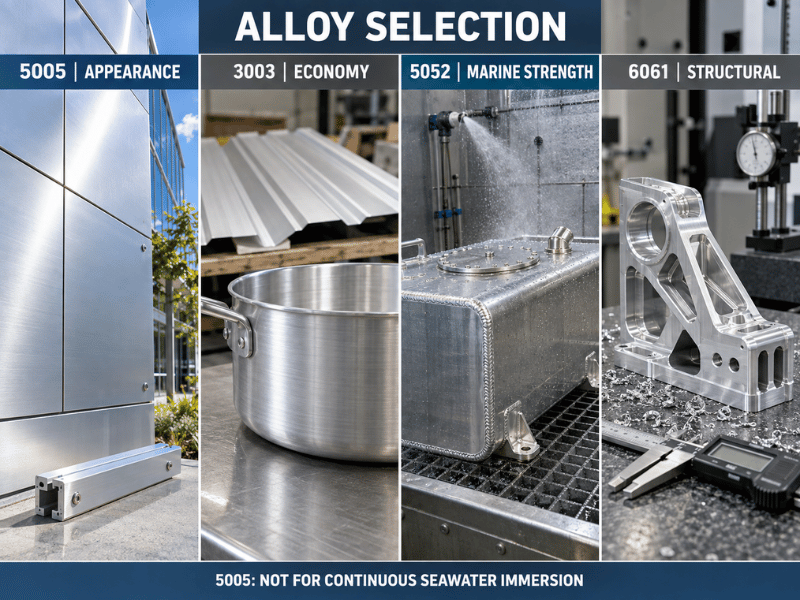
| 5052-H32 | 228 | 193 | 12 | 60 | Redelijk — minder uniform | Mariene onderdelen, brandstoftanks, gevormde behuizingen |
| 6061-T6 | 310 | 276 | 12 | 95 | Goed — iets minder uniform | Structurele frames, extrusies, bewerkte onderdelen |
5005 vs 3003. Bij vergelijkbare temper liggen deze twee dicht bij elkaar qua sterkte — binnen een paar procent — dus wie tussen hen kiest op basis van sterkte optimaliseert de verkeerde variabele. 5005 wint op anodiseerhelderheid, kleurmatch met 6063 en geleidbaarheid (~52% IACS tegen ~40%). 3003 wint op prijs en marginaal beter dieptrekken. Kies 5005 wanneer het oppervlak zichtbaar is; kies 3003 wanneer dat niet het geval is.
5005 vs 5052. 5052 is aanzienlijk sterker — 228 MPa tegen 159 MPa bij de temper die de meeste mensen daadwerkelijk kopen — en houdt zich beter in echte mariene onderdompeling. Het betaalt daarvoor met een minder uniforme anodische film en hogere kosten. 5052 voor structuur en zoutwater; 5005 voor uiterlijk.
5005 vs 6061. Verschillende categorieën. 6061-T6 verdubbelt ruwweg de vloeigrens van 5005 en bewerkt veel beter, maar het is warmtebehandelbaar, verliest vervormbaarheid in T6, en het kopergehalte kost enige corrosieweerstand en anodische uniformiteit. 5005 is een decoratieve plaatlegering; 6061 is een structurele legering.
Go/No-Go: Wanneer 5005 te specificeren
Specificeer 5005 wanneer:
- Het onderdeel geanodiseerd wordt en uiterlijk een acceptatiecriterium is — vooral waar het moet kleurmatchen met 6063-extrusies
- De omgeving atmosferisch, kust of licht alkalisch is in plaats van continue onderdompeling
- Het onderdeel gevormd, gebogen of getrokken wordt, en matige sterkte voldoende is
- De bedrijfstemperatuur omgevings- of slechts matig verhoogd is, en u de 65 °C-sensibilisatielimiet wilt vermijden die hogere-Mg-kwaliteiten beperkt
- Hogere thermische of elektrische geleidbaarheid dan 5052/5083 nuttig is
Kijk elders wanneer:
- Draagvermogen het ontwerp bepaalt — ga naar 5052 voor gevormde plaat of 6061-T6 voor structuur
- Het onderdeel ondergedompeld is of in spatzone-mariene toepassing — 5083 of 5086
- Het bewerkingsvolume hoog is en cyclustijd belangrijk is — 6061
- Slijtvastheid in bulk de vereiste is — anodiseren verbetert alleen het oppervlak, en een 4xxx- of hardcoat-oplossing kan nodig zijn
- De specificatie hardheid boven ruwweg 51 HB vereist, wat het punt is waar 5005 stopt
Waar 5005 wordt gebruikt
| Sector | Typische onderdelen | Waarom 5005 |
|---|---|---|
| Architectuur en constructie | Gevels, dakbedekking, wandpanelen, decoratieve sierlijsten, geanodiseerde profielen | Anodiseerhelderheid, corrosiebestendigheid, kleurmatch met 6063 |
| Signage en displays | Geanodiseerde borden, naamplaten, retaildisplays, decoratieve panelen | Heldere uniforme afwerking, vervormbaarheid, lichtgewicht |
| Maritiem en kustgebonden | Interieur bootfittingen, maritieme hardware, architectonische kustonderdelen | Atmosferische mariene corrosiebestendigheid zonder kosten voor onderdompelingskwaliteit |
| Elektrisch | Busbars, geleiderails, behuizingen | ~52% IACS-geleidbaarheid met vervormbaarheid |
| Apparaten en consumenten | Apparaatsierlijsten, gebruiksvoorwerpen, meubels, verpakkingen | Economie van gevormd en geanodiseerd |
| Automotive en transport | Interieursierlijsten, niet-structurele panelen | Vervormbaarheid en afwerkingskwaliteit |
| Chemisch en proces | Tankpanelen, apparatuurbehuizingen | Alkalibestendigheid en lasbaarheid |
Voor- en nadelen in één oogopslag
| Afmeting | Voordeel | Aandachtspunt |
|---|---|---|
| Anodiseren | Heldere, uniforme film; beste in klasse 6063-kleurmatch | Strepen mogelijk — specificeer 5005-AQ voor kritische afwerkingen |
| Corrosie | Uitstekend atmosferisch en kustgebonden | Niet voor continu onderdompeling in zeewater |
| Temperatuurveiligheid | Onder de 3% Mg-drempel — geen 65 °C SCC-plafond | Koudvervormde tempers verzachten nog steeds bij aanhoudende warmte |
| Vervormbaarheid | Uitstekend in O; krappe buigstralen in H32/H34 | Ductiliteit daalt snel bij H36/H38 |
| Lasbaarheid | Schoon TIG/MIG, geen voor- of naverwarming, geen risico op sensitisatie | HAZ keert terug naar gegloeide sterkte |
| Bewerking | Beter dan 1100/3003 | Kleverige spanen; duidelijk achter op 6061 |
| Geleidbaarheid | ~201 W/m·K, ~52% IACS — hoog voor 5xxx | Beide dalen in hardere tempers |
| Sterkte | Voldoende voor decoratief en licht werk | Plafond rond 200 MPa / 51 HB |
Conclusie
5005 verdient zijn plaats op een tekening om één reden: het anodiseert beter dan de alternatieven tegen een prijs die decoratief architectonisch werk economisch maakt — terwijl het 3003 evenaart op corrosiebestendigheid en de sensitisatielimiet bij verhoogde temperatuur ontwijkt die hogere magnesium-5xxx-graden treft. Het hardheidsvenster is bewust smal (28 HB gegloeid tot 51 HB volhard), en de temperkeuze is waar specificaties slagen of falen: H32/H34 voor gevormde onderdelen, H38 alleen wanneer niets wordt gevormd, en 5052 of 6061 zodra dragend vermogen, onderdompelingsservice of bewerkingsvolume de drijfveer wordt. Als het oppervlak zichtbaar en blootgesteld is, besteed dan de kleine meerprijs aan 5005-AQ.
Bij Linsy Aluminum leveren we 5005 in plaat, coil, plaatwerk, staaf, buis en draad in de gangbare tempers, met in-house bewerking, lassen, lasersnijden, anodiseren en polijsten. Stuur uw tekening en specificatie — inclusief temper- en anodiseervereiste — en we bevestigen hardheid en afwerking voordat u zich vastlegt.
Veelgestelde vragen
Hoe hard is 5005-aluminium?
Het hangt volledig af van de temper, omdat 5005 niet warmtebehandelbaar is en hardheid alleen verkrijgt door koudvervorming. Typische Brinell-waarden lopen van 28 HB in de gegloeide O-conditie, 36 HB in H32, 41 HB in H34, 46 HB in H36 en 51 HB in H38. Gepubliceerde cijfers variëren enigszins per bron en dikte, dus behandel deze als typisch en bevestig gegarandeerde waarden op de MTC.
Kan aluminium 5005 een warmtebehandeling ondergaan?
Nee. 5005 kan niet precipitatiehardend worden gemaakt; alle sterkte komt van koudversteviging, uitgedrukt in de H-tempers. Het kan worden gegloeid — rond 345 °C gevolgd door langzame afkoeling — maar dat verzacht het in plaats van het te versterken. Als u warmtebehandelbare sterkte nodig hebt, is 6061 de gebruikelijke keuze.
Welke 5005-temper moet ik specificeren?
Gebruik O wanneer het onderdeel diep wordt getrokken of zwaar wordt gevormd. H32 is de algemene keuze en de veiligste standaard voor architectonisch plaatwerk, waarbij H34 sterkte toevoegt waar wat vervormbaarheid kan worden opgeofferd. H36 en H38 leveren maximale sterkte, maar de rek daalt tot ongeveer 6%, wat de meeste vormgeving uitsluit. H32 en H34 hebben de voorkeur voor geanodiseerd architectonisch werk omdat de gestabiliseerde H3x-conditie zijn eigenschappen behoudt.
Maakt anodiseren 5005 harder?
Het verhardt het oppervlak, niet het metaal. De anodische oxidelaag is aanzienlijk harder dan het aluminiumsubstraat, dus kras- en slijtvastheid verbeteren aanzienlijk — maar de bulkhardheid eronder blijft ongewijzigd, en een 5005-H34-onderdeel heeft nog steeds 41 HB onder zijn coating. Anodiseren is het juiste antwoord voor oppervlakteduurzaamheid en het verkeerde antwoord voor draagcapaciteit.
Is 5005 geschikt voor mariene omgevingen?
Voor mariene atmosfeer, ja — het presteert goed bij kust- en zoutnevelblootstelling en wordt veel gebruikt voor interieurbootbeslag en architectonische kustonderdelen. Voor continu onderdompeling in zeewater of zwaar belaste mariene constructies zijn hogere magnesiumgraden zoals 5083 of 5086 de juiste specificatie. 5005 heeft hier ook een voordeel: bij ~0,8% Mg ligt het onder de drempel waar de 65 °C-sensitisatie- en spanningscorrosiebarstgrens geldt voor graden zoals 5083 en 5056.