Was ist 5005 Aluminium?
5005 ist das magnesiumarme Ende der 5xxx-Familie und enthält etwa 0,8% Magnesium — deutlich weniger als 5052 (~2,5%) oder 5083 (~4,5%). Diese einzige Zahl erklärt fast alles darüber. Mit weniger Magnesium tauscht 5005 die hohe Festigkeit seiner 5xxx-Verwandten gegen zwei Eigenschaften ein, für die Käufer es tatsächlich spezifizieren: eine hervorragende Eloxalreaktion und Korrosionsbeständigkeit nahe der von 3003 bei geringerem Legierungsgewicht. Es ist die Standardwahl für eloxierte Architekturbleche, und seine mechanischen Eigenschaften liegen im selben Bereich wie 3003 und nicht im strukturellen Bereich.
Es ist eine nicht aushärtbare Legierung. Jeder Festigkeitszuwachs stammt aus Kaltverfestigung, ausgedrückt in den H-Zuständen, und sie kann nicht ausscheidungsgehärtet werden wie 6061 oder 7075. Die praktische Konsequenz ist, dass Härte und Festigkeit durch den Zustand bestimmt werden, den Sie kaufen, und nicht durch irgendetwas, das Sie danach mit dem Teil machen — außer es durch Glühen wieder weicher zu machen.
Es gibt auch einen echten Vorteil, der übersehen wird: Da 5005 deutlich unter der Schwelle von ~3% Magnesium liegt, ist es keine nicht anfällig für die β-Phasen-(Al₃Mg₂-)Korngrenzenausscheidung, die höher magnesiumhaltige Sorten wie 5083 und 5056 auf etwa 65 °C im Dauerbetrieb begrenzt. Für warme, leicht korrosive Beanspruchung trägt 5005 diese Einschränkung nicht.
Chemische Zusammensetzung von 5005
Zusammensetzungsgrenzen gemäß ASTM B209 / EN 573-3, in Gewichtsprozent. Magnesium ist das einzige absichtliche Legierungselement von Bedeutung; alles andere ist entweder eine kleine kontrollierte Zugabe oder eine Verunreinigungsobergrenze.
| Element | Inhalt (%) | Rolle |
|---|---|---|
| Magnesium (Mg) | 0.50 – 1.10 | Hauptlegierungselement; Festigkeit und Korrosionsverhalten |
| Silizium (Si) | 0,30 max. | Verunreinigung, niedrig gehalten für Eloxalklarheit |
| Eisen (Fe) | 0,70 max. | Verunreinigung; beeinflusst die Oberflächenbeschaffenheit |
| Kupfer (Cu) | 0,20 max. | Niedrig gehalten zum Schutz der Korrosionsbeständigkeit und der anodischen Farbe |
| Mangan (Mn) | 0,20 max. | Geringe Zugabe, Kornstruktur |
| Chrom (Cr) | 0,10 max | Geringe Zugabe für Korrosionsbeständigkeit |
| Zink (Zn) | 0,25 max | Spuren |
| Titan (Ti) | 0.05 – 0.15 | Kornfeinungsmittel |
| Sonstige (jeweils) | 0,05 max | Spuren von Verunreinigungen |
| Sonstige (insgesamt) | 0,15 max | Summe der Spurenverunreinigungen |
| Aluminium (Al) | Restbetrag | Basis |
Die engen Obergrenzen für Kupfer und Silizium sind wichtiger, als sie erscheinen. Beide Elemente verfärben einen anodischen Film — Kupfer treibt ihn ins Gelbe, Silizium ins Graue — weshalb eine Cu-arme, Si-arme Chemie das ist, was 5005 zu einer Eloxallegierung macht und nicht nur zu einer weiteren 5xxx-Sorte.
Härte von 5005 nach Zustand
Die Härte ist der Bereich, in dem sich die kaltverfestigte Struktur von 5005 am direktesten zeigt. Die untenstehenden Werte sind typische Brinell-Werte, gemessen mit 500 kg Last und 10 mm Kugel (ASTM E10), der für Knetaluminium üblichen Konvention.
| Temperament | Zustand | Brinellhärte (HB) | Ungefähre Scherfestigkeit (MPa) |
|---|---|---|---|
| O | Geglüht | 28 | 76 |
| H32 | Kaltverfestigt, stabilisiert (¼ hart) | 36 | 96 |
| H34 | Kaltverfestigt, stabilisiert (½ hart) | 41 | 96 |
| H36 | Kaltverfestigt, stabilisiert (¾ hart) | 46 | 103 |
| H38 | Kaltverfestigt, stabilisiert (vollhart) | 51 | 110 |
Aus dieser Tabelle ergeben sich drei Dinge.
Die Spanne ist eng. Über die gesamte Zustandsspanne bewegt sich 5005 von 28 auf 51 HB — weniger als das Doppelte von geglüht bis vollhart. Vergleichen Sie das mit 6061, das sich von O bis T6 etwa verdreifacht. Wenn Ihr Design eine Härte benötigt, die Kaltverfestigung nicht liefern kann, ist 5005 der falsche Ausgangspunkt, und keine noch so sorgfältige Zustandswahl wird das beheben.
Härte ist ein Wareneingangsprüfwerkzeug, keine Designgröße. HB ist schnell und zerstörungsfrei genug, um eine Lieferung gegen ihr MTC zu prüfen, und korreliert gut mit der Zugfestigkeit. Aber kein Ingenieur dimensioniert eine Halterung nach Brinell. Verwenden Sie HB, um zu bestätigen, dass Sie den bestellten Zustand erhalten haben; verwenden Sie Zugfestigkeit und Streckgrenze für die eigentliche Berechnung.
Eloxieren verändert die Oberflächenhärte, nicht die Volumenfestigkeit. Dies ist das häufigste Missverständnis bei einer Härteanfrage. Die anodische Oxidschicht ist weitaus härter als das Substrat — Aluminiumoxid liegt auf der Härteskala weit über jeder Aluminiumlegierung —, sodass Kratz- und Verschleißfestigkeit erheblich verbessert werden. Das darunterliegende Metall bleibt unverändert, und ein 5005-H34-Blech hat unter seiner Beschichtung immer noch 41 HB. Wenn eine Zeichnung “härter” sagt, klären Sie, ob Oberflächenverschleißfestigkeit (eloxieren) oder Tragfähigkeit (Legierung wechseln) gemeint ist.
Mechanische Eigenschaften von 5005 nach Zustand
Typische Werte für Blech und Platte. Beachten Sie, dass ASTM B209 Mindest Werte unter diesen Zahlen liegen und mit der Dicke variieren — garantierte Zahlen für Ihre spezifische Charge stammen aus dem MTC, nicht aus dieser Tabelle.
| Temperament | Zugfestigkeit (MPa) | Streckgrenze (MPa) | Dehnung (1% in 50 mm) | Härte (HB) |
|---|---|---|---|---|
| O | 124 | 41 | 25 | 28 |
| H32 | 138 | 117 | 11 | 36 |
| H34 | 159 | 138 | 8 | 41 |
| H36 | 179 | 165 | 6 | 46 |
| H38 | 200 | 186 | 6 | 51 |
Die Dehnungsspalte ist diejenige, die die meisten realen Spezifikationen entscheidet. Der Wechsel von H32 auf H38 bringt etwa 45% mehr Zugfestigkeit und kostet Sie fast die Hälfte der verfügbaren Dehnung — von 11% auf 6%. Für ein flaches Dekorblech ist dieser Tausch kostenlos. Für alles mit einem Biegeradius, einer Bördelung oder einer gerollten Kante ist H32 oder H34 die Obergrenze, und O ist die Antwort, wenn die Umformung extrem ist.
Die Bezeichnungen H1x und H3x sind nicht austauschbar. H1x-Zustände sind nur kaltverfestigt; H3x-Zustände sind kaltverfestigt und dann mit einer Wärmebehandlung bei niedriger Temperatur stabilisiert, was etwas Festigkeit nimmt und nennenswerte Duktilität zurückbringt. Diese Stabilisierung ist der Grund, warum H32/H34 die Architekturarbeit dominieren — die zusätzliche Duktilität bringt Umformbarkeit, und der stabilisierte Zustand behält seine Eigenschaften, anstatt im Regal alterungsweich zu werden.
Physikalische Eigenschaften von 5005
| Eigentum | Wert |
|---|---|
| Dichte | 2,70 g/cm³ |
| Schmelzbereich | 632 – 655 °C |
| Wärmeleitfähigkeit | ~201 W/m·K (O-Zustand) |
| Elektrische Leitfähigkeit | ~52% IACS (nimmt in härteren Zuständen ab) |
| Wärmeausdehnungskoeffizient | 23,7 × 10⁻⁶ /°C (20–100 °C) |
| Spezifische Wärmekapazität | ~900 J/kg-K |
| Elastizitätsmodul | ~69 GPa |
| Querkontraktionszahl | 0.33 |
Zwei davon haben Einkaufsrelevanz. Wärme- und elektrische Leitfähigkeit mit ~201 W/m·K und ~52% IACS sind hoch für eine 5xxx-Legierung — der niedrige Magnesiumgehalt ist der Grund — und beide fallen mit steigender Zustandshärte ab, sodass eine leitfähigkeitsgetriebene Spezifikation gegen den O- oder H32-Zustand gestellt werden sollte und nicht über die gesamte Spanne angenommen werden darf. Der Schmelzbereich ist hauptsächlich für das Schweißen und jede Diskussion über den Einsatz bei erhöhten Temperaturen relevant.
Korrosionsbeständigkeit und Eloxieren
Atmosphärische und schwach alkalische Beanspruchung. 5005 widersteht allgemeiner atmosphärischer Korrosion vergleichbar mit 3003, einschließlich industrieller und küstennaher Atmosphären, mit dem zusätzlichen 5xxx-Vorteil besserer Leistung in leicht alkalischen Bedingungen. Es ist nicht die Wahl für kontinuierliche Meerwassertauchung — 5083 und 5086 halten dieses Terrain —, aber für marine Atmosphäre, Küstenarchitektur und Innenausstattung von Booten ist es problemlos ausreichend.
Die 65-°C-Frage. Höher magnesiumhaltige 5xxx-Qualitäten weisen eine Dauerbetriebsgrenze bei etwa 65 °C auf, oberhalb derer β-Phasen-Ausscheidung entlang der Korngrenzen einen Pfad für Spannungsrisskorrosion eröffnet. Bei ~0,8 % Mg liegt 5005 unterhalb der Schwelle, ab der dieser Mechanismus praktisch relevant wird. Dies ist ein echter Unterscheidungsfaktor gegenüber 5083 und 5056 im Warmbetrieb und einer der am wenigsten beachteten Gründe, es zu wählen.
Erhöhte Temperatur erweicht es dennoch. Kaltverfestigte Zustände verlieren zunehmend an Festigkeit, wenn die Einsatztemperatur steigt, mit vollständiger Rekristallisationsglühung bei etwa 345 °C. Wenn ein Bauteil anhaltender Wärme ausgesetzt ist, sollte gegen die Werte des geglühten Zustands (O-Zustand) ausgelegt werden, nicht gegen die H-Zustandswerte auf der Bestellung — die Kaltverfestigung, für die Sie bezahlt haben, übersteht die Wärme nicht.
Eloxieren — und der Haken. Im eloxierten Zustand erzeugt 5005 eine klare, homogene Schicht, die transparenter ist als die von 3003 und eine hervorragende Farbübereinstimmung mit Architekturstrangpressprofilen aus 6063 liefert. Diese Kombination ist der Grund, warum es die Standardwahl für eloxierte Fassaden und dekorative Zierleisten ist.
Der Haken: 5005 kann beim Eloxieren sichtbare Streifenbildung zeigen, manchmal “Barcoding” genannt. Wenn die Oberfläche kritisch ist — eine Fassadenplatte in voller Sicht, eine große ununterbrochene Fläche —, spezifizieren Sie 5005-AQ (Eloxierqualität, manchmal als spezielle Eloxierqualität verkauft) zum Zeitpunkt der Bestellung. Es kostet mehr, und es ist weitaus günstiger, als die Streifen nach der Installation zu entdecken. Galvanische Korrosion ist der andere bestehende Vorbehalt: Wie jedes Aluminium korrodiert 5005 schnell, wenn es in feuchter Umgebung elektrisch mit einem edleren Metall gekoppelt wird, daher ist es von Stahl und Kupferlegierungen zu isolieren.
Bearbeitung von 5005
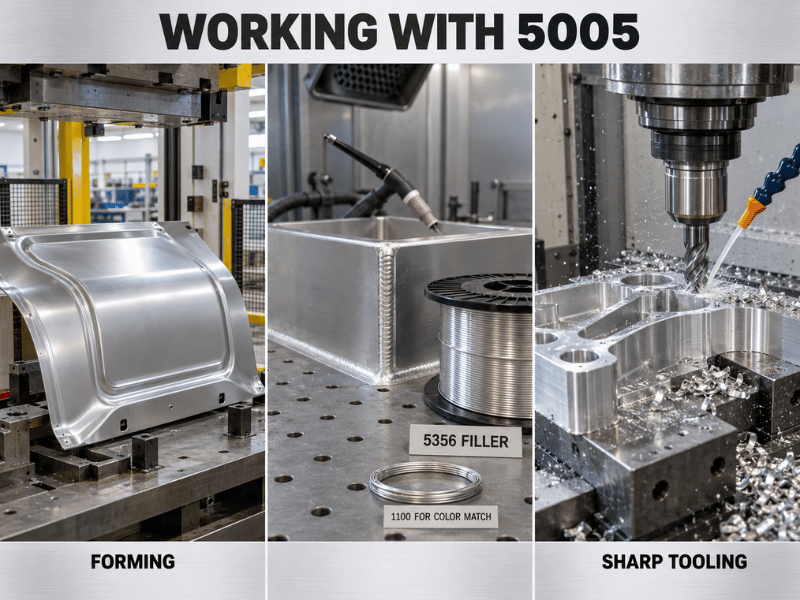
Umformen. 5005 lässt sich gut umformen, besonders im geglühten Zustand. Dünnes H32-Blech kann ohne Versagen auf sehr enge Radien gebogen werden — etwa 0 bis ½ × Dicke —, und H34 bewältigt im Allgemeinen 1 bis 2 × Dicke. Tiefziehen, Drücken und Rollformen sind im O-Zustand Standard. Umformkräfte und Werkzeugverschleiß sind bei vergleichbarer Geometrie geringer als bei Kohlenstoffstahl.
Schweißen. GTAW (WIG) und GMAW (MIG) laufen beide sauber, ebenso Widerstandspunktschweißen und Rührreibschweißen. Die Zusatzwerkstoffwahl teilt sich nach Priorität auf: 4043 (Al-Si) wird oft wegen seiner Heißrissbeständigkeit und Schweißnahtfließfähigkeit bevorzugt, während 5356 (Al-Mg) mechanisch festeres Schweißgut erzeugt. Keiner erfordert eine Wärmebehandlung vor oder nach dem Schweißen, und der niedrige Magnesiumgehalt bedeutet, dass kein nennenswertes Sensibilisierungsrisiko nach dem Schweißen besteht. Erwarten Sie, dass die Wärmeeinflusszone zur geglühten Festigkeit zurückkehrt — wie bei jeder nicht aushärtbaren Legierung kommt diese Festigkeit nicht zurück.
Zerspanung. Angemessen. 5005 lässt sich besser zerspanen als sehr weiche Qualitäten wie 1100 oder 3003 und schlechter als zerspanungsfreundliche Legierungen wie 2017 oder 6082. Seine Weichheit erzeugt schmierige Späne und Aufbauschneiden, daher sind scharfes Werkzeug, höhere Schnittgeschwindigkeiten und großzügige Schmierung zu verwenden. Wo ein Bauteil eher zerspanungs- als oberflächenbestimmt ist, ist 6061 die bessere Wahl.
Glühen. Die Standardbehandlung liegt bei etwa 345 °C, gefolgt von langsamer Abkühlung. Es wird im Allgemeinen nicht warmumgeformt — Schmieden wird selten auf 5xxx-Legierungen angewendet und ist kein üblicher Weg für 5005.
5005 vs. 3003 vs. 5052 vs. 6061
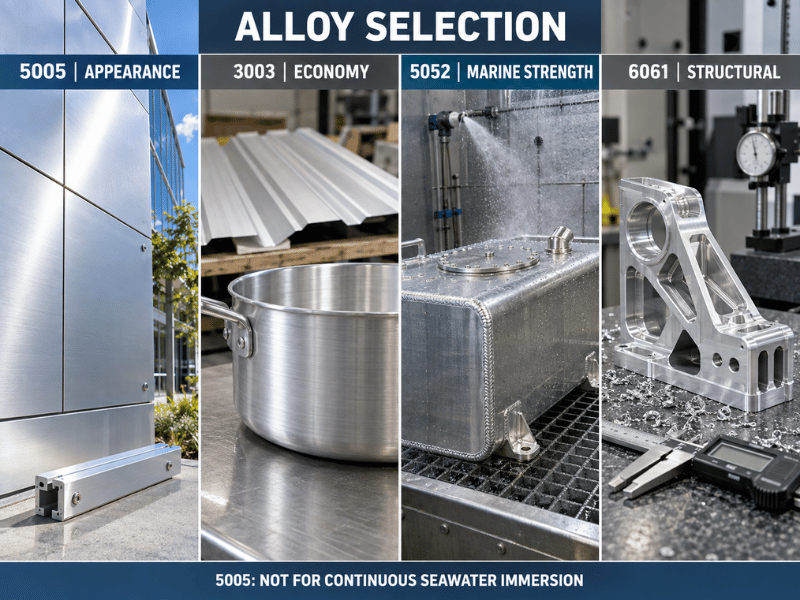
| Legierung und Zustand | Zugfestigkeit (MPa) | Streckgrenze (MPa) | Dehnung (%) | Härte (HB) | Eloxieren | Am besten für |
|---|---|---|---|---|---|---|
| 5005-H34 | 159 | 138 | 8 | 41 | Ausgezeichnet — klare Schicht, passt zu 6063 | Eloxierte Architekturpaneele, Beschilderung |
| 3003-H14 | 152 | 145 | 8–16 | 40 | Gut — kann sich leicht verfärben | Kochgeschirr, Bedachung, allgemeine Blecharbeiten |
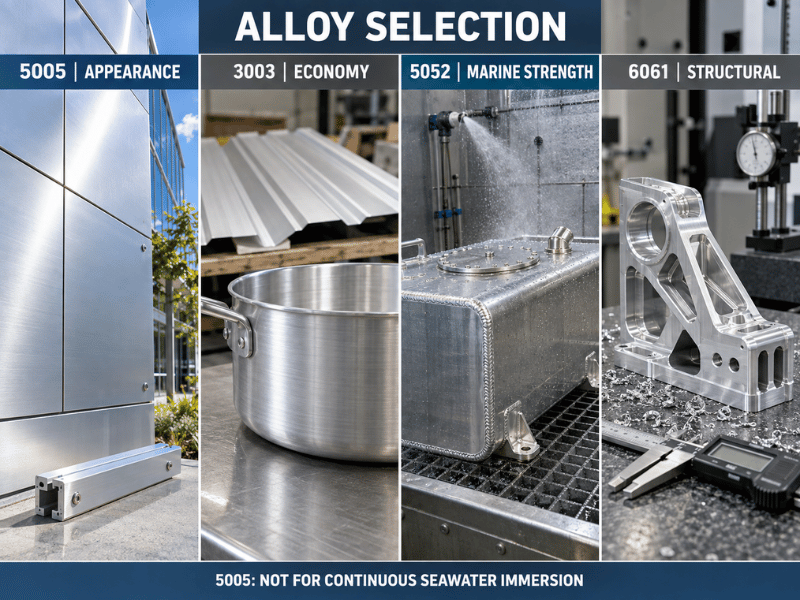
| 5052-H32 | 228 | 193 | 12 | 60 | Mäßig — weniger gleichmäßig | Marinekomponenten, Kraftstofftanks, umgeformte Gehäuse |
| 6061-T6 | 310 | 276 | 12 | 95 | Gut — etwas weniger gleichmäßig | Strukturrahmen, Strangpressprofile, bearbeitete Teile |
5005 vs. 3003. Bei vergleichbarem Zustand liegen diese beiden bei der Festigkeit nahe beieinander — innerhalb weniger Prozent —, sodass jeder, der zwischen ihnen anhand der Festigkeit wählt, die falsche Variable optimiert. 5005 gewinnt bei Eloxierklarheit, Farbübereinstimmung mit 6063 und Leitfähigkeit (~52 % IACS gegenüber ~40 %). 3003 gewinnt beim Preis und beim etwas besseren Tiefziehen. Wählen Sie 5005, wenn die Oberfläche sichtbar ist; wählen Sie 3003, wenn sie es nicht ist.
5005 vs. 5052. 5052 ist deutlich fester — 228 MPa gegenüber 159 MPa bei dem Zustand, den die meisten tatsächlich kaufen — und hält bei echter Meerwasseruntertauchung besser stand. Das bezahlt es mit einer weniger gleichmäßigen Eloxalschicht und höheren Kosten. 5052 für Struktur und Salzwasser; 5005 für das Erscheinungsbild.
5005 vs. 6061. Unterschiedliche Kategorien. 6061-T6 verdoppelt in etwa die Streckgrenze von 5005 und lässt sich weit besser zerspanen, ist aber aushärtbar, verliert im T6-Zustand an Umformbarkeit, und sein Kupfergehalt kostet etwas Korrosionsbeständigkeit und Eloxiergleichmäßigkeit. 5005 ist eine dekorative Blechlegierung; 6061 ist eine Strukturlegierung.
Go/No-Go: Wann 5005 zu spezifizieren ist
Spezifizieren Sie 5005, wenn:
- Das Bauteil eloxiert wird und das Erscheinungsbild ein Abnahmekriterium ist — besonders wenn es farblich zu 6063-Strangpressprofilen passen muss
- Die Umgebung atmosphärisch, küstennah oder leicht alkalisch ist statt kontinuierlicher Untertauchung
- Das Bauteil umgeformt, gebogen oder gezogen wird und mäßige Festigkeit ausreicht
- Die Einsatztemperatur Umgebungstemperatur oder nur mäßig erhöht ist und Sie die 65-°C-Sensibilisierungsgrenze vermeiden wollen, die höher magnesiumhaltige Qualitäten einschränkt
- Höhere thermische oder elektrische Leitfähigkeit als 5052/5083 nützlich ist
Suchen Sie woanders, wenn:
- Die Tragfähigkeit das Design bestimmt — gehen Sie zu 5052 für umgeformtes Blech oder 6061-T6 für Struktur
- Das Bauteil untergetaucht oder im Spritzwasserbereich im Marineeinsatz ist — 5083 oder 5086
- Das Zerspanungsvolumen hoch ist und die Zykluszeit zählt — 6061
- Verschleißfestigkeit in der Masse gefordert ist — Eloxieren verbessert nur die Oberfläche, und eine 4xxx- oder hartbeschichtete Lösung kann erforderlich sein
- Die Spezifikation eine Härte über etwa 51 HB verlangt, wo 5005 endet
Wo 5005 verwendet wird
| Sektor | Typische Teile | Warum 5005 |
|---|---|---|
| Architektur und Bauwesen | Fassaden, Dacheindeckungen, Wandpaneele, dekorative Zierleisten, eloxierte Profile | Eloxierklarheit, Korrosionsbeständigkeit, Farbübereinstimmung mit 6063 |
| Beschilderung und Displays | Eloxierte Schilder, Typenschilder, Verkaufsdisplays, Dekorplatten | Helle gleichmäßige Oberfläche, Umformbarkeit, geringes Gewicht |
| Marine und Küstenbereich | Innenausstattung für Boote, Beschläge für den Schiffsbau, architektonische Teile für Küstenregionen | Beständigkeit gegen atmosphärische Meereskorrosion ohne Kosten für Tauchqualität |
| Elektrisch | Stromschienen, Stromabnehmer, Gehäuse | ~52 % IACS Leitfähigkeit mit Umformbarkeit |
| Haushaltsgeräte und Konsumgüter | Geräteverkleidungen, Utensilien, Möbel, Verpackungen | Wirtschaftlichkeit von Umformen und Eloxieren |
| Automobil und Transport | Innenverkleidungen, nichttragende Paneele | Umformbarkeit und Oberflächenqualität |
| Chemie und Verfahrenstechnik | Tankwände, Gerätegehäuse | Alkalibeständigkeit und Schweißbarkeit |
Vor- und Nachteile im Überblick
| Abmessung | Vorteil | Achtung |
|---|---|---|
| Eloxieren | Klarer, gleichmäßiger Film; branchenbeste Farbübereinstimmung mit 6063 | Streifenbildung möglich — für kritische Oberflächen 5005-AQ spezifizieren |
| Korrosion | Ausgezeichnete atmosphärische und Küstenbeständigkeit | Nicht für kontinuierliche Meerwasserimmersion |
| Temperatursicherheit | Unterhalb der 3 % Mg-Schwelle — keine 65 °C-SCC-Obergrenze | Kaltverfestigte Zustände erweichen dennoch bei anhaltender Wärme |
| Verformbarkeit | Ausgezeichnet in O; enge Biegeradien in H32/H34 | Duktilität fällt schnell ab bei H36/H38 |
| Schweißeignung | Sauberes TIG/MIG, keine Vor- oder Nachwärmung, kein Sensibilisierungsrisiko | Wärmeeinflusszone kehrt zur geglühten Festigkeit zurück |
| Bearbeitung | Besser als 1100/3003 | Gummierte Späne; deutlich hinter 6061 |
| Leitfähigkeit | ~201 W/m·K, ~52 % IACS — hoch für 5xxx | Beide sinken in härteren Zuständen |
| Stärke | Ausreichend für dekorative und leichte Arbeiten | Obergrenze bei etwa 200 MPa / 51 HB |
Schlussfolgerung
5005 verdient seinen Platz auf einer Zeichnung aus einem Grund: Es eloxiert besser als die Alternativen zu einem Preis, der dekorative Architekturanwendungen wirtschaftlich macht — während es bei der Korrosionsbeständigkeit mit 3003 mithält und die Hochtemperatur-Sensibilisierungsgrenze umgeht, die höher magnesiumhaltige 5xxx-Legierungen betrifft. Sein Härtefenster ist konstruktionsbedingt eng (28 HB geglüht bis 51 HB vollhart), und die Zustandswahl entscheidet über Erfolg oder Misserfolg der Spezifikation: H32/H34 für umgeformte Teile, H38 nur wenn nichts umgeformt wird, und 5052 oder 6061 sobald tragende Lasten, Immersionsservice oder Zerspanungsvolumen zum Treiber werden. Wenn die Oberfläche sichtbar und exponiert ist, investieren Sie den kleinen Aufpreis in 5005-AQ.
Bei Linsy Aluminum liefern wir 5005 in Blech, Coil, Platte, Stange, Rohr und Draht in den gängigen Zuständen, mit Inhouse-Bearbeitung, Schweißen, Laserschneiden, Eloxieren und Polieren. Senden Sie Ihre Zeichnung und Spezifikation — einschließlich Zustand und Eloxieranforderung — und wir bestätigen Härte und Oberfläche, bevor Sie sich festlegen.
Häufig gestellte Fragen
Wie hart ist 5005-Aluminium?
Es hängt vollständig vom Zustand ab, da 5005 nicht aushärtbar ist und Härte nur durch Kaltverformung gewinnt. Typische Brinell-Werte liegen bei 28 HB im geglühten O-Zustand, 36 HB in H32, 41 HB in H34, 46 HB in H36 und 51 HB in H38. Veröffentlichte Werte variieren etwas je nach Quelle und Dicke, daher sind diese als typisch zu betrachten und garantierte Werte auf dem MTC zu bestätigen.
Ist Aluminium 5005 wärmebehandelbar?
Nein. 5005 kann nicht ausscheidungsgehärtet werden; alle Festigkeit stammt aus Kaltverfestigung, ausgedrückt in den H-Zuständen. Es kann geglüht werden — bei etwa 345 °C gefolgt von langsamer Abkühlung — aber das erweicht es rather als es zu stärken. Wenn Sie aushärtbare Festigkeit benötigen, ist 6061 der übliche Weg.
Welchen 5005-Zustand sollte ich spezifizieren?
Verwenden Sie O, wenn das Teil tiefgezogen oder stark umgeformt wird. H32 ist die Allzweckwahl und der sicherste Standard für Architekturblech, wobei H34 Festigkeit hinzufügt, wo etwas Umformbarkeit aufgegeben werden kann. H36 und H38 liefern maximale Festigkeit, aber die Dehnung fällt auf etwa 6 %, was die meisten Umformungen ausschließt. H32 und H34 werden für eloxierte Architekturanwendungen bevorzugt, da der stabilisierte H3x-Zustand seine Eigenschaften hält.
Macht Eloxieren 5005 härter?
Es härtet die Oberfläche, nicht das Metall. Die anodische Oxidschicht ist erheblich härter als das Aluminiumsubstrat, sodass Kratz- und Verschleißfestigkeit deutlich verbessert werden — aber die Grundhärte darunter bleibt unverändert, und ein 5005-H34-Teil hat weiterhin 41 HB unter seiner Beschichtung. Eloxieren ist die richtige Antwort für Oberflächenhaltbarkeit und die falsche Antwort für Tragfähigkeit.
Ist 5005 für Meeresumgebungen geeignet?
Für Meeresatmosphäre ja — es verhält sich gut bei Küsten- und Salzspray-Exposition und wird weit verbreitet für Innenbootbeschläge und Küstenarchitekturteile verwendet. Für kontinuierliche Meerwasserimmersion oder stark belastete Meeresstrukturen sind höher magnesiumhaltige Legierungen wie 5083 oder 5086 die korrekte Spezifikation. 5005 hat hier auch einen Vorteil: Bei ~0,8 % Mg liegt es unterhalb der Schwelle, bei der die 65 °C-Sensibilisierungs- und Spannungsrisskorrosionsgrenze für Legierungen wie 5083 und 5056 gilt.